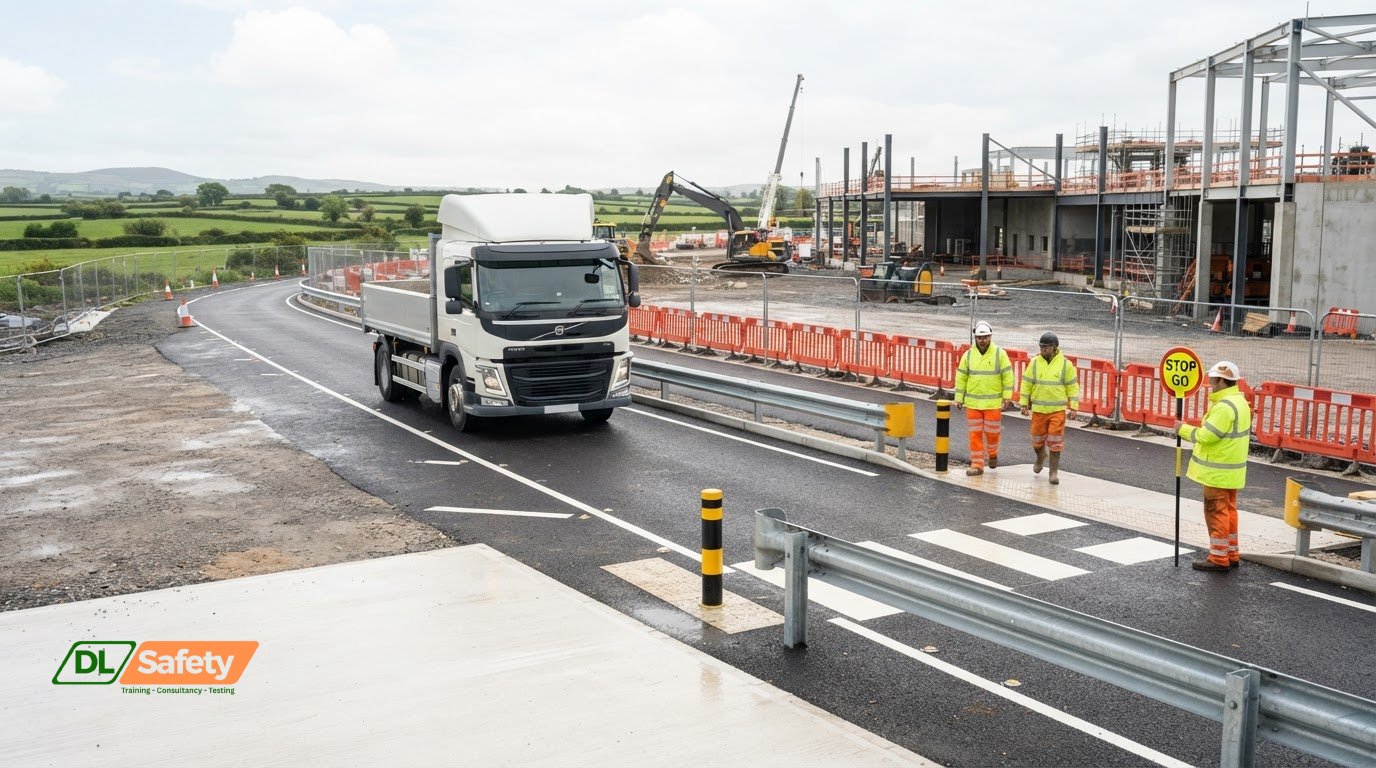
A delivery vehicle reversing while workers cross its route can turn a routine site movement into a serious risk. The safest approach is to separate people and vehicles by design, then manage the points where their routes still meet. That is the practical starting point for managing vehicle and pedestrian safety on site.
Shared entrances, tight work areas and changing site conditions can all make traffic arrangements harder to follow. Managers need a clear system that works for employees, drivers, visitors and contractors, not just a plan on paper. This guide explains how to identify interaction points, assess the risks and choose controls that fit the site, its activities and changing conditions.
You will also learn how to communicate arrangements, check whether they are working and review them when the site changes. DL Safety provides traffic management design to help turn risk assessment into usable site arrangements, supported by site audits and ongoing safety support. Visit www.dlsafety.ie, email info@dlsafety.ie or call 085 8316885.
Key Takeaways
- Observe how vehicles and pedestrians actually move, including during deliveries, shift changes and less common tasks.
- Use your risk assessment to match controls to each interaction point, rather than relying on signs or rules alone.
- Managing vehicle and pedestrian safety on site means setting out clear routes and crossing arrangements people can follow.
- Brief workers, drivers, visitors and contractors, and assign responsibility for checking that routes and controls remain in place.
- Review arrangements when site activities or layouts change, using audits to identify where controls may need adjustment.
Why managing vehicle and pedestrian safety on site starts with separating movement
Managing vehicle and pedestrian safety on site begins by identifying where moving vehicles, mobile plant and people on foot could meet. The risk is not limited to high-speed travel. Reversing, turning, loading and manoeuvring in confined spaces can bring people close to vehicles, especially where drivers have restricted visibility. A pedestrian crossing a vehicle route or stepping around stored materials may also enter a driver’s path unexpectedly.
Pay particular attention to deliveries. Vehicles may arrive at busy times, use unfamiliar parts of the site or need room to unload. A layout that works during routine operations may be harder to use when a delivery blocks access or a temporary work area changes the usual flow. Signs and instructions help people understand the arrangements, but they cannot make up for routes that bring pedestrians and vehicles into avoidable contact.
Effective site traffic management combines planned separation, controlled crossings and active review as work changes. Use this as a practical test: first look for ways to keep routes apart, then manage any remaining interaction points clearly. For broader context on pedestrian risks and design, see Pedestrian Safety on Wikipedia.
Where do vehicle-pedestrian conflicts arise on a working site?
Map movement across the whole site, not just the main work area. Include workers, delivery drivers, visitors and contractors. Consider where each group enters, walks, drives, loads or waits, and check how the arrangements work during normal operations and when the site is busier or access is restricted.
- Entrances and shared access routes, where people on foot may meet arriving or departing vehicles.
- Loading areas and reversing zones, where vehicles manoeuvre and visibility may be limited.
- Crossings between work areas, welfare facilities, offices or parking areas.
- Temporary work zones and storage areas that may obstruct sightlines or narrow a walkway.
Walk the routes from both a pedestrian’s and a driver’s viewpoint. A barrier, stack of materials or parked vehicle can change what each person can see. A temporary task may also redirect foot traffic into a route normally used by vehicles. Record these conditions to help identify where controls are needed.
Why is physical separation the starting point?
Barriers and separate walkways can keep routine pedestrian travel away from moving vehicles. Controlled crossing points make necessary intersections more predictable. The right arrangement depends on the site layout, vehicle movements and work being carried out. No single measure suits every situation, so assess what each interaction point needs rather than relying on signs alone.
Some separation can be built into the regular site layout; other arrangements may need to change as work progresses. If materials, equipment or temporary tasks alter access or visibility, review whether walkways and crossings remain usable. Keep instructions and signs aligned with the actual routes, so they support a practical arrangement rather than asking people to work around a poor one.
How to assess vehicle and pedestrian movements before setting controls
A useful assessment starts with how the site actually operates, not just how it looks on a plan. Observe normal work as well as deliveries, shift changes and less frequent tasks. A quiet access route may become a busy crossing point when a delivery arrives or a work team changes location. Record what happens, where it happens and who is involved before deciding which controls are suitable.
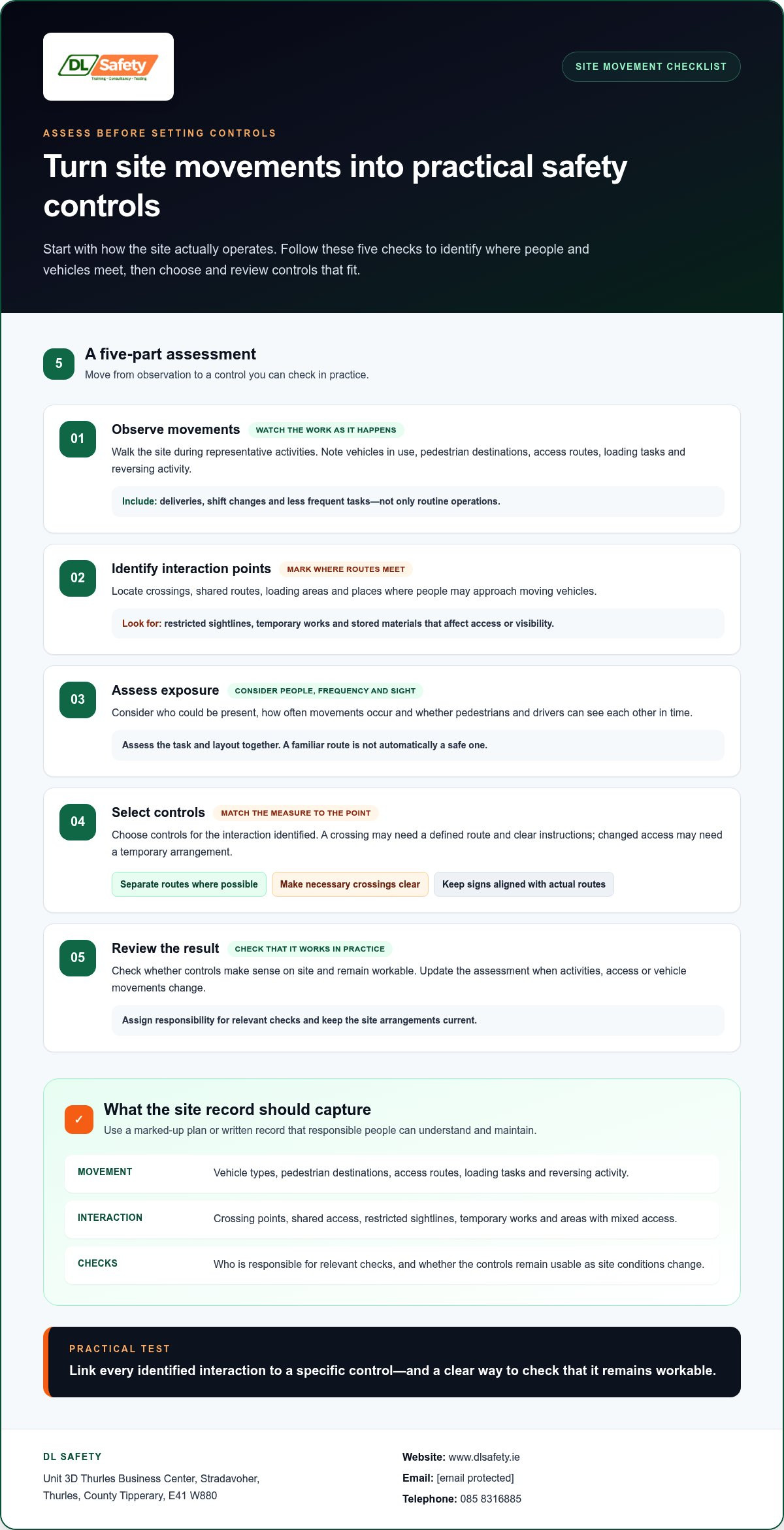
Use a consistent sequence to turn those observations into practical decisions:
- Observe movements. Walk the site during representative activities and note the vehicles in use, pedestrian destinations, access routes, loading tasks and reversing activity. Include different operating periods, such as deliveries and shift changes.
- Identify interaction points. Mark crossings, shared routes, loading areas and places where people may approach moving vehicles. Note restricted sightlines, temporary works and stored materials that could affect access or visibility.
- Assess exposure. Consider who could be present, how often movements occur and whether people or drivers can see each other in time. Look at the task and layout together, rather than treating a route as safe simply because it is familiar.
- Select controls. Match measures to the interaction identified. A crossing point, for example, may need a defined route and clear instructions, while work that changes access may call for a temporary arrangement.
- Review the result. Check whether the controls make sense in practice and update the assessment when activities, access or vehicle movements change.
A useful movement assessment links every identified interaction to a specific control and a clear way to check that it remains workable. This keeps managing vehicle and pedestrian safety on site grounded in observable conditions rather than assumptions.
What should a site movement assessment record?
Use a marked-up plan or written record that the people responsible for the site can understand and maintain. Include vehicle types, pedestrian destinations, access routes, loading tasks, reversing activity, crossing points and areas with mixed access. Mark restricted sightlines and temporary works, too. Record who is responsible for relevant checks and how workers, visitors, drivers and contractors receive site instructions.
Keep the record focused on the workplace and the movements observed there. A useful assessment reflects the site’s actual layout, tasks and people, rather than relying on general information that may not apply to its conditions.
How should changing site conditions affect the assessment?
Review the assessment when the layout, work sequence or vehicle movements change. Short-duration tasks count: a temporary delivery area, maintenance activity or repositioned materials can alter a route or sightline, even if the change lasts only part of a shift. Keep the record proportionate, but specific enough for people to act on it. DL Safety’s traffic management design service can help translate movement risks into usable site arrangements.
Which site traffic controls work best for different vehicle movements?
Choose controls to address the particular movement and location where people and vehicles may meet. Physical separation is a stronger starting point than relying on people to notice signs or react in time, but the site layout, work activity and vehicle type all affect what is workable. A control that suits a permanent route may need adapting around temporary work or a delivery.
The comparison below can help you identify a suitable starting point. Measures can be combined, but they are not interchangeable. A sign can explain a route, for example, but it cannot physically keep pedestrians away from a vehicle’s path.
Control: Barriers and separate walkways. Suitable context: Areas where the layout allows people on foot to travel apart from vehicles. Limitations: Barriers can obstruct access or sightlines if poorly placed. Review: Check their condition and position when work areas or routes change.
Control: Designated vehicle routes. Suitable context: Sites where movements can follow a clear, consistent path. Limitations: A route may become impractical if access is blocked or site activity shifts. Review: Confirm that the route remains usable and reflects current operations.
Control: Controlled crossing points. Suitable context: Places where pedestrians need to cross a vehicle route. Limitations: Crossings still involve interaction and need to be visible and understood. Review: Check that the crossing remains clear and appropriate as the layout changes.
Control: Signs and briefings. Suitable context: Reinforcing routes and explaining arrangements to regular and occasional site users. Limitations: They rely on people seeing and following the information. Review: Update signs and briefings when instructions or routes change.
Control: Supervised movements. Suitable context: Specific manoeuvres where a banksman can help guide a vehicle. Limitations: Supervision depends on clear communication and should not be the sole planned safeguard. Review: Reconsider the arrangement if the movement, visibility or working area changes.
When should a site use barriers, walkways and controlled crossings?
Use barriers and defined pedestrian routes where the site layout makes separation practical, particularly for regular foot traffic alongside vehicle routes. Where people must cross, a designated crossing can make that interaction deliberate and easier to understand. Keep routes clear and maintain barriers. Temporary work or stored materials may mean they need repositioning so they continue to guide people safely.
What role do banksmen, signs and communication play?
A banksman can support a particular vehicle movement, but should not replace a safe route or other suitable controls. Signs and clear briefings reinforce the arrangements for employees, delivery drivers, visitors and contractors, including people who do not use the site every day. Keep information consistent with the actual layout. Traffic management design can help turn assessed movement risks into clear site arrangements.
Effective managing vehicle and pedestrian safety on site combines controls that reduce routine contact with clear arrangements for the interactions that remain. Recheck the measures as work changes and adjust them if they no longer fit the movement or layout.
How to put a site vehicle and pedestrian safety system into practice
A workable traffic system needs to be understood by the people using it and maintained by someone responsible for checking it. Put the arrangements into a clear, accessible document, supported by a site plan where useful. A construction site traffic management plan template can help organise information such as routes, crossing points, delivery arrangements and responsibilities. The finished plan should reflect the actual site, not remain a generic form.
Managing vehicle and pedestrian safety on site is an ongoing process, not a one-off briefing. The arrangements need to make sense to regular site users and to people unfamiliar with the layout, including delivery drivers, visitors and contractors.
How can managers make the arrangements clear to everyone?
Explain the routes and crossing arrangements during induction, then reinforce them in task briefings when work or access changes. Keep site information visible and straightforward, using familiar terms and a clear site plan where helpful. Delivery instructions should match the designated access route and site controls, so drivers are not given directions that conflict with the arrangements on arrival.
Give people practical information: where to enter, where pedestrians should walk, where vehicles may load or manoeuvre, and whom to approach if a route is blocked. Avoid relying on unwritten local knowledge. A contractor arriving for a short task needs to understand the relevant rules just as clearly as someone who works on site every day.
How should traffic controls be monitored and improved?
Assign responsibility for checking the system, including signs, barriers, routes and changes to the site layout. Routine observations can reveal whether people follow the planned routes and whether controls remain clear and usable during real work. Note any obstruction, damaged barrier, confusing sign or movement that regularly brings people and vehicles together, then decide what needs attention.
Near misses and unsafe interactions are prompts to examine the arrangements, not just individual behaviour. Ask what happened, where the planned control failed to guide the movement, and whether the site layout, task sequence or instructions contributed. Changes to operations should also trigger a review, even if no incident has occurred.
- Record what was observed and the location or activity involved.
- Assign an owner to any follow-up action.
- Check that the change has addressed the problem in practice.
When a site needs a more structured review, a health and safety site audit or ongoing safety support can help managers assess whether arrangements remain suitable as work changes. DL Safety’s traffic management design support can help translate identified movement risks into practical site arrangements. Discuss your site traffic management needs with DL Safety.
How DL Safety can support safer vehicle and pedestrian management
Turning a risk assessment into arrangements people can follow takes more than marking vehicle and pedestrian routes on a plan. The design needs to reflect the site layout, where work takes place and how activity is sequenced. DL Safety’s traffic management design helps businesses develop practical arrangements that connect vehicle routes, pedestrian access and site operations, so the plan can support day-to-day work.
Documenting arrangements can make them easier to communicate and review. A construction site traffic management plan template may provide a useful structure for recording routes, access points, crossing arrangements and responsibilities. The important part is adapting the document to the actual site and keeping it aligned with changing work, rather than relying on a generic template that no longer reflects conditions on the ground.
When can traffic management design add practical value?
Design support can be useful when a site is planning work, changing its layout or finding that established routes no longer suit its activities. Considering vehicle movements alongside pedestrian destinations and the sequence of tasks helps identify where arrangements need to work together. For example, a planned delivery or work-area change may affect access routes, so consider those movements as part of the overall design rather than treating them as separate issues.
Consider the design alongside how the system will be communicated and reviewed. Clear documented arrangements give managers and site teams a shared reference point as operations evolve. That connection between assessment, practical layout and ongoing review is central to managing vehicle and pedestrian safety on site.
What is a sensible next step for a site manager?
Start with a clear picture of your operation: the work taking place, the vehicle movements involved, where people need to go and which parts of the current arrangements are difficult to manage. DL Safety supports construction and industrial businesses nationally with traffic management design, health and safety site audits and Monthly Safety Support Packages. Audits can help review whether existing controls remain workable, while ongoing packages provide continuing health and safety management and compliance support.
If you are considering a new layout or need a structured review of established arrangements, outline the site activities and movement challenges you want to address. DL Safety can discuss traffic management design or ongoing safety support in the context of your operation. Visit DL Safety’s traffic management support, email info@dlsafety.ie or call 085 8316885.
Make your next site change a safety checkpoint
Before the next delivery, layout change or new work phase, use it as a prompt to check whether your traffic arrangements still fit the way the site will operate. This forward-looking habit keeps managing vehicle and pedestrian safety on site connected to real work, rather than leaving controls unchanged as conditions shift.
DL Safety supports this process through traffic management design, health and safety site audits and accident investigation. For businesses seeking continued health and safety management and compliance support, Monthly Safety Support Packages provide ongoing support. The right support depends on what your operation needs, whether that means planning practical arrangements or reviewing how existing controls are working.
Take the next step with a clear picture of your site activities and the movement issues you want to address. Discuss traffic management design and ongoing safety support with DL Safety, email info@dlsafety.ie or call 085 8316885. A considered review can help you move forward with greater clarity and confidence.
Frequently Asked Questions
What is the safest way to separate pedestrians from vehicles on a site?
Plan continuous pedestrian access from the point people enter to the places they need to reach, keeping it apart from vehicle routes wherever the layout allows. Check for gaps at doors, parking areas and busy work zones where people might step into a vehicle path for convenience. For managing vehicle and pedestrian safety on site, make sure separation still works during deliveries and changes in work activity, not only during quieter periods.
Can a banksman make reversing safe on a construction site?
No. A banksman can help guide a particular reversing movement, but their presence alone does not remove the risk. Before the manoeuvre, agree how the driver and banksman will communicate and where the banksman will stand to guide the vehicle without entering its path. If they lose sight of each other or instructions become unclear, pause the movement until communication is re-established and it is safe to proceed.
How should delivery drivers be managed on a site?
Give drivers clear instructions before they arrive, including the correct entrance, where to wait and where unloading will take place. Make sure the information matches current site arrangements, especially if access or delivery locations have changed. On arrival, direct drivers to the agreed area and explain relevant site rules in plain language. Do not leave drivers to choose a route or unloading point by guesswork. Navigating these controlled environments safely is also a central focus in professional driver training, where providers such as Lone Star Truck Driving Academy instruct commercial drivers on tight manoeuvring and compliance with site-specific safety protocols.
What should happen if pedestrians and vehicles must share a route?
Keep shared use controlled and predictable. Define where pedestrians should walk and where vehicles should travel, and consider whether vehicle movements can be paused while people pass through a constrained section. Avoid allowing people to cross at arbitrary points, particularly where sightlines are poor. If the route becomes busier or visibility worsens, reassess whether the shared arrangement remains workable or needs a temporary change.
How often should a site traffic management plan be reviewed?
Review it whenever a change could make the documented arrangements inaccurate, such as a new access route, different vehicle movements, altered work sequencing or relocated storage. A planned review can also help catch gradual changes that have not prompted an obvious trigger. Record when the plan was checked, what changed and who is responsible for follow-up, so site managers can identify the current version.
What should a site manager do after a vehicle near miss involving a pedestrian?
First make sure the people involved are safe and prevent the same movement from continuing unchanged if it presents an immediate concern. Record the location, activity, visibility conditions, vehicle movement and accounts from those involved while details are fresh. Then examine whether the route, task timing or instructions contributed, and decide what needs to change before similar work continues. Track the action and check that it addresses the issue.