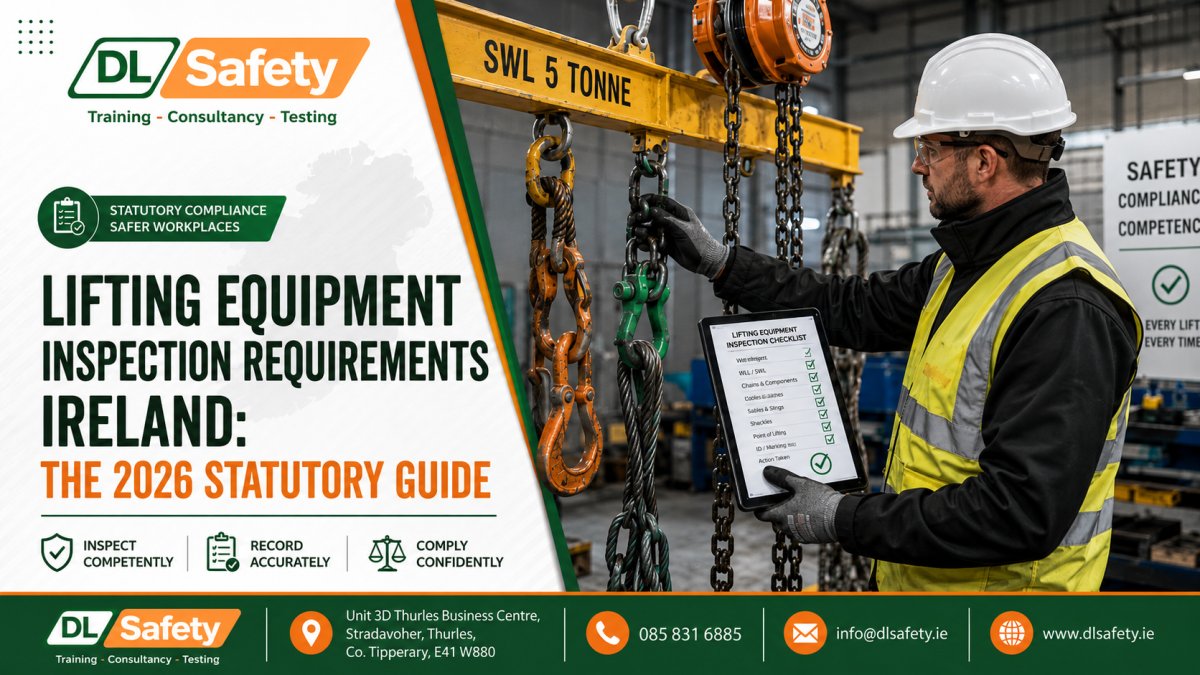
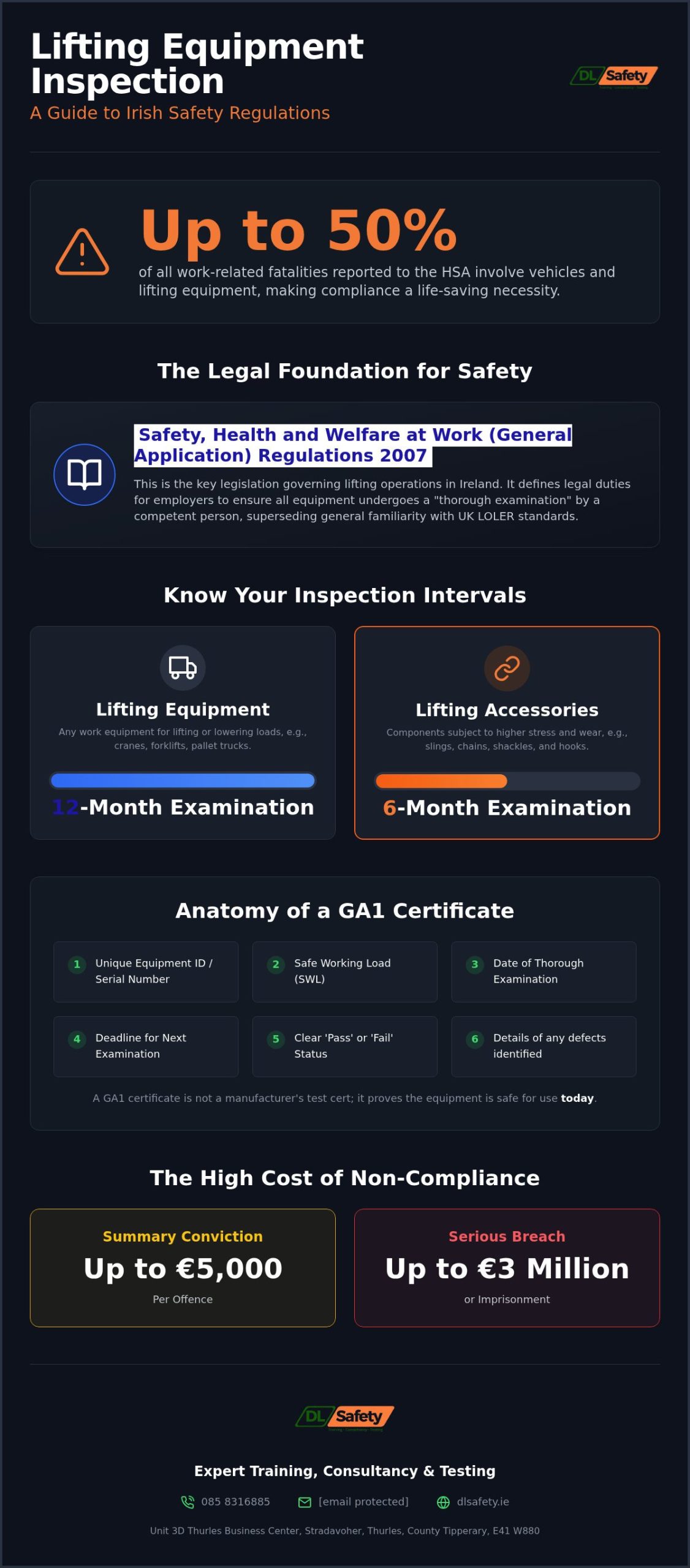
Did you know that up to 50% of all work-related fatalities reported to the HSA involve vehicles and lifting equipment? This sobering statistic highlights why understanding lifting equipment inspection requirements Ireland is about far more than just ticking a box for an auditor; it’s about protecting lives while ensuring your operations don’t grind to a halt due to an unexpected site shutdown. We know that the subtle differences between Irish regulations and UK LOLER standards often cause unnecessary confusion for site managers who just want to get the job done safely.
You likely want a way to simplify your compliance without compromising on safety or quality. This 2026 statutory guide provides a clear breakdown of your legal obligations, from 6-month accessory checks to 12-month plant examinations. We’ll help you master GA1 certifications and identify truly competent persons so you can pass every HSA audit with confidence. For expert support, visit www.dlsafety.ie or reach us at Unit 3D Thurles Business Center, Stradavoher, Thurles, County Tipperary, E41 W880. You can also call 085 8316885 or email info@dlsafety.ie. Let’s ensure your equipment is always ready for the heavy lifting ahead.
Key Takeaways
- Understand the legal distinction between lifting equipment and accessories under the 2007 Regulations so you don’t misclassify your assets.
- Identify exactly what a valid GA1 Certificate must contain to ensure your site is always ready for a surprise HSA audit.
- Master the 6-month and 12-month schedules for lifting equipment inspection requirements Ireland to keep your plant and accessories in constant compliance.
- Learn how simple site preparation, such as cleaning and organising gear, can minimise inspection time and prevent unnecessary operational delays.
- Discover why DL Safety (085 8316885) recommends Monthly Safety Support Packages to help you move beyond reactive testing toward a total safety culture.
The Legal Framework for Lifting Equipment in Ireland
Understanding the statutory landscape is the first step toward a safer workplace. Whilst many Irish site managers are familiar with the UK framework known as the Lifting Operations and Lifting Equipment Regulations (LOLER), the actual legal standard in this jurisdiction is governed by the Safety, Health and Welfare at Work (General Application) Regulations 2007. These regulations define lifting equipment as any work equipment used for lifting or lowering loads, including the attachments used for anchoring, fixing, or supporting it. This covers everything from massive tower cranes to the smallest pallet truck.
It’s vital to distinguish between the primary machine and lifting accessories. Items such as lifting slings, chains, and shackles are classified as accessories. Because these components are subject to extreme stress and frequent wear, they fall under stricter lifting equipment inspection requirements Ireland than the machines they support. The Health and Safety Authority (HSA) enforces these standards with zero tolerance for negligence. Failing to comply isn’t just a paperwork error; summary convictions can result in fines of up to €5,000 per offence, whilst serious breaches tried in higher courts can lead to fines of €3 million or imprisonment.
Safety, Health and Welfare at Work Regulations 2007
Part 2, Chapter 2 of the 2007 Regulations specifically addresses the use of work equipment. Under this law, a “thorough examination” is a specific legal term. It isn’t a casual look-over; it’s a detailed, systematic inspection performed by a specialist to identify any defects that are, or might become, a danger. Employers have a non-delegable duty to ensure all equipment is safe and that a valid GA1 certificate is always available for inspection. Employees also play a role; they’re legally required to report any visible defects immediately to prevent accidents before they happen.
The Definition of a Competent Person
A GA1 certificate is only valid if issued by a “competent person.” The 2005 Act defines this as someone possessing sufficient training, experience, and knowledge appropriate to the nature of the work. They must be able to detect defects and assess their importance in relation to the continued safe use of the equipment. At DL Safety, we believe that independence is just as important as technical skill. Whilst your own team should perform daily pre-use checks, these internal “quick checks” don’t replace statutory examinations. A professional inspector provides an impartial assessment, ensuring that “compliance fatigue” never leads to a missed safety critical fault.
If you have questions about your specific site requirements, our team at Unit 3D Thurles Business Center, Stradavoher, Thurles, County Tipperary, E41 W880 is ready to help. You can reach us at www.dlsafety.ie, email info@dlsafety.ie, or call 085 8316885 to discuss your compliance needs.
Understanding the GA1 Certificate of Thorough Examination
The term “GA1” is the common industry name for the Report of a Thorough Examination. It isn’t just a piece of paper; it’s your primary shield against legal liability and the most important document an HSA inspector will ask to see. Many businesses make the mistake of confusing a manufacturer’s test certificate or a CE declaration of conformity with a GA1. While a test cert proves the equipment was safe when it left the factory, the GA1 proves it’s safe to use today. Meeting the lifting equipment inspection requirements Ireland demands that this report is current, accurate, and kept on a register that’s easily accessible during an audit.
Core Components of a GA1 Report
A valid GA1 certificate must contain specific information to be considered legally compliant. It needs to clearly identify the equipment, often through a serial number or unique fleet ID, and state the Safe Working Load (SWL). The report must also document the date of the examination and, crucially, the deadline for the next inspection. If defects are identified, the inspector must categorise them. Some faults might allow for continued use with a scheduled repair, while others require the equipment to be taken out of service immediately. A report that lacks a clear “pass” or “fail” status or fails to specify the next due date won’t stand up to scrutiny during an HSA inspection.
How to Verify a Safety Training Certificate
Checking the credentials of the person signing your reports is just as vital as the inspection itself. You should ensure the inspector is a competent person with the right balance of training and practical experience. It’s also wise to confirm they hold professional indemnity insurance. If you’re unsure about the validity of a report or need to cross-reference your current documentation, you can learn more about GA1 testing in Ireland to see what a professional standard looks like. Discovering a fraudulent or expired certificate after an accident is too late; proactive verification is the only way to protect your team and your business reputation.
In 2026, the trend toward digital record-keeping is accelerating. While paper copies are still legal, the HSA supports the use of digital tools to manage certificates and receive automatic notifications when deadlines approach. This ensures you never miss a 6-month or 12-month window. If you’re struggling to keep your records organised, our team at Unit 3D Thurles Business Center, Stradavoher, Thurles, County Tipperary, E41 W880 can help. You can view our services at www.dlsafety.ie, email us at info@dlsafety.ie, or call 085 8316885 for a straightforward chat about your compliance status. Maintaining a clear digital trail is a simple way to stay audit-ready at all times.
Inspection Intervals: When is Examination Required?
Lifting accessories, such as lifting slings, chains, and shackles, must be thoroughly examined at least once every six months. These items are the “hands” of your lifting operation. They take the most abuse. They’re frequently dragged across abrasive surfaces, exposed to harsh weather, or subjected to chemical contamination. Failure is often sudden. The shorter window is essential for these high-wear items. You’re also legally required to maintain a comprehensive register of all loose lifting gear. This register helps you track the history of each shackle or sling, ensuring that nothing slips through the cracks during a busy project.
Mobile Plant and Cranes (12-Month Cycle)
Standard lifting equipment, including mobile cranes, telehandlers, and excavators used for lifting, generally falls under a 12-month inspection rule. However, if the equipment is used to lift people, such as a MEWP or a passenger lift, the requirement immediately drops to a 6-month cycle. For fleet managers operating in high-intensity environments, we often suggest coordinating quarry vehicle brake testing with your lifting inspections. This integrated approach saves time. It ensures that your heavy plant is compliant from the hook to the wheels. For those also managing industrial weighing systems, specialists like Independent Scale Service provide essential calibration services that ensure your entire operation remains precise and safe. Tracking multi-site equipment can be a challenge, so using a centralised digital log is a practical way to prevent missed deadlines across different locations.
Beyond the standard calendar dates, inspections are mandatory after “exceptional circumstances.” If a piece of equipment has been involved in an accident, undergone major repairs, or sat idle for a long period, it must be examined before returning to work. Similarly, any equipment that is relocated or installed for the first time must have a valid GA1 issued at its new position. If you’re unsure where your fleet stands, contact our team at Unit 3D Thurles Business Centre, Stradavoher, Thurles, County Tipperary, E41 W880. You can also reach DL Safety at 085 8316885 or info@dlsafety.ie. We’re here to help you manage your schedules so you can focus on the job at hand.
An inspector’s visit shouldn’t be a source of operational stress. Effective preparation is the difference between a smooth, efficient examination and a day of frustrating delays. To meet lifting equipment inspection requirements Ireland, you must ensure your gear is in a condition that allows for a meaningful assessment. If an inspector arrives to find equipment buried under mud or scattered across a five-acre site, the process will take twice as long and cost more in lost productivity. Taking a proactive approach ensures your site remains audit-ready and your downtime stays minimal.
Cleaning and degreasing are your first priorities. Dirt, grease, and heavy rust can easily hide hairline cracks or structural fatigue in metal components. If the inspector can’t see the surface of a chain or the weave of a sling, they cannot legally certify it as safe. Likewise, ensure that all Safe Working Load (SWL) markings are clearly legible. If the weight limit has worn off a shackle or a machine’s plate is painted over, the equipment will likely fail the inspection on a technicality regardless of its physical strength. You should also have your previous GA1 records and maintenance logs organised and ready for review before the professional arrives.
The Pre-Inspection Checklist
Setting up a dedicated “inspection area” is a simple way to keep the process moving. Rather than having the inspector hunt for gear, bring all loose lifting accessories to a central, well-lit location. You should also:
- Locate and clean all serial numbers and ID tags on chains, slings, and shackles.
- Ensure that keys and operators are available if the inspector needs to see a machine, such as a telehandler or crane, in operation.
- Check that all previous repair invoices are on hand to prove that past defects were properly addressed.
Common Failure Points and How to Avoid Them
You can avoid “fail” reports by conducting your own pre-checks. In lifting chains, look for nicks, deep gouges, or links that appear stretched or frozen. Synthetic lifting slings are particularly vulnerable to chemical damage, UV degradation, or fraying along the edges; if you see the internal red core threads, the sling is already a “fail.” For hooks and shackles, check for any visible deformation or “opening” of the hook throat. Missing safety latches are one of the most common reasons for a machine to be grounded, yet they’re also one of the easiest and cheapest parts to replace before the inspector walks onto the site.
If you need help getting your gear ready or want to replace worn accessories before your next audit, you can book your GA1 testing with DL Safety today. Our team operates out of Unit 3D Thurles Business Center, Stradavoher, Thurles, County Tipperary, E41 W880. For immediate assistance, call 085 8316885 or email info@dlsafety.ie to ensure your site meets every statutory standard.
Integrating Inspections into Monthly Safety Support
Standalone GA1 inspections are essentially snapshots in time. They confirm that your equipment was safe to use on a specific Tuesday, but they don’t account for the aggressive wear and tear that occurs on a Wednesday morning. To truly master lifting equipment inspection requirements Ireland, businesses should move beyond reactive testing and embrace a more holistic safety culture. Integrating these checks into a broader safety management system ensures that minor issues are caught during daily operations, long before they become expensive “fail” items on a statutory report. This proactive approach is why many firms now opt for Monthly Safety Support Packages, which bridge the gap between periodic examinations and the daily realities of a busy site.
Managed Compliance vs. Ad-hoc Testing
Retained support takes the guesswork out of your compliance calendar. Instead of a site manager scrambling to find a competent person at the last minute, professional consultants manage the schedule for you. This significantly reduces the administrative burden on owners and ensures you never miss a critical 6-month or 12-month deadline. By conducting regular health and safety site audits, we can identify risks to your lifting operations in real-time. This allows us to build a robust safety statement that isn’t just a document gathering dust on a shelf, but a practical, living guide for your entire team.
Replacement and Procurement Strategy
When gear fails an inspection, the immediate priority is a safe and swift replacement. We provide a one-stop-shop solution, supplying high-quality lifting slings, lifting chains, and lifting shackles to replace condemned items on the spot. Sourcing your equipment from the same expert who understands lifting equipment inspection requirements Ireland provides an added layer of confidence. We don’t just sell gear; we offer expert advice on whether a specific chain or sling is the best fit for your site’s unique hazards. Every new piece of equipment we supply comes with the correct EC Declaration of Conformity, ensuring your records stay audit-ready from the moment the gear arrives.
If you’re looking to simplify your safety processes and ensure your lifting operations are always compliant, our team at DL Safety is ready to help. We are based at Unit 3D Thurles Business Center, Stradavoher, Thurles, County Tipperary, E41 W880. You can reach us directly at 085 8316885 or via email at info@dlsafety.ie to discuss a bespoke support plan that fits your business needs. Let’s work together to make compliance a seamless part of your daily routine.
Secure Your Site with Proactive Compliance
Mastering lifting equipment inspection requirements Ireland involves moving from a state of reactive panic to a culture of proactive care. By distinguishing between the 6-month cycle for accessories and the 12-month rule for standard plant, you protect your team and your legal standing. Remember that a valid GA1 is more than a certificate; it’s proof of your commitment to a safe workplace. Simple steps like cleaning equipment for crack detection and maintaining a digital register can transform your next HSA audit from a stressful event into a routine validation of your high standards.
At DL Safety, we provide LEEA-standard inspections and comprehensive monthly support to ensure you never miss a deadline. Based at Unit 3D Thurles Business Center, Stradavoher, Thurles, County Tipperary, E41 W880, our team is dedicated to your long-term success. You can reach us at 085 8316885 or email info@dlsafety.ie to discuss your site’s specific needs. We’re here to take the stress out of compliance so you can focus on the job at hand.
Book your GA1 Lifting Equipment Inspection with DL Safety today. We look forward to helping you build a safer, more efficient site.
Frequently Asked Questions
How long is a GA1 certificate valid for in Ireland?
A GA1 certificate validity is tied to the equipment’s risk profile. Lifting accessories and any plant used for lifting people require a thorough examination every 6 months. Most other lifting equipment follows a 12-month cycle. It’s vital to check the “next due date” field on your certificate, as this is the date an HSA inspector will look for during an audit. Staying ahead of these lifting equipment inspection requirements Ireland prevents costly site shutdowns.
Do I need a GA1 cert for a brand new piece of lifting equipment?
Yes, every piece of lifting equipment must have a valid report before its first use on-site. For brand new gear, the manufacturer’s EC Declaration of Conformity usually serves as the initial certificate, provided it’s less than a year old. However, if the equipment is installed at your location, such as a jib crane, a thorough examination is required after installation to ensure it’s set up correctly and safe to operate.
What is the difference between a thorough examination and a weekly check?
A thorough examination is a detailed statutory inspection conducted by an independent competent person to issue a GA1 certificate. By contrast, a weekly check is a routine operational inspection performed by your own staff or supervisors. While weekly checks identify obvious wear or leaks, they don’t replace the rigorous technical testing required by law. Both are essential for a safe site, but only the thorough examination satisfies your legal obligations to the HSA.
Can a qualified mechanic perform my GA1 inspections?
A mechanic can only perform GA1 inspections if they meet the legal definition of a “competent person,” possessing specific training and experience for that equipment. Crucially, the inspector must be impartial and independent. If a mechanic is responsible for the daily maintenance of a machine, they shouldn’t be the person performing the statutory thorough examination. This independence ensures the inspection is unbiased and focuses entirely on safety rather than repair convenience or cost.
What happens if a piece of equipment fails its statutory inspection?
When equipment fails, it must be withdrawn from service immediately and tagged to prevent accidental use. The competent person will record the defects on the GA1 report. If the fault is “dangerous,” the inspector has a legal duty to notify the HSA. You’ll need to complete the required repairs and have a follow-up thorough examination before the equipment can return to work. DL Safety (085 8316885) can assist with both the inspection and replacement gear.
Are excavators used for lifting subject to GA1 requirements?
Yes, any excavator used for object handling is subject to the same lifting equipment inspection requirements Ireland as a crane. This includes a 12-month thorough examination of the machine and 6-month checks for lifting accessories. The machine must also be fitted with safety devices, such as check valves and an acoustic warning device. Using an excavator for lifting without a valid GA1 is a serious breach of health and safety law.
Do I need to keep paper copies of lifting certificates on site?
You don’t need to keep physical paper copies, provided your digital records are readily accessible during an audit. Many modern businesses use cloud-based systems to store GA1 reports, which makes retrieval much faster when an HSA inspector arrives. Whether you use paper or digital files, the records must be current and available at the location where the equipment is operated. Our team at Unit 3D Thurles Business Center can help you organise your digital compliance files.
Is LOLER the same as the Irish lifting regulations?
LOLER is the UK framework, whilst Ireland follows the Safety, Health and Welfare at Work (General Application) Regulations 2007. Although the safety principles are similar, the legal references and specific reporting forms, like the GA1, are different. Multi-national companies often make the mistake of using UK forms on Irish sites, but this doesn’t meet Irish statutory standards. You must ensure your documentation specifically references the 2007 Irish Regulations to remain fully compliant.