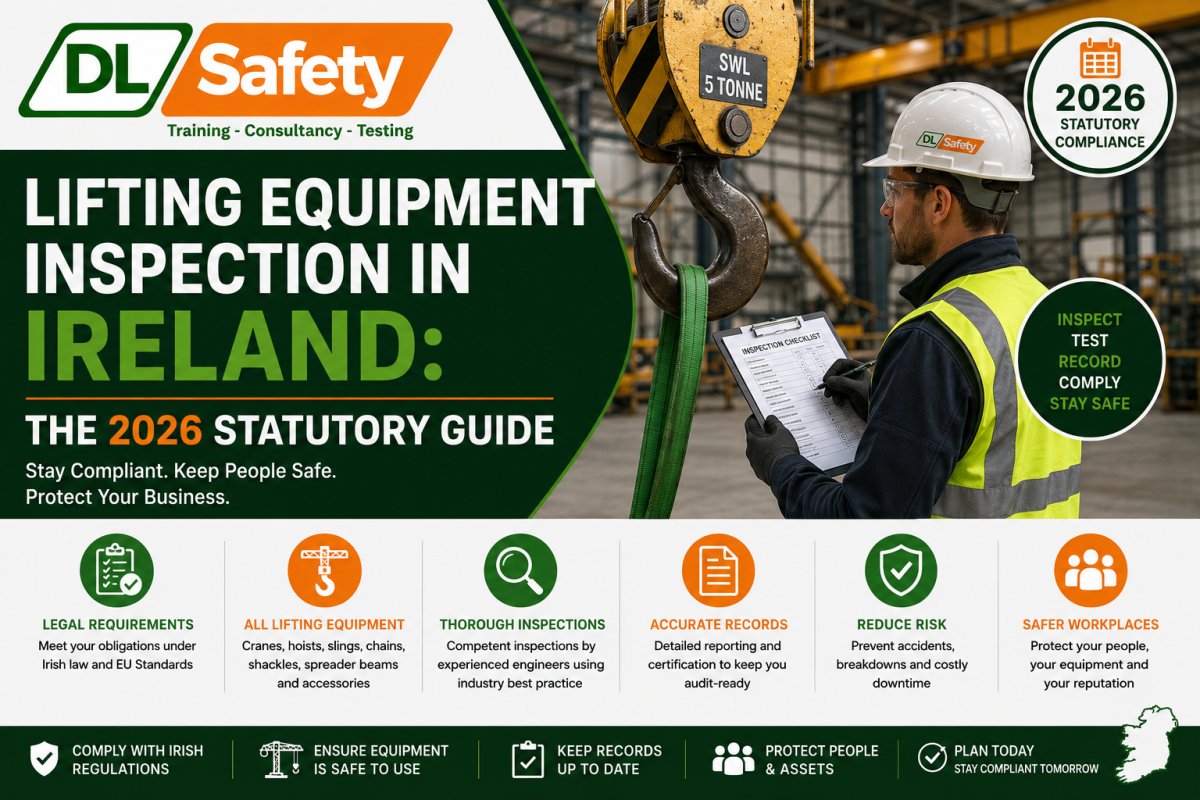
Did you know that vehicle-related incidents, including forklifts and loaders, are involved in up to 50% of all work-related fatalities reported to the HSA? It’s a sobering figure that highlights why a rigorous approach to lifting equipment inspection Ireland is a legal necessity rather than a mere clerical task. We understand that managing a busy site is a complex balancing act where the fear of a surprise HSA audit or a fine of up to €3 million creates significant pressure. Tracking multiple expiry dates for slings, chains, and cranes whilst trying to avoid unplanned equipment downtime can feel like an exhausting uphill battle for even the most organised manager.
This guide will help you master the 2026 Irish lifting regulations; we want to ensure your equipment remains safe and your documentation stays audit-ready at all times. By the end of this article, you’ll have a clear understanding of the specific statutory requirements for GA1 testing, the essential roles of a competent person, and a practical framework for achieving total regulatory compliance. We’re here to help you move beyond the paperwork and build a proactive culture of safety that protects both your team and your bottom line.
Key Takeaways
- Understand your statutory obligations under Irish safety legislation and the critical role the HSA plays in enforcing workplace standards.
- Master the GA1 certification process by identifying the correct inspection intervals for both lifting accessories and primary machinery.
- Protect your business from unplanned downtime and insurance complications by prioritising regular lifting equipment inspection Ireland across your entire fleet.
- Streamline your next site audit with a practical framework for organising equipment and documentation before an inspector arrives.
- Discover how integrating technical GA1 testing with monthly safety support can simplify your compliance journey and improve site culture.
Understanding Lifting Equipment Inspection Requirements in Ireland
Ensuring your site remains compliant requires more than a quick look at your gear before a shift starts. In Ireland, the concept of a “thorough examination” is a specific legal requirement, not a suggestion. Whilst many operators are familiar with the UK’s Lifting Operations and Lifting Equipment Regulations (LOLER), it’s vital to remember that these do not apply here. Instead, our standards are defined by the Safety, Health and Welfare at Work (General Application) Regulations 2007. This distinction matters because the Health and Safety Authority (HSA) strictly enforces these Irish-specific rules. Relying on routine maintenance to satisfy an inspector is a common mistake that often leads to heavy penalties. Maintenance keeps a machine running; a formal lifting equipment inspection Ireland confirms it’s safe for use and legally certified.
The Legal Framework: 2005 Act and 2007 Regulations
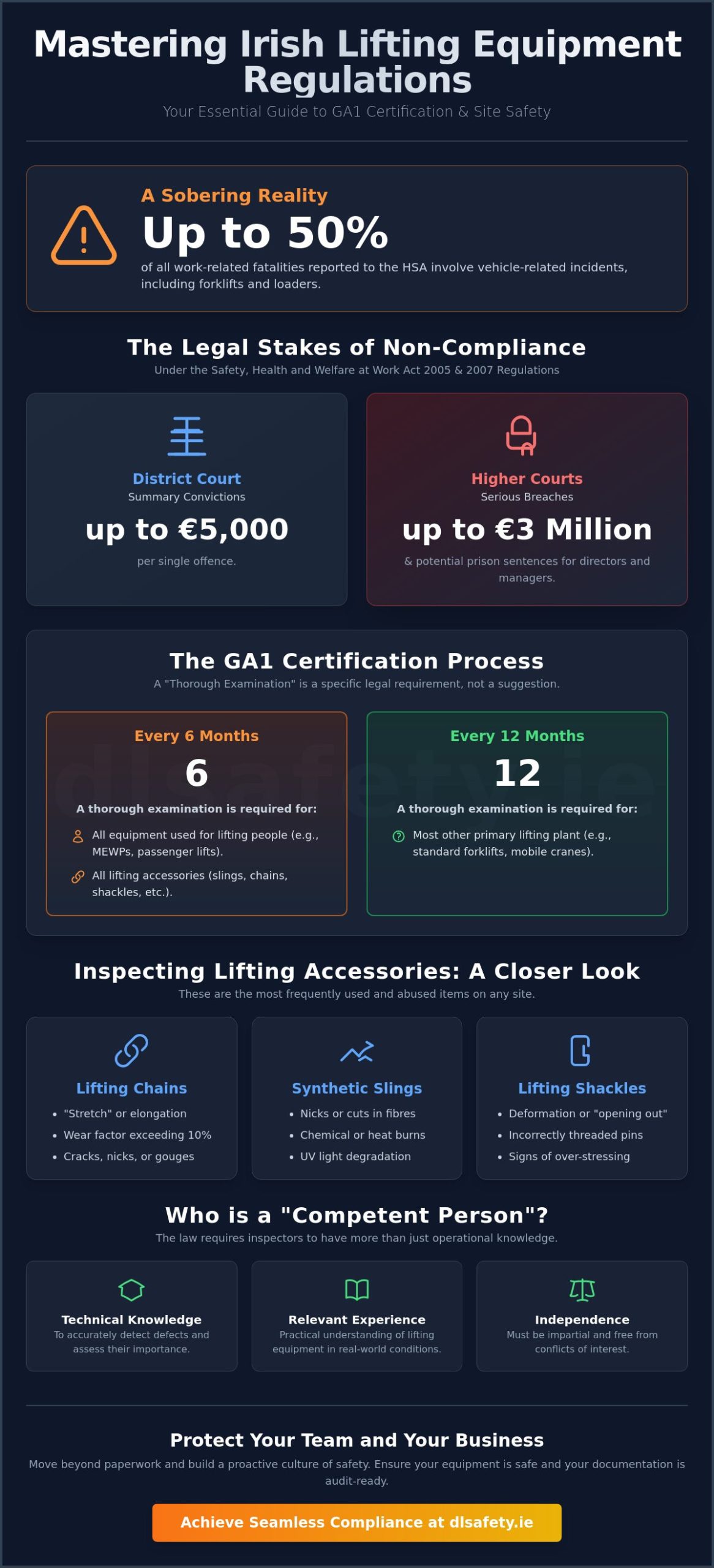
The Safety, Health and Welfare at Work Act 2005 provides the foundation for all site safety. Under the 2007 General Application Regulations, any equipment used for lifting must undergo a thorough examination at set intervals. If you’re found without valid GA1 records during an audit, the consequences are severe. Summary convictions in a District Court can result in fines of up to €5,000 per offence. For more serious breaches, higher courts can impose fines reaching €3 million or even prison sentences. These aren’t just corporate risks; they can apply directly to directors and managers found to be negligent.
Who is a “Competent Person” for Inspections?
A thorough examination must be carried out by a “competent person” who possesses the necessary skills and independence. This isn’t just someone who knows how to operate the machine. The law requires an inspector to have the technical knowledge and experience to detect defects and assess their importance accurately. Crucially, they must also have the independence to remain impartial, avoiding any conflict of interest that might arise from internal maintenance roles. At DL Safety, we believe in providing more than just a tick-box exercise. We prioritise industry-literate expertise because we understand the practical realities of your site. Our goal is to provide GA1 testing that adds genuine value, ensuring your gear is safe without creating unnecessary hurdles for your team.
The GA1 Certification Process: What is Thoroughly Examined?
The GA1 form is the heartbeat of site safety documentation in Ireland. Whilst the HSA provides a standard template, the document itself is essentially a report of a “thorough examination” by a competent person. A valid certificate must contain specific details to be legally robust: a clear description of the gear, its unique identification mark, the Safe Working Load (SWL), and the date of the examination. It also specifies the date the next inspection is due, creating a clear timeline for your safety officer to follow. Transitioning to digital certification has transformed this process, allowing teams to access records instantly on-site via mobile devices rather than digging through weathered paper files in a site hut.
Timing is everything when it comes to a lifting equipment inspection Ireland. The law sets out strict intervals that you must follow to remain compliant. Any equipment used to lift people, such as MEWPs or passenger lifts, must be inspected every 6 months. This same 6-month rule applies to all lifting accessories. For most other primary lifting plant, such as standard forklifts or mobile cranes, a 12-month interval is the statutory requirement. Following these benchmarks, which align with the safety principles found in the UK’s LOLER Regulations, ensures your site remains both safe and productive.
Inspecting Lifting Accessories: Slings, Chains, and Shackles
Accessories are the most frequently used and abused items on any site. During an inspection, we look for “stretch” or elongation in lifting chains, as even a 10% wear factor can compromise structural integrity. Synthetic lifting slings require a different eye; we check for nicks, chemical burns, or UV degradation that weakens the fibres. Even small lifting shackles need individual attention. We verify that pins are correctly threaded and that the body shows no signs of deformation or “opening out” from over-stressing. Understanding the technical distinctions between Bow and Dee shackle types is essential for correct selection and compliance; our guide to lifting shackles Ireland covers EN 13889 certification standards and six-month inspection requirements in full detail. If you’re struggling to manage these high-turnover items, our team can help you organise a robust GA1 Testing schedule that keeps your inventory current.
Primary Lifting Plant: Cranes, Hoists, and Forklifts
When examining primary plant, the focus shifts to mechanical reliability and structural health. We test critical safety devices, including limit switches that prevent over-hoisting and braking systems that must hold the load securely. For mobile and tower cranes, we inspect the chassis and boom for stress cracks or corrosion. Equipment used for personnel lifting receives the highest level of scrutiny, with a focus on emergency lowering mechanisms and cage integrity. These checks ensure that your heaviest assets aren’t just functional, but are operating within the strict safety margins required by Irish law.
Beyond Compliance: The Commercial Value of Regular Testing
Viewing safety requirements as a mere administrative hurdle is a missed opportunity for site managers. Whilst the legal necessity of a lifting equipment inspection Ireland is clear, the commercial advantages of a proactive approach are often overlooked. A failed component doesn’t just risk a fine; it can lead to a total site shutdown, delaying project milestones and incurring massive penalty clauses. By integrating inspections into your business strategy, you transform a “cost centre” into a tool for operational resilience. Valid GA1 certificates are also your primary shield in insurance discussions. If an incident occurs and your gear lacks current certification, your liability coverage may be voided, leaving your business exposed to catastrophic financial claims.
Modern procurement in the Irish construction and quarrying sectors is increasingly rigorous. When you’re pitching for high-value tenders, your safety record is scrutinised as closely as your pricing. Demonstrating a consistent history of thorough examinations shows Tier 1 contractors that you’re a reliable, low-risk partner. This reputation for rigour doesn’t just satisfy auditors; it wins contracts. Additionally, the data gathered during these tests provides a roadmap for capital expenditure. Instead of facing surprise replacement costs, you can use inspection reports to predict when a fleet of lifting chains or lifting slings will reach the end of its service life, allowing for smarter budgeting and procurement. When that time comes, understanding how to buy lifting equipment Ireland professionals trust — with valid certification from day one — ensures your replacements meet statutory requirements without delay.
Reducing Equipment Downtime
Unplanned downtime is the enemy of profitability. A proactive inspection framework allows for the early detection of metal fatigue, hairline cracks, or hydraulic leaks before they cause a machine to seize. We recommend scheduling your thorough examinations during natural site lulls or planned maintenance windows. This strategic timing ensures that your primary plant, such as forklifts and hoists, remains productive when the pressure is on. The cost of a scheduled test is a fraction of the expense of an emergency repair and the subsequent loss of man-hours whilst equipment sits idle.
Protecting Your Most Valuable Asset: The Workforce
Safety culture has a profound impact on site morale. When your team sees that every lifting shackle and crane is regularly tested and certified, it builds a sense of trust and professional pride. This visible commitment to welfare reduces the high-stress environment that often leads to human error. Given that the HSA reported 36 work-related fatalities in 2024, with vehicle-related incidents being a primary cause, the human stakes couldn’t be higher. At DL Safety, we don’t just provide a checklist; we act as a supportive partner. Our goal is to help your team embrace safety protocols as a natural part of their daily rhythm, ensuring everyone goes home safe at the end of the shift.
Preparing Your Site for a Lifting Equipment Audit
A successful lifting equipment inspection Ireland depends on your physical preparation as much as your technical compliance. When an inspector arrives on site, their time is best spent examining gear rather than hunting for it in a storage container. We recommend organising your equipment by category before the scheduled visit. Grouping your lifting chains, slings, and shackles in a clean, well-lit area allows for a methodical flow and prevents items from being overlooked. It’s also vital to appoint a dedicated site liaison; this person should have the authority to move machinery and the keys to all storage areas, ensuring the inspector can work without constant delays.
Documentation is the second pillar of a smooth audit. You should have a folder ready containing all previous GA1 records and original manufacturer plant manuals. These manuals are essential because they specify the original design standards and Safe Working Load (SWL) limits that the inspector must verify. If gear is caked in grease or quarry dust, serial numbers and safety decals can become illegible. A quick clean-down of your primary plant and accessories before the audit isn’t just about appearances; it’s a practical step that reveals hidden structural flaws or hairline cracks that might otherwise be missed during the examination.
A Manager’s Pre-Inspection Checklist
Before the inspector pulls into the yard, run through these essential checks to avoid simple administrative failures:
- Legibility: Verify that every serial number on your register is clearly visible on the physical equipment.
- Safety Features: Check that all safety guards, emergency stops, and warning decals are present and functional.
- Access: Ensure that areas intended for load testing are clear of obstructions and that there is sufficient space for the inspector to move around the machinery safely.
Handling Failed Inspections with Integrity
Finding out that a piece of gear has failed is never ideal, but it’s a critical part of the safety process. If an item is deemed unsafe, it must be “quarantined” immediately. This means physically removing it from the work area and tagging it clearly to prevent accidental use. Understanding the difference between an “observation” and an “immediate failure” is key. An observation might note minor wear that requires monitoring, whereas a failure means the gear is a direct risk to life. If you find your inventory is falling behind, our team can help you get back on track with professional GA1 Testing that identifies issues before they become accidents.
Once a failure is reported, develop a corrective action plan immediately. This might involve sourcing a replacement lifting sling or scheduling a repair with a qualified technician. By documenting these steps, you demonstrate to the HSA that you take your safety obligations seriously and are committed to maintaining a rigorous standard on your site. This proactive approach turns a potential setback into a demonstration of your business’s integrity and commitment to its workforce.
Seamless Compliance with DL Safety’s Integrated Services
Many providers treat a lifting equipment inspection Ireland as a standalone transaction, leaving you to manage the resulting paperwork and follow-up actions alone. We believe that true safety is an ongoing cycle rather than a once-a-year event. By combining technical GA1 Testing with our Monthly Safety Support Packages, we offer a solution that looks at the big picture of your site’s health. This integrated approach means we don’t just identify a worn lifting chain; we help you understand why it wore prematurely and provide the certified Lifting Equipment replacements you need to stay operational without delay.
For complex projects, safety requirements often overlap. A heavy lift on a busy site requires more than just a certified crane; it needs a comprehensive Lift Plan and effective Traffic Management Design to protect the public and your crew. We streamline these moving parts by acting as your single point of contact for both equipment certification and operational planning. This synergy reduces administrative friction and ensures that every piece of gear, from Lifting Slings to heavy plant, is managed within a unified safety framework that supports your project’s momentum.
The DL Safety Support Advantage
David’s extensive hands-on experience in the Irish construction and quarrying sectors allows us to provide advice that is grounded in reality. We know that site conditions change and deadlines loom. Our monthly support packages are designed to alleviate the stress of tracking expiry dates, as we proactively manage your inspection schedule for you. We also bridge the gap between technical certification and workforce behaviour. Through Online Safety Courses and Simulation Training, we ensure your team has the competency to use the gear we’ve just inspected, creating a safer environment for everyone involved.
Getting Started: From Audit to Excellence
Moving from a state of uncertainty to total compliance begins with a clear baseline. We typically start with a thorough Health & Safety Site Audit to identify any gaps in your current lifting register or documentation. From there, we customise a testing and support programme that fits your specific project timeline and fleet size. This bespoke approach ensures you aren’t paying for services you don’t need, whilst guaranteeing that every statutory requirement is met with rigour and integrity. If you’re ready to simplify your site safety, you can enquire about our GA1 testing and safety support packages today to start building a more resilient operation.
Building a Culture of Rigour and Resilience
Mastering your statutory obligations is about more than avoiding the HSA’s €3 million maximum fine; it’s about fostering a workplace where safety and productivity go hand in hand. We’ve explored how a thorough lifting equipment inspection Ireland serves as the heartbeat of your site documentation, ensuring that every chain, sling, and crane is a reliable asset rather than a liability. By preparing your site physically and administratively, you transform a required audit into a streamlined process that protects both your workforce and your bottom line.
DL Safety, led by industry veteran David, provides the comprehensive technical testing and consultancy you need to navigate these complex regulations with confidence. We specialise in the unique demands of the Irish construction and quarry sectors, offering a partnership that extends far beyond a simple checklist. Whether you need precise GA1 certification or a broader safety management cycle, we’re here to help you lead with integrity. Secure your site compliance with professional GA1 testing from DL Safety today. Let’s work together to ensure your equipment remains safe, your site stays audit-ready, and your team returns home safely every evening.
Frequently Asked Questions
How often does lifting equipment need to be inspected in Ireland?
Lifting equipment must be inspected every 6 or 12 months depending on its specific use. Accessories like lifting chains and any gear used for lifting people, such as MEWPs, require a thorough examination every 6 months. For general lifting plant like forklifts and cranes, the statutory interval is every 12 months. This ensures your site maintains a rigorous lifting equipment inspection Ireland schedule that aligns with current HSA enforcement priorities.
What is the difference between a GA1 and a GA2 form?
A GA1 form records a thorough examination by a competent person, whilst a GA2 form is used for weekly site inspections. The GA1 is your high-level statutory certification that confirms the equipment’s structural integrity and safety for a set period. In contrast, the GA2 is a routine check performed by the operator or site foreman to ensure no obvious defects have appeared during daily use. Both documents are essential for a complete safety file.
Can my own mechanic perform a statutory thorough examination?
Your mechanic can only perform the examination if they meet the legal definition of a competent person and maintain sufficient independence. They must have the technical knowledge to detect flaws and the authority to fail equipment without being influenced by production pressures. Many businesses choose an external partner for lifting equipment inspection Ireland to ensure an impartial assessment that avoids any potential conflict of interest during a high-stakes safety audit.
What happens if I operate lifting gear with an expired GA1 cert?
Operating gear with an expired certificate exposes your business to immediate legal and financial risks. You are in breach of the 2007 General Application Regulations, which can lead to fines of up to €5,000 for summary offences. Your insurance company will likely void your liability cover if they discover the equipment lacked valid certification, leaving you personally responsible for any injury claims or property damage that may occur during an incident.
Does new lifting equipment need to be inspected before its first use?
Yes, all new lifting equipment must have a valid report of thorough examination before it’s put into service for the first time. If the equipment is brand new and accompanied by an EC Declaration of Conformity issued within the last 12 months, this document can often serve as the initial certification. However, if the gear was assembled or installed on-site, like a tower crane, a fresh GA1 examination is mandatory to verify its safety.
Are hired lifting accessories the responsibility of the hirer or the owner?
The responsibility for ensuring a valid certificate exists lies with the employer using the equipment on their site. Whilst the hire company should provide a current GA1 cert with the gear, you must verify this document before allowing your team to use the accessories. If an inspector visits your site, they’ll hold you accountable for any uncertified shackles or slings in use, regardless of whether you own them or have hired them.
How long must I keep records of lifting equipment inspections?
You are legally required to keep reports of thorough examination for at least two years or until the next inspection report is issued. For certain types of lifting plant, it is best practice to keep records for the entire life of the machine. These documents must be readily available for inspection by an HSA official at the place of work; keeping digital copies ensures they are always accessible even if site paperwork is lost.
Do I need a separate lift plan if I have a valid GA1 for my crane?
Yes, a GA1 certificate and a Lift Plan serve two entirely different purposes. The GA1 confirms that the machine itself is mechanically safe to operate. A Lift Plan is a separate operational document that details how a specific lift will be carried out safely, considering the load weight, ground conditions, and nearby hazards. Even a perfectly certified crane can cause an accident if the operation hasn’t been properly planned by a competent person.