
A Construction Phase Plan is far more than a static folder sitting on a site office shelf; it’s the definitive roadmap for keeping every person on your project safe from the first sod-turning to the final handover. We recognise that the pressure of staying compliant with evolving HSA standards in 2026 can feel like a moving target, especially when you’re already juggling tight deadlines and multiple subcontractors. You want to ensure your site is legally watertight, yet the dense regulatory jargon often makes the process of learning how to write a construction phase plan feel unnecessarily complicated. It’s a common frustration, but it doesn’t have to be a barrier to your project’s progress or your peace of mind.
In this guide, we’ll demystify the requirements and show you how to create a document that’s both robust and practical. By following our step-by-step approach, you’ll gain the confidence that your site is fully compliant, helping you avoid the fear of inspections or costly shutdowns. We’ll walk you through a structural template and explain how to coordinate safety information across all trades. For bespoke advice tailored to your specific project needs, you can reach the DL Safety team via www.dlsafety.ie or by calling 085 8316885 to ensure your site remains safe and secure.
Key Takeaways
- Understand the legal framework of the Safety, Health and Welfare at Work (Construction) Regulations and the specific duties of the PSCS in 2026.
- Master the practical steps of how to write a construction phase plan, from reviewing the Preliminary Safety and Health Plan to integrating vital subcontractor safety data.
- Identify the core components required for HSA compliance, including project management structures, site rules, and essential welfare arrangements for all trades.
- Learn how to maintain your document as a “live” operational strategy that adapts to evolving site hazards and keeps every worker informed and safe.
- Discover how professional site audits and support packages can alleviate the administrative burden whilst ensuring your project remains legally watertight and efficient.
What is a Construction Phase Plan and Who is Responsible?
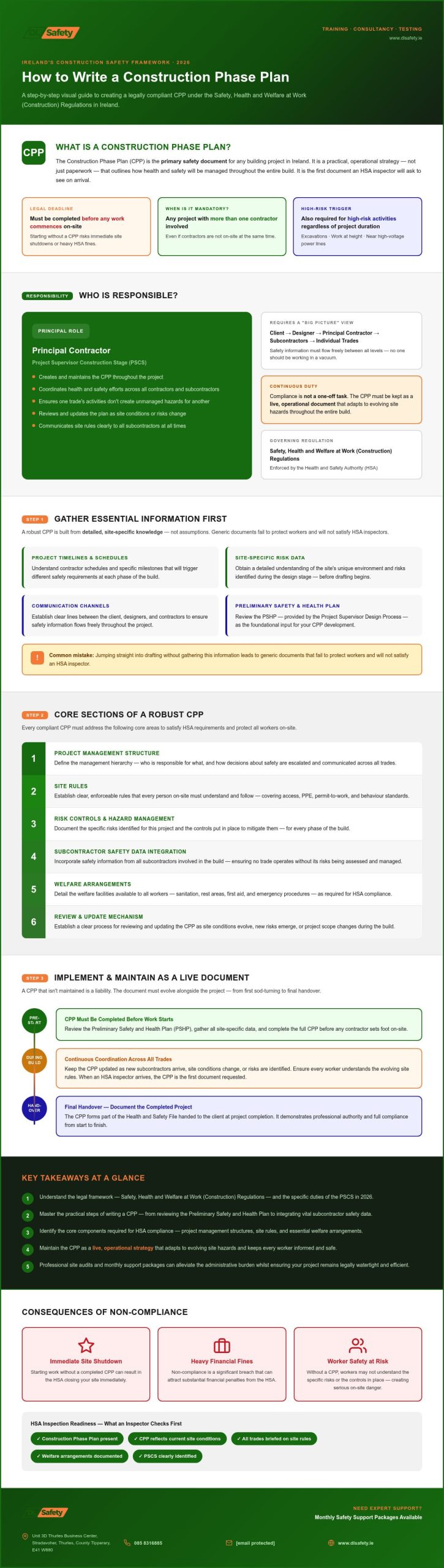
A Construction Phase Plan (CPP) is the foundational safety document for any building project in Ireland. It isn’t merely a piece of administrative paperwork to be filed away; it’s a practical, operational strategy that outlines how health and safety will be managed throughout the duration of the build. Governed by the Safety, Health and Welfare at Work (Construction) Regulations, this document serves as the primary reference point for every person on-site, from the site manager to the individual tradespeople. It ensures that everyone understands the specific risks associated with the project and the controls put in place to mitigate them.
Legally, the plan must be developed and in place before any work commences on-site. Starting a project without a completed CPP is a significant breach of compliance that can lead to immediate site shutdowns or heavy fines from the Health and Safety Authority (HSA). At DL Safety, we often see how the pressure of a looming start date can make the task of learning how to write a construction phase plan feel like an insurmountable hurdle, yet having this roadmap ready ensures you start your project on a footing of professional authority and site-wide safety.
The Role of the Principal Contractor
In the Irish construction sector, the responsibility for creating and maintaining the CPP sits firmly with the Principal Contractor, often designated as the Project Supervisor Construction Stage (PSCS). Their duty involves more than just drafting the initial document; they must coordinate the health and safety efforts of every contractor and subcontractor involved in the build. This role requires a “big picture” perspective to ensure that the activities of one trade don’t create unmanaged hazards for another.
The Principal Contractor is also responsible for reviewing and updating the plan as the project evolves. If site conditions change or new risks are identified, the CPP must reflect these realities. Ensuring that all subcontractors understand and adhere to the site rules laid out in the plan is a continuous task that requires clear communication and disciplined site management. If you need assistance with this level of coordination, our team at Unit 3D Thurles Business Center, Stradavoher, Thurles, County Tipperary, E41 W880, provides expert support via www.dlsafety.ie to help you stay ahead of these requirements.
When is a CPP Legally Required?
A Construction Phase Plan is mandatory for any project where more than one contractor is involved. This applies even if the contractors aren’t on-site at the same time. Furthermore, the HSA requires a plan for projects involving high-risk work, such as excavations, work at height, or activities near high-voltage power lines, regardless of the project’s duration. Having a robust plan is essential for HSA inspection readiness. When an inspector arrives, the CPP is often the first document they’ll ask to see to verify that you’ve properly considered how to write a construction phase plan that truly protects your workforce.
Gathering Essential Information Before You Start Writing
Before you sit down to learn how to write a construction phase plan, you must first gather the raw data that will form the document’s backbone. A robust plan isn’t built on assumptions; it’s constructed from a detailed understanding of the site’s unique environment and the specific risks identified during the design stage. Jumping straight into drafting without this information often leads to generic documents that fail to protect workers or satisfy HSA inspectors. You need a clear picture of the project timelines, contractor schedules, and the specific milestones that will trigger different safety requirements throughout the build.
Establishing clear communication channels between the client, the designers, and the contractors is equally vital. This ensures that safety information flows freely and that no one is working in a vacuum. Managing these moving parts is often the most demanding part of the pre-construction phase, which is why many firms choose to use Monthly Safety Support Packages to keep their documentation accurate and their site-specific data up to date as the project progresses.
Utilising the Preliminary Safety and Health Plan
The Preliminary Safety and Health Plan (PSHP), provided by the Project Supervisor Design Process (PSDP), is your most valuable starting point. This document outlines the hazards that the designers couldn’t “design out” and must now be managed by you, the Principal Contractor. You’ll need to extract these design-stage risks and translate them into operational controls. The PSHP also identifies existing site constraints, such as underground services, contaminated land, or overhead power lines, which must be factored into your traffic management and excavation strategies from day one.
Site-Specific Risk Profiling
Every site has its own personality and its own set of dangers. You must evaluate hazards unique to your location, such as proximity to public transport hubs, schools, or busy residential areas where pedestrian safety is a high priority. This profiling also determines the level of technical testing required for your equipment; for example, ensuring all lifting gear has valid GA1 certificates before it ever enters the site. Identifying site-specific hazards requires a methodical preliminary audit that cross-references existing site surveys with a physical walkthrough to spot evolving environmental risks. By being this thorough, you ensure that the guidance you provide on how to write a construction phase plan is grounded in the reality of your specific project rather than a generic template.
For professional assistance with site-specific audits or technical safety requirements, our team at Unit 3D Thurles Business Center, Stradavoher, Thurles, County Tipperary, E41 W880, is available at info@dlsafety.ie or 085 8316885 to help you secure your site’s compliance.
The Core Sections of a Robust Construction Phase Plan
Once you’ve gathered your site data, the next stage of learning how to write a construction phase plan is to organise that information into a logical, accessible structure. A robust plan acts as the definitive “site manual” for safety, providing clear instructions for every worker who steps onto the project. It shouldn’t be a dense, academic tome; instead, it needs to be a practical guide that addresses five core areas: project description, site rules, high-risk management, emergency protocols, and monitoring processes. By breaking the document down into these specific steps, you ensure no critical safety detail is overlooked.
Management and Site Rules
The first section of your plan must define the management structure and the people responsible for day-to-day safety. You need to name your Site Manager, Safety Officer, and designated First Aiders so there’s no ambiguity about who to contact in an emergency. Following this, you must establish clear site rules. These should be explicit regarding PPE requirements, designated smoking areas, and restrictions on mobile phone usage to prevent dangerous distractions. Don’t forget that welfare arrangements, including clean canteen facilities and proper sanitation, are legal requirements that must be detailed here to ensure a dignified and safe working environment for all trades.
Managing High-Risk Construction Work
This is the technical heart of your document where you address the activities most likely to cause serious injury. If your project involves crane operations, you must include detailed lift plans and verify that all lifting equipment has current GA1 certification. Excavation safety is another priority; your plan should outline shoring requirements and specific exclusion zones for working near overhead or underground power lines. We also recommend integrating a professional traffic management design into this section. This ensures a physical separation between pedestrians and heavy machinery, which is one of the most effective ways to prevent on-site accidents.
Emergency and Monitoring Arrangements
Your plan must clearly outline what happens when things go wrong. This includes drafting fire safety plans, identifying evacuation routes, and ensuring every worker knows the location of the nearest assembly point. However, a great plan is also proactive. You should set a strict schedule for regular site safety audits and inspections to catch hazards before they result in harm. Establishing a clear protocol for accident investigation and root cause analysis is also essential. This allows you to learn from near-misses and improve your site safety over time. If you find this level of detail daunting, the team at DL Safety can provide expert guidance from our base at Unit 3D Thurles Business Center, Stradavoher, Thurles, County Tipperary, E41 W880. You can reach us at www.dlsafety.ie, info@dlsafety.ie, or 085 8316885 to ensure your plan is both compliant and practical.
Implementing and Reviewing the Plan on a Live Site
A common mistake in the industry is treating the document as a static hurdle to clear before ground-breaking. In reality, a construction site is a shifting environment where new risks emerge as the project progresses from excavation to fit-out. A plan that doesn’t evolve alongside these changes is a liability rather than an asset. Understanding how to write a construction phase plan involves recognising that the document must remain “live,” acting as the central hub that connects your high-level strategy to the specific Method Statements and Risk Assessments used by your subcontractors every day.
Regular reviews ensure the plan remains effective and relevant to the current site conditions. This isn’t just about ticking a box for compliance; it’s about maintaining a proactive safety culture that protects every person on-site. To ensure your documentation stays as dynamic as your project, you can utilise our Monthly Safety Support Packages, which provide the professional oversight needed to keep your safety standards high throughout the build.
Communication and Site Inductions
The most robust plan in the world is useless if the workers on the ground don’t know what’s in it. Your CPP should serve as the primary curriculum for all site inductions, ensuring every person understands the site rules and emergency procedures before they start work. However, communication shouldn’t stop at the gate. Organising regular toolbox talks allows you to address specific high-risk phases as they happen, such as transitioning from groundworks to structural steel. Whilst digital copies are useful for version control, you must ensure the most current version of the plan is easily accessible to all workers in the site office or canteen.
Dynamic Review and Updating
You need to identify specific trigger points that require an immediate update to the plan. These include changes in the project scope, the arrival of new contractors with specialised equipment, or the occurrence of an accident or near-miss. Documenting these changes creates a clear audit trail that is vital for HSA inspections, proving that you are actively managing safety rather than just filing paperwork. We also recommend incorporating direct feedback from site workers during these reviews. Those working at the coalface often spot practical hazards that might be missed from the site office, and including their insights significantly improves the real-world effectiveness of your safety protocols.
For expert assistance in managing these reviews or to discuss your site safety needs, contact DL Safety at Unit 3D Thurles Business Center, Stradavoher, Thurles, County Tipperary, E41 W880. You can reach our team at info@dlsafety.ie or call 085 8316885 to ensure your project remains compliant from start to finish.
Professional Support for Your Construction Phase Plan
Mastering the intricacies of how to write a construction phase plan is a significant achievement for any Principal Contractor, yet the true test of site safety lies in the consistent application and updating of that plan over time. As projects grow in complexity, the administrative weight of managing safety documentation can distract from the physical progress of the build. Partnering with a dedicated safety expert allows you to delegate this burden whilst ensuring your site remains legally watertight and your workforce stays protected from avoidable hazards. It’s about moving beyond mere compliance to create a culture where safety is built into every task. This emphasis on structured expertise is reflected globally, where consulting practices like PK Services help builders and developers drive operational excellence across the construction industry.
Tailored Safety Support Packages
Our Monthly Safety Support Packages are designed to provide the proactive oversight needed to keep your documentation in a state of constant readiness for HSA inspections. We don’t just provide a template; we act as a trusted advisor, offering expert guidance on complex regulatory shifts and technical testing requirements that might otherwise be overlooked. This dedicated support ensures that your safety strategy is never left to chance. By choosing DL Safety, you gain access to a team that is deeply invested in your project’s success, helping you navigate the high-stakes environment of Irish construction with total confidence and professional authority.
Technical Services and Training
Beyond the primary document, a robust safety regime requires specialised technical inputs that often fall outside the scope of general site management. This includes critical services such as GA1 testing for lifting equipment, bespoke traffic management design, and on-site quarry vehicle brake testing to ensure your machinery meets the highest safety standards. Integrating these technical checks directly into your site safety regime provides a layer of verification that generic plans simply cannot match. Professional audits identify critical gaps in a CPP before the HSA has the opportunity to do so, providing a vital safety net for your business and your reputation.
Training is the final piece of the compliance puzzle. We offer a range of bespoke and online safety courses, covering everything from Manual Handling and Working at Height to Chemical Awareness Training, ensuring your workforce has the competency required to follow the plan you’ve worked so hard to create. If an incident does occur, our accident investigation proficiency helps you identify root causes and implement corrective actions that prevent recurrence. For comprehensive support with your safety documentation and site audits, contact the DL Safety team at Unit 3D Thurles Business Center, Stradavoher, Thurles, County Tipperary, E41 W880. You can reach us at www.dlsafety.ie, via email at info@dlsafety.ie, or by calling 085 8316885 to discuss how we can support your project’s safety needs.
Securing Site Safety and Compliance for the Road Ahead
Mastering how to write a construction phase plan ensures your site remains a safe, productive environment rather than a source of regulatory stress. We’ve explored how a robust plan relies on gathering design-stage data and maintaining the document as a “live” operational tool throughout the project’s life. By focusing on clear communication through site inductions and regular toolbox talks, you bridge the gap between office paperwork and site-level practice.
If the complexity of coordinating multiple subcontractors or managing high-risk activities feels overwhelming, professional support is always available. You can Contact DL Safety today for expert help with your Construction Phase Plan or visit us at Unit 3D Thurles Business Center, Stradavoher, Thurles, County Tipperary, E41 W880. Our team is ready to assist via info@dlsafety.ie or 085 8316885 to ensure your project stays on track. Taking these proactive steps today protects your workforce and your project’s future. You’ve got the knowledge to build a safer site; now it’s time to lead with confidence.
Frequently Asked Questions
Do I need a Construction Phase Plan for a small project?
Yes, you need a CPP if your project involves more than one contractor or any high-risk work, regardless of the project’s size or duration. The HSA mandates this document to ensure that coordination between different trades is managed effectively from the outset. Even a small renovation involving a plumber and an electrician requires this document to satisfy legal obligations under the Safety, Health and Welfare at Work (Construction) Regulations.
How often should a Construction Phase Plan be updated?
Your plan must be updated whenever site conditions change significantly, such as the arrival of a new subcontractor or a shift in the project’s scope. It’s a live document that should reflect the actual hazards present on the ground. When learning how to write a construction phase plan, it’s vital to include a review schedule that accounts for project milestones, ensuring the document remains relevant as you move from groundworks to fit-out.
What happens if I start work without a Construction Phase Plan?
Commencing work without a completed CPP is a serious legal breach that can result in an immediate site shutdown by the Health and Safety Authority. Beyond the risk of heavy fines or prosecution, you’re also leaving your workforce vulnerable to unmanaged hazards. Having this document ready before the first spade hits the ground is the only way to demonstrate that you’ve fulfilled your duty as a Principal Contractor.
What is the difference between a CPP and a Safety Statement?
A Safety Statement is a broad document outlining your company’s general approach to health and safety, whereas a CPP is a specific roadmap for a single construction project. Whilst the Safety Statement covers your permanent staff and office activities, the CPP addresses the unique risks and site rules of a particular build. Both are required for compliance, but they serve different operational purposes on a live construction site.
Can I use a template to write my Construction Phase Plan?
You can use a template to structure your document, but it must be heavily customised to reflect the specific risks of your site. Generic, “off-the-shelf” plans often fail to address unique hazards like underground services or nearby schools, which makes them ineffective during HSA audits. Using a professional template as a starting point is helpful, but the real value comes from the site-specific details you add during the writing process.
Who is responsible for the CPP if there are multiple contractors?
The Principal Contractor, often acting as the Project Supervisor Construction Stage (PSCS), holds the primary responsibility for the document. They must ensure that the plan is created, communicated, and updated as different contractors enter and leave the site. Whilst subcontractors provide their own risk assessments and method statements, the PSCS ensures these individual pieces fit into the overarching safety strategy for the entire project phase.
How does the Construction Phase Plan relate to Method Statements?
The CPP acts as the master safety document, whilst Method Statements provide the granular detail for specific high-risk tasks. When you’re determining how to write a construction phase plan, you should ensure it references the specific Method Statements required for activities like crane lifts or deep excavations. This ensures that the high-level site rules and the practical, task-based instructions are always in total alignment to protect workers.
Where should the Construction Phase Plan be kept on-site?
The plan must be kept in an easily accessible location on-site, typically within the site office or the welfare canteen area. It’s not enough to have a digital copy saved on a remote server; every worker needs to be able to consult the document to understand site rules and emergency procedures. Keeping a physical, up-to-date copy in a central hub ensures that safety information is always available when it’s needed most.
