
A workplace accident investigation is only as useful as the plan behind it. A clear workplace accident investigation procedure sets out who will lead the inquiry, who must be notified, how the scene and evidence will be protected, and who will prepare the findings. The aim is to understand what happened and what needs to change, not to assign blame.
It is natural to focus first on the immediate incident: the people involved, the sequence of events and the evidence that could clarify what happened. A thorough investigation also examines the conditions and systems behind those events, so corrective actions address underlying causes rather than visible symptoms alone.
This article explains what to include in an investigation plan, what information an investigator needs, and how to assess observations, records, photographs and interviews together. It also covers how to identify root causes and choose practical corrective actions that can help prevent a similar incident. The steps focus on a clear, evidence-led process for workplaces in Ireland.
Key Takeaways
- Build the investigation plan around clear roles, timely notifications, witness interviews and responsibility for the final report.
- Use open-ended questions and give witnesses room to describe events in their own words before exploring details.
- Preserve scene evidence promptly, then compare observations with photographs, records and interview accounts.
- For an employee accident in Ireland, the Health and Safety Authority says reporting is required when the employee cannot perform their normal work for more than 3 consecutive days, excluding the day of the accident.
- Trace contributing factors back to underlying causes, then set corrective actions that can be followed up for effectiveness.
What Should a Professional Accident Investigation Plan Include?
A clear plan gives each investigator a defined role, sequence of tasks and reporting responsibility. It also explains how witness accounts, workplace records and physical evidence will inform management decisions.
- Before gathering evidence, assign an investigation lead, a note-taker and a report writer. List the supervisors, workers and witnesses to interview, and record who must be notified and when. Include contact arrangements for nights and weekends, who will provide site access, and what protective equipment is required. A written workplace accident investigation procedure keeps these responsibilities clear when several departments are involved.
How professionals use open-ended questions in witness interviews
Interview witnesses separately, starting with an uninterrupted account in their own words. Then use open questions beginning with What, When, Where, Who and How to clarify the sequence. For example, ask, “What happened when the load began to move?” Avoid leading questions that suggest an answer. During initial fact-gathering, first establish what each person observed before asking why.
Record the witness’s wording, the interview time and any points requiring follow-up. Compare accounts with documents and observations at the scene, rather than treating opinions as established facts.
How professionals interview the injured employee
Speak with the injured employee when their condition allows, keeping their wellbeing the priority. Invite them to describe the task, equipment and events in sequence, without pressure to explain immediately. Ask what they saw, heard or did before the incident, then clarify details with open questions. Record which points are based on direct observation and which are uncertain or recalled later.
Compare the account with work instructions, training records and other evidence. Avoid questions that imply the employee caused the incident or should have acted differently.
How professionals interpret findings for management
Organise the evidence into a timeline, then compare interview accounts with records, procedures and physical observations. For example, check whether the task followed the current method statement and whether relevant training was completed. Note where sources agree, where accounts differ and what evidence supports each finding. This helps management distinguish confirmed events from assumptions.
Present findings in practical terms: identify the immediate event, contributing conditions and any gaps in controls. Explain how each proposed action addresses a specific finding, rather than listing unrelated recommendations. Consider relevant regulations and workplace arrangements when interpreting the evidence.
- Complete the report with the evidence reviewed, findings, limitations and actions assigned to named roles. Include interview records, relevant workplace documents and a clear explanation of how conclusions were reached. Identify who will monitor each action and record follow-up findings. This allows management to track implementation and assess whether changes address the identified causes. Should an incident prompt formal liability claims or legal scrutiny for operations in the UK, organisations can turn to North East Barristers Chambers for direct access legal advice on the findings and supporting evidence.
Why Perform an Accident Investigation at Work?
In Ireland, the Health and Safety Authority says an accident involving an employee is reportable when they cannot perform normal work for more than 3 consecutive days, excluding the day of the accident. Investigate as soon as possible after the incident, while accounts and conditions remain clearer.
The employer should assign an investigation lead and ensure relevant incidents are reported. Corrective actions should address identified causes, have clear owners and be followed up.
- Identify the reporting threshold and act promptly. The Health and Safety Authority says non-fatal workplace accidents or dangerous occurrences must be formally reported within 10 working days of the event. The 3 consecutive days threshold determines whether an employee accident is reportable; the 10 working days period is the formal reporting deadline. Record the incident date, injury details and effect on normal duties to support accurate reporting.
- Assign responsibility for investigation and reporting. The employer should appoint a competent lead, provide access to relevant records, and define who submits reports to the Health and Safety Authority. Managers can coordinate investigations and corrective actions for incidents connected with their work. Clear roles help prevent delays between local reporting and formal notification.
- Apply the Irish reporting rules to the incident type. The Safety, Health and Welfare at Work (Reporting of Accidents and Dangerous Occurrences) Regulations 2016, S.I. No. 370 of 2016, cover reporting of accidents and dangerous occurrences. The Health and Safety Authority’s 10 working days deadline applies to formal reports of non-fatal accidents or dangerous occurrences. Record the event and its circumstances so the report reflects evidence, not assumptions.
- Use the correct reporting route for the workplace. In health and social care settings, work-related accidents and incidents are reported through the National Incident Management System (NIMS). Follow the relevant NIMS process rather than treating an internal entry as a substitute. Keep the investigation record aligned with the reporting channel and any internal escalation steps.
- Develop an incident reporting strategy that encourages direct, timely accounts from employees. Make the reporting route clear to workers, supervisors and contractors, and record near misses as well as injuries. A blame-focused response can discourage reporting and leave management with an incomplete picture. A consistent process can reveal recurring equipment, task or training issues across reports.
- Turn findings into practical corrective actions. Assign each action to a responsible role, set a completion point and record how its effectiveness will be reviewed. For example, if an investigation identifies an outdated procedure, update it and address related training needs. Follow-up is essential: management should check that actions were implemented and that the identified risk is being controlled.
Recording observations and scene evidence
Investigators collect evidence through observations at the scene, documents and witness accounts, then compare these sources. They record observations separately from explanations so conclusions remain grounded in evidence.
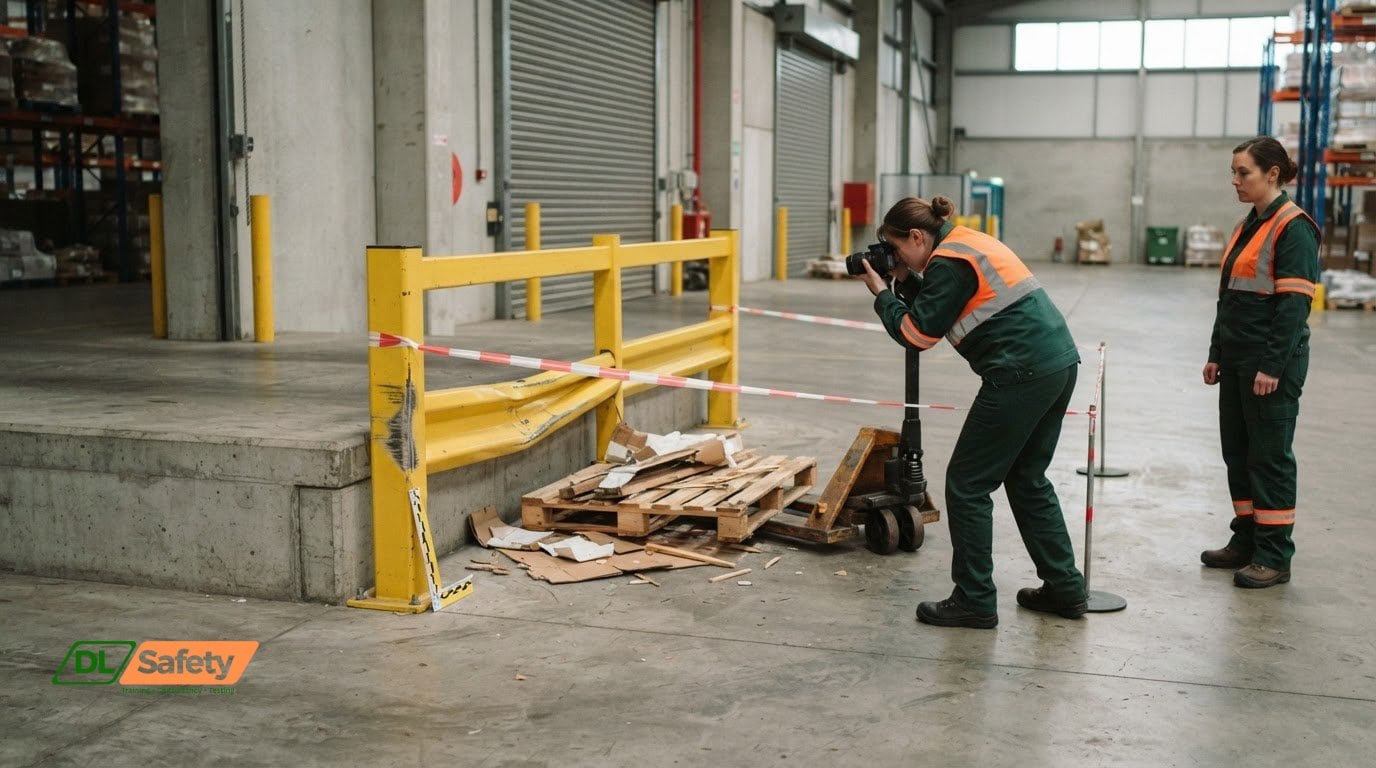
- Secure the scene and record its condition before anything changes. Note the location, equipment involved, visible hazards, lighting and any relevant environmental conditions. For example, record whether a walkway was wet or an access route obstructed. If work must continue or the scene changes, document what changed, when and who was responsible. This provides a clear reference for interpreting later evidence.
How professionals gather evidence objectively
Gather accounts and records from separate sources, noting where each item came from. Record witness statements in their own words and distinguish direct observations from opinions or later assumptions. For example, “the guard was open” is an observation; “the guard caused the injury” is an interpretation that needs supporting evidence.
Compare each account with the scene, relevant work documents and other statements. Record disagreements without choosing a version prematurely, and identify what further evidence could resolve them.
How professionals photograph and preserve the scene
Photograph the scene before moving equipment, materials or other relevant items, provided it is safe. Start with wider views showing the location, then take closer images of the hazard, equipment and visible damage. Include enough surrounding detail to show where each feature is located. Record the date, time, location and photographer for each image.
Preserve original photographs and video, and record any later edits or copies. If weather, clothing or another condition may change, document it promptly and explain how it was observed.
How professionals collect and analyse evidence
Collect relevant documents alongside physical observations and witness accounts. Depending on the task, these may include risk assessments, safe systems of work, permits, method statements and training records. Note which version applied at the time, who supplied it and what aspect of the incident it may explain. A document alone does not prove that a procedure was followed.
Build a sequence of events from the available material, then compare sources for agreement and gaps. A timeline can show where accounts differ or records fail to explain a change in the task. Support each conclusion with identified evidence.
- Maintain a clear evidence record from collection through reporting. Describe each item, record its source, collection time and storage location, and note who handles it. Link photographs, documents and statements to the relevant event in the timeline. Keep observations, reported accounts and analysis distinct in the final record. This allows management to trace findings to their evidence and identify unresolved questions.

Identifying root causes without blame
Trace the incident from its immediate trigger to the conditions that allowed it. A fair investigation examines evidence, work systems and decisions instead of stopping at individual behaviour.
- Separate the immediate event from its underlying conditions. The immediate cause may be a worker slipping, while the investigation examines a wet floor, missing warning signs or cleaning arrangements. Record a point as a finding only when evidence supports it. This distinction helps management avoid mistaking the first visible event for the full explanation.
- Build a sequence of events using accounts, records and observations at the scene. Identify what happened directly before the injury, then examine earlier conditions that shaped the task. For example, a worker may have lifted an unstable load after receiving unclear instructions. Check the task method, available equipment and supervision before deciding which factors contributed.
- Ask what made each contributing condition possible. If a procedure was not followed, establish whether it was current, accessible and understood. Review relevant training records and whether instruction matched the task. If a safeguard was absent, examine maintenance, planning and management decisions. These checks help distinguish an individual action from weaknesses in the system supporting the work.
- Use repeated “why” questions to explore causes, not to interrogate workers. Asking why several times can help move from an immediate event towards underlying factors. For example, a spill may have caused a slip; further questions could examine how the spill occurred, how it remained and why controls failed. Treat each answer as a line of enquiry, then test it against evidence.
- Look for organisational causes as well as task-level hazards. Poor planning, inadequate supervision, unclear responsibilities or a cramped work area may influence how people work. Check whether managers provided appropriate resources and put safety arrangements into practice. Avoid labels such as “careless” unless a specific behaviour is established and evidence shows its relevance.
- Write findings in neutral language and connect each cause to supporting evidence. Separate confirmed facts, reasonable interpretations and unanswered questions in the report. For example, identify an outdated method statement as a contributing factor only when its version and relevance are established. This gives management a sound basis for selecting corrective actions that address causes, not blame.
- Review proposed actions against the causes identified. If unclear instructions contributed, revise the relevant procedure and explain the change to affected workers. If equipment condition contributed, assign responsibility for inspection or maintenance. Record who will carry out each action and how management will assess its effectiveness. An action that does not address a supported finding is unlikely to prevent the same failure.
Identify initiating events, contributing events, root causes and other contributing causes. Recommend measures that address the problems and root causes. Typical root causes include failures in an established safety management system and line management failures to teach and enforce rules.
Workplace accident investigation methods
In Ireland, investigators secure the scene, gather facts, analyse events and causal factors, then recommend and monitor actions. They choose a method suited to the incident’s complexity and the available evidence.
- Define the investigation’s scope before analysis begins. Identify the event, work activity, people involved and immediate risks. Separate the sequence of events from possible causes so early assumptions do not shape later findings. The method should examine what happened, how it happened and which controls were expected to prevent it.
- Assemble evidence into a clear timeline. Combine observations, witness accounts, work records, risk assessments and method statements. Mark where sources agree and where information is missing. For example, compare the documented task sequence with accounts of how the work actually proceeded. This helps investigators identify necessary follow-up enquiries before choosing corrective actions.
- Choose an analysis method that fits the case. A straightforward event may need a focused review of the timeline and relevant controls. A more complex occurrence involving several teams or decisions may need a structured systems approach. Explain why the chosen method suits the evidence rather than applying a model mechanically.
- Use the Finnish model when a structured sequence helps organise the enquiry. This practical tool uses a 10-step process for occupational accident investigations. It can help investigators move from gathering information towards analysing causes and proposing measures. Keep each step connected to the evidence, and adapt the enquiry to the work activity and incident.
- Consider AcciMap when decisions at different levels may have influenced the event. It maps causal chains and focuses on decisions that could improve system safety, rather than identifying a guilty person. This can be useful when planning, supervision and task-level actions all shaped the circumstances. Record the links between events and decisions clearly.
- Apply MTO analysis when human, organisational and technical factors all need attention. Review the work activity, management arrangements and equipment together. For example, equipment failure may also involve maintenance planning or unclear operating instructions. Considering all three areas can reveal interacting causes that a narrow focus on worker actions might miss.
- Turn supported findings into actions, then monitor their implementation and effect. Match each action to a causal factor, assign a responsible role and record how progress will be reviewed. If actions address only the immediate event, underlying weaknesses may remain. Use investigation results to improve relevant procedures and share lessons that could prevent similar occurrences.
For support planning the next steps after an incident, speak with a safety professional.
Secure the scene so people cannot move anything, and check risk assessments, safe systems of work, permits to work, method statements and training records as part of the evidence. Where video footage is available, scan it slowly through 360 degrees to establish the location. Simple accident investigation techniques are intended to take no more than a couple of hours to carry out.
Use appropriate methods to analyse emerging problem areas, and include someone with knowledge of investigation methods who can help select them. The enquiry should gather facts and available information, analyse them, compare findings with applicable standards and requirements, and then implement and monitor the resulting actions.
DL Safety: Accident Investigation
DL Safety provides Accident Investigation for employers who need an independent, structured review after a workplace incident. The investigation can help clarify what happened, assess relevant evidence and identify corrective actions. It may be useful when an incident has several contributing factors, when records and accounts need to be brought together, or when management needs clear findings to inform prevention.
Relevant incident records, procedures and witness details help establish the context. DL Safety also offers Monthly Safety Support Packages for ongoing workplace safety support.
Contact details: info@dlsafety.ie, 085 8316885, www.dlsafety.ie. Address: Unit 3D Thurles Business Center, Stradavoher, Thurles, County Tipperary, E41 W880.
Contact DL Safety to discuss an accident investigation.
Turn investigation findings into lasting improvements
The value of a workplace accident investigation procedure lies in what happens after the report. Use its findings to guide practical decisions, assign ownership for changes and build lessons into everyday planning. As work methods or risks change, revisit those lessons so procedures continue to reflect actual conditions.
Where findings point to wider support needs, DL Safety offers Monthly Safety Support Packages, Online Safety Courses and Lift Plans. These services support different aspects of workplace safety, from ongoing guidance and learning to lift planning. Choose the next step that best fits the issues identified in your investigation.
A clear, evidence-led approach can help turn a difficult incident into a constructive opportunity to improve how work is planned and managed. Contact DL Safety for support with your workplace accident investigation.
Frequently Asked Questions
How do professionals identify the root cause of a workplace accident?
Investigators identify root causes by testing possible explanations against available evidence. They compare how the task was planned with how it was carried out, then examine whether equipment, instructions, supervision or workplace conditions contributed. For example, if a worker used a different route, investigators can assess whether the planned route was accessible and suitable. The report should distinguish supported findings from possibilities the evidence cannot establish.
What records must an employer keep after a workplace accident in Ireland?
Keep a written record of the incident, investigation findings, evidence reviewed and corrective actions, including who is responsible for each action. Relevant records may include photographs, witness accounts, work procedures, risk assessments and training information. Retain any accident book entry; it can make incident details available if a compensation claim arises. Certain incidents must also be reported to the Health and Safety Authority using IR1 or IR3 forms under S.I. No. 370 of 2016.
