In 2025, Ireland recorded 61 work-related fatalities, the highest figure since 2007, which has led to a rigorous HSA mandate for 2026 where fines for non-compliance can exceed €50,000. When you begin to compare health and safety consultants Ireland, it’s clear that the stakes have shifted. You likely feel the constant pressure of potential inspections or the confusion of managing complex statutory requirements like GA1 testing and quarry vehicle brake testing. It’s exhausting to juggle multiple vendors whilst trying to maintain a safe environment for your team.
This guide will help you master the criteria for evaluating Irish safety consultancies to ensure your business moves beyond paper compliance to a robust, site-ready safety culture. We will preview the 2026 selection framework, showing you how to choose a single partner who integrates strategic advice with technical testing. For expert assistance, contact DL Safety at Unit 3D Thurles Business Centre, Stradavoher, Thurles, County Tipperary, E41 W880. You can visit www.dlsafety.ie, email info@dlsafety.ie, or call 085 8316885 to ensure your operations remain fully compliant and secure.
Key Takeaways
- Understand the 2026 HSA inspection landscape and why “paper compliance” is no longer enough to protect your business from significant enforcement actions.
- Learn how to effectively compare health and safety consultants Ireland to identify partners who offer technical expertise in high-risk environments like construction and quarries.
- Evaluate the financial and legal advantages of Monthly Safety Support Packages over fragmented, ad-hoc consultancy models for better liability protection.
- Utilise a 5-point framework to verify essential technical credentials, such as LEEA standards, whilst assessing the proactive personality of your potential advisor.
- Discover how integrating technical services like GA1 testing and brake testing into your safety programme eliminates administrative gaps and ensures total regulatory compliance.
Navigating the 2026 Irish Health and Safety Landscape
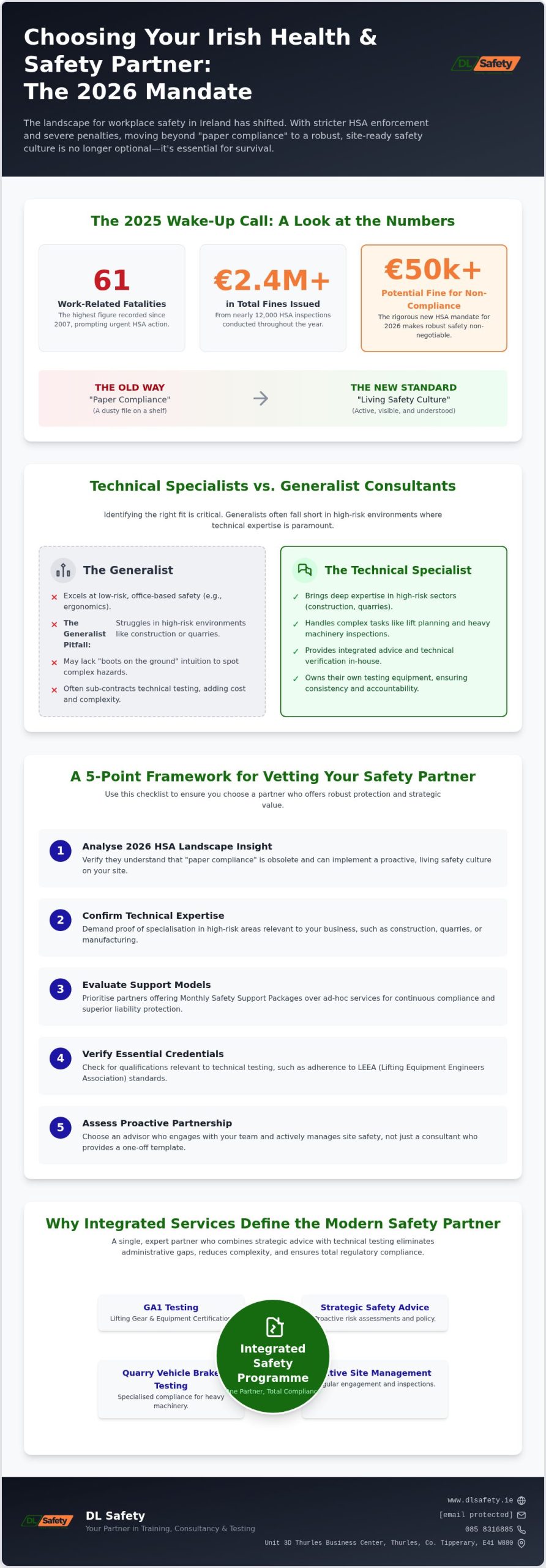
The Irish safety landscape has undergone a significant transformation heading into 2026. Following a tragic spike in workplace fatalities during 2025, where 61 people lost their lives, the Health and Safety Authority (HSA) has intensified its enforcement strategy. We’ve moved beyond the era of “paper compliance,” where a dusty safety statement on a shelf was considered enough. Now, the emphasis is on a “living safety culture” where procedures are active, understood, and visible on the shop floor or site. When you compare health and safety consultants Ireland, you must look for partners who understand this cultural shift. A modern safety partner isn’t just a document writer; they’re an integrated technical and advisory resource that bridges the gap between legal theory and site reality.
The cost of falling behind is steeper than ever. In 2025, the HSA conducted nearly 12,000 inspections, resulting in over €2.4 million in total fines. For 2026, the mandate is even more rigorous, with potential fines for non-compliance exceeding €50,000. Non-compliance doesn’t just mean a financial penalty; it leads to stop-work orders that cripple your timeline and reputational damage that can effectively blacklist your firm from future contracts. Ensuring your business adheres to the principles of Occupational safety and health is now a fundamental requirement for operational survival.
HSA Inspection Priorities for the Current Year
This year, the HSA is targeting specific occupational health risks with renewed vigour. There’s a heavy focus on silica dust exposure and chemical awareness training, particularly in the construction, quarrying, and manufacturing sectors. Static documents are no longer sufficient to satisfy an inspector. They now expect to see dynamic risk assessments that evolve as site conditions change. Your consultant must be able to prove they are actively managing site safety through regular engagement, rather than just providing a one-off template. This proactive approach ensures that hazards are identified before they lead to accidents.
The Business Case for Professional Safety Oversight
Beyond avoiding fines, robust safety systems are a vital commercial necessity. High-level safety performance directly reduces insurance premiums and removes significant hurdles during the tendering process. When you compare health and safety consultants Ireland, consider how their expertise acts as a competitive advantage. Large-scale Irish projects now require evidence of sophisticated safety management, such as Safe T Cert or ISO preparation, before you can even begin the bidding process. Maintaining Health and Safety Compliance Ireland is no longer an overhead; it’s a strategic asset that opens doors to higher-value contracts.
For expert guidance on navigating these requirements, contact DL Safety at Unit 3D Thurles Business Center, Stradavoher, Thurles, County Tipperary, E41 W880. You can reach our team at info@dlsafety.ie, call 085 8316885, or visit www.dlsafety.ie to learn more about our integrated support packages.
Technical Specialists vs Generalist Consultancies: Identifying the Right Fit
When you compare health and safety consultants Ireland, the distinction between a generalist and a specialist becomes critical. Generalists often excel at office-based risks, such as ergonomics or basic fire safety. However, they frequently struggle in high-risk environments like quarries or construction sites. This “Generalist Pitfall” can leave your business vulnerable when complex tasks like lift planning or heavy machinery inspections are required. A specialist brings “boots on the ground” intuition, identifying hazards that a desk-bound consultant might miss whilst conducting a surface-level walkthrough.
It’s also vital to check if your consultant actually owns their testing equipment when you compare health and safety consultants Ireland. Many firms act as middle-men, charging a premium to hire third-party gear or sub-contractors. At DL Safety, we maintain our own technical equipment, ensuring that the person giving you advice is the same person conducting the technical verification. This transparency creates an atmosphere of trust and ensures that your safety standards are never compromised by equipment availability or third-party scheduling.
When Your Site Requires a Technical Specialist
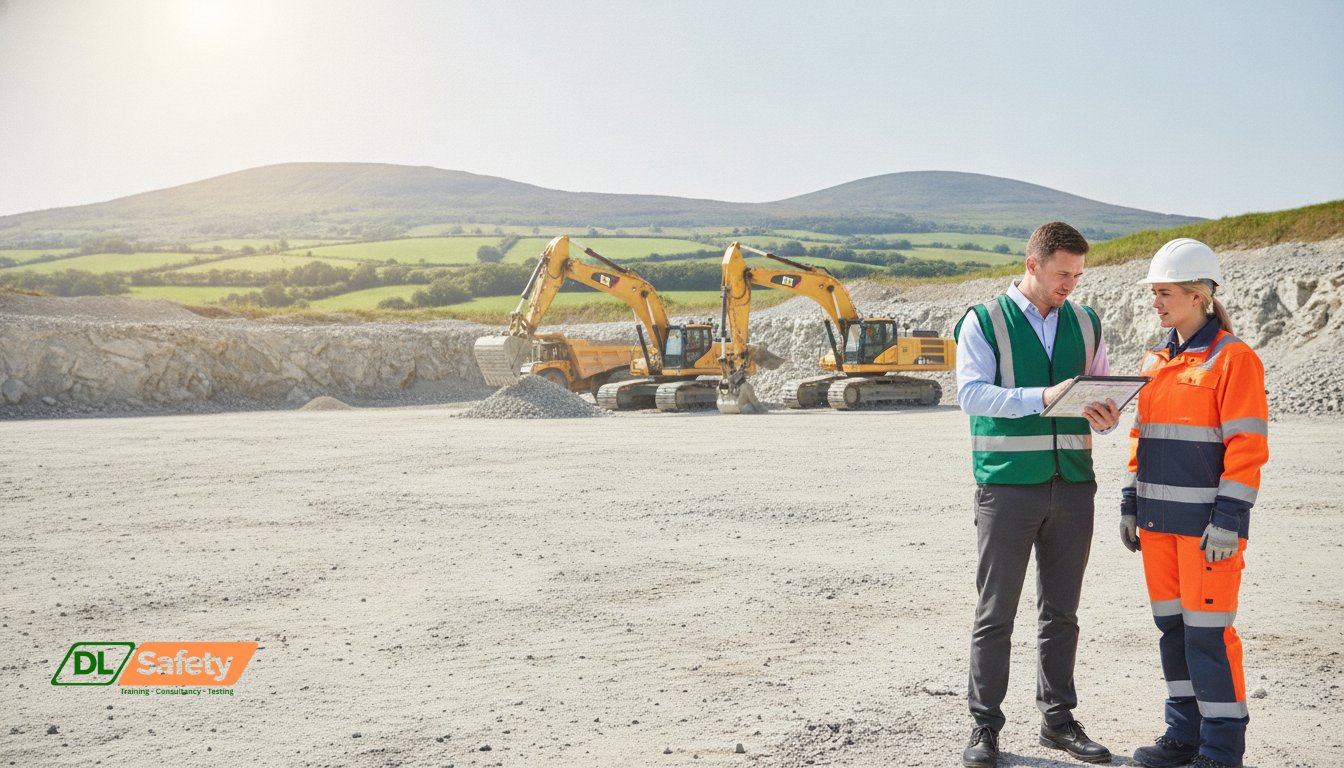
High-risk sites demand specific statutory testing that goes beyond a standard audit. For instance, GA1 testing for lifting equipment and plant machinery is a legal requirement that demands precise technical knowledge. Similarly, specialised on-site expertise is non-negotiable for certain sectors. If you operate in the extraction industry, refer to our Quarry Vehicle Brake Testing Ireland guide to understand these unique requirements. The Health and Safety Authority (HSA) expects these technical records to be accurate and readily available during any inspection.
The Problem with Outsourced Technical Testing
Relying on multiple vendors for safety advice and technical testing often creates administrative chaos. Communication gaps between an auditor and a third-party tester can lead to missed deadlines or conflicting reports. Choosing a single partner who handles both site audits and statutory testing is significantly more cost-efficient. It ensures that LEEA standards are met consistently without the need for additional third-party inspectors. This integrated approach closes the “compliance gap,” providing you with a seamless safety solution that saves time and reduces stress.
If you’re looking for a partner who understands the technical demands of your site, consider how our Monthly Safety Support Packages can streamline your compliance. Contact David and the team at DL Safety, Unit 3D Thurles Business Center, Stradavoher, Thurles, County Tipperary, E41 W880. You can reach us at 085 8316885, email info@dlsafety.ie, or visit www.dlsafety.ie to start a conversation about your specific site needs.
Evaluating Support Models: Monthly Packages vs Ad-hoc Services
Choosing the right engagement model is a pivotal decision when you begin to compare health and safety consultants Ireland. Many businesses start with ad-hoc consultancy, viewing it as a “pay-as-you-go” solution for immediate problems. Whilst this might seem cost-effective initially, it often leads to “snapshot” safety. This approach only identifies hazards present on the day of the audit, leaving your business exposed during the intervals between visits. In contrast, a retained monthly model provides superior liability protection by ensuring your safety systems are continuously monitored and updated.
When you evaluate the total cost of ownership, ad-hoc fees can quickly spiral if a site incident occurs or if an unexpected HSA inspection requires urgent documentation. Predictable monthly investments eliminate these financial spikes. This model allows for proactive accident investigation and regular site audits, ensuring that your business stays ahead of regulatory changes. Under the Safety, Health and Welfare at Work Act 2005, the responsibility for a safe workplace is ongoing, not occasional. A retained partner ensures you meet these statutory duties every single day.
The Benefits of Monthly Safety Support Packages
A retained partnership offers continuous oversight that ad-hoc services simply cannot match. It ensures that your safety statements and method statements aren’t just documents in a folder but are current, working records that reflect your actual site activities. You also gain priority access to expert advice during critical moments, such as site incidents or unannounced inspections. For a deeper look at how these models function, our guide to Monthly Safety Support in Ireland provides a comprehensive breakdown for business owners.
Is Ad-hoc Consultancy Ever Enough for High-Risk Sites?
For high-risk environments like quarries or large construction projects, ad-hoc consultancy is rarely sufficient. These sites involve moving parts, changing terrain, and shifting subcontractor teams that require a consistent, retained framework to manage safely. A monthly partner can oversee subcontractor compliance and integrate online safety courses to maintain continuous workforce competency. This steady rhythm of professional oversight prevents the “compliance gap” that often leads to workplace accidents. It transforms safety from a reactive chore into a disciplined, manageable part of your daily operations.
To discuss how a tailored support model can protect your team, contact DL Safety at Unit 3D Thurles Business Center, Stradavoher, Thurles, County Tipperary, E41 W880. You can reach us at 085 8316885, email info@dlsafety.ie, or visit www.dlsafety.ie to explore our specialised monthly packages.
A 5-Point Framework for Vetting Your Safety Partner
Selecting the right advisor requires a structured approach that prioritises technical capability over administrative convenience. When you begin to compare health and safety consultants Ireland, you need a framework that filters out passive observers and identifies proactive partners. This five-point selection framework ensures your chosen consultancy can handle the rigours of a modern Irish workplace.
- Step 1: Verify Technical Certifications. Ensure they hold industry-recognised credentials, such as LEEA standards for lifting equipment.
- Step 2: Assess Personality Fit. Determine if they are proactive advisors who spot hazards early or passive observers who only react to problems.
- Step 3: Review Technical Toolkits. Confirm they perform GA1 and PAT testing in-house rather than outsourcing to third parties.
- Step 4: Check Investigation Track Records. Ask for examples of how they have managed accident investigations and HSA mediation in the past.
- Step 5: Demand Pricing Transparency. Insist on clear, fixed-fee pricing models that eliminate hidden extras or unexpected hourly charges.
This framework moves the conversation away from basic compliance and towards operational excellence. A partner who meets these criteria will do more than just write a safety statement; they’ll actively reduce your risk profile on-site. To see how these standards are applied in practice, you can explore our Monthly Safety Support Packages which are designed around these core principles.
Checking Credentials and Site Experience
It’s essential to verify a GA1 inspector’s competency for your specific plant types. Not all inspectors are qualified for every piece of machinery, so ask for proof of experience within the Irish construction or quarrying sectors. You should also enquire about their familiarity with local site conditions and Irish statutory requirements. For a detailed breakdown of what to look for, refer to our GA1 Testing Ireland Guide to ensure your equipment remains fully compliant.
Evaluating Modern Efficiency: Online Courses and Simulations
The best consultants now utilise a blended learning approach to improve worker behaviour. This combines online theory with on-site practicals to ensure knowledge is retained and applied. Simulation training is particularly effective for high-risk tasks, allowing workers to practice safety protocols in a controlled environment. Furthermore, digital reporting tools now provide real-time safety statistics to your board, allowing for data-driven decisions. This modern efficiency ensures that your safety culture is supported by the latest technology and training methodologies.
For a partner who combines technical rigour with modern efficiency, contact DL Safety at Unit 3D Thurles Business Center, Stradavoher, Thurles, County Tipperary, E41 W880. You can reach David and the team at 085 8316885, email info@dlsafety.ie, or visit www.dlsafety.ie to discuss your 2026 safety strategy.
Why Integrated Technical Services Define the Modern Safety Partner
When you compare health and safety consultants Ireland, the most significant differentiator is the ability to bridge the gap between high-level strategy and technical execution. Traditional consultancies often provide the advice but leave the technical testing to third parties. This creates what we call the “compliance gap”—a space where essential tasks like GA1 testing or brake testing can fall through the cracks because of poor communication between vendors. An integrated partner eliminates this risk by owning the entire process, from the initial audit to the final statutory certification.
The DL Safety approach combines professional consultancy with the technical tools required to maintain a site-ready safety culture. Having a single point of contact for all your safety needs provides immense peace of mind. It means your safety statement isn’t just a separate document; it’s a living programme that is directly informed by the data from your vehicle brake tests and equipment inspections. This synergy ensures that your safety measures are always grounded in the technical reality of your operations.
The DL Safety Advantage for Irish Industry
Our commitment to technical excellence is reflected in our in-house capabilities for GA1, PAT, and specialised brake testing. We don’t just tell you what the regulations require; we arrive on-site with the gear to ensure those requirements are met. Our Monthly Support Packages are specifically tailored to the unique demands of the construction and quarrying sectors, where heavy plant and complex lifting operations are daily realities. This site-ready expertise ensures that David and the team are proactive partners in your success, not just office-bound observers. To discuss your 2026 safety roadmap, you can reach us at info@dlsafety.ie.
Securing Your Compliance Today
Waiting for a HSA inspection to identify weaknesses in your system is the most expensive way to manage safety. The transition from a generalist to a technical specialist partner is a strategic move that protects your people and your bottom line. By integrating your strategic advice with technical execution, you create a robust shield against accidents and enforcement actions. Now is the time to move beyond simple comparison and establish a partnership that offers year-round reliability and professional integrity. You can view our Monthly Safety Support Packages at dlsafety.ie to see how we can organise your compliance more effectively.
For a dedicated safety partner who understands the Irish industrial landscape, contact DL Safety at Unit 3D Thurles Business Center, Stradavoher, Thurles, County Tipperary, E41 W880. Our team is available at 085 8316885 or via www.dlsafety.ie to help you build a safer, more compliant workplace for 2026 and beyond.
Organising Your Site Safety for 2026 and Beyond
Navigating the intensified inspection landscape of 2026 requires more than a standard safety statement. As you compare health and safety consultants Ireland, remember that the most effective partners are those who combine high-level advisory strategy with on-site technical execution. Moving away from fragmented, ad-hoc services toward an integrated support model ensures that statutory requirements like GA1 testing and quarry vehicle brake testing never fall through the cracks. This transition closes the compliance gap and provides the steady oversight necessary for high-risk industrial environments.
By adopting a structured vetting framework, you’ll secure a partner who understands your specific site challenges in construction and quarrying. This proactive approach doesn’t just satisfy the HSA; it actively protects your workforce and your commercial reputation. DL Safety is ready to help you build a safety culture that is both disciplined and easy to manage. Book a consultation with DL Safety to secure your 2026 compliance. Visit us at Unit 3D Thurles Business Center, Stradavoher, Thurles, County Tipperary, E41 W880. For direct support, email info@dlsafety.ie or call 085 8316885. We look forward to protecting your business and your people.
Frequently Asked Questions
What is the average cost of a health and safety consultant in Ireland for 2026?
In 2026, industry data shows that on-site day rates for Irish safety consultants typically range from €715 to €2,235. Hourly rates for tasks like document reviews often fall between €110 and €270. Monthly retainers vary based on company size, with small firms often paying between €1,800 and €4,000 for ongoing support. These figures reflect market averages, so you should always request a fixed-fee quote to ensure your safety budget remains predictable.
How do I check if a health and safety consultant is properly qualified?
You should verify their industry-specific credentials and technical certifications, such as LEEA standards for lifting equipment. Look for consultants with extensive experience in high-risk sectors like construction or quarrying. It’s also vital to check their professional indemnity insurance and membership in recognised safety bodies. When you compare health and safety consultants Ireland, ask for specific examples of their work in accident investigation to ensure they have the practical expertise required for your site.
Can one consultant handle both my safety statement and my GA1 testing?
Yes, an integrated safety partner like DL Safety handles both the strategic development of safety statements and the technical execution of GA1 testing. This combined approach is highly efficient because it eliminates the communication gap between separate vendors. By having one expert manage your documentation and your statutory equipment inspections, you ensure that your safety protocols are always grounded in the technical reality of your plant and machinery, leading to more robust compliance.
What is the difference between a safety retainer and ad-hoc consultancy?
A safety retainer, such as our Monthly Safety Support Packages, provides continuous oversight and predictable costs, whereas ad-hoc consultancy is a “pay-as-you-go” model for one-off tasks. Retainers offer superior liability protection because they ensure your safety statements and risk assessments are updated regularly. Ad-hoc services only provide a snapshot of safety on a specific day, which can leave dangerous gaps in your compliance during the periods between consultant site visits.
Why is quarry vehicle brake testing a statutory requirement in Ireland?
Under the Safety, Health and Welfare at Work (Quarries) Regulations 2025, which came into force on January 1, 2026, rigorous brake testing is mandatory to prevent vehicle-related accidents in extraction environments. These regulations require documented proof that all quarry vehicles can stop safely under load. Failure to provide current brake test certificates during a HSA inspection can result in significant fines, making on-site technical verification a critical operational priority for every quarry operator.
How often should a safety consultant visit my construction site?
The frequency of site visits depends on the scale and risk level of your project, but high-risk construction sites typically require at least one monthly audit. These visits allow the consultant to perform dynamic risk assessments and ensure that method statements are being followed correctly by all subcontractors. Regular presence on-site builds a stronger safety culture amongst the workforce and ensures that hazards are identified and mitigated before they lead to accidents or costly project delays.
What should I do if a HSA inspector arrives and my consultant is not on-site?
You should remain calm and provide the inspector with full access to your safety documentation, including your safety statement and statutory testing records like GA1 certificates. If you have a Monthly Safety Support Package, you should contact your consultant immediately for priority advice. Most inspectors understand that consultants aren’t on-site 24/7, provided you can demonstrate a proactive safety management system and have clear digital records of your recent audits and technical inspections.
How long is a GA1 certificate valid for under current Irish regulations?
Most lifting equipment and accessories require a GA1 inspection every six or twelve months, depending on the type of machinery and its application. For example, equipment used for lifting people usually requires a six-month inspection cycle, whilst standard plant machinery often falls under a twelve-month requirement. It’s essential to check the specific statutory intervals for your equipment to avoid using machinery with expired certifications, as this is a primary focus for HSA inspectors during site visits.
For further assistance with your safety strategy, contact DL Safety at Unit 3D Thurles Business Center, Stradavoher, Thurles, County Tipperary, E41 W880. You can reach our team at info@dlsafety.ie, call 085 8316885, or visit www.dlsafety.ie to learn more about our national support services.