Could a lifting equipment record look complete yet leave you unsure whether the equipment is ready for work? Businesses need to know what a GA1 examination covers, which equipment may be in scope and how inspection intervals apply. A GA1 lifting equipment inspection Ireland service is more than a document to file: the findings should help inform practical decisions about equipment safety.
This guide explains what a thorough examination involves, how a GA1 report differs from routine checks, and how to prepare equipment and records. You’ll also learn how to interpret findings, assign follow-up actions and organise records so inspection results support safer work rather than become another paper trail to manage.
DL Safety provides GA1 testing for construction and industrial businesses across Ireland. The service can support clear examination records and follow-up. Visit www.dlsafety.ie, email info@dlsafety.ie or call 085 8316885.
Key Takeaways
- Understand what a GA1 report records and how it differs from routine equipment checks.
- Learn why inspection scope and intervals depend on the equipment and how it is used.
- Prepare by identifying equipment, arranging access and gathering available site records.
- Use inspection findings to record issues, assign follow-up and support safe equipment decisions.
- This guide to GA1 lifting equipment inspection Ireland explains how to make the examination part of a practical equipment safety process.
What does GA1 lifting equipment inspection mean in Ireland?
A GA1 inspection is the common name for a thorough examination of lifting equipment, with the outcome documented in a report. This guide to GA1 lifting equipment inspection Ireland explains the process in practical terms. The examination helps identify safety-related defects and creates a traceable record for equipment management and follow-up. In Ireland, the relevant framework is the Safety, Health and Welfare at Work (General Application) Regulations 2007 to 2016.
A thorough examination is distinct from routine pre-use checks. Pre-use checks help users spot visible damage or other problems before operating equipment. A thorough examination is a separate, formal assessment carried out by a competent person. Neither replaces the other. The report is useful evidence, but it doesn’t establish that equipment is suitable for every lift, load or working condition. Site controls and task planning still matter.
What is a GA1 certificate of thorough examination?
“GA1 certificate” is a familiar industry expression, but the formal document is a Report of Thorough Examination. GA1 is a commonly used way to record examination details and findings; the form itself isn’t the legislation. The report links an examination and its outcome to identifiable equipment, making records easier to manage and findings easier to follow up. Keep it with the relevant equipment records and manage any actions through site procedures.
The UK’s Lifting Operations and Lifting Equipment Regulations 1998 (LOLER) provide background on the UK term “thorough examination”, but LOLER isn’t Irish legislation. For Irish requirements, refer to the applicable General Application Regulations and Health and Safety Authority guidance.
Which lifting equipment may need examination?
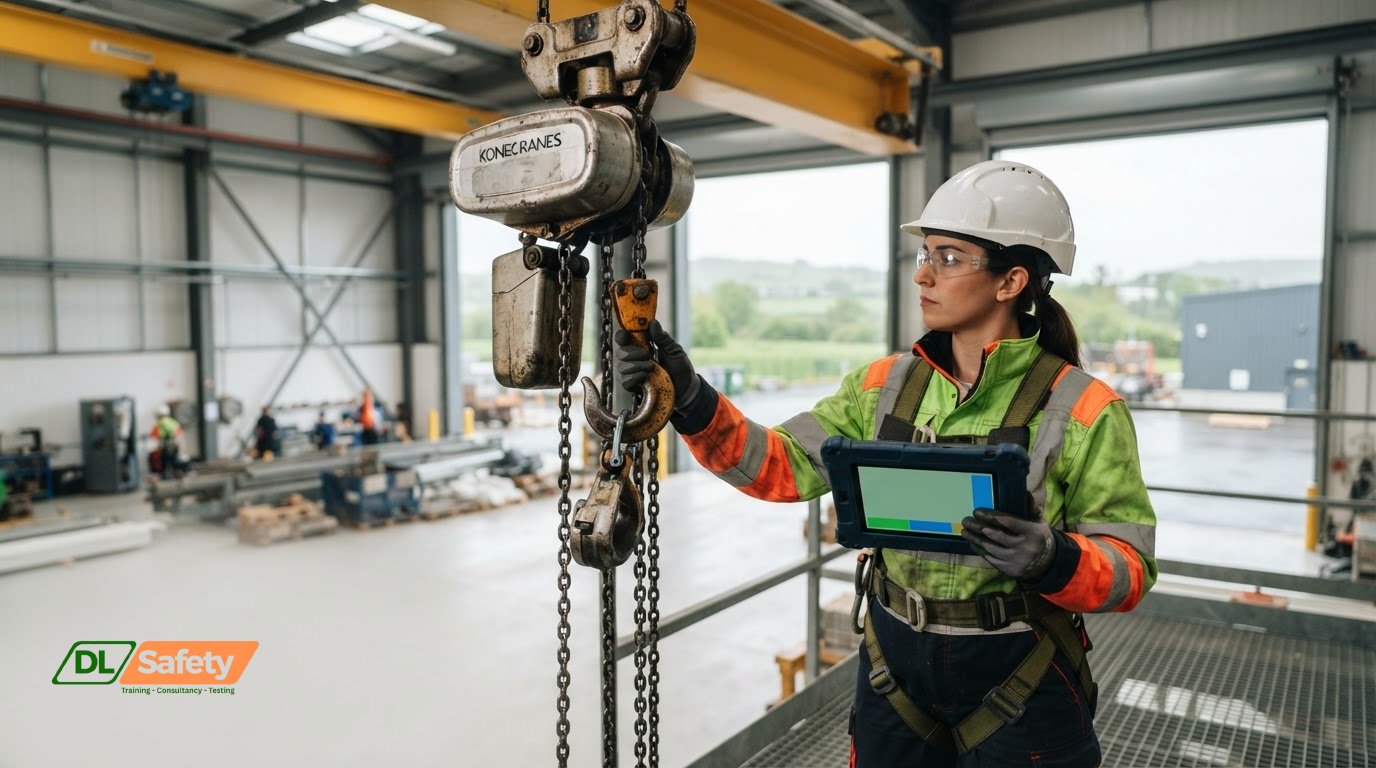
Lifting equipment can include machinery such as cranes, forklifts and telehandlers, as well as accessories used to connect or support a load. Lifting slings, chains and shackles are familiar examples of accessories, but they aren’t the only equipment that may be subject to examination requirements.
The applicable scope depends on the equipment and how it is used. For a GA1 lifting equipment inspection Ireland programme, start by listing each item and its role in lifting operations. This helps you consider the relevant Irish requirements and match reports to the correct equipment. Clear identification supports traceability and makes follow-up more manageable.
How does a GA1 lifting equipment inspection work?
A clear process starts before the examination. Equipment needs to be identifiable and accessible, and its type and use help determine the appropriate examination scope under Irish requirements. A crane, a lifting accessory and equipment used for a particular lifting task shouldn’t automatically be treated as though the same examination applies to each.
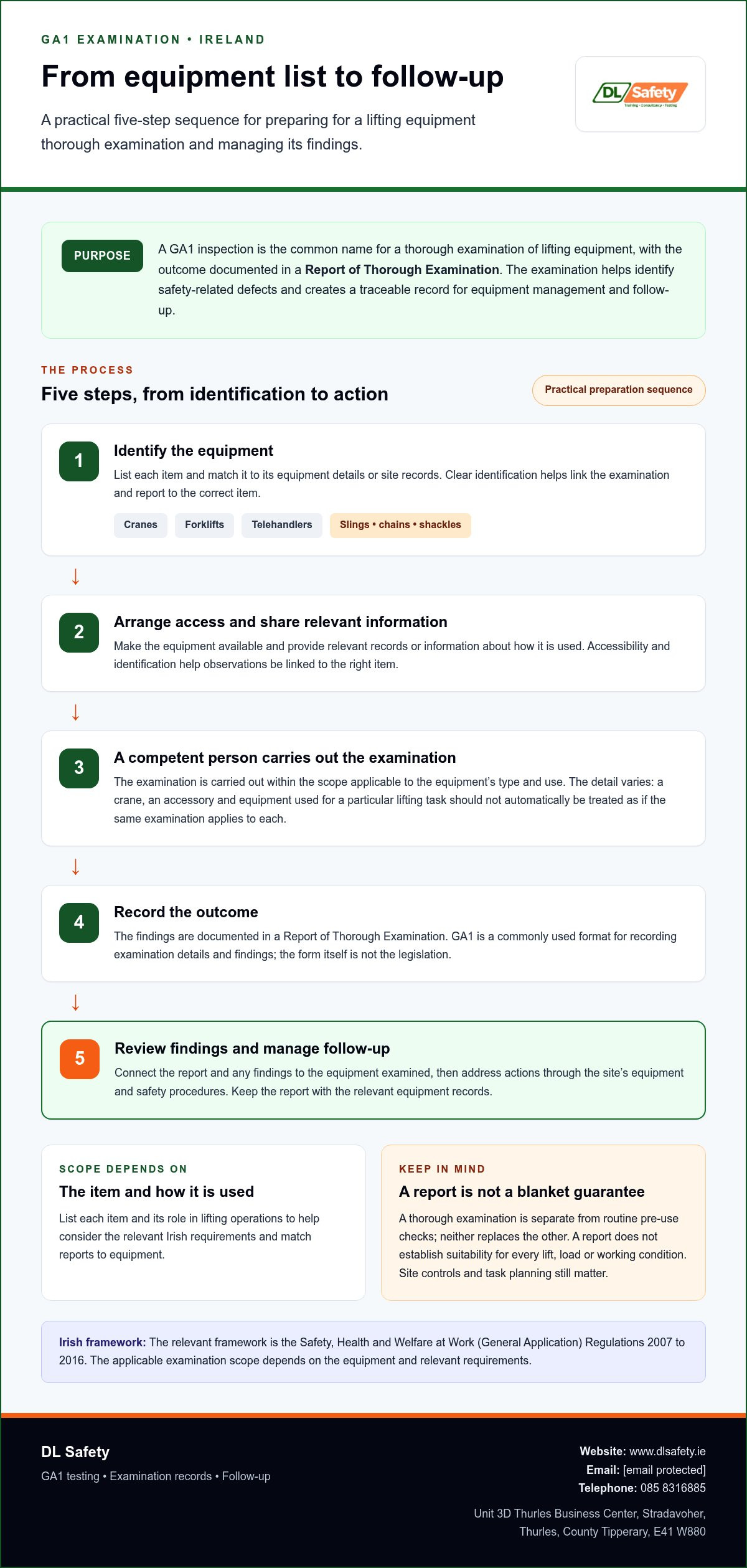
For a GA1 lifting equipment inspection in Ireland, use this sequence to prepare:
- 1. Identify the equipment. Match each item to its equipment details or site records so the examination and report can be linked to the correct item.
- 2. Arrange access. Make the equipment available and provide relevant records or information about how it is used.
- 3. Carry out the examination. A competent person examines the equipment within the scope applicable to its type and use.
- 4. Record the outcome. The findings are documented in a report of thorough examination.
- 5. Manage follow-up. Review the findings and address any actions through the site’s equipment and safety procedures.
This sequence is a practical way to prepare, not a claim that every examination follows identical steps or uses the same method. The General Application Regulations 2007 provide the Irish statutory framework for thorough examinations and reporting. The appropriate scope depends on the equipment and applicable requirements.
What happens during the examination?
A competent person carries out the thorough examination, applying the knowledge and experience needed to assess the equipment in question. The detail varies according to the item and its use. Don’t assume one test method or acceptance threshold applies to all lifting equipment. Before the examination, make each item accessible and clearly identifiable so observations can be linked to the correct equipment and the resulting record is useful to the site.
What information should the inspection record contain?
The report documents the examination and its outcome. It isn’t a blanket guarantee that equipment will remain safe or suit every future lift. Traceability is essential: site teams need to connect the report and any findings to the equipment examined, then manage follow-up through their own procedures.
For the record: the Irish Statute Book’s General Application Regulations 2007 set out the information required in a report of thorough examination in Schedule 1, Part E. GA1 is a commonly used format for recording examination details and findings.
DL Safety’s GA1 testing service supports a practical approach to examination records and follow-up for lifting equipment.
How often is GA1 lifting equipment inspection needed in Ireland?
The examination schedule depends on the type of lifting equipment, so there isn’t one interval for every item. Irish rules distinguish between lifting accessories, equipment used to lift people and other lifting equipment. Classifying each item helps you set a suitable schedule instead of relying on one renewal date for the entire site. The intervals below are set out in the legislation.
- Every six months: lifting accessories, such as slings, chains and shackles, and equipment used to lift people.
- Every 12 months: other lifting equipment, including forklifts, telehandlers and cranes used for lifting.
These intervals are specified in the Safety, Health and Welfare at Work (General Application) Regulations 2007. The Irish Statute Book also sets out circumstances requiring examination outside the routine schedule. These include before first use where safety depends on installation, after a major alteration or repair, or following an incident that could have compromised safety. Treat this as a practical guide, not a substitute for checking current requirements or obtaining legal advice for a specific situation.
How long is a GA1 certificate valid?
There’s no single validity period that applies to every GA1 report. The relevant interval depends on the equipment category, and an examination may be required sooner in circumstances set out in the regulations. A report records the outcome of an examination; it doesn’t guarantee that equipment will remain safe or suitable for every future task. When planning a GA1 lifting equipment inspection Ireland programme, match each item to its applicable interval.
Keep the equipment identity, examination date and next due date together in your records. Take particular care to classify accessories and equipment used to lift people correctly, as these have a different routine interval from other lifting equipment.
What can affect inspection scheduling?
Equipment type and use determine the routine schedule, but some events can call for an examination outside it. The regulations identify situations including installation where safety depends on correct installation, major alteration or repair, and an incident that may have affected safety. These are separate from planned examinations, so don’t rely on the next scheduled date alone if one of these situations arises.
Build your schedule around identifiable equipment, its category and the applicable requirements. If damage or a change raises a safety concern, manage equipment use in line with competent advice and relevant requirements, then record the actions taken.
How should a site prepare for inspection findings?
Good preparation makes it easier to connect each examination result to the right equipment and act on it afterwards. Before a GA1 lifting equipment inspection in Ireland, bring identification, access and records together. Make sure someone on site is responsible for reviewing the findings and coordinating follow-up.
What should you have ready before the inspection?
Use an equipment register or another clear identification system where available. Gather previous examination reports and relevant equipment information so each item can be matched to its history. If records are incomplete, note what is available and identify the gaps rather than assuming details.
Plan access around site operations. Identify where the equipment is located, arrange for it to be made available and coordinate timing with the people responsible for the work. This reduces confusion, especially where several items look similar or are stored in different areas.
What should happen after a defect or restriction is recorded?
Start with the report. Match each finding to the equipment, record any required action in the site’s equipment or safety system, and make sure the responsible person understands what needs attention. Record who will coordinate the follow-up and how progress will be tracked.
If a finding raises a safety concern, control the equipment’s use in line with the report and competent advice. Depending on that advice, this may mean isolating the item or restricting its use until the concern has been addressed. Don’t treat a report as permission to continue using equipment where a restriction or unresolved safety issue applies.
Record the action taken, who completed it and any related follow-up examination or updated report. This closes the loop between the finding and the site decision, while giving relevant personnel a traceable account of what happened.
For broader Irish compliance context, refer to the GA1 guidance in this article alongside the applicable requirements. DL Safety provides GA1 testing to support practical equipment records and follow-up. Arrange GA1 testing with DL Safety, or contact the team at info@dlsafety.ie or 085 8316885.
Arrange GA1 lifting equipment inspection with DL Safety
Once you understand what an examination involves and how to manage its findings, arranging GA1 testing is a practical next step. DL Safety provides GA1 testing and lifting equipment services for construction and industrial businesses across Ireland. Clear, traceable findings help site teams organise equipment records, review issues and plan follow-up as part of their wider equipment safety process.
What support can DL Safety provide?
DL Safety’s GA1 testing supports the examination and reporting process for lifting equipment. Clear records linked to the relevant equipment help those responsible for site operations keep track of findings and related actions. The report informs equipment management, but it doesn’t replace safe-use controls or determine whether equipment is suitable for every lift.
Some lifting operations also need planning support beyond the examination. DL Safety provides lift plans to help plan lifting operations. A lift plan isn’t automatically part of GA1 testing; it supports a different aspect of managing lifting work.
For construction and industrial teams, the practical goal is to connect the examination to the correct equipment, keep findings accessible and give follow-up a clear place in site procedures. That’s the value of a considered GA1 lifting equipment inspection Ireland process, rather than treating the report as paperwork to file and forget.
How can you take the next step?
If you’re responsible for lifting equipment, contact DL Safety about GA1 testing. Outline the equipment and the records you currently manage to start a practical conversation about the examination process and how its findings can fit into your site arrangements.
Visit DL Safety’s GA1 testing service, email info@dlsafety.ie or call 085 8316885 to discuss GA1 testing.
Make your lifting-equipment records work for you
A sound GA1 process starts with identifying the equipment and understanding the examination schedule that applies to it. The report gives your team documented findings to review, record and follow up through site procedures. Treat it as part of equipment management, alongside routine checks and safe-use controls, not as a guarantee of future suitability.
DL Safety provides GA1 testing and lifting equipment services for construction and industrial businesses across Ireland. If you’re ready to discuss GA1 lifting equipment inspection Ireland for your site, discuss GA1 testing with DL Safety.
For direct enquiries, visit www.dlsafety.ie, email info@dlsafety.ie or call 085 8316885. With clear records and follow-up in place, you can take a more organised approach to managing lifting equipment.
Frequently Asked Questions
How long is a GA1 certificate valid in Ireland?
There isn’t one validity period for every GA1 report. The examination schedule depends on equipment type and use. Under Ireland’s General Application Regulations, lifting accessories and equipment used to lift people are generally subject to examination every six months, whilst other lifting equipment is generally examined every 12 months. Specific circumstances can require an examination outside the routine schedule. Treat the report as a record of an examination, not a guarantee of future safety.
Is a GA1 inspection required for all lifting equipment?
Not every item used on a site automatically falls within the same examination requirements. The relevant category, function and use of equipment matter, and lifting accessories may have different requirements from lifting machinery. Slings, chains and shackles are examples of accessories that may require examination. Identify the equipment and check its scope against the applicable Irish requirements rather than assuming one rule covers every item or use.
Who can carry out a GA1 lifting equipment inspection?
A thorough examination must be carried out by a competent person. In practical terms, that means someone with the relevant practical and theoretical knowledge and experience to examine the equipment in question. Competence needs to be appropriate to the equipment and examination, rather than assumed from familiarity with routine operation. Record the examination outcome in a report that can be matched to the item inspected.
What happens if lifting equipment fails an inspection?
If a report records a defect, restriction or safety concern, review the finding and follow the competent person’s advice. Where necessary, control or stop use of the equipment until the issue has been addressed. Record the action taken, who is responsible and any follow-up examination or updated report. Don’t treat a GA1 document as permission to use equipment where the findings indicate a concern or restriction.
How often should lifting slings and chains be inspected?
Slings and lifting chains are lifting accessories. Under the Irish examination schedule, lifting accessories are generally subject to a thorough examination at intervals not exceeding six months. That interval is for the thorough examination, not a replacement for checks required by site procedures before use or during work. Keep each item identifiable and its examination record traceable so findings and due dates aren’t confused with another item’s details.
Does a GA1 inspection replace daily or pre-use checks?
No. A GA1 thorough examination and a routine pre-use check serve different purposes, so one doesn’t replace the other. A thorough examination provides a recorded assessment by a competent person at the applicable interval. Pre-use checks help users identify visible damage or other concerns before operating equipment. If a check raises a safety concern, follow site procedures and don’t rely on an earlier GA1 report as proof that the equipment remains safe to use.