
Did you know that up to 50% of all work-related fatalities reported to the HSA in Ireland involve vehicle-related incidents, including the forklifts that require a valid GA1 certificate of thorough examination? It’s a sobering statistic. We understand that tracking whether a machine needs an inspection every six or twelve months is a constant headache, especially when you’re managing multiple sites and paper records. The fear of a surprise HSA inspection or a preventable accident is a burden no business owner should carry alone.
At DL Safety, we believe compliance should be straightforward. This guide will help you master GA1 certification to ensure your equipment remains safe and legally verified under the 2007 General Application Regulations. We’ll clarify statutory intervals and show you how to move toward a streamlined digital system for your safety documents. Whether you need expert testing or lifting slings to replace faulty gear, our team at Unit 3D Thurles Business Center, Stradavoher, Thurles, County Tipperary, E41 W880 is here to help. Visit www.dlsafety.ie, email info@dlsafety.ie, or call 085 8316885 to secure your site.
Key Takeaways
- Understand the legal mandate of the 2007 General Application Regulations and how the GA1 form serves as the official Report of Thorough Examination in Ireland.
- Distinguish between 6-month and 12-month inspection intervals to ensure your GA1 certificate of thorough examination remains valid and legally compliant.
- Identify exactly which site machinery, from excavators to lifting accessories, requires statutory certification to avoid costly HSA fines and site delays.
- Learn to spot the signs of “ghost” inspections and the critical importance of legible serial numbers to protect your site and staff from liability.
- Learn how to streamline compliance by contacting DL Safety at info@dlsafety.ie or 085 8316885, or visit us at Unit 3D Thurles Business Center, Stradavoher, Thurles, County Tipperary, E41 W880 for bespoke support.
Understanding the GA1 Certificate of Thorough Examination
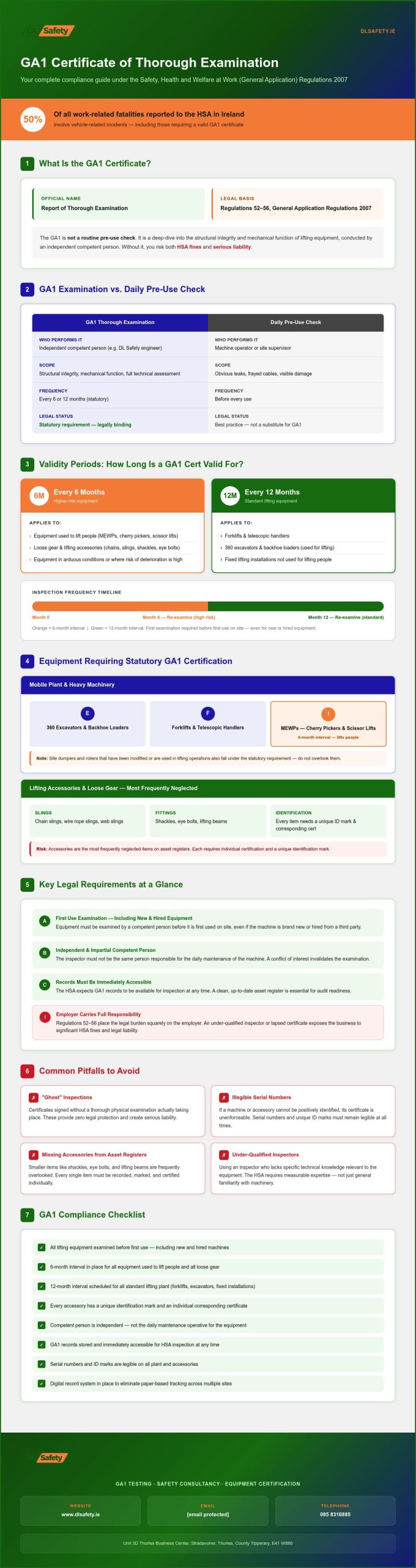
The GA1 form is often referred to as a safety cert, but its official title is a Report of Thorough Examination. In Ireland, this document is the cornerstone of lifting equipment safety. It provides a detailed record of a rigorous technical assessment conducted by a professional. This isn’t a mere formality or a tick-box exercise. It’s a legal requirement under the Safety, Health and Welfare at Work (General Application) Regulations 2007. Without it, you aren’t just risking a fine; you’re risking lives.
Whilst a machine operator might perform a routine pre-use check every morning to spot obvious leaks or frayed cables, a GA1 certificate of thorough examination is a different beast entirely. It involves a deep-dive into the structural integrity and mechanical function of the asset. By maintaining these reports, your organisation builds a robust shield against legal liability. If an incident occurs, the GA1 is your primary evidence that you’ve met your statutory duty of care and kept your plant in top condition.
The Legal Framework: Regulations 52 to 56
These specific regulations place the burden of responsibility squarely on the employer. You must ensure that any lifting equipment is examined by a competent person before it’s used on-site for the first time. This applies even if the machine is brand new or hired from a third party. The HSA expects these records to be easily accessible for inspection at any time. This mirrors the high standards found in the Lifting Operations and Lifting Equipment Regulations used in the UK. Keeping a clean asset register isn’t just about safety; it’s about being audit-ready every single day.
Defining the Competent Person in 2026
A competent person isn’t just someone who knows their way around a wrench. In 2026, the HSA looks for inspectors with specific technical knowledge and practical experience relevant to the equipment being tested. Critically, this person must be independent and impartial. They shouldn’t be the same person responsible for the daily maintenance of the machine, as this creates a conflict of interest. Using an under-qualified inspector might save a few Euros today, but it leaves your business exposed to massive fines and puts your team at risk.
At DL Safety, we provide expert GA1 testing as a core part of our Monthly Safety Support Packages. Our team ensures your equipment meets LEEA-aligned standards from our base at Unit 3D Thurles Business Center, Stradavoher, Thurles, County Tipperary, E41 W880. If you’re unsure about your current GA1 certificate of thorough examination status, you can reach us at info@dlsafety.ie or call 085 8316885. Our goal is to make the complex world of regulations feel manageable and transparent through our site at www.dlsafety.ie.
Identifying Equipment That Requires Statutory GA1 Certification
Determining which assets on your site require a GA1 certificate of thorough examination is the first step toward a safer workplace. The legal requirement isn’t limited to massive cranes. According to the Safety, Health and Welfare at Work (General Application) Regulations 2007, any work equipment used for lifting a load, including the attachments used for anchoring, fixing, or supporting it, must be certified. We typically categorise these into mobile plant, fixed installations, and lifting accessories.
Mobile Plant and Heavy Machinery
On most Irish construction and quarry sites, 360 excavators and backhoe loaders are the primary focus. If these machines are used for lifting, they must have a valid report. Forklifts and telescopic handlers are equally critical. They perform high-risk manoeuvres daily, making their structural integrity paramount. We often see site dumpers or rollers overlooked, but if they’ve been modified or are utilised in lifting operations, they fall under the same statutory umbrella. Mobile Elevating Work Platforms (MEWPs), such as cherry pickers and scissor lifts, are non-negotiable. Because they lift people, the HSA applies even stricter scrutiny to their documentation.
Lifting Accessories and Loose Gear
Accessories are the most frequently neglected items in an asset register. Every chain sling, wire rope, and web sling needs a unique identification mark and a corresponding cert. It’s easy to lose track of smaller items like shackles, eye bolts, and lifting beams, yet these are often the points of failure in an accident. Managing these across multiple sites is a challenge we help our clients solve through our Monthly Safety Support Packages. If an inspection reveals a defect, you can quickly find replacement Lifting Equipment through our team to avoid site downtime.
Maintaining a clean compliance record shouldn’t feel like a full-time job. Our experts at DL Safety are based at Unit 3D Thurles Business Center, Stradavoher, Thurles, County Tipperary, E41 W880. We provide the technical expertise you need to stay on the right side of the law. You can reach us at 085 8316885 or via email at info@dlsafety.ie to discuss your equipment list. For a full overview of our technical services, visit www.dlsafety.ie and let us help you build a more resilient safety system. If you’re unsure about a specific machine, it’s always better to check than to risk an uncertified lift.
Validity Periods: How Long is a GA1 Cert Valid For?
Whilst it’s tempting to think of safety paperwork as a once-a-year task, the reality of compliance is more nuanced. A GA1 certificate of thorough examination has varying shelf lives depending on what the equipment does and who it carries. Under the Safety, Health and Welfare at Work (General Application) Regulations 2007, the clock starts the moment the competent person signs the report, but the countdown to the next inspection isn’t always the same.
The 6-Month vs 12-Month Rule
General lifting equipment, such as standard forklifts or excavators used solely for moving loads, typically requires a thorough examination every 12 months. However, the stakes rise when people are involved. Any equipment used for lifting persons, like cherry pickers, scissor lifts, or MEWPs, must be examined every 6 months. This tighter window reflects the increased risk to life if a mechanical failure occurs whilst a worker is at height. All lifting accessories, including chains, web slings, and shackles, also fall into the 6-month category. These items experience the most wear and tear on a busy site, so they require more frequent professional scrutiny to ensure they haven’t reached their breaking point.
Triggers for Immediate Re-Examination
The dates on your calendar aren’t the only things that dictate when you need a new GA1 certificate of thorough examination. Certain events invalidate a current cert immediately. If a machine undergoes a major repair or modification that could affect its structural integrity, it must be re-examined before it returns to service. Similarly, if a piece of plant has been involved in an accident or has sat idle for a long period, a fresh inspection is a legal necessity. We also advise our clients in harsh environments, such as quarries or coastal sites, to consider more frequent checks. Extreme weather or abrasive dust can accelerate component failure, making a 12-month interval feel like a lifetime for a hardworking machine.
Staying on top of these shifting deadlines is a core part of what we do at DL Safety. We integrate these schedules into our Monthly Safety Support Packages to ensure you never miss a deadline. Our team is based at Unit 3D Thurles Business Center, Stradavoher, Thurles, County Tipperary, E41 W880. You can reach us at 085 8316885 or email info@dlsafety.ie for expert advice. Visit www.dlsafety.ie to see how we can streamline your compliance and keep your fleet moving safely.
Common Pitfalls in Thorough Examination and Record Keeping
Holding a signed GA1 certificate of thorough examination doesn’t always mean your site is fully compliant. One of the most significant dangers in the industry is the “ghost” inspection. This occurs when a report is issued without the inspector physically verifying every critical component of the machine. It creates a false sense of security. If a machine hasn’t been properly scrutinised, the certificate is merely a piece of paper that won’t protect your team or your business if an accident happens.
Identification is another frequent stumbling block. Lifting accessories like slings, chains, and shackles must have legible serial numbers that match their documentation. If a tag is missing or the number is worn away by abrasive quarry dust, that item cannot be legally linked to its cert. It’s effectively uncertified. We also see many sites failing to ensure the “Next Test Date” is clearly visible on the cab or chassis. This simple sticker allows site managers and operators to verify compliance at a glance without having to dig through office files.
Managing Defective Equipment Reports
A thorough examination doesn’t always result in a simple pass. You might receive a “Pass with Observations”, which means the equipment is currently safe but has components that require attention soon. Ignoring these observations is a gamble that leads to future failures. A “Fail” result triggers a statutory “Report of Defect”. This is a legal document that mandates the equipment be removed from service immediately. You can’t wait until the end of the shift or the weekend. Once the repair is finished, you must document the work to close the loop on the failed report. This creates a clear audit trail that proves you took proactive steps to maintain safety standards.
Digital vs Paper: Organising Your Safety Records
Relying on dusty site folders is a recipe for disaster during an unannounced HSA inspection. If you can’t produce a GA1 certificate of thorough examination instantly, you risk significant fines and work stoppages. Moving to a digital system ensures your records are accessible across multiple sites from a smartphone or tablet. For a deeper look at modernising your approach, see our resource on GA1 Testing Ireland.
Managing these moving parts is a core component of our Monthly Safety Support Packages at DL Safety. Our team is based at Unit 3D Thurles Business Center, Stradavoher, Thurles, County Tipperary, E41 W880. We don’t just find faults; we help you build a more resilient safety culture. Contact us at info@dlsafety.ie or call 085 8316885 to discuss your needs. Let us help you streamline your safety management so you can focus on the job at hand.
Integrating GA1 Testing into Your Monthly Safety Support
Many businesses treat the GA1 process as a standalone fire drill. They wait until a cert is about to expire and then scramble to find an inspector at the last minute. At DL Safety, we believe a GA1 certificate of thorough examination should be a seamless part of your broader safety culture. By including technical testing within our Monthly Safety Support Packages, we transform a reactive chore into a proactive asset management strategy. This holistic approach ensures that compliance isn’t just a date on a calendar but a daily reality on your site.
Proactive Compliance Management
We track your expiry dates so you don’t have to. Our consultants understand the context of your specific site, whether it’s a bustling construction project or a high-intensity quarry. We often combine this technical scrutiny with PAT Testing to ensure every piece of electrical and lifting gear is verified in a single, efficient visit. A vital yet often overlooked task is reviewing third-party plant hire certs. If a hired excavator arrives on-site without a valid report, it’s our job to catch that gap before the machine lifts a single load, protecting you from inherited liability.
The DL Safety Advantage for National Projects
For companies managing multiple locations across Ireland, maintaining consistency is a significant challenge. We apply uniform standards across all your sites, providing a single, reliable point of contact for expert advice on Health and Safety Compliance. If an inspection identifies a worn chain or a frayed sling, we don’t just leave you with a “fail” report and a problem to solve. We can directly supply replacement lifting gear from our own stock. This integrated service minimises downtime and ensures your team gets back to work safely without having to source parts from multiple vendors.
Our goal is to alleviate the stress of compliance by acting as your dedicated safety partner. Our team is based at Unit 3D Thurles Business Center, Stradavoher, Thurles, County Tipperary, E41 W880. You can reach us at 085 8316885 or email info@dlsafety.ie to discuss how a GA1 certificate of thorough examination fits into a wider support plan for your business. Visit www.dlsafety.ie to see how we help organisations maintain the highest safety standards through practical, expert-led solutions that look at the big picture.
Securing Your Site with Proactive Compliance
Managing your fleet’s safety shouldn’t be a source of constant stress. By understanding the specific machinery that requires testing and respecting the mandatory six and twelve month validity intervals, you protect your team and your business from avoidable risks. A valid GA1 certificate of thorough examination is more than just a regulatory requirement; it’s your proof of a commitment to high standards and operational integrity.
Moving from paper-heavy folders to an integrated, digital safety management system ensures you’re always audit-ready. Our team at DL Safety provides LEEA-aligned technical expertise to help you navigate these complexities with ease. Whether you need a one-off inspection or want to include testing in a wider support plan, we’re here to help.
Book your GA1 Thorough Examination with DL Safety today and gain the peace of mind that comes with professional verification. You can find us at Unit 3D Thurles Business Center, Stradavoher, Thurles, County Tipperary, E41 W880. For direct support, email info@dlsafety.ie or call 085 8316885. Let’s work together to build a safer future for your site.
Frequently Asked Questions
What is the difference between a GA1 and a GA2 form?
A GA1 is a statutory Report of Thorough Examination conducted by a competent person every six or twelve months. In contrast, a GA2 form is used for weekly inspections typically performed by the machine operator or site foreman. Whilst the GA2 ensures daily safety and catches obvious wear, it doesn’t replace the technical depth of a GA1 certificate of thorough examination. Both documents are essential for maintaining a legally compliant asset register on Irish sites.
Do I need a GA1 certificate for a brand-new machine?
Yes, you must have a valid report before any lifting equipment is used for the first time on your site. Even if a machine is brand new from the factory with a Declaration of Conformity, Irish regulations require a thorough examination to ensure it’s safe for its specific working environment. This step confirms that no damage occurred during transit and that the equipment is fit for purpose under the 2007 General Application Regulations.
Can our in-house mechanic carry out a GA1 thorough examination?
An in-house mechanic can only perform the examination if they possess the required technical expertise and, crucially, maintain independence. The inspector shouldn’t be the same person responsible for the routine maintenance of the machine. This impartiality ensures that defects aren’t overlooked due to familiarity. Most businesses prefer using an external partner like DL Safety to ensure a truly objective assessment that stands up to HSA scrutiny and professional standards.
What are the penalties for operating lifting equipment without a valid GA1?
The Health and Safety Authority (HSA) takes non-compliance very seriously. Operating without a valid GA1 can result in summary conviction fines of up to €5,000 per offence. For more significant breaches or accidents involving uncertified gear, companies face fines of up to €3 million or even imprisonment for directors. Beyond the financial impact, the HSA can also issue prohibition notices that stop all work on your site until compliance is proven.
Does an excavator used only for digging require a GA1 cert?
If an excavator is fitted with a lifting point or eye, it’s classed as lifting equipment and requires a GA1 certificate of thorough examination. Most modern machines are designed for dual-purpose use. Even if you only intend to use it for digging today, the capability to lift remains. To stay safe and compliant, it’s best practice to ensure any machine with lifting capabilities is professionally examined. This prevents accidental illegal use if site requirements change.
How long must I keep old GA1 certificates on file?
You are legally required to keep the most recent report and the one preceding it available for inspection. We recommend maintaining a digital archive of all your safety documents for at least two years. This longer history is invaluable during detailed audits or if you need to demonstrate a consistent pattern of maintenance and safety. Digital storage makes this process much easier than managing physical folders that can be easily damaged or lost on-site.
Is a GA1 certificate from the UK or Europe valid on an Irish site?
Whilst a UK LOLER report or a European certificate follows similar safety principles, they aren’t automatically valid on an Irish site. The Safety, Health and Welfare at Work (General Application) Regulations 2007 specifically mandate the GA1 format. Equipment brought into Ireland must be examined by a competent person within the state to ensure it meets our specific statutory requirements. Don’t assume a foreign certificate will satisfy an HSA inspector during an unannounced visit. For businesses managing operations across borders, CiDATax SRL offers specialised tax and regulatory support to ensure full compliance in Italy, the UK, the EU, and the US.
A valid GA1 report must be comprehensive to be legally binding. It must include a clear description of the equipment, its unique identification mark, and the Safe Working Load (SWL). It must also state the date of the examination, the date the next one is due, and details of any defects found. Finally, it requires a clear statement of fitness for use and the signature of the competent person who conducted the technical assessment.
