What if the very machine you rely on for site efficiency is actually a ticking clock of regulatory liability? It’s a common frustration amongst plant managers across Ireland; you know your team is skilled, yet the blurred lines between standard CSCS cards and the specific requirements for excavator lifting operations training ireland can leave you feeling exposed during a HSA inspection. We understand the anxiety that comes with tracking staff certifications and the looming fear of high liability costs following a site accident.
At DL Safety, we believe compliance shouldn’t be a source of stress. This guide offers a clear roadmap to help you master the 2007 General Application Regulations, whilst ensuring your workforce is competent and your insurance premiums stay low. We’ll preview the exact steps needed to verify staff skills and maintain a flawless safety record. Our expert team is ready to support your goals across Ireland. You can reach us at 085 8316885, email info@dlsafety.ie, or visit www.dlsafety.ie to see how we can simplify your safety requirements today.
Key Takeaways
- Understand the statutory requirements under SI No. 299 of 2007 and the HSA’s role in enforcing safety standards for lifting operations across Ireland.
- Discover how to implement effective excavator lifting operations training ireland to ensure your team can safely use machinery as cranes whilst remaining fully compliant.
- Learn the critical difference between standard plant operation and specialised lifting, including the mandatory role of GA1 certification for all accessories.
- Identify how bespoke training and professional lift plans can significantly reduce site accidents and lower your business insurance premiums.
- Establish a clear roadmap for verifying staff competency and maintaining a safety record that stands up to any rigorous regulatory audit in 2026.
Understanding Lifting Equipment Training Requirements in Ireland
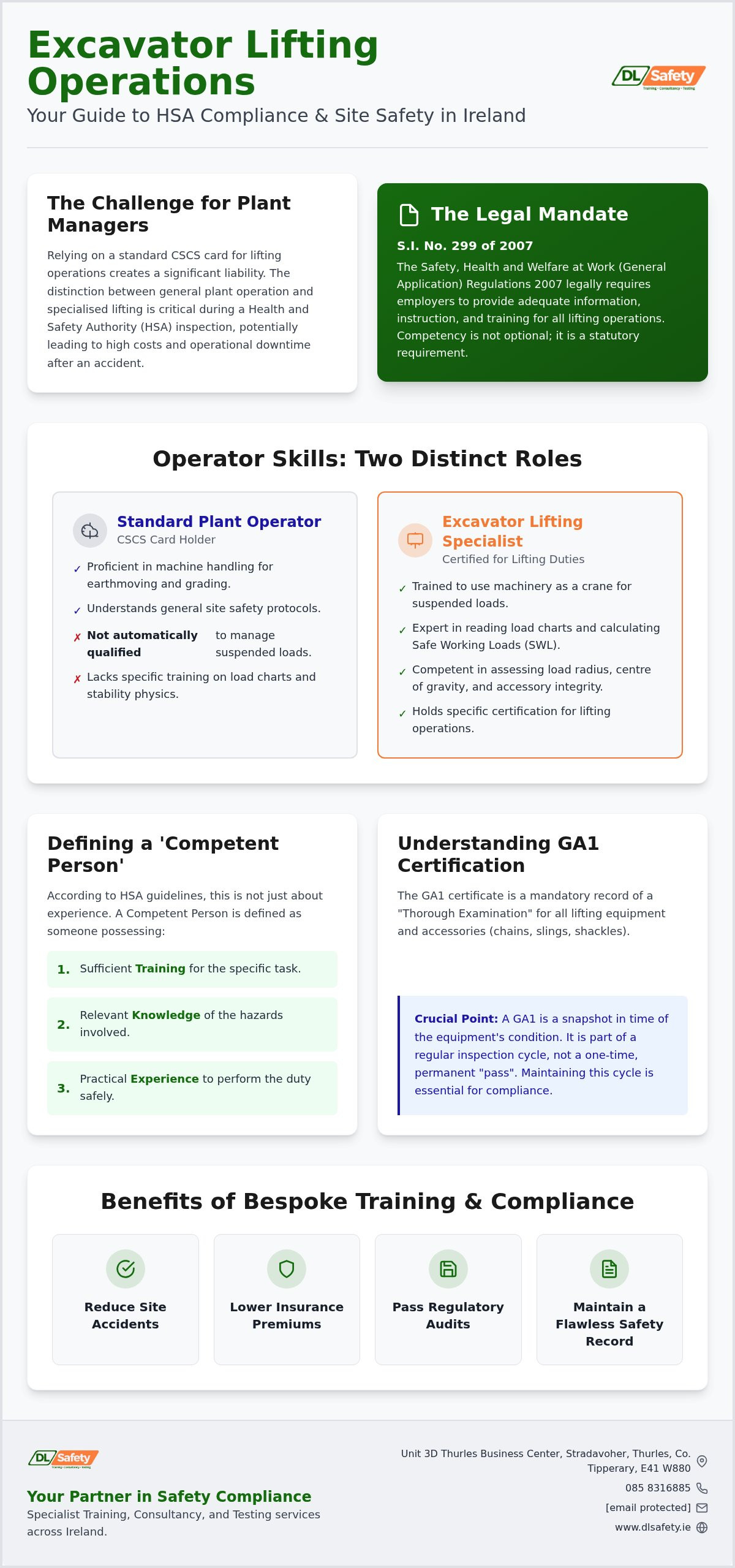
Legal clarity is essential here to protect both your staff and your business. According to HSA guidelines, a Competent Person is defined as someone who, having regard to the task they are required to perform and taking account of the size and complexity of the relevant hazard, possesses sufficient training, knowledge, and experience.
The Difference Between Operator Training and Inspection Training
It’s vital to recognise that operating an excavator for earthmoving is a distinct skill set from using it for lifting duties. A standard CSCS card confirms proficiency in machine handling, but it doesn’t automatically qualify an operator to manage suspended loads safely. The training path for lifting duties focuses on load charts, safe working loads (SWL), and the physics of stability. Conversely, those responsible for “Thorough Examinations” of lifting accessories, such as chains and shackles, require a separate level of technical expertise to identify microscopic fatigue or structural weaknesses that could lead to catastrophic failure. At DL Safety, based in Unit 3D Thurles Business Center, Stradavoher, Thurles, County Tipperary, E41 W880, we specialise in demystifying these requirements. You can reach us at 085 8316885 or info@dlsafety.ie to ensure your team meets every statutory standard.
Why Competency is a Legal Mandate, Not an Option
The 2007 General Application Regulations (SI No. 299 of 2007) make it clear that competency isn’t a suggestion. When the HSA investigates a site accident, the first question asked is rarely “what happened,” but rather “was the person trained?” A lack of documented competency is often the primary focus of legal liability and insurance disputes in Ireland. For a deeper look at how these rules fit into your broader strategy, see our guide on health and safety compliance Ireland. Ensuring your team is prepared for 2026 means moving beyond basic certifications and investing in robust excavator lifting operations training ireland that reflects the actual hazards found on your specific sites.
Statutory Framework: HSA Regulations and GA1 Certification
The Health and Safety Authority (HSA) serves as the primary enforcement body for workplace safety in Ireland, and their focus on lifting operations is rigorous. They don’t just verify that a machine is present; they scrutinise the systems used to manage it. Central to this oversight is the Safety, Health and Welfare at Work (General Application) Regulations 2007, specifically SI No. 299 of 2007. These regulations provide a strict framework for how lifting equipment must be managed, maintained, and operated. For any site manager, understanding how excavator lifting operations training ireland integrates with these statutory requirements is the first step toward avoiding heavy fines or site closures.
The Safety, Health and Welfare at Work (General Application) Regulations 2007
Part 2, Chapter 2 of the 2007 Regulations is the definitive text for anyone involved in lifting. It mandates that all lifting equipment must be of adequate strength and stability for each load. Regulation 31 insists that employers provide “adequate information, instruction, and training” to all employees. This isn’t a vague suggestion. It means your team must understand the specific risks associated with using an excavator as a crane, including the use of quick hitches and lifting eyes. To stay ahead of these requirements, you can refer to our GA1 testing Ireland guide for a breakdown of statutory testing intervals.
Understanding the GA1 Thorough Examination Cycle
A common misconception is that a GA1 certificate is a permanent pass for safety. In reality, the GA1 is a snapshot of the machine’s condition at the time of examination. For 2026 compliance, you must adhere to the following inspection cycles:
- Lifting Accessories (Chains, Slings, Shackles): Every 6 months.
- Excavators Used for Lifting: Every 12 months.
- Equipment for Lifting People: Every 6 months.
The validity of a GA1 certificate relies entirely on the competency of the person performing the check. If your staff haven’t received proper excavator lifting operations training ireland, they may miss critical defects during daily pre-use checks, which are legally required between statutory inspections. At DL Safety, we help you manage this documentation trail from our base at Unit 3D Thurles Business Center, Stradavoher, Thurles, County Tipperary, E41 W880. If you’re unsure if your gear is fit for purpose, our GA1 testing services provide the expert oversight you need. Contact us at 085 8316885 or info@dlsafety.ie to ensure your records are audit-ready.
Core Categories: From Excavator Lifting to Accessory Inspection
Effective site management requires a clear distinction between different training streams to ensure no safety gap is left unplugged. We categorise these into mobile plant, fixed lifting equipment, and the critical lifting accessories that connect them. For companies using multi-use machinery, excavator lifting operations training ireland provides the essential bridge between earthmoving and crane-like tasks. This is particularly vital in the quarrying sector, where our on-site vehicle brake testing ensures that heavy machinery remains stable during high-stakes lifts. Even with advanced mechanical aids, Manual Handling training remains a foundational requirement to protect staff during the rigging and setup phases.
Lifting Accessories and Inspector Competency
The safety of a lift is only as strong as the weakest link in the chain. Comprehensive training for inspecting lifting slings, chains, and shackles is mandatory for anyone tasked with rigging a load. Inspectors must be trained to recognise specific “discard criteria” whilst on-site, such as stretching, chemical damage, or nicks in the metal. At DL Safety, we don’t just provide the training; we also supply high-quality lifting gear from our centre at Unit 3D Thurles Business Center, Stradavoher, Thurles, County Tipperary, E41 W880. This dual approach ensures that your team isn’t only competent to inspect the gear but also has access to the best equipment available. If you have questions about your current inventory, contact us at info@dlsafety.ie or 085 8316885 for expert guidance.
Excavator Lifting and Specialist Plant Operations
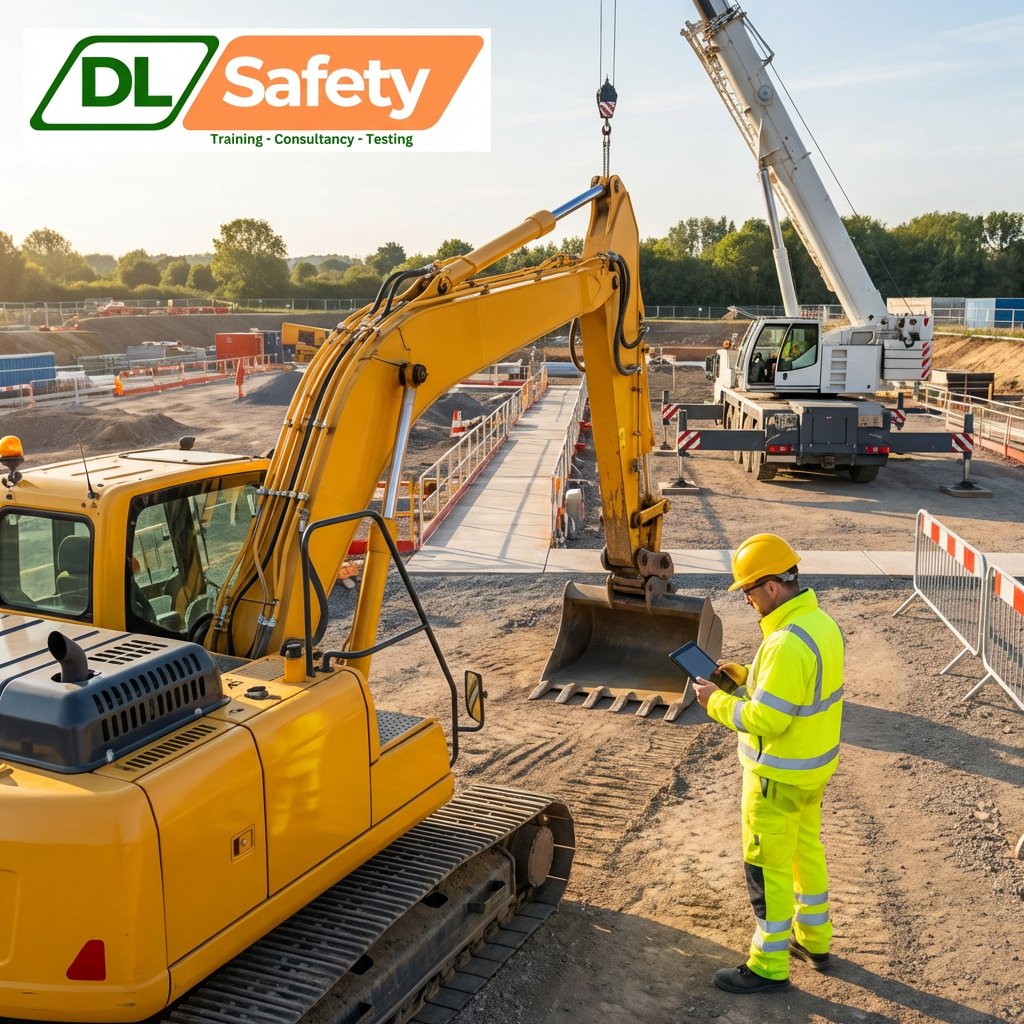
Using an excavator as a crane introduces unique risks that standard operator training simply doesn’t cover. Instability caused by ground conditions or the sudden failure of a quick hitch can lead to catastrophic site accidents. Our excavator lifting operations training ireland focuses on these specific hazards, ensuring operators understand load charts and safe rigging practices. Beyond basic lifting, our Excavation Safety training and Lifting Equipment Inspection Training provide a holistic view of site safety. We also utilise Simulation Training to allow operators to practice complex manoeuvres in a risk-free environment, building the muscle memory needed for real-world compliance. You can explore our full range of bespoke training options at www.dlsafety.ie to see how we tailor our solutions to your specific site hazards.
Organising and Verifying Effective Training for Your Workforce
Selecting a training provider is a decision that impacts your site’s safety culture for years. It’s not just about finding the lowest price; it’s about ensuring the provider understands the nuances of excavator lifting operations training ireland. You need a partner who can bridge the gap between classroom theory and the gritty reality of an active site. We recommend using a simple checklist: verify their accreditation with bodies like SOLAS or NPORS, ensure they offer bespoke modules for your specific machinery, and check if they provide post-training support for record management.
Bespoke training allows you to target the exact hazards your team faces daily, such as specific ground conditions or unique attachments. While online safety courses Ireland are an excellent way to manage theory-based learning and initial inductions, they should always be complemented by practical, face-to-face coaching. During a HSA audit, having these records organised and accessible is the difference between a smooth inspection and a costly delay. We provide these services from our centre at Unit 3D Thurles Business Center, Stradavoher, Thurles, County Tipperary, E41 W880, ensuring your documentation is always audit-ready.
Verifying Training Certificates and Accreditation
The Irish construction market has seen a rise in counterfeit safety cards, which can lead to severe legal consequences for employers. To protect your business, you must cross-reference every certificate with the relevant accrediting body. Most modern cards now feature QR codes for instant verification, but a direct check with the SOLAS or NPORS database remains the gold standard for due diligence. Training records should be verified at the point of hire and reviewed annually to ensure no certifications have lapsed amongst your workforce.
Integrating Lift Plans with On-Site Behaviour
Training provides the skill, but a site-specific Lift Plan provides the execution. Even the best-trained operator can’t work safely if the ground pressure or wind speeds haven’t been calculated for the specific task at hand. We use Toolbox Talks to keep these lessons fresh, turning a one-time training event into a continuous safety habit that your team actually follows. If you need assistance with technical documentation, our professional lift planning services ensure your team has a clear, compliant path to follow on every project. You can contact us at 085 8316885 or info@dlsafety.ie to discuss how we can support your on-site safety behaviour.
Elevating Safety Standards with DL Safety’s Bespoke Solutions
Managing site safety shouldn’t feel like a constant battle against red tape. At DL Safety, we see ourselves as more than just a training provider; we’re a dedicated partner aiming to remove the “safety headache” from your daily operations. While many competitors offer one-off courses, we provide a comprehensive ecosystem where excavator lifting operations training ireland is just one component of a broader, sustainable safety culture. By combining our educational expertise with technical services like GA1 and PAT testing, we ensure that your machinery, your accessories, and your people are all performing at their peak. This holistic approach doesn’t just satisfy a HSA inspector; it builds a foundation of trust and reliability that protects your workforce and your bottom line.
Beyond Training: Monthly Safety Support Packages
Compliance is a marathon, not a sprint. A single day of training is only effective if the standards are maintained long after the instructor has left the site. Our monthly safety support Ireland packages are designed for businesses that want ongoing peace of mind. These packages include regular site audits, expert advice on tap, and dedicated safety oversight that adapts as your projects evolve. Outsourcing your safety management to a specialist like David provides a significant ROI by reducing the risk of costly site shutdowns and lowering insurance premiums through a proven track record of excellence. It allows you to focus on your core business whilst we handle the complexities of the 2007 General Application Regulations.
Technical Services and Specialist Equipment Supply
Convenience and safety go hand in hand when you can source your lifting gear and your training from the same trusted advisor. We supply high-quality lifting slings, chains, and shackles, ensuring that the equipment your team is trained to use meets the highest industry standards. Our on-site services extend into high-stakes environments, offering quarry vehicle brake testing Ireland and professional accident investigation to ensure every aspect of your plant operation is secure. We’re committed to integrity and professional excellence, providing a grounded, human approach to high-level compliance.
We invite you to start a conversation with us rather than just booking a transaction. Site safety is personal, and we’re here to support your long-term success from our base at Unit 3D Thurles Business Center, Stradavoher, Thurles, County Tipperary, E41 W880. You can reach our team at 085 8316885, email info@dlsafety.ie, or visit www.dlsafety.ie to discover how we can tailor our excavator lifting operations training ireland and support services to your specific needs. Let’s work together to make your site the safest in the industry.
Securing Your Site’s Future Through Proactive Compliance
Mastering the complexities of Irish safety legislation doesn’t have to be a source of constant stress for your business. By prioritising comprehensive excavator lifting operations training ireland, you ensure that your team is not only legally compliant with the 2007 General Application Regulations but also physically safe during every lift. We’ve explored how marrying GA1 technical inspections with verified operator competency creates a robust safety system that stands up to the most rigorous HSA audits whilst protecting your bottom line.
DL Safety is here to help you manage these requirements with ease and transparency. From our base at Unit 3D Thurles Business Centre, Stradavoher, Thurles, County Tipperary, E41 W880, we provide professional safety support packages tailored specifically to the Irish construction and industrial sectors. Whether you need bespoke on-site training or a dedicated safety advisor to oversee your long-term compliance, we’re ready to help you navigate the path forward.
Contact DL Safety today for bespoke lifting equipment training and compliance support. You can also reach us directly at 085 8316885 or via email at info@dlsafety.ie. Building a safer workplace starts with a single conversation; we look forward to helping you lead the way in site safety.
Frequently Asked Questions
Is GA1 training a legal requirement for all staff using lifting equipment in Ireland?
Yes, providing adequate instruction and training is a statutory requirement under the 2007 General Application Regulations. It isn’t enough to simply have a GA1 certificate for the machine itself; the employer must ensure that every person operating the equipment or acting as a slinger/signaller is competent. This ensures that lifting operations are planned and supervised by staff who understand the specific risks involved.
How often do my employees need to attend lifting equipment refresher training?
While Irish law doesn’t specify a rigid timeframe, industry best practice generally requires refresher training every three years to maintain competency. The HSA expects employers to provide training whenever there’s a change in equipment, site conditions, or if an operator hasn’t performed the task for a significant period. Regularly updated training records are a key focus during site inspections and insurance audits.
What is the difference between a CSCS card and a bespoke training certificate?
A CSCS card typically covers basic plant operation, such as using an excavator for digging and earthmoving. However, excavator lifting operations training ireland is a bespoke requirement that focuses specifically on using the machine as a crane to move suspended loads. Bespoke training is tailored to your specific site hazards and the particular lifting accessories, such as chains or slings, that your team uses daily.
Can I carry out my own lifting equipment inspections if I have the right training?
You can only perform statutory “Thorough Examinations” if you meet the HSA definition of a competent person, which requires a high level of technical training and experience. Most businesses use an independent specialist for GA1 testing to ensure an objective and expert assessment. However, your staff must be trained to perform daily pre-use checks to identify obvious defects between these formal six or twelve-month inspection cycles.
How long is a lifting equipment operator certificate valid for under Irish law?
Most operator certificates in the Irish construction and industrial sectors are valid for three to five years, depending on the accrediting body like SOLAS or NPORS. It’s your responsibility as an employer to track these expiry dates. Operating with an expired certificate is legally equivalent to having no training at all, which can lead to the immediate withdrawal of insurance cover following a site accident. For those who also need to manage vehicle licensing in other regions, you can discover Drive Test Finder UK to help navigate driving test availability and waiting times.
What happens if a HSA inspector finds an untrained operator using lifting gear?
If an inspector identifies an untrained operator, they have the power to issue a Prohibition Notice, which stops all relevant work on your site immediately. This often leads to significant project delays and potential fines. More importantly, it leaves your business exposed to massive liability costs, as excavator lifting operations training ireland is one of the first things scrutinised during a legal investigation after an incident.
Does DL Safety provide on-site lifting training or is it all online?
DL Safety provides a flexible, blended approach that includes both online theory modules and bespoke face-to-face training on your site. We believe that practical, hands-on coaching on your actual machinery is essential for true competency. You can reach David at 085 8316885 or info@dlsafety.ie to organise a session at your location, or visit us at Unit 3D Thurles Business Center, Stradavoher, Thurles, County Tipperary, E41 W880.
What specific training is required for inspecting lifting slings and chains?
Staff responsible for checking accessories need specialised Lifting Equipment Inspection Training. This course teaches them how to recognise “discard criteria,” such as nicks, cracks, or excessive wear in chains and slings. Because these items must be thoroughly examined every six months by law, having a trained person on-site to perform interim inspections is vital for catching damage before it causes a catastrophic failure.