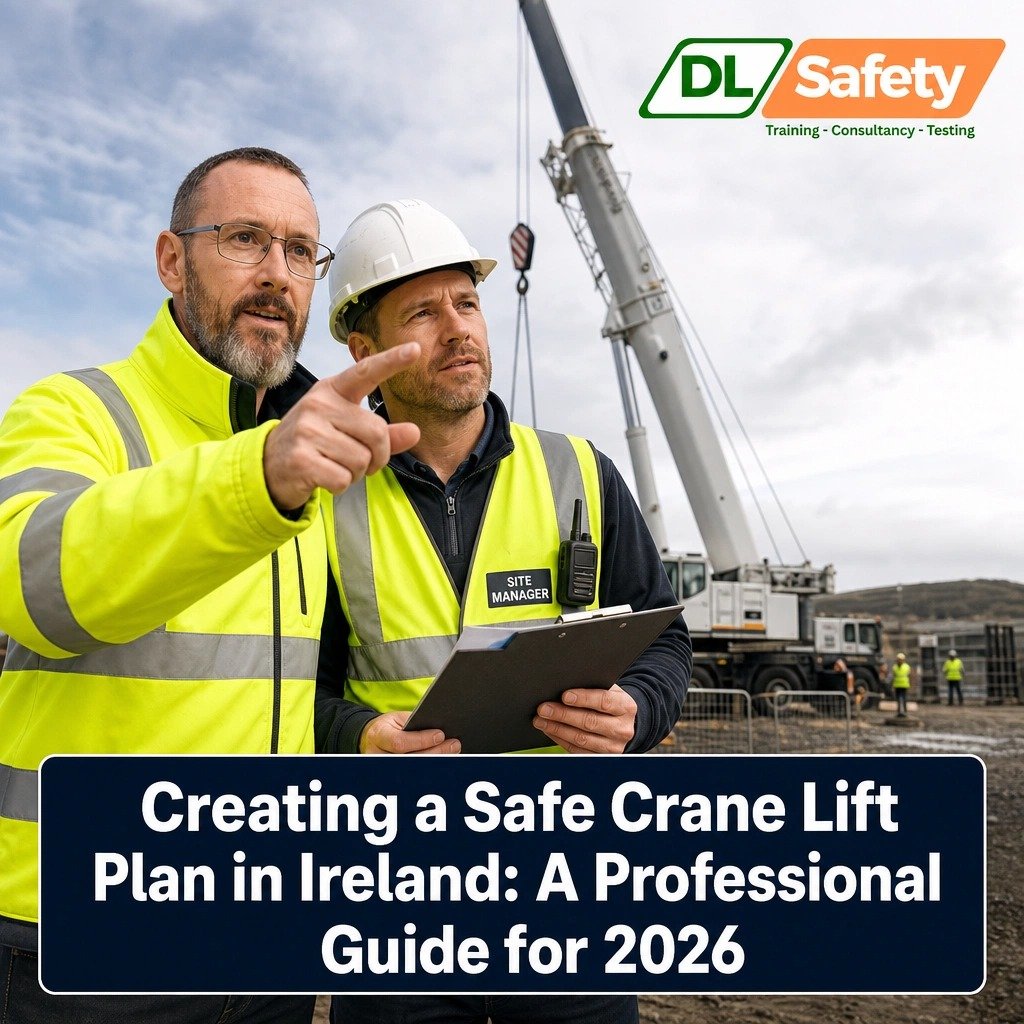
With workplace fatalities in Ireland rising to 58 in 2025 and construction deaths doubling within a single year, the margin for error on site has never felt thinner. Developing a meticulous crane lift plan Ireland inspectors will approve is no longer just a regulatory hurdle; it’s a vital safeguard for your people and your reputation.
It’s understandable why the role of the Appointed Person carries such heavy responsibility. You’re likely feeling the pressure of potential HSA inspections whilst trying to balance complex ground bearing pressure calculations with the need to keep your project moving. We believe that safety shouldn’t be a source of anxiety, but rather a foundation of professional excellence. This guide will help you master the essential steps to drafting a compliant plan that meets current safety standards and protects your site. We’ll explore the latest I.S. 360:2019 and I.S. 361:2024 standards, clarify the legal duties of your personnel, and provide a clear framework for a robust safe system of work that ensures every lift is conducted with total confidence.
Key Takeaways
- Understand the legal framework of the 2007 General Application Regulations to ensure your crane lift plan Ireland documentation is fully compliant with HSA standards.
- Clarify the critical roles of the Appointed Person and Crane Supervisor to establish a clear, safe chain of command for every lifting operation.
- Master the process of calculating “Total Load” and conducting site surveys to identify hidden hazards before the crane even arrives.
- Learn how to categorise lifts as basic, standard, or complex to streamline your risk management and resource allocation.
- Recognise the mandatory GA1 certification requirements for both machinery and lifting accessories to ensure your equipment is always fit for purpose.
What is a Crane Lift Plan? Legal Requirements in Ireland
A crane lift plan is much more than a box-ticking exercise for site records. It’s a comprehensive, written Safe System of Work (SSoW) that outlines exactly how a lifting operation will be managed, from the initial arrival of equipment to the final de-rigging. Under the Safety, Health and Welfare at Work (General Application) Regulations 2007, specifically Part 2, Chapter 2, every lifting operation must be planned by a competent person. This legal framework ensures that risks are identified and mitigated before a load ever leaves the ground.
The Health and Safety Authority (HSA) maintains a rigorous focus on lifting operations because the stakes are incredibly high. With workplace fatalities in Ireland reaching 58 in 2025, a significant portion of which involved machinery and falling objects, the HSA expects sites to move beyond generic documentation. If you’re just starting to explore the basics, such as What is a Crane? and how different models function, it’s vital to realise that a generic plan is never sufficient. Every site in Ireland has unique challenges, from the soft peat of the midlands to the tight, congested urban centres of Dublin or Cork. A crane lift plan Ireland inspectors find acceptable must be tailored specifically to the environment, the equipment, and the specific load in question.
The Core Components of a Compliant Plan
To meet Irish standards, your plan needs to be methodical and precise. It must include detailed load descriptions where you calculate the “total load,” which includes the weight of the item itself plus all lifting accessories like chains or slings. You’ll also need to include specific crane data, such as outrigger loading figures, and a thorough assessment of ground conditions. Identifying environmental hazards like overhead power lines, nearby structures, or public access points is not optional; it’s a fundamental part of the risk assessment process that keeps your team safe.
When is a Formal Lift Plan Mandatory?
Irish law requires a formal plan for every lifting operation involving a crane, regardless of the project’s scale. Whilst the level of detail might vary between a routine lift and a complex tandem lift involving multiple cranes, the necessity for a written system of work is constant. Beyond legal compliance, these plans are your primary safeguard regarding insurance and liability. In the event of an incident, being able to produce a professionally drafted crane lift plan Ireland compliant document proves that you prioritised safety and followed the I.S. 360:2019 code of practice. This level of diligence protects your business, your site, and, most importantly, the lives of your workers.
Defining Roles: The Appointed Person and Lift Team
A robust crane lift plan Ireland compliant doesn’t just live on paper; it’s brought to life by a team of trained professionals who understand their specific duties. The most critical figure in this safety structure is the Appointed Person (AP). Under Irish safety standards, the AP is responsible for the overall planning and safety of the lifting operation. They must possess the technical knowledge to assess risks and the organisational authority to oversee the entire process. While some hire companies might provide an AP in a contract lift, if you’re managing the operation yourself, the responsibility for appointing a competent person falls squarely on your shoulders.
The Crane Supervisor works directly under the AP to ensure the lift is executed exactly as described in the plan. They are on the ground, monitoring the environment and the machinery in real time. Supporting them is the Slinger/Signaller, who is responsible for securing the load and providing clear, unambiguous directions to the crane operator. In Ireland, every member of this team must hold a valid Construction Skills Certification Scheme (CSCS) card. This isn’t just a recommendation; it’s a legal requirement that proves they’ve reached the necessary level of competency to manage high-risk tasks safely.
Competency and Training Requirements
Verifying certifications is a non-negotiable step before any equipment moves. You need to ensure that every individual’s experience matches the complexity of the task at hand. The Appointed Person must have the absolute authority to halt operations if site conditions change or if safety is compromised. To keep your team’s knowledge current, investing in online safety courses can provide a convenient way to reinforce these high standards across your workforce. When everyone understands the principles of Categorising Risk, the entire site becomes significantly more resilient.
Communication Protocols on Site
Clear communication is the heartbeat of a safe lift. You must establish standardised hand signals and dedicated radio frequencies before any work begins. This is particularly important when managing language barriers amongst a diverse site crew. Every lift should start with a ‘Toolbox Talk’ where the AP or Supervisor briefs the team on the specific crane lift plan Ireland document, highlighting potential hazards and the safe path of travel. If you need assistance in structuring these briefings or developing your team’s skills, our Monthly Safety Support Packages offer ongoing professional guidance to keep your site fully compliant with HSA expectations.
How to Organise and Draft Your Crane Lift Plan
Drafting a professional crane lift plan Ireland demands a methodical transition from site observation to technical engineering. It’s about more than just drawing a map; it’s about anticipating how the environment interacts with the machinery under load. A well-organised plan provides a clear narrative of the lift, ensuring that every person on site understands the sequence of events and the safety boundaries in place. When you move from the conceptual stage to the drafting table, your focus must shift toward the granular details that keep a site stable.
Step 1: The Site Survey and Hazard Identification
Success begins with your boots on the ground. A thorough site survey identifies the constraints that a satellite map might miss, such as underground services, drainage pipes, or hidden voids that could collapse under the weight of a crane. You must also assess the proximity to public roads, railways, or occupied buildings, as these require specific exclusion zones and potentially even permits from local authorities. A comprehensive construction traffic management plan design is an essential companion to your lift plan at this stage, ensuring that vehicles and pedestrians are safely segregated from the crane’s operating radius. Weather is another critical factor. Every crane has specific wind speed limits, and your plan should clearly state the thresholds at which operations must cease. By identifying these variables early, you prevent costly delays and ensure your crane lift plan Ireland document is grounded in reality rather than assumptions.
Step 2: Technical Calculations and Rigging
Calculations are where the margin for error disappears. The “Total Load” is a composite figure that must include the weight of the item itself along with all rigging gear, such as lifting slings and chains, to ensure the crane’s capacity is never breached. Understanding the centre of gravity is vital, especially for asymmetrical loads that may tilt or shift unexpectedly during the initial lift. Every accessory you select must have a Safe Working Load (SWL) that comfortably exceeds the tension it will face. We often find that using the right Lifting Equipment, verified and tested, is the simplest way to build confidence in your rigging setup.
Once your weights are confirmed, you must select the correct crane by consulting duty charts and calculating the required radius. This technical data then dictates the ground bearing pressure. If the existing ground cannot support the concentrated force of the outriggers, you’ll need to specify the size and type of outrigger mats required to spread the load safely. The final document should bring all these elements together, featuring precise site maps and crane positions that leave no room for interpretation. If you’re managing multiple sites, our Monthly Safety Support Packages can help streamline this drafting process, ensuring consistency and high standards across all your lifting operations.

Categorising Risk: Basic, Standard, and Complex Lifts
Categorisation is the engine that drives your resource allocation and risk management strategy. By sorting lifts into distinct levels of complexity, you ensure that high-risk tasks receive the engineering oversight they deserve whilst keeping routine operations efficient. It’s a pragmatic way to approach a crane lift plan Ireland project, allowing the Appointed Person to focus their expertise where it’s needed most. Without this clear distinction, you risk over-complicating simple tasks or, more dangerously, under-preparing for high-stakes manoeuvres.
Basic lifts involve known loads in clear areas with no significant hazards. Think of repetitive tasks like moving empty skips or standard pallets in a spacious site compound where the variables don’t change. Standard lifts introduce predictable variables, such as working near existing structures or managing tighter radii, where the load might be less familiar but still within standard operating procedures. Complex lifts are the highest tier, covering tandem lifts with two or more cranes, exceptionally heavy loads, or operations in confined urban spaces where every millimetre counts.
Managing Complex Lifting Operations
When a lift is categorised as complex, the documentation must shift from a standard procedure to a highly detailed, engineered plan. These operations often involve lifting over public thoroughfares or working in proximity to critical infrastructure, requiring additional safety measures like temporary road closures or specific exclusion zones. In these scenarios, involving a professional safety consultant ensures that every variable is accounted for. If your project involves high-risk manoeuvres, our team can provide the technical expertise needed to draft a robust Lift Plan that satisfies both your insurers and the HSA.
The Danger of Underestimating “Simple” Lifts
Complacency is often more dangerous than a complex load. It’s a sobering reality that most site accidents occur during “routine” operations where the team feels comfortable and skips essential checks. Avoiding this trap requires a culture of constant vigilance, supported by regular site audits and equipment inspections. Maintaining these high standards across a long-term project can be challenging, which is why many firms rely on Monthly Safety Support in Ireland to provide an objective, expert eye on their operations. By integrating regular oversight into your safety programme, you ensure that even the most basic lift is treated with the respect it deserves. If you’re looking to bolster your site’s safety culture, we can help you implement a Health & Safety Site Audit to identify and close any gaps in your current procedures.
Ensuring Compliance: GA1 Testing and Professional Oversight
A professional crane lift plan Ireland compliant is only as strong as the machinery executing it. You can have the most sophisticated engineering drawings in the world, but if the crane or the rigging gear fails due to a lack of maintenance, the plan becomes irrelevant. This is where GA1 testing becomes the essential partner to your lift planning. In Ireland, a GA1 Certificate, or Report of Thorough Examination, is a mandatory safety requirement that ensures your equipment is mechanically sound and fit for purpose. By integrating technical testing with your planning phase, you create a seamless safety loop that protects your site from both mechanical failure and regulatory scrutiny.
Managing multiple vendors for planning, testing, and equipment supply often leads to communication gaps that can compromise safety. We believe in a more holistic approach. When you work with a single partner to draft your Lift Plans and conduct your GA1 Testing, you ensure that the person planning the lift fully understands the capabilities and the certified status of the equipment being used. This transparency doesn’t just satisfy the HSA; it gives your entire team the confidence to operate at their best.
The Link Between GA1 Testing and Lift Safety
Compliance is a continuous process. Under Irish law, most plant and machinery require a GA1 examination every 12 months. However, for equipment and accessories used for lifting people or the Lifting Equipment itself, such as Lifting Shackles or slings, this requirement drops to every 6 months. Using uncertified gear is a significant risk that can invalidate your insurance and lead to catastrophic failure. This same principle of rigorous, scheduled equipment testing applies across all heavy plant on your site — for example, ensuring your vehicles meet quarry vehicle brake testing Ireland requirements is equally critical to maintaining a compliant and safe operation. We help site managers stay ahead of these deadlines, ensuring that every component of the crane lift plan Ireland relies upon is fully certified and safe to use.
Final Review: The Lift Plan Approval Process
The final sign-off is the most important gate in the process. Before the first lift occurs, the Appointed Person must review the plan in its entirety and provide a formal signature of approval. This isn’t a static document. If site conditions shift, such as the arrival of new structures or a change in ground stability, the plan must be updated and re-approved. This live approach to documentation ensures that your safety protocols reflect the reality of the site at all times. If you’re ready to secure your site with professional oversight, contact us today for expert lift planning and GA1 testing Ireland services that keep your project moving safely.
Securing Your Site with Professional Oversight
Building a safer construction industry starts with moving beyond basic paperwork and embracing a live Safe System of Work. We’ve explored how a robust crane lift plan Ireland inspectors respect is built on the foundation of the 2007 General Application Regulations and the technical expertise of a competent Appointed Person. By accurately categorising risks and ensuring every shackle and sling has a valid GA1 certificate, you directly protect your team from the rising workplace risks seen across the sector in 2025.
Our mission is to take the stress out of compliance so you can focus on the build. Whether you need expert GA1 testing and certification, comprehensive monthly safety support packages, or a reliable supply of specialised lifting equipment, we’re ready to act as your proactive partner. Contact DL Safety today for professional crane lift planning and technical support to ensure your site remains a benchmark for safety and efficiency. We’re here to help you move forward with total confidence.
Frequently Asked Questions
Who is responsible for creating the crane lift plan on an Irish site?
The Appointed Person is the individual legally responsible for the planning and safe execution of any lifting operation. They must be competent and have the authority to manage the team, ensuring that every detail of the written plan is followed correctly on the day of the lift. This person doesn’t have to be the site manager, but they must have the expertise to sign off on the technical safety of the operation.
Do I need a new lift plan if the crane model changes but the load is the same?
You’ll need a new or revised plan if the crane model changes. Since every crane has its own specific duty charts, boom lengths, and outrigger pressures, a plan designed for one machine won’t accurately reflect the safety margins or ground requirements of another. Swapping equipment without updating your documentation is a major compliance risk that could lead to equipment failure or site accidents.
What is the difference between a CPA Crane Hire and a Contract Lift in Ireland?
The main difference lies in who carries the legal liability and provides the planning. In a CPA hire, the hirer manages the safety and provides the Appointed Person, whilst a Contract Lift sees the crane company provide the personnel and the crane lift plan Ireland standards demand for a fully managed service. Choosing a Contract Lift is often the preferred route for those who want to transfer the planning risk to specialists.
How long is a crane lift plan valid for?
A lift plan remains valid as long as the variables of the operation stay the same. It’s a live document that should be reviewed regularly, especially if site conditions change or if the lifting team identifies a new hazard that wasn’t in the original draft. There isn’t a fixed expiry date like a GA1 certificate, but the plan must always reflect the current reality of the site.
What qualifications does an Appointed Person need in Ireland?
An Appointed Person needs to hold a valid CSCS (Construction Skills Certification Scheme) card to prove their competency in Ireland. This certification confirms they’ve the technical knowledge to assess risks, calculate loads, and oversee the entire lifting team safely. Beyond the card, they should also have a deep understanding of the I.S. 360:2019 code of practice to ensure every lift meets national safety standards.
Can I use a generic lift plan for multiple sites?
Generic plans aren’t acceptable because they don’t account for site-specific hazards like underground voids, drainage pipes, or overhead power lines. A robust crane lift plan Ireland must be tailored to the unique physical constraints and environmental factors of each individual construction site. Using a “copy-paste” approach is one of the fastest ways to fail an HSA inspection and put your crew at risk.
What happens if a crane lift is performed without a formal plan?
Performing a lift without a formal plan is a direct violation of Irish health and safety law under the 2007 General Application Regulations. This leaves you open to HSA prosecution, significant financial penalties, and a complete loss of insurance protection if something goes wrong. Beyond the legalities, lifting without a plan significantly increases the chance of a catastrophic mechanical failure or a serious site accident.
How do ground conditions affect the crane lift plan?
Ground bearing capacity dictates where the crane can be positioned and how much support it needs under its outriggers. Your plan must account for soil types, recent weather conditions, and hidden services to ensure that outrigger mats are sized correctly. Failing to calculate ground pressure accurately can lead to the crane sinking or tipping, even if the load is well within the machine’s lifting capacity.