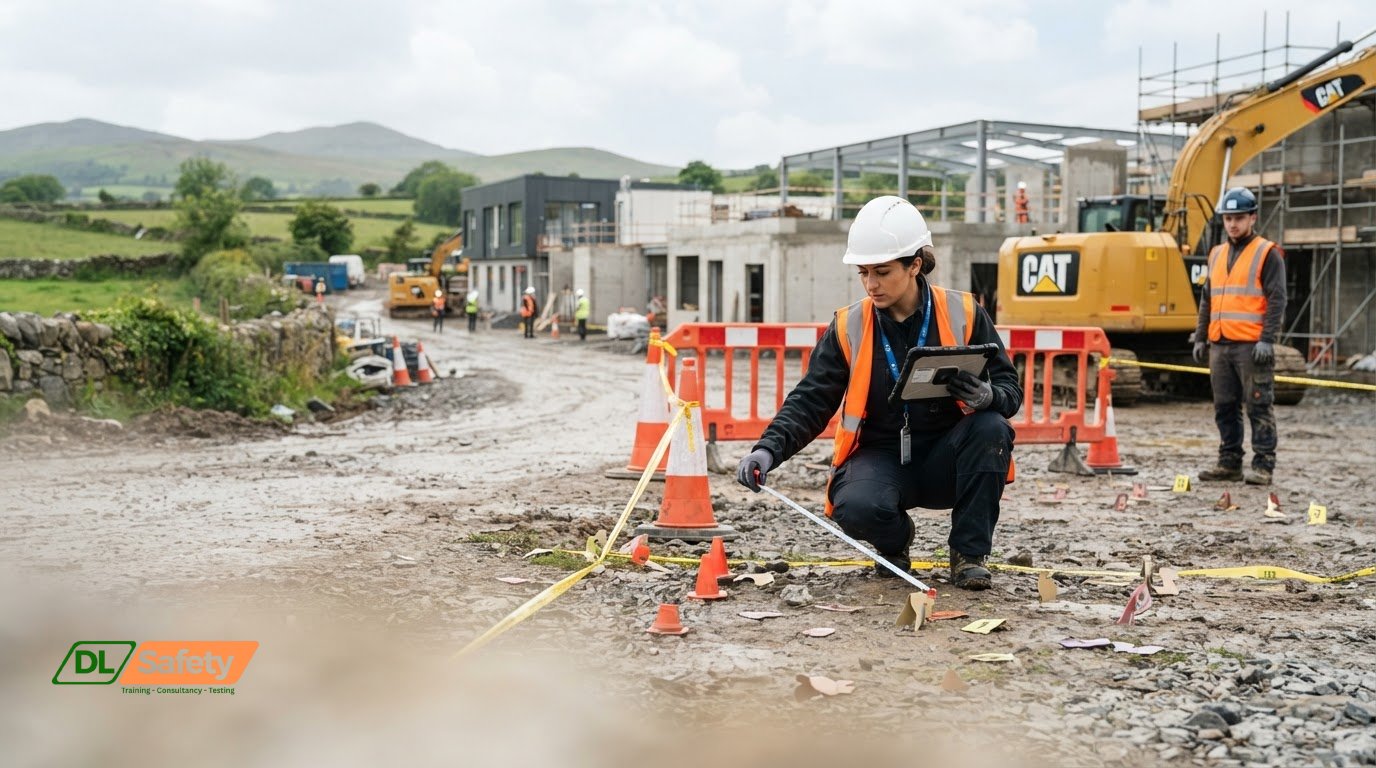
What if the most important part of a site accident investigation happens after the immediate danger has passed? A clear construction accident investigation in Ireland can establish what happened, preserve useful evidence and turn findings into practical steps to reduce the risk of recurrence.
After an incident, focus first on the injured person and making the area safe. Once immediate risks are addressed, record relevant facts promptly: memories can fade and site conditions can change. Investigation and HSA reporting are separate responsibilities. An investigation should be documented, and reportable incidents must be submitted to the HSA using the IR1 Form or IR3 Form, as applicable. Under S.I. No. 370 of 2016, reporting is required when an employee cannot work for three consecutive days after an incident. Use the HSA website for current reporting guidance.
This 2026 guide explains how to investigate an incident, capture reliable evidence, distinguish investigation records from HSA reporting, and use findings to strengthen site controls. DL Safety provides an Accident Investigation Service nationwide, backed by over 25 years of industry expertise. Its tagline is “Affordable online training & expert consultancy”. Visit www.dlsafety.ie, email info@dlsafety.ie or call 085 8316885.
Key Takeaways
- A construction accident investigation Ireland process should establish what happened and identify contributing conditions, not simply assign blame.
- Prioritise safety first, then record site conditions, gather relevant evidence and build a clear incident timeline.
- Distinguish investigation records from HSA reporting, including when the IR1 Form or IR3 Form may apply.
- Turn each finding into a practical corrective action, with responsibility and progress recorded so it can be followed up.
- DL Safety’s Accident Investigation Service supports organisations with a structured, documented route from incident facts to prevention.
Why a construction accident investigation matters beyond recording the incident
A useful investigation does more than record that an incident occurred. It examines the sequence of events, the available evidence and the conditions that may have contributed, then uses what it establishes to inform prevention. An accident investigation is a structured review of evidence and contributing conditions that creates an accurate record and helps identify practical ways to reduce recurrence risk.
This matters on construction sites, where work areas can change as tasks progress, plant and materials move, and contractors may work alongside one another. Accounts can be difficult to assess if they lack a clear timeline or mix observations with assumptions. A careful review keeps the focus on verifiable facts and relevant site conditions, rather than jumping to conclusions about individual blame.
What makes a construction incident investigation useful?
A clear sequence helps explain how work was planned and underway, what changed, and what happened next. For example, review the order of tasks, the position of materials or plant, and how work activities interacted. These are prompts for gathering context, not assumptions about what caused the incident.
Once the sequence is clearer, consider which controls were relevant and whether conditions affected how they worked in practice. This can identify questions for follow-up, such as whether work arrangements or coordination need attention. General accident investigation principles are outlined in Accident Investigation on Wikipedia; on site, the value comes from applying an evidence-led approach to the specific circumstances.
Investigation, incident record and HSA report: what is the difference?
These are related but distinct parts of the response. The investigation examines the circumstances and contributing factors. The incident record is the employer’s documented account of the event and the investigation’s findings. Keep it factual and clear, distinguishing confirmed information from points that remain uncertain.
HSA reporting is a separate obligation. Under S.I. No. 370 of 2016, reporting is required when an employee cannot work for three consecutive days after an incident. The applicable report is made using the IR1 Form or IR3 Form, as relevant, and the HSA website provides current reporting guidance. An investigation record does not replace a required HSA submission. Equally, submitting a report does not establish what happened or determine which prevention steps may be appropriate.
For construction accident investigation Ireland, keep these tasks distinct: examine evidence to understand the event, document the findings, and address any applicable reporting requirement. The aim is to build a reliable account that can guide considered action, not force a single explanation before the facts are clear.
How to investigate a construction accident: preserve evidence and build the timeline
Start with people, not paperwork. Emergency response and making the area safe take priority over collecting evidence. Once that is addressed, follow a clear sequence so important details aren’t lost as the site changes. A practical construction accident investigation Ireland process builds an evidence-based account without treating early assumptions as established facts.
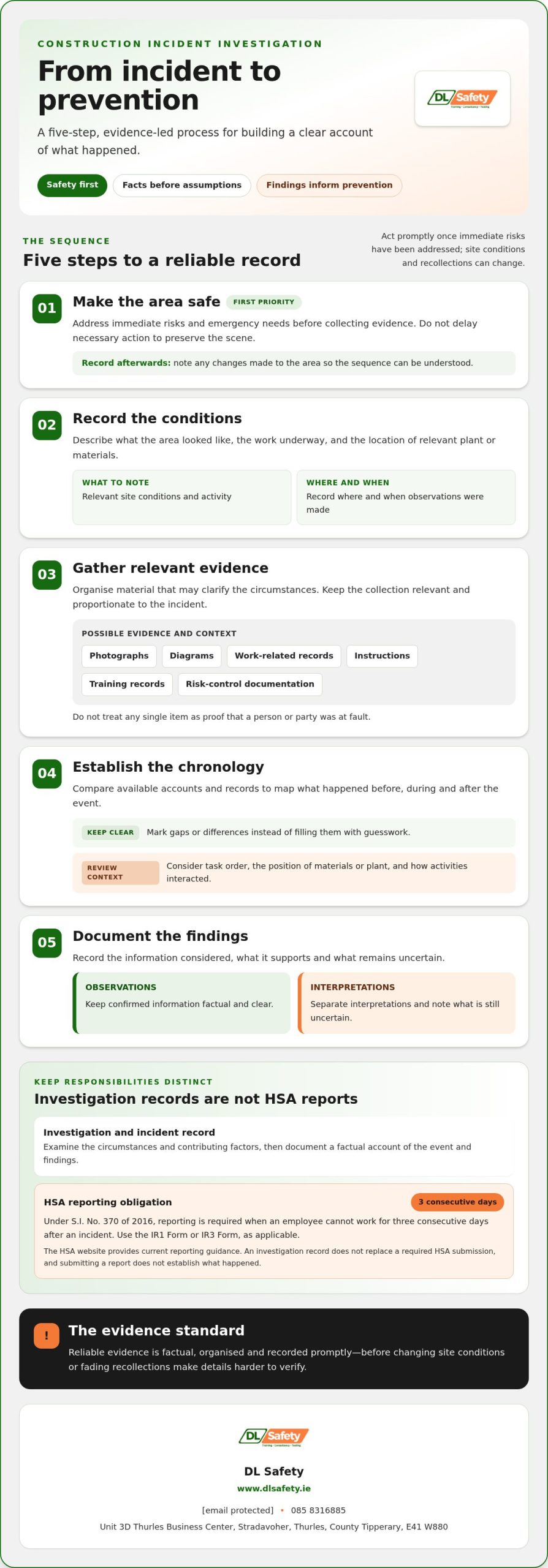
- Make the area safe. Address immediate risks and emergency needs first. Don’t delay necessary action to preserve the scene. Where relevant, record changes made afterwards so the sequence can be understood.
- Record the conditions. Note what the area looked like, the work underway and the location of relevant plant or materials. Record conditions that may change as work resumes, including when and where observations were made.
- Gather relevant evidence. Organise available photographs, diagrams and work-related records that may clarify the circumstances. Keep the material relevant to the incident rather than collecting information without a clear purpose.
- Establish the chronology. Compare available accounts and records to map what happened before, during and after the event. Mark gaps or differences instead of filling them with guesswork.
- Document the findings. Record the information considered, what it supports and what remains uncertain. Separate observations from interpretations so the account can be understood and reviewed.
Reliable evidence is factual, organised and recorded promptly, before changing site conditions or fading recollections make details harder to verify. The OSHA Guidance on Incident Investigation also discusses examining incidents to identify contributing factors. It is a general reference, not a substitute for Irish requirements.
What evidence should an employer record at a construction site?
Focus on information that explains the work context: relevant scene conditions, equipment and plant, materials, and the activity underway. Photographs or a simple diagram can help show positions and layout. Relevant instructions, work records, training records and risk-control documentation may also provide context. Keep the collection proportionate, and don’t treat any single item as proof that a person or party was at fault.
How should witness accounts and the event timeline be documented?
Record each account accurately, making clear what the person observed directly and what they heard from someone else. Build a timeline by comparing accounts with available records, noting where details differ or are missing. Don’t make accounts fit a preferred explanation. Separate established facts from uncertainties and interpretations in the investigation record. This makes the reasoning transparent and gives later reviewers a clear basis for understanding the findings.
DL Safety provides an Accident Investigation Service as part of its practical safety consultancy, supporting organisations that need a structured, documented review.
Irish Accident Reporting: Using IR1 or IR3 Forms
For employers, reporting and investigating an incident are connected but distinct tasks. Under S.I. No. 370 of 2016, a reportable accident or dangerous occurrence must be reported to the Health and Safety Authority (HSA) using the relevant form. Reporting is required when an employee cannot work for three consecutive days after an incident. The investigation record helps establish the circumstances; the form fulfils the applicable reporting process. One does not replace the other.
For a construction accident investigation Ireland, keep the details in the HSA report consistent with the documented facts. Record what is known, avoid presenting an unverified explanation as fact, and use the HSA website for current guidance on reportability, form completion and submission. The HSA’s online reporting service provides the route for submitting required reports.
When does an injury require an IR1 Form?
The IR1 Form is used to report an injury where the applicable reporting criteria are met. In particular, the reporting threshold applies when an employee cannot work for three consecutive days after the incident. This requirement does not replace the need to record the incident and consider its circumstances. Use current HSA guidance for the procedure and information required for the report.
Before submitting, make sure the account is clear and factual. Describe the incident accurately using the information available, and keep the relevant investigation record alongside the report. If details remain uncertain, don’t turn an assumption into a definite statement. The aim is to provide a reliable account while meeting the reporting requirement.
When is an IR3 Form used for a dangerous occurrence?
The IR3 Form is used for 16 specified serious dangerous occurrences, including events where no one may have been injured. Whether an event falls within a reportable category depends on the applicable criteria, so consult the HSA website rather than relying on assumptions or an informal comparison with another incident. Use current HSA guidance to identify the relevant category and submission requirements.
Submitting an IR3 Form records the dangerous occurrence for HSA reporting purposes. It doesn’t complete the employer’s wider investigation or prevention work. Keep the investigation focused on establishing what happened and what conditions contributed, then document findings separately in the organisation’s incident record.
Irish reporting requirements differ from those in other jurisdictions, so don’t apply another country’s forms or rules to an Irish site. Refer to S.I. No. 370 of 2016 and current HSA guidance when deciding which reporting route applies. A clear distinction between the IR1 Form, the IR3 Form and the investigation record helps keep the submission accurate and follow-up work focused.
Turn investigation findings into corrective actions that can be followed up
An investigation creates lasting value when its findings lead to considered action. Connect each proposed change to something documented, rather than responding to an assumption or introducing a general rule that doesn’t address the conditions identified. For a construction accident investigation Ireland, a clear action log helps move from findings to follow-up without suggesting that any measure will prevent every future incident.
How can investigation findings become practical site actions?
Start with a finding and ask what it indicates about the work arrangements in place. If the documented finding concerns how tasks were coordinated, for example, review those arrangements rather than defaulting to an unrelated equipment change. Depending on the evidence, procedures, work coordination, equipment or supervision may warrant review. Make each action specific enough to show how it addresses the factor identified.
Record each action in a follow-up log that is accessible to the people responsible for carrying it through. Useful fields include:
- Finding: the documented condition or contributing factor the action addresses.
- Action: the practical change or review agreed in response.
- Owner: the person responsible for progressing the action.
- Status: whether it is open, in progress or complete.
- Evidence: a record showing what was done, such as an updated document or a note of the relevant review.
These entries show what remains outstanding and why an action was selected. Avoid vague entries such as “improve safety” without explaining the finding they relate to or what completion means. If a proposed action changes a procedure or site arrangement, record the change clearly so those affected can understand it.
How should employers check whether corrective actions are effective?
Marking an action complete confirms that it was carried out; it doesn’t establish whether it addressed the original concern in practice. Review the completed action against the finding and relevant site arrangements. Consider whether the revised control is being used as intended in the conditions where the work takes place, and record observations or remaining concerns for management review.
Keep follow-up proportionate to the action. A document review may show that a procedure was updated, whilst a review of site arrangements may help assess whether the change fits the work as carried out. If a control isn’t operating as intended, record what remains unresolved and consider further action. Don’t close out a concern simply because an action was assigned.
Patterns across findings can inform future reviews of risk controls. Recurring issues may indicate that an existing arrangement needs broader attention, but each action should still be linked to the evidence and circumstances relevant to it. Corrective action can strengthen controls; it can’t guarantee that an incident will never recur.
DL Safety’s Accident Investigation Service supports organisations in connecting documented findings with practical follow-up.
When DL Safety’s Accident Investigation Service can support your organisation
After an incident, an organisation may need support to make sense of available information and document its findings clearly. DL Safety’s Accident Investigation Service supports this work as part of its practical safety consultancy and site audit services. A structured investigation record makes findings easier to consider alongside the site’s safety arrangements.
Support can be useful when circumstances are complex, when accounts or records need to be brought together, or when an organisation wants an experienced perspective on its investigation. The purpose is to establish a clear account based on the information available, distinguish findings from assumptions and support practical follow-up. An investigation can inform decisions, but no service or action can guarantee that an incident will never happen again.
What to expect from expert-led investigation support
DL Safety’s Accident Investigation Service supports organisations in documenting an investigation and understanding what its findings indicate. Clear records explain the reasoning behind conclusions, whilst practical follow-up connects those findings with site controls for consideration. The focus is a careful, evidence-led process that helps organisations move from incident information towards prevention without presuming that one person is to blame.
Investigation support sits alongside DL Safety’s wider safety consultancy and site audit work, giving organisations practical support when reviewing site safety matters. DL Safety is Irish-owned and provides nationwide coverage, with over 25 years of industry expertise. This experience informs its work with construction organisations while keeping the focus on the facts and circumstances of each incident.
Discuss an investigation or ongoing safety support
If your organisation needs support with a construction accident investigation Ireland, DL Safety provides an Accident Investigation Service to help document the event and consider its findings. The investigation remains distinct from any HSA reporting requirement, which should be addressed using current HSA guidance.
DL Safety provides Affordable online training & expert consultancy. Visit DL Safety online, email info@dlsafety.ie or call 085 8316885 to discuss accident investigation support.
Make incident learning part of the next project decision
Bring investigation learning into the decisions that shape upcoming work. Before tasks begin, consider whether previous findings still apply to the site’s current conditions, work sequence and coordination arrangements. If they do, make the relevant controls clear to the people involved and identify how they’ll be reviewed. This keeps learning connected to day-to-day planning, rather than leaving it in a report that’s rarely revisited.
A consistent approach to construction accident investigation Ireland can help your organisation build confidence in its records and make considered safety decisions over time. Each incident has its own circumstances, so review whether actions remain appropriate as work changes. The aim isn’t to create paperwork for its own sake, but to make useful learning accessible when it can inform the next decision.
DL Safety’s Accident Investigation Service supports organisations with a documented investigation that can turn incident learning into more informed planning and a stronger focus on prevention.
Frequently Asked Questions
What should an employer do immediately after a construction accident?
Prioritise people’s safety and arrange appropriate emergency action first. Once the situation is safe, preserve relevant information before normal work changes the scene: note the work underway, conditions that may shift and equipment involved. Record who provided each account and when. If details are unclear, mark them as uncertain rather than filling gaps with assumptions. Consider HSA reporting separately from the investigation record.
When must a construction accident be reported to the HSA in Ireland?
Reporting is required when an employee cannot work for three consecutive days after an incident. Under S.I. No. 370 of 2016, the applicable report is made using the IR1 Form or IR3 Form, depending on the event. Use the HSA website for current reporting guidance and submission procedures. Keep a note of the information used to complete the form so the submission can be understood alongside the organisation’s own records.
What is the difference between an IR1 Form and an IR3 Form?
The IR1 Form is used for applicable injury reporting, while the IR3 Form relates to 16 specified serious dangerous occurrences. They serve different reporting purposes, so the event’s circumstances matter when identifying the relevant form. Neither form replaces the organisation’s investigation record. A report may meet an HSA reporting requirement, while the separate investigation record explains what information was considered and what follow-up is planned.
Who should carry out a construction accident investigation?
The investigation should be carried out by someone able to review the incident objectively, gather relevant information and keep clear records. The appropriate level of support depends on the event’s complexity and the organisation’s capacity to review it. A construction accident investigation Ireland may benefit from specialist support where several work activities or records need consideration. DL Safety provides an Accident Investigation Service alongside safety consultancy and site audits.
What evidence should be included in a construction accident investigation?
Include information that helps explain the event, such as relevant site conditions, work activity, equipment and available work documentation. Capture accounts accurately, noting whether a person saw something directly or heard it from someone else. A timeline can reveal where accounts differ or information is missing. For instance, if two records indicate different task sequences, document the discrepancy for review rather than choosing one without a clear basis.
Does an HSA report replace an accident investigation?
No. An HSA report addresses the reporting requirement, while an investigation examines the event’s circumstances and contributing factors. Completing one doesn’t automatically complete the other. Keep the investigation findings in the organisation’s records, and submit the relevant IR1 Form or IR3 Form through the HSA website when reporting is required. This separation ensures reporting information is available while the organisation considers what its findings mean for site arrangements.
What should happen after a construction accident investigation is completed?
Use the findings to identify actions that address documented concerns, then record who is responsible and whether each action is complete. Keep evidence of what changed, such as a revised work document or a record of a relevant review. Afterwards, consider whether the change fits the work as carried out and note any remaining concerns. This follow-up gives managers useful information for future planning without treating an action as a guarantee against recurrence.