In Ireland, a competent person must be appointed by every employer to perform specified health and safety functions that protect employees and prevent risks, under section 18(1) of the Safety, Health and Welfare at Work Act 2005. The Act defines competence by reference to sufficient training, experience and knowledge appropriate to the work. So, what a competent person in health and safety needs to know and do depends on the risks and tasks involved.
A job title or certificate alone does not show whether someone can manage the risks in a particular workplace. The key question is whether they have relevant knowledge and experience, can apply them in practice, and recognise when a situation calls for additional expertise.
This article explains the role and responsibilities of a competent person, how to assess competence in proportion to workplace risks, and when an employee may be suitable or external support may be needed. It also covers higher-risk work, including lifting, working at height and confined spaces.
Key Takeaways
- Assess competence through relevant training, knowledge, skills and experience, not a job title or certificate alone.
- Match the person’s capability and support to the workplace risks, tasks and complexity.
- For specialist work such as lifting, working at height or confined spaces, make sure competence fits the specific work involved.
- An employer may appoint a suitable employee or seek external support, but remains responsible for managing health and safety.
- Consider ongoing safety support when your workplace risks or responsibilities call for regular professional input.
What is a competent person?
In Ireland, an employer appoints one or more competent people to perform specified health and safety functions. To understand what a competent person in health and safety does, start with the work, its hazards and the capability needed to manage them.
Training, Knowledge and Practical Skills
Competence combines suitable training, knowledge, practical skills and experience for the work being undertaken. Under section 2(2) of Ireland’s Safety, Health and Welfare at Work Act 2005, competence means having sufficient training, experience and knowledge appropriate to the work.
A formal qualification alone does not establish competence, and there is no single qualification for every workplace role. For example, someone advising on chemical handling needs relevant knowledge of the substances, procedures and controls used at that workplace.
Experience must also be relevant to the task. A worker familiar with routine office hazards may not have the practical ability to assess a lifting operation or confined-space work. They need to recognise hazards, understand the controls and know when a task exceeds their capability.
Training should match each staff member’s duties and the risks they encounter. Before starting a task, a new worker may need instruction on site procedures, emergency arrangements and equipment. If their duties change, review their training and capability against the new work.
Clear communication is part of competence. The appointed person must be able to explain hazards and procedures in terms workers understand. For instance, a briefing about a change to the work area should identify safe routes and explain which protective measures apply.
Assessing and Recording Competence
An Irish employer assesses competence by comparing a person’s training, knowledge, skills and experience with the functions they will perform. This matters because a certificate or job title may not show whether someone can apply procedures safely in that workplace.
A competent person supports the employer’s health and safety functions, while a safety representative expresses workers’ views and raises workplace safety concerns. The roles have different purposes, although a suitably capable worker may be appointed to either or both.
For a practical assessment, compare the person’s experience with the actual task, observe how they apply relevant procedures and identify any training needs. Record their appointment and assigned functions, along with relevant training, experience and assessment evidence. Review the record when duties or workplace risks change.
Under section 18(2) of the 2005 Act, an employee appointed as a competent person must receive adequate time for the role without loss of pay. Recording the time and support provided helps show how the person can carry out their assigned functions alongside other duties.
Competence proportionate to risk and workplace complexity
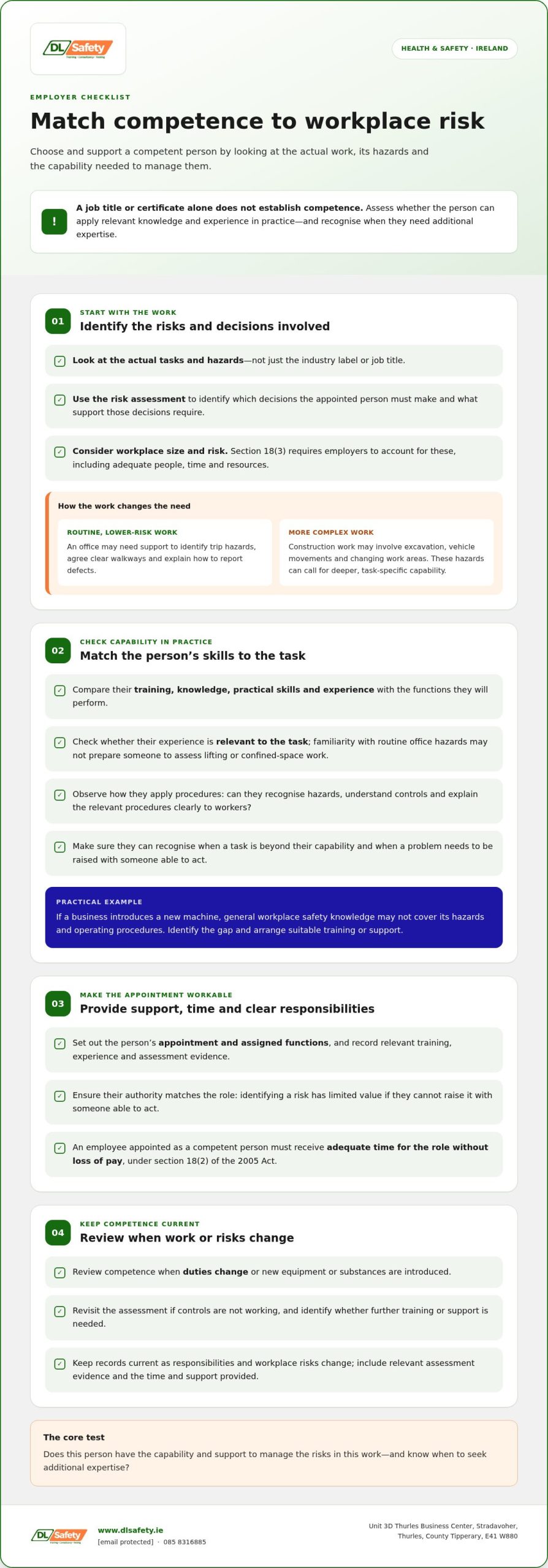
The capability needed depends on the workplace, its hazards and the help required to control them. Section 18(3) of Ireland’s Safety, Health and Welfare at Work Act 2005 requires employers to account for workplace size and risks, including adequate people, time and resources.
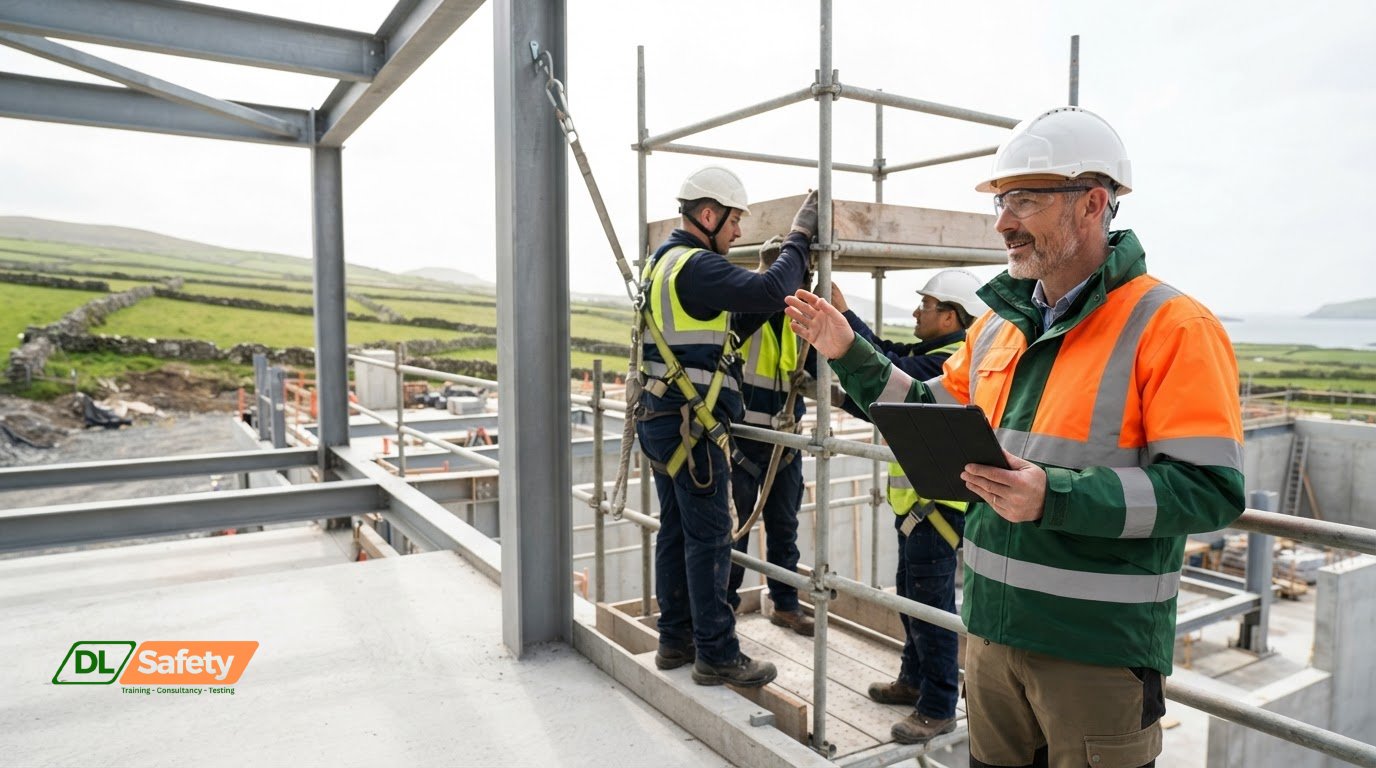
Competence is not a fixed qualification or job title. An office with routine activities may need different health and safety support from a construction site involving excavation, vehicle movements and changing work areas. Assess the actual work, not just the industry label.
In a lower-risk workplace, an employer may be able to manage health and safety with workers’ help. For example, they can identify trip hazards in an office, agree on clear walkways and explain how staff should report defects. Anyone taking responsibility still needs enough knowledge to recognise when a hazard requires additional expertise.
More complex work may require deeper, task-specific capability. Lifting operations, hazardous substances or multiple contractors can create interacting hazards. The person assessing the risks needs to understand how the work is organised, which controls are in place and whether they remain effective as tasks change.
Start the assessment with the risk assessment and identify the decisions the appointed person must make. Can they recognise the relevant hazards? Do they understand the procedures and controls, explain them to workers and identify when a problem needs escalation? Their authority must also match their role: identifying a risk is of limited value if they cannot raise it with someone able to act.
Consider a small business introducing a new machine. Its appointed person may understand general workplace safety but lack knowledge of that equipment’s hazards and operating procedures. The employer should identify the gap, arrange suitable training or support, and not assume the machine is covered simply because a general risk assessment already exists.
Review competence when the work changes, new equipment or substances are introduced, or an assessment reveals controls aren’t working. Refreshers should reflect the risks and help workers apply procedures consistently. For a workplace whose risks or responsibilities need ongoing review, ongoing health and safety support can help maintain that focus.
Competent persons for scaffolding, lifting, electrical work and confined spaces
Specialist work requires competence suited to its specific hazards, procedures and decisions. In Ireland, requirements depend on the activity, so one general appointment may not cover every task.
Competence for Specific Types of Work
For specialist work, competence means having the capability to plan, supervise or inspect the task safely. General workplace knowledge may not cover the technical risks involved.
Part 4 of Ireland’s Safety, Health and Welfare at Work (General Application) Regulations 2007 requires competent-person inspections for scaffolding and work at height. Ireland’s Confined Spaces Regulations 2001 require competent planning and supervision for confined-space work.
For lifting, assess whether the person understands the equipment, load, work area and planned operation. A lift plan should set out the intended sequence and relevant controls so everyone involved understands their role. For electrical work, match capability to the specific task and hazards rather than assuming general site experience is enough.
These activities require different knowledge. Someone able to coordinate a routine lift may not have the experience to plan a more complex operation. Likewise, familiarity with ordinary site access does not establish the ability to assess scaffolding or confined-space work.
Applying Competence to the Work
Applying competence means matching a person’s ability to the decisions and actions required for a specific task. This is essential when work is complex, conditions may change or hazards interact.
Before assigning work, identify what the person must plan, supervise or inspect. Consider the procedures they need to apply, the hazards they must recognise and the limits of their authority. A competent person should know when conditions have moved beyond the agreed plan and when work needs to pause for further assessment.
A safe system of work turns an assessment into clear arrangements. For confined-space work, planning and supervision should address the sequence, hazards and controls. Scaffolding inspection arrangements should reflect the structure and the work at height, not rely on a generic site check.
For a lifting operation, explain who directs the work, how the load will move and what to do if conditions change. For electrical tasks, clarify task boundaries and relevant procedures for everyone involved. These arrangements help workers understand what to do and whom to approach if the job differs from the plan.
Review capability when equipment, tasks or site conditions change. Experience with one operation does not automatically apply to another. Clear responsibilities, appropriate supervision and task-specific procedures help keep safety measures relevant throughout the work.
Definition of a competent person
In Ireland, section 2(2) of the Safety, Health and Welfare at Work Act 2005 defines competence through sufficient training, experience and knowledge appropriate to the work. The definition focuses on whether someone can perform the relevant functions, not simply their job title or completed course. The person’s capability should match the duties they’re assigned.
In practice, the employer considers whether the person can recognise relevant hazards, understand suitable controls and apply them to the work. For example, experience with routine office safety does not automatically demonstrate the knowledge needed to advise on excavation or lifting operations.
Section 18(1) of the 2005 Act requires every employer to appoint one or more competent people to perform specified functions for protecting employees and preventing risks. The appointment is therefore tied to defined health and safety responsibilities. It doesn’t grant a person blanket competence for every activity in the business.
A course or qualification can provide evidence of training, but it does not, by itself, demonstrate practical ability across all tasks. Consider whether someone can apply their learning in the workplace, follow relevant procedures and identify when a task exceeds their knowledge. Evidence may include relevant training records and demonstrated experience with the work.
Reassess competence as work changes. New equipment, different duties or unfamiliar hazards may require additional training or support. Review assigned functions against the person’s current capability instead of relying indefinitely on an earlier assessment.
Section 18(4) of the 2005 Act requires employers to prefer a competent employee over an external appointee unless the employee’s knowledge and experience are inadequate for the functions. This makes the fit between the person and the assigned work central to the appointment. An employee’s familiarity with the workplace can be useful, while a gap in specialist knowledge may mean the required functions need other support.
For appointments in Northern Ireland, relevant legislation includes the Management of Health and Safety at Work Regulations (Northern Ireland) 2000 and the Health and Safety at Work (Northern Ireland) Order 1978. Both are relevant when considering how competent-person arrangements apply there.
Self-appointment, employee appointments and external consultants
In Ireland, an employer may appoint themselves, a suitable employee, an external professional or a combination of people. The arrangement should provide competent assistance for the health and safety functions the business needs to manage.
Section 18(4) of Ireland’s Safety, Health and Welfare at Work Act 2005 requires employers to prefer a competent employee over an external appointee unless the employee’s knowledge and experience are inadequate for the functions. An in-house appointment can suit duties the employee understands well. If a task involves hazards beyond their expertise, the employer needs additional competent support for those functions.
A business may need external health and safety support when its in-house capability is not sufficient for the functions it needs covered. External advice may also help when work is complex or high risk and internal capability cannot adequately address the hazards. Define the functions the external person will assist with and explain the relevant workplace risks and protective measures.
Under section 18(2) of the 2005 Act, an employee appointed as a competent person must receive adequate time for the role without loss of pay. The employer should make the person’s responsibilities and reporting arrangements clear, and ensure the role can be carried out alongside their other duties.
Appointing a competent person does not transfer the employer’s legal responsibility for health and safety. The appointed person assists with specified functions, but the employer remains responsible for decisions and for ensuring suitable controls are put into practice. For example, receiving advice about a hazard does not, by itself, ensure workers follow the necessary procedures.
Where an employer lacks competent support, they may be unable to meet the appointment duty in section 18(1) or adequately manage workplace risks. The Irish provisions described here establish the employer’s duties; they don’t set out a specific penalty for this circumstance alone.
Construction has a further Irish requirement. Regulation 26 of the Safety, Health and Welfare at Work (Construction) Regulations 2013 requires certain contractors to appoint safety officers in writing. It applies where a contractor normally has more than 20 persons under direct control on a site at a given time or 30 persons engaged in construction work.
When an external competent person is appointed, section 18(5) of the 2005 Act requires the employer to provide information about workplace risks, protective measures, evacuation arrangements and temporary staff. Explore ongoing safety support when your business needs help managing its health and safety responsibilities.
DL Safety: Monthly Safety Support Packages
DL Safety offers Monthly Safety Support Packages for businesses that need ongoing help with health and safety responsibilities. They can be a practical next step when internal resources are stretched or workplace risks need regular attention. For specific requirements, DL Safety also offers Lift Plans, Thorough Examinations and Accident Investigation.
External support does not transfer the employer’s legal responsibility. It can assist with safety tasks that match the business’s needs, while the employer remains responsible for decisions and controls.
To discuss support, contact DL Safety at info@dlsafety.ie or 085 8316885, or visit dlsafety.ie. The office address is Unit 3D Thurles Business Centre, Stradavoher, Thurles, County Tipperary, E41 W880.
Keep safety capability aligned with the work ahead
Understanding what a competent person in health and safety means is a starting point. The next step is to keep that capability aligned with how work happens. Build competence reviews into everyday planning so changes to tasks, equipment or responsibilities prompt timely discussions about the support workers need.
Before introducing a new activity, consider who will oversee it, what knowledge it requires and whether existing procedures remain suitable. This makes safety capability part of operational decisions, rather than a record left untouched until a problem arises.
DL Safety provides Monthly Safety Support Packages, Online Safety Courses and Lift Plans to support different workplace needs. Choose the option that fits the practical work or training support your business needs.
Talk with DL Safety about the support that fits your workplace: contact DL Safety to discuss your needs. A clear next step can help you keep safety responsibilities connected to the work ahead.
Frequently Asked Questions
What is meant by ‘competent’?
Competence means being able to carry out assigned health and safety work effectively. In Ireland, assessment depends on the work: can the person recognise relevant hazards, understand suitable controls and apply them in practice? For example, someone familiar with office procedures may not have the skills to assess a lifting operation. Competence also means recognising when a task requires expertise beyond their own.
Who can take on this role?
An employer, employee, external professional or combination of people can take on competent-person functions, provided they have the capability required for those functions. Under section 18(4) of Ireland’s Safety, Health and Welfare at Work Act 2005, a competent employee is preferred over an external appointee unless their knowledge and experience are inadequate. An employer should allocate clear responsibilities and ensure an employee has adequate time for the role.
What does competent person mean under Irish health and safety law?
Section 2(2) of Ireland’s Safety, Health and Welfare at Work Act 2005 defines competence through sufficient training, experience and knowledge appropriate to the work. Section 18(1) requires employers to appoint one or more competent people for specified functions that protect employees and prevent risks. The definition is work-specific, so an appointment for routine safety tasks doesn’t automatically establish competence for specialist activities.
What qualifications and experience make someone competent in health and safety in Ireland?
There is no single qualification that establishes competence for every Irish workplace role. Relevant training and experience should match the hazards, equipment and decisions involved. For example, experience preparing office procedures may be useful in that setting, but does not by itself demonstrate the ability to plan confined-space work. Consider training records alongside practical evidence, such as how the person applies procedures to the tasks they will oversee.
What health and safety duties does a competent person perform?
The appointed functions depend on the employer’s needs and the person’s capability. They may help identify workplace hazards, support risk assessments, advise on controls, communicate procedures or review changes to work. For example, someone asked to advise on new equipment could help identify its hazards and suitable operating controls. The employer remains responsible for managing health and safety, even when assistance is appointed.
Does a competent person need specific certificates or professional registration in Ireland?
Irish law’s general definition focuses on suitable training, experience and knowledge, rather than requiring one certificate or professional registration for every competent-person appointment. A course or certificate can provide evidence of training, but does not alone prove someone can apply their learning in a particular workplace. For specialist work, assess whether the person’s preparation and practical ability match the task and its risks.