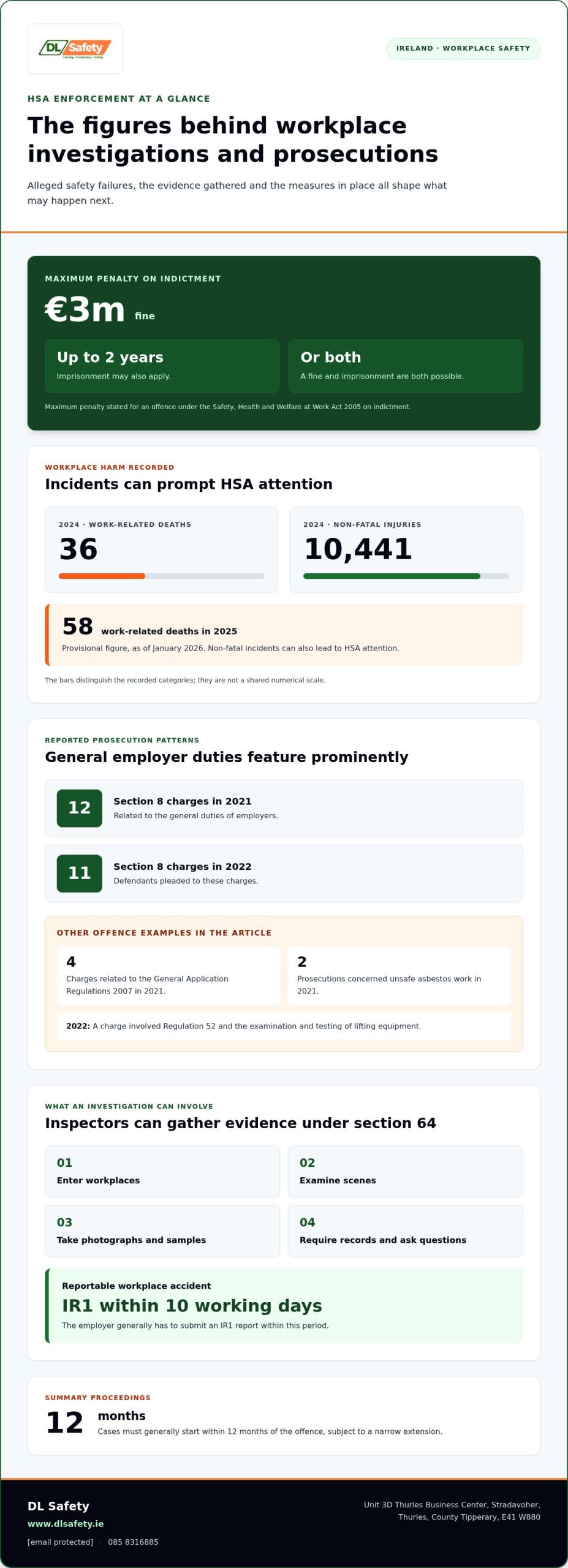
Common HSA prosecutions in Ireland typically concern alleged failures to manage workplace risks, provide safe systems of work or comply with safety regulations. The HSA can investigate incidents, issue notices and bring prosecutions for alleged breaches. For an offence under the Safety, Health and Welfare at Work Act 2005 on indictment, the Irish Statute Book sets the maximum penalty at a €3,000,000 fine, imprisonment for up to two years, or both.
It’s understandable to focus on what happens after a serious incident, but enforcement can also follow a failure to address hazards before anyone is hurt. The alleged breach, the evidence and the steps taken to protect workers all shape what may happen next.
This article explains the incidents that can prompt HSA action, the charges and penalties employers may face, and when directors or managers may be held personally liable. It also explains how investigation findings can be used as evidence, highlighting the practical importance of effective safety management.
Key Takeaways
- Understand which workplace incidents can lead to an HSA investigation and what inspectors may examine.
- Learn how alleged failures in employers’ general duties and safe systems of work can lead to prosecution.
- See when a director or manager may face personal liability, not just the company.
- Recognise the offence patterns and business sectors that feature in Irish prosecution cases.
- Explore how ongoing safety support, lift planning, GA1 testing and accident investigation can help address workplace safety needs.
Types of workplace incidents that prompt HSA investigations
The HSA may investigate fatal accidents, serious injuries, dangerous work practices and alleged breaches found during inspections. Under section 64 of the Safety, Health and Welfare at Work Act 2005, inspectors can enter workplaces, examine scenes, take photographs and samples, require records, and ask people questions. These powers help establish what happened and whether safety duties may have been breached. Prosecutions for failing to comply with the law or an HSA notice are brought through the Office of the Director of Public Prosecutions.
Falls from height show how a workplace hazard can lead to enforcement. In May 2022, an employee at Shay Murtagh (Pre-Cast) Limited fell more than seven metres through a fragile roof light onto a concrete floor. The incident involved roof work at a maintenance shed. It illustrates why an employer should identify fragile surfaces, plan access and set controls before work begins, rather than relying on workers to recognise hazards as they arise.
Risk assessment is a practical prevention step, particularly for hazardous work such as working at height. The HSA advises employers to assess risks before work begins. A useful assessment identifies hazards, who could be harmed and the necessary controls. For roof work, consider fragile roof lights and safe access before anyone starts. Review controls when the task or workplace conditions change, so the assessment reflects the work being done.
Fatal and non-fatal accidents can both lead to HSA attention. According to the Health and Safety Authority, Ireland recorded 36 work-related deaths in 2024 and 10,441 non-fatal workplace injuries that year. The Authority recorded 58 work-related deaths in 2025, a provisional figure as of January 2026. These figures underline that an investigation is not limited to fatalities; the nature of an injury, the circumstances and possible safety failures can all matter.
After a fatal workplace accident, the employer should focus first on preventing further harm and preserving relevant information about the scene and work activity. For a reportable workplace accident, an employer generally has to submit an IR1 report within 10 working days. Records of training, risk assessments, maintenance and work arrangements can help explain what controls were in place. A safety representative may also be able to describe how the task was normally carried out and raise concerns workers had previously reported.
How does the HSA investigate and decide whether to prosecute in Ireland? Inspectors can examine the scene, gather records and question people under section 64, then assess whether the evidence indicates a breach of safety law or an HSA notice. If prosecution is pursued for an alleged failure to comply, proceedings are brought through the Office of the Director of Public Prosecutions. An investigation may therefore examine both the immediate cause of an accident and the employer’s wider safety arrangements.
Criminal charges under the Safety, Health and Welfare at Work Act 2005
Irish workplace prosecutions often focus on employers’ general duties and whether work was organised safely. The charge depends on the alleged breach, the evidence available and the circumstances of any injury.
Employer duties and penalties
Section 8(1) of Ireland’s Safety, Health and Welfare at Work Act 2005 requires every employer to ensure, so far as is reasonably practicable, the safety, health and welfare at work of employees, according to the Irish Statute Book. Section 8(2)(e) addresses safe systems of work, requiring them to be planned, organised, performed, maintained and revised appropriately.
These duties make everyday decisions relevant: how work is planned, whether controls are maintained, and whether identified problems are addressed. In 2021, 12 charges related to section 8’s general employer duties. In 2022, defendants pleaded to 11 section 8 charges. In a separate case, EW Technologies Limited pleaded guilty to charges concerning management of work activities and a safe system of work.
The Irish Statute Book sets the maximum penalty for an offence under the Safety, Health and Welfare at Work Act 2005 on indictment at a €3,000,000 fine, imprisonment for up to two years, or both. For summary proceedings, the Irish Statute Book states that cases must generally start within 12 months of the offence, subject to a narrow extension. The court route and alleged offence affect the potential consequences.
Health and safety manager liability
Work activities can put people’s safety, health or welfare at risk, and individuals may be held responsible where their conduct contributes to that risk. It matters to managers because responsibility may extend beyond the employer: a health and safety manager can face a charge if evidence supports an alleged personal breach. In one prosecution, a company health and safety manager was prosecuted under sections 14 and 77(2). Records of decisions, instructions and safety concerns can help clarify individual roles.
Commonly prosecuted offences
Common charges include alleged failures to meet general employer duties, provide a safe system, or comply with regulations. In 2021, four charges related to the General Application Regulations 2007, and two prosecutions concerned unsafe asbestos work. In 2022, a charge involved Regulation 52 and examination and testing of lifting equipment.
After an incident or inspection, employers can review the evidence, identify the underlying control failure and record corrective action. Share relevant changes with supervisors, workers and safety representatives, then update procedures and training so the improvement reaches the people doing the work. Clear records can show how safety arrangements were reviewed and revised. A focused review of workplace safety arrangements can help organise that improvement process.
Personal liability of company directors and managers
A company can face prosecution for workplace breaches, but responsibility may also reach individuals. In Ireland, section 80 of the Safety, Health and Welfare at Work Act 2005 addresses when directors, managers and similar officers can be personally liable. The key issue is not job title alone. Investigators consider the person’s role and whether the alleged offence involved their consent, connivance or neglect.
Section 80 provides that an officer may also be guilty of certain offences committed by the company where the offence was committed with their consent or connivance, or was attributable to their neglect. This means an individual charge requires attention to their own connection with the alleged breach. A director’s position, signature on an annual report or presence at a meeting does not, by itself, explain what they knew or did. Evidence about decisions, delegated responsibilities and follow-up on safety issues can help show that context.
Practical records can clarify how responsibilities were handled. Board minutes, risk review actions, maintenance records and written instructions can show whether a concern reached management and what happened next. When a director assigns a safety task, records can identify who is responsible, when the task will be reviewed and how unresolved issues should be escalated. Records do not replace safe working arrangements, but they help establish what steps were taken and where responsibility lay.
Personal exposure is not limited to directors. A manager or similar officer may face an individual charge where the statutory conditions apply. Four individuals were personally prosecuted under Irish occupational safety and health legislation in 2021 and 2022; no custodial sentences were given in those cases. The figures show that individual prosecutions occur, while also distinguishing them from charges brought against companies.
Criminal proceedings and civil claims are separate routes. A civil case arising from a fatal workplace accident in Ireland may be issued pursuant to the Civil Liability Act 1961, as amended. A prosecution concerns alleged criminal breaches of workplace safety law; a civil case addresses a different legal claim arising from the incident. One does not, by itself, establish the outcome of the other. For directors, it is useful to understand which process is underway and what evidence each addresses.
Workplace criminal proceedings usually begin in the District Court and are usually remitted to the Circuit Court for trial after the Book of Evidence is served. This step brings the charges and supporting material into focus for the accused. After a safety concern, directors and managers should preserve relevant records, identify who made key decisions and document corrective action. A clear timeline can help distinguish organisational oversight from an individual’s actions or omissions.
In the Shay Murtagh case, the company and its director faced allegations concerning a safe system of work, with the alleged director offence brought under sections 77(9) and 80. The director and health and safety manager each had the Probation Act applied to them. The case illustrates why management involvement and the specific statutory basis matter when assessing personal liability, rather than assuming every company prosecution automatically makes a director liable.
What offences does the HSA most commonly prosecute in Ireland?
Common HSA prosecutions in Ireland often concern employers’ general duties, as well as alleged failures involving specific workplace hazards. Cases may relate to unsafe systems, hazardous materials or regulated equipment. The charge identifies the alleged failure; the circumstances help show how it arose and which controls were missing.
Case numbers show that prosecutions can relate to fatal incidents. Ireland recorded 18 occupational safety and health prosecutions in 2021, with six relating to fatal workplace accidents. In 2022, there were 10 prosecutions, and eight concerned a worker’s or member of the public’s death resulting from work activity. These figures describe prosecutions, not every HSA investigation or workplace accident.
The broader charge pattern includes alleged failures under section 8 of the Safety, Health and Welfare at Work Act 2005. These may concern an employer’s general duties or an unsafe system of work. Other cases involve specific regulations. Examples include unsafe work with asbestos, quarry safety requirements, and examination and testing of lifting equipment under Regulation 52 of the General Application Regulations 2007.
These categories matter because a charge relates to the alleged duty, not simply the type of accident. A case involving lifting equipment, for example, may focus on examination and testing obligations. An asbestos prosecution may concern unsafe handling. Employers can make safety reviews more focused by examining the equipment records, task arrangements and worker instructions relevant to each activity.
Not every prosecution follows a contested trial. Defendants pleaded guilty in all 28 occupational safety and health prosecutions reviewed for 2021 and 2022; none was contested. That figure covers those reviewed cases only. It does not mean every allegation results in a guilty plea, or establish what happened in cases outside that review.
For a practical review, compare the alleged offence with the work activity and its records. Check whether written arrangements match the task, equipment checks are documented and workers received relevant instructions. For lifting equipment, examination and testing records are directly relevant. For asbestos work, review how the material was handled and what safeguards were in place.
Employers studying common HSA prosecutions in Ireland can use these patterns to identify activities that need closer attention. Link each legal duty to the work being carried out, then review the controls and records for that activity. The offence named in a case is a starting point; understanding the alleged breach means examining the specific work, decisions and evidence involved.
What types of Irish businesses are most often prosecuted by the HSA?
Construction accounts for the largest share identified in the reviewed Irish prosecution figures. The sector represented 64% of prosecutions under occupational safety and health legislation in the review covering 2021 and 2022. That points to a notable concentration, but it does not mean every construction employer faces the same risks or enforcement outcome.
The 2022 figures offer a closer view: five of the 10 prosecutions involved construction or organisations carrying out construction activities. The description includes organisations undertaking construction work, not only businesses whose main trade is construction. For example, a company working on a building project may face worksite risks even if construction is not its usual activity.
Construction projects can bring together different tasks, equipment and employers at one location. Work may involve working at height, excavations, vehicle movements or lifting operations. Each activity raises questions about planning, coordination and controls. Begin a safety review with the work actually taking place, rather than relying only on the company’s sector.
The prosecution figures are a snapshot of cases, not a ranking of every Irish industry’s safety performance. The 64% share relates to prosecutions in the 2021 and 2022 sector review. The five construction-related cases refer specifically to the 10 prosecutions taken in 2022. Neither figure tells employers how many incidents occurred across each sector or how many workplaces were inspected.
For businesses involved in construction, examine how responsibilities are divided across the project. Identify who plans each task, communicates changes and records checks or concerns. For a lifting operation, the plan and the people involved should be clear to those doing the work. For vehicle movements, review how routes and work areas are arranged. These checks focus attention on actual activities, not assumptions about the business category.
Organisations outside construction should not treat the figures as a reason to overlook their own work hazards. The 2021 and 2022 prosecutions included cases involving asbestos and quarry safety, while a 2022 case concerned lifting-equipment examination and testing. Those examples show that the work being performed can matter as much as the sector name. Employers can map their tasks, equipment and work locations to identify where controls need review.
Use the prosecution pattern as a prompt for a practical workplace review: list construction-related tasks, identify interfaces between teams, and record how risks are controlled. Then revisit the arrangements when the work changes, such as when a new task or work area is introduced. A structured review of workplace safety arrangements can help bring those project details into focus.
DL Safety: Monthly Safety Support Packages
DL Safety offers Monthly Safety Support Packages for organisations seeking ongoing help with workplace safety responsibilities. They provide a practical next step when a business wants regular support reviewing safety arrangements, rather than addressing issues only after an incident. For specific needs, DL Safety also offers Lift Plans, GA1 Testing and Accident Investigation.
Accident Investigation can help examine an incident and its circumstances, while Lift Plans and GA1 Testing address distinct operational requirements. The right support depends on the work activity and the safety issue your organisation needs to address.
To discuss support, contact DL Safety at info@dlsafety.ie or 085 8316885, or visit dlsafety.ie. The address is Unit 3D Thurles Business Center, Stradavoher, Thurles, County Tipperary, E41 W880.
Turn enforcement lessons into practical action
The cases behind common HSA prosecutions in Ireland show why safety arrangements must work in practice, not simply exist on paper. Identify the highest-risk tasks in your workplace, then assess whether your procedures, records and staff knowledge support those activities.
Where workers need relevant learning, DL Safety offers Online Safety Courses. For ongoing attention to safety responsibilities, its Monthly Safety Support Packages provide a practical way to support health and safety management. Choose the support that fits the issue you need to address, then make the next improvement clear to the people doing the work.
Contact DL Safety for guidance on the safety support that may suit your organisation. A considered next step can help you build a more consistent approach to workplace safety.
Frequently Asked Questions
What can the HSA actually do to an employer?
The HSA can investigate a workplace, gather evidence and issue enforcement notices when it identifies alleged breaches. Inspectors may examine work areas, require records and ask people questions. An Improvement Notice gives an employer a minimum 14-day timeframe for corrective action, while a Prohibition Notice takes immediate effect if an activity poses a serious risk of personal injury. Local safety representatives must be copied on these notices.
How many HSA prosecutions were brought in Ireland in recent years?
The HSA concluded 11 workplace safety prosecutions in Ireland in 2024. That figure counts prosecutions concluded during that year, rather than all investigations, inspections or incidents. Annual prosecution totals can vary, and a prosecution figure should not be read as a measure of every workplace’s safety performance. For context, the cases reviewed in this article also show that charges and outcomes depend on the particular alleged breach and evidence.
What health and safety breaches typically lead to an HSA prosecution?
Prosecutions commonly involve alleged failures in employers’ general duties, unsafe systems of work, or breaches relating to specific hazards and equipment. Examples include unsafe asbestos work and failures involving the examination and testing of lifting equipment. The practical question is whether the work was properly controlled: for example, whether equipment checks were recorded and the work method addressed the hazards workers faced.
What penalties and fines can Irish courts impose for HSA offences?
For an offence under the Safety, Health and Welfare at Work Act 2005 on indictment, the maximum is a €3,000,000 fine, imprisonment for up to two years, or both. For summary conviction, the maximum is a €5,000 fine, imprisonment for up to 12 months, or both. The offence and court route matter; these are statutory maximum penalties, not automatic sentences in every prosecution.
How can an Irish business reduce the risk of an HSA prosecution?
Keep safety arrangements current, record checks and training, and act on reported hazards before work continues. After a qualifying incident, document the investigation and submit the required report to the HSA through its website under S.I. No. 370 of 2016, using the IR1 Form or IR3 Form. An IR1 Form applies where an employee cannot work for three consecutive days; an IR3 Form covers specified serious dangerous occurrences.