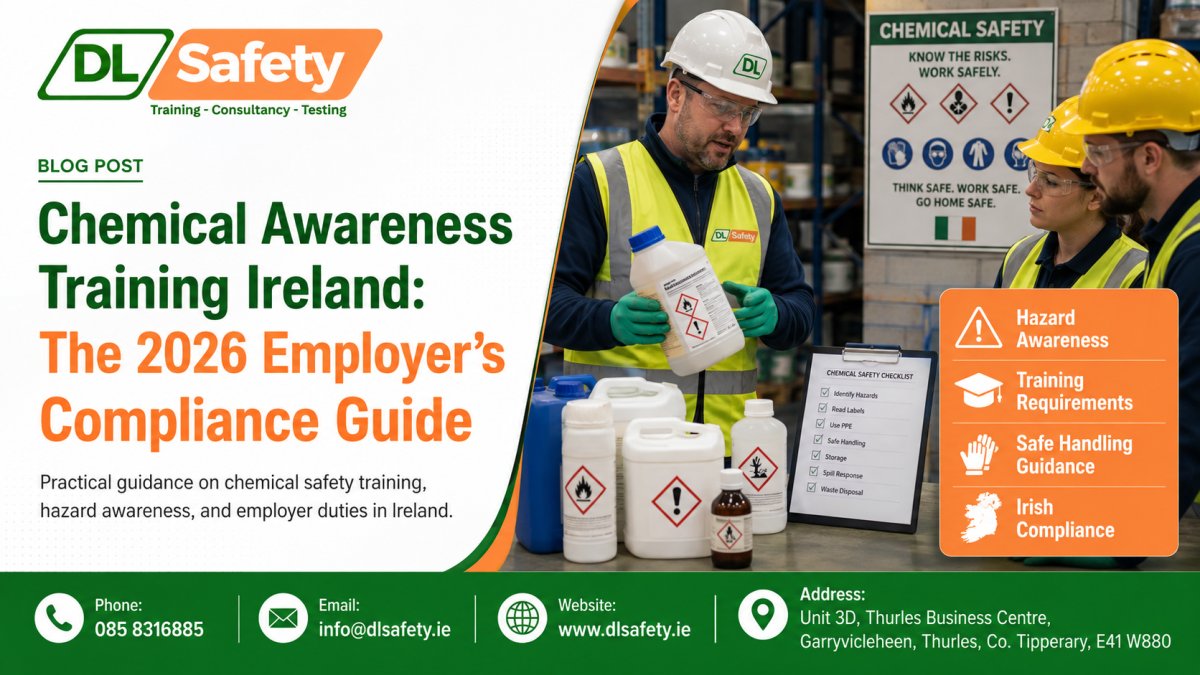
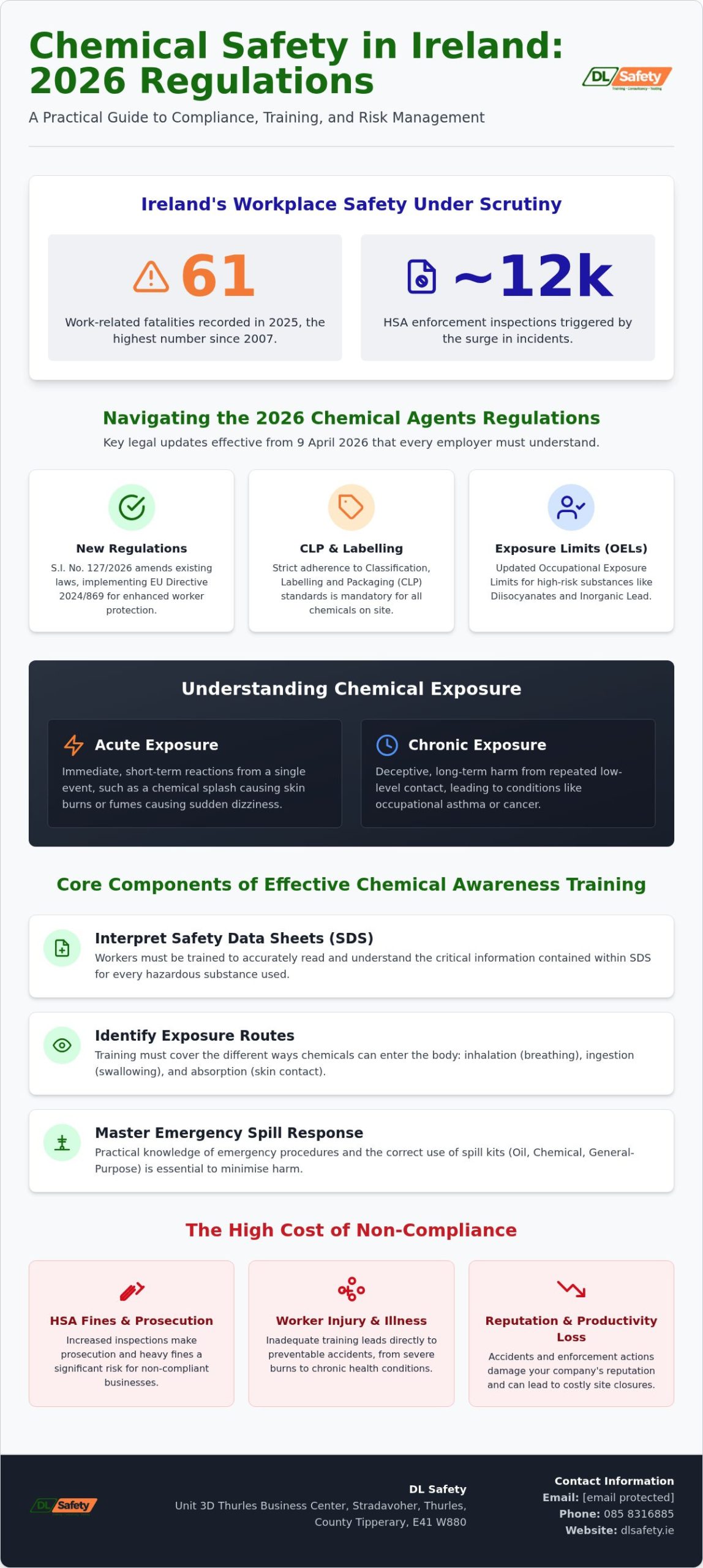
In 2025, Ireland recorded 61 work-related fatalities, which was the highest number since 2007 and triggered a significant surge in HSA enforcement with nearly 12,000 inspections. If you feel a sense of unease regarding the latest 2026 Safety, Health and Welfare at Work (Chemical Agents) Regulations, you certainly aren’t alone. Managing complex CLP standards whilst ensuring your staff can handle a hazardous spill with confidence is a heavy responsibility for any employer. We understand that the fear of a workplace accident or a costly HSA fine is a constant source of stress, especially when the legal landscape shifts so rapidly.
This comprehensive guide is designed to remove that burden by providing a clear, pragmatic roadmap to 2026 compliance. You’ll learn exactly how to master your legal obligations and implement effective chemical awareness training ireland to protect your workforce from harm. We will walk you through the updated occupational exposure limits for substances like diisocyanates, the nuances of the 2026 Code of Practice, and the practicalities of spill kit deployment. By the end of this article, you’ll have the knowledge to transform your workplace into a centre of safety excellence where your team feels competent and your business remains fully protected.
Key Takeaways
- Understand the critical 2026 updates to the Chemical Agents Regulations and how they impact your mandatory legal compliance as an employer.
- Master the core components of chemical awareness training ireland, including the accurate interpretation of Safety Data Sheets and the identification of exposure routes.
- Learn the practical steps for emergency spill response and how to select the appropriate spill kit for oil, chemical, or general-purpose hazards.
- Discover how bespoke, on-site training sessions can be tailored to your specific industrial or construction site to reduce the risk of accidents and costly HSA fines.
Understanding Chemical Hazards in Irish Workplaces
Under Irish health and safety law, specifically the Safety, Health and Welfare at Work Act 2005 and the Chemical Agents Regulations 2001 to 2026, a hazardous substance is defined as any agent that can cause harm to health or safety due to its chemical properties. For many industrial and construction firms, these aren’t just exotic laboratory chemicals; they’re the everyday fuels, adhesives, and dusts found on every site. Gaining a foundational Understanding Chemical Hazards is the first step in protecting your team. Chemical awareness training ireland is a mandatory legal requirement, ensuring that workers don’t just see a label, but actually understand the danger it represents.
Exposure usually falls into two categories: acute and chronic. Acute exposure involves immediate reactions, such as a chemical splash causing a skin burn or fumes causing sudden dizziness. Chronic exposure is more deceptive; it involves low-level contact over months or years, which can lead to life-altering conditions like occupational asthma or even cancer. Because these risks are often invisible, employers must take a proactive approach to hazard identification.
Identifying Hazardous Substances on Site
On a busy Irish construction site or in a manufacturing plant, hazards are often hidden in plain sight. Solvents used for degreasing, diesel fuel for plant machinery, and even common cleaning agents can all be toxic if mishandled. One of the most dangerous, yet frequently overlooked, substances is crystalline silica dust, which is generated during stone cutting or concrete drilling. Investing in comprehensive chemical awareness training ireland ensures your staff can identify these risks before they become accidents. Identifying these risks shouldn’t be a guessing game. During a professional Health and Safety Site Audit, we help you pinpoint exactly where these substances are stored and used. This data then feeds into your Safety Statement, which serves as the backbone of your risk management strategy.
The Consequences of Inadequate Training
The fallout from poor chemical management is rarely limited to a single incident. Beyond the immediate physical pain of respiratory issues or skin burns, there’s a significant legal and financial burden for company directors. With HSA inspections reaching record highs in 2025, the risk of prosecution or heavy fines is a reality for those who neglect their duties. Poorly trained staff are also less productive, as they lack the confidence to handle materials safely, which often leads to avoidable site closures. Protecting your reputation means ensuring your team is competent. For expert guidance on compliance, you can contact DL Safety at info@dlsafety.ie or visit our office at Unit 3D Thurles Business Center, Stradavoher, Thurles, County Tipperary, E41 W880. You can also reach our team directly at 085 8316885 to discuss your training needs.
The Legal Framework: HSA Regulations and CLP Standards
The legal landscape for chemical safety in Ireland underwent a significant shift on 9 April 2026. The introduction of the Safety, Health and Welfare at Work (Chemical Agents) (Amendment) Regulations 2026 (S.I. No. 127/2026) has updated the standards for protecting workers from hazardous substances. These new rules, which implement EU Directive 2024/869, work alongside the Classification, Labelling and Packaging (CLP) Regulation. For employers, this means that simply having a safety policy isn’t enough. You’re legally required to ensure that your chemical awareness training ireland reflects these latest statutory updates, particularly regarding new exposure limits for substances like diisocyanates and inorganic lead.
HSA enforcement is more rigorous than ever. In 2025, the Authority conducted 1,052 inspections specifically related to the Chemicals Act, resulting in hundreds of improvement and prohibition notices. Most of these notices were issued because of a gap between the company’s paperwork and the actual knowledge of the staff on the ground. Compliance with REACH (Registration, Evaluation, Authorisation and Restriction of Chemicals) is another pillar of your responsibility. It requires you to communicate effectively with your supply chain and ensure that every substance used on your site is correctly documented and handled. If you’re unsure how these changes affect your site, our team can help you organise a compliance review to identify any gaps in your current safety systems.
Decoding GHS Hazard Symbols
A core element of modern safety is the Globally Harmonised System (GHS). We’ve moved away from the old orange square symbols to nine standard red-bordered diamond pictograms. Training your staff to recognise these at a glance is vital. Whether it’s the “flame” symbol for flammable liquids or the “exploding chest” for chronic health hazards, your team must be able to interpret these labels whilst under pressure. Reinforcing this through visual aids, such as those provided by workplace safety posters australia, can help maintain awareness of these symbols on the shop floor. This visual literacy is a primary focus of our training sessions, ensuring that a worker’s first instinct in a high-stakes situation is the correct one.
Statutory Documentation and Compliance
Effective management starts with a robust Chemical Risk Assessment. This document must be site-specific and must account for the actual chemicals your team uses daily. Alongside this, you must maintain a live chemical inventory and keep detailed training records. These records don’t just sit in a folder; they provide the evidence needed to support your Safety Statement during an HSA audit. For bespoke support in managing this documentation, you can visit us at Unit 3D Thurles Business Center, Stradavoher, Thurles, County Tipperary, E41 W880. You can also reach our expert advisors at info@dlsafety.ie or call 085 8316885 to ensure your records are up to the 2026 standard.
Core Components of Effective Chemical Awareness Training
Effective chemical awareness training ireland must go beyond simple theory. It needs to provide your team with the practical skills to apply the Hierarchy of Controls to every task they perform. This systematic approach prioritises eliminating the hazard entirely or substituting it for a safer substance before relying on lower-level measures like Personal Protective Equipment (PPE). Whilst PPE is a vital last line of defence, our training ensures that staff understand its limitations. They learn how to select the correct grade of glove or respirator and how to maintain this equipment to prevent failure when it is needed most. We focus on creating a culture where workers don’t just wear gear because they’re told to, but because they understand the specific risks they are mitigating.
Understanding how chemicals enter the body is equally critical for long-term health. We train workers to recognise the three primary routes of exposure: inhalation of vapours or dusts, accidental ingestion through poor hygiene, and direct skin contact. By demystifying these pathways, we empower staff to take ownership of their own safety. If you need to discuss a bespoke training plan for your team, you can reach us at info@dlsafety.ie or call 085 8316885. Our office is located at Unit 3D Thurles Business Center, Stradavoher, Thurles, County Tipperary, E41 W880, where we help businesses across Ireland organise their safety requirements.
Mastering Safety Data Sheets (SDS)
The Safety Data Sheet is the most important document for any substance on your site, yet it is often misunderstood. A modern SDS contains 16 essential sections that provide a wealth of information. We train your team to quickly navigate these documents to find life-saving data. Section 4 covers immediate first aid measures, whilst Section 5 details specific fire-fighting instructions. It isn’t enough to have these sheets in a folder in the main office. They must be accessible to every worker at the point of use, ensuring that if an accident occurs, the correct information is at their fingertips instantly.
Safe Storage and Handling Procedures
Storage is about more than just shelf space; it’s about chemistry. Incompatible chemicals, such as acids and flammables, should never be stored together as they can react violently if a leak occurs. Proper chemical awareness training ireland teaches your staff to recognise these risks and manage bunded storage requirements correctly. Secondary containment, or bunding, ensures that spills are captured before they reach drains or soil. We also cover ventilation standards and the safe transport of materials across the worksite to prevent accidental damage to containers. For more information on our on-site training solutions, visit our website at www.dlsafety.ie.
Implementing Spill Response and Emergency Procedures
When a chemical leak occurs, the initial seconds are the most critical. It’s easy to panic, but a structured response is what prevents a minor leak from becoming a major environmental incident or a medical emergency. Chemical awareness training ireland provides the framework for these moments. Your team should first identify the substance and assess whether the leak can be safely stopped at the source. If there’s any doubt, evacuation and isolation of the area must take priority. Protecting the local environment is a statutory duty, so preventing chemicals from entering drains or watercourses is paramount. Using drain seals or absorbent socks to block entry points can save your business from significant environmental fines and reputational damage.
Choosing the right tools is the next hurdle. Spill kits are colour-coded for a reason, and using the wrong one can be ineffective or even dangerous. Yellow kits are designed for aggressive chemicals and acids, whilst blue or white kits are specifically for oils because they repel water. Grey kits are general-purpose and suitable for non-aggressive liquids like coolants or detergents. After any significant spill, you must follow your internal reporting procedures. Depending on the volume and toxicity, you may also be legally required to notify the Environmental Protection Agency (EPA) or the HSA. If you’re unsure if your current kits are sufficient, you can book a Spill Kit Deployment training session with us to audit your equipment and train your staff.
Spill Kit Deployment Walkthrough
We believe in hands-on learning, as theory alone rarely survives the stress of a real-world leak. During our on-site sessions, we walk your team through a four-step deployment process that ensures every drop is accounted for. This methodical approach reduces the risk of secondary contamination and ensures your site returns to safe operation as quickly as possible.
- Step 1: Assess the risk and don appropriate PPE. Never approach a spill without the specific gear identified in the Safety Data Sheet (SDS).
- Step 2: Contain the spill using socks or booms. Create a perimeter to stop the liquid from spreading, focusing heavily on protecting sensitive areas like drains.
- Step 3: Absorb the liquid and clean the surface. Use absorbent pads or granules to soak up the remaining pool until the surface is dry.
- Step 4: Dispose of contaminated materials as hazardous waste. Use the designated bags within your kit and seal them according to national waste regulations.
Emergency First Aid for Chemical Exposure
If a staff member is exposed, speed is life. Eye-wash stations and emergency showers must be clearly marked and accessible within ten seconds of the hazard. If skin contact occurs, remove contaminated clothing immediately and flush the area with water for at least fifteen minutes. For any exposure involving high-risk substances, escalate to emergency services without delay. For expert advice on emergency setup, contact us at info@dlsafety.ie or call 085 8316885. Our team is based at Unit 3D Thurles Business Center, Stradavoher, Thurles, County Tipperary, E41 W880, and we are ready to help you build a safer workplace.
Professional Training Solutions with DL Safety
Many training providers treat safety as a one-time event, leaving you with a certificate but no real-world confidence. We take a different approach. At DL Safety, we believe that chemical awareness training ireland should be a living part of your safety culture. Our bespoke sessions aren’t “off-the-shelf”; instead, they’re meticulously tailored to the specific substances and risks present on your industrial or construction site. This ensures your staff aren’t just memorising symbols, but are learning how to handle the exact chemicals they use every day. We focus on practical, on-site spill kit deployment training, giving your team the chance to practice containment and clean-up in their actual working environment.
For businesses looking for a complete solution, we integrate this training into our Monthly Safety Support Packages. This model provides ongoing peace of mind, ensuring your safety statement, risk assessments, and training records remain compliant as regulations evolve. If your team needs flexible theory learning before the practical session, our Online Safety Courses offer a high-standard foundation that can be completed at their own pace. This hybrid approach ensures that chemical awareness training ireland is both thorough and convenient for your operations.
Why Choose a Personable Expert?
David’s approach is rooted in years of hands-on experience within the Irish construction sector. He doesn’t just deliver a lecture; he acts as a Trusted Advisor who understands the daily pressures of site management. We move beyond simple “box-ticking” to build genuine competency amongst your workforce. Whether you’re preparing for a scheduled HSA inspection or need help updating your technical documentation, we provide the pragmatic support you need to keep your project moving safely. We take pride in being deeply invested in your success, looking beyond immediate tasks to the long-term impact on your company’s safety standards.
Booking Your Training Session
Ready to organise a bespoke training day for your team? We’re here to help you demystify the 2026 regulations and protect your business. You can reach us through the following channels to discuss your specific requirements or to book a site visit:
- Website: www.dlsafety.ie
- Email: info@dlsafety.ie
- Phone: 085 8316885
- Address: Unit 3D Thurles Business Center, Stradavoher, Thurles, County Tipperary, E41 W880
Securing Your Workplace for the 2026 Regulatory Landscape
The 2026 Chemical Agents Regulations have set a new benchmark for safety in Ireland, requiring employers to move beyond basic paperwork toward genuine workforce competency. By prioritising the practical interpretation of Safety Data Sheets and mastering the physical deployment of spill kits, you don’t just avoid HSA fines; you create a resilient environment where your team feels truly protected. Ensuring your team receives high-quality chemical awareness training ireland is now a fundamental pillar of business continuity and staff well-being.
As an experienced Irish safety consultancy, we’re dedicated to helping you demystify these requirements through fully certified training and comprehensive monthly support. We’re ready to help you build a safer, more compliant future for your project. Book your bespoke Chemical Awareness Training with DL Safety today by contacting us at info@dlsafety.ie or calling 085 8316885. You can also visit our office at Unit 3D Thurles Business Center, Stradavoher, Thurles, County Tipperary, E41 W880. Let’s work together to make safety a seamless part of your daily operations.
Frequently Asked Questions
Is chemical awareness training a legal requirement in Ireland?
Yes, chemical awareness training ireland is a mandatory legal requirement under the Safety, Health and Welfare at Work Act 2005 and the Chemical Agents Regulations 2001 to 2026. Employers must provide clear information, instruction, and training to any staff member who may be exposed to hazardous substances. Failing to meet this obligation leaves your business liable for HSA prosecution and, more importantly, endangers the health and safety of your workforce.
How often should chemical safety training be refreshed?
While Irish legislation doesn’t specify a fixed expiry date, industry best practice suggests a refresher every two to three years. You should also organise updated training immediately if your workplace introduces new hazardous substances, changes its chemical storage processes, or if there’s a significant shift in national safety standards. Regular refreshers ensure that safety protocols remain fresh in your team’s minds and that they’re aware of the latest 2026 compliance requirements.
What is the difference between a chemical risk assessment and a safety statement?
A Safety Statement is a broad document outlining your company’s overall commitment to health and safety management. In contrast, a Chemical Risk Assessment is a focused, detailed evaluation of the specific hazards associated with a particular substance or task. Think of the Safety Statement as your high-level policy framework, whilst the risk assessment provides the granular, step-by-step control measures required to manage specific chemical dangers on your site.
Can chemical awareness training be delivered online or must it be face-to-face?
Both formats have their place in a robust safety programme. Online courses are excellent for delivering foundational theory, such as understanding CLP regulations and SDS interpretation. However, practical chemical awareness training ireland, particularly spill kit deployment, is most effective when delivered face-to-face. This hands-on approach allows your team to physically practice containment techniques on your actual site, which is essential for building real-world competency and confidence during an emergency.
What should be included in a standard workplace spill kit?
A standard workplace spill kit should include absorbent materials like pads, socks, or booms, alongside granules for soaking up liquids on porous surfaces. It must also contain essential PPE, such as chemical-resistant gloves and goggles, and heavy-duty disposal bags for contaminated waste. Every kit should include a clear, laminated instruction card to guide your staff through the correct deployment steps whilst they’re under the pressure of a real-world leak.
How do I know if a chemical is hazardous under CLP regulations?
You can identify a hazardous chemical by looking for the red-bordered diamond GHS pictograms on the product label. These symbols provide an immediate visual warning of the substance’s properties, such as whether it’s flammable, corrosive, or toxic. For a complete understanding, you must consult the Safety Data Sheet (SDS) provided by your supplier. Section 2 of the SDS will explicitly list the hazard classification and any specific precautionary statements you must follow.
Who is responsible for providing PPE for chemical handling?
Under the Safety, Health and Welfare at Work Act 2005, it’s the employer’s absolute responsibility to provide all necessary Personal Protective Equipment (PPE) for chemical handling. This equipment must be provided at no cost to the employee. Employers must also ensure the PPE is appropriate for the specific hazard, fits the worker correctly, and is maintained in a functional condition through regular inspections and timely replacements when gear becomes worn.
What happens if a HSA inspector finds we have no chemical training records?
If an HSA inspector discovers a lack of adequate chemical training records, they’ll likely issue an Improvement Notice or a Prohibition Notice. An Improvement Notice requires you to rectify the gap within a set timeframe, whilst a Prohibition Notice can shut down specific site operations immediately. Beyond these notices, a lack of records significantly weakens your legal defence in the event of an accident, potentially leading to heavy fines or criminal prosecution.