Could a lift stay within the rating marked on the equipment and still be wrongly assessed? Yes. The calculation may overlook how the load is attached, the sling arrangement or conditions at the lift site. Calculating safe working load (SWL) is not simply a matter of applying a formula. It starts with understanding the equipment’s rating and how the planned lift affects capacity.
SWL, Working Load Limit (WLL) and equipment capacity can be confusing, especially when older terminology is still in use. WLL is the current term, while SWL may still appear on older equipment or in everyday conversation. A rating is an important starting point, but it does not assess the complete lifting configuration on its own.
This guide explains what a rated capacity means, how sling arrangement and angle can affect a lift, and what to check before work proceeds. It also covers how a lift plan brings load details, equipment ratings and site conditions together, and when competent planning and inspection support matter.
DL Safety provides lift plans, lifting equipment and GA1 testing. Visit www.dlsafety.ie, email info@dlsafety.ie or call 085 8316885.
Key Takeaways
- Learn what an equipment rating tells you and why SWL and WLL labels should not automatically be treated as interchangeable.
- Use a measured process for calculating safe working load (SWL), starting with the load and verified equipment ratings rather than guesswork.
- Understand how sling angles and multi-leg arrangements can change the forces on lifting components, and why the angle convention matters.
- Check the load, equipment condition and lift authorisation in sequence, and recognise when information is missing rather than estimating it.
- See how a lift plan brings load details, equipment ratings and site conditions together to support a considered lifting operation.
What does safe working load (SWL) mean in a lifting operation?
Safe working load (SWL) is the load limit assigned to lifting equipment for use under specified conditions. It gives the person planning a lift a capacity to work within, but it does not confirm that every lift below that figure is safe. The equipment, its configuration and the conditions of the operation all matter.
SWL is a stated load limit for equipment in defined conditions, not a guarantee that a lift is safe. This distinction is central to calculating safe working load (SWL): a marking is useful only when it applies to the equipment and arrangement actually being used.
SWL and WLL: what do the markings tell you?
Manufacturers communicate rated capacity through markings and supporting information, which may specify the conditions or configuration the rating applies to. You may encounter both SWL and Working Load Limit (WLL), and terminology can vary between equipment, documents and guidance. Although the terms are sometimes used similarly, do not assume they are automatically interchangeable. The Working Load Limit (WLL) reference offers background on the term. For a lift, use the applicable manufacturer information for the specific equipment.
Read the marking alongside the relevant instructions, rather than treating the number as a general capacity for any use. A rating for one arrangement may not apply if the equipment is used differently. If identification is unreadable or the applicable rating cannot be established, there is no sound basis for relying on a guessed capacity.
Why a marked capacity is not the whole lift assessment
A lift uses a connected arrangement of components. The hook, shackle, sling and other lifting equipment each have their own ratings and conditions of use. The complete arrangement is limited by the weakest applicable rated component, so a higher-capacity sling cannot make an under-rated shackle suitable. Check that every component suits the planned configuration, not just that one item carries a sufficient-looking figure.
The rating also says nothing by itself about the load’s weight and shape, the route it must travel or the conditions where the lift takes place. For example, equipment may carry a clear marking but be damaged or worn. In that condition, its stated capacity may no longer be a reliable basis for the lift. Missing identification creates a similar problem because the rating and its conditions cannot be verified.
Keep the distinction clear: an equipment rating is one input, while the lift assessment considers the complete operation. A calculation can help compare the load with applicable capacities, but it cannot inspect equipment, resolve unknown information or assess the lift path and working conditions. It does not replace competent assessment or a lift plan, which brings the relevant load, equipment and site factors together before the lift proceeds.
How to calculate safe working load (SWL) without relying on guesswork
A useful capacity check begins with evidence, not a calculator. Before calculating safe working load (SWL), establish the load’s weight, identify the equipment and its applicable ratings, then check how the actual arrangement affects capacity. If an essential input is unknown, pause rather than fill the gap with an assumption.
A lifting calculation is only as reliable as its verified inputs and clearly stated assumptions. This helps prevent a neat-looking result from being mistaken for proof that a lift is suitable.
What information must be established before doing the maths?
Work through the information in order. Record what you know, where it came from and what still needs competent assessment. This makes uncertainty visible before it becomes part of a calculation.
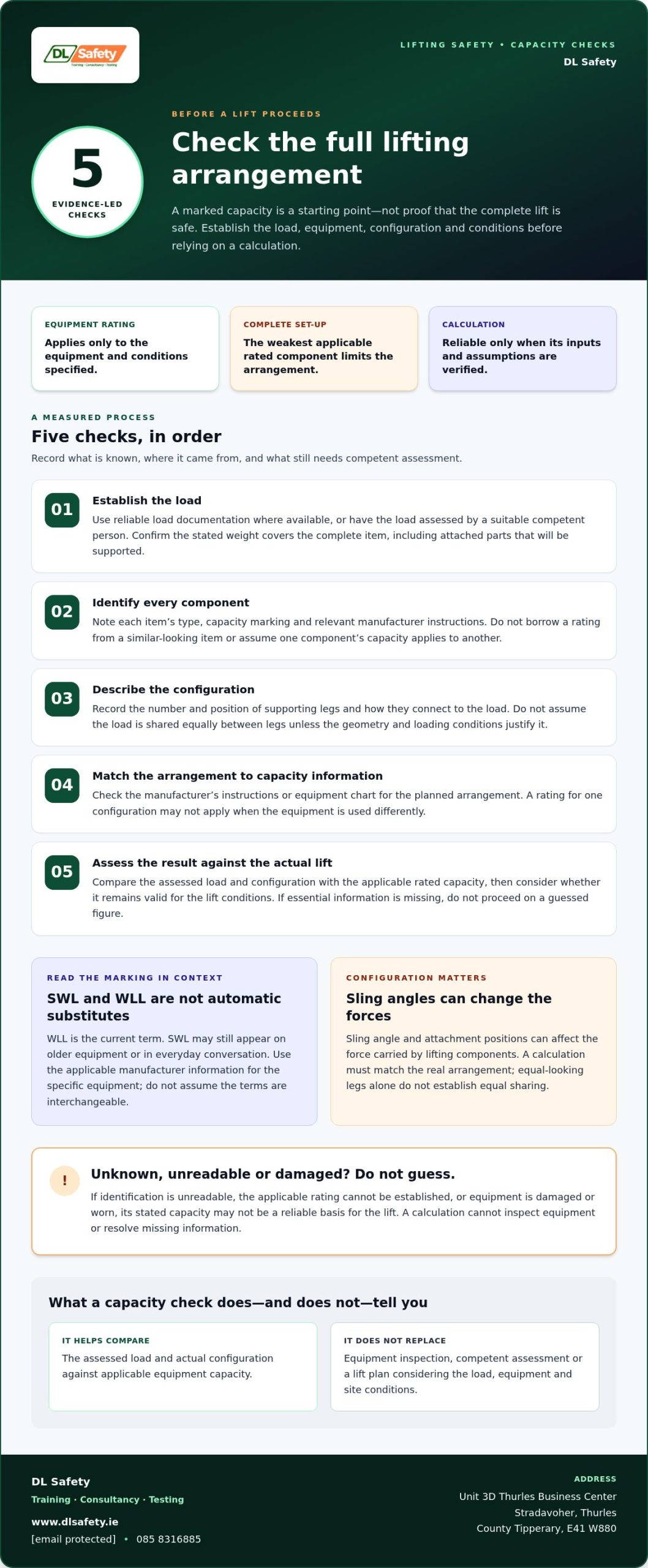
- Establish the load. Use reliable load documentation where available, or have the load assessed by a suitable competent person. Check whether the stated weight covers the complete item being lifted, including any attached parts that will be supported.
- Identify each component. Note the equipment type, capacity marking and relevant manufacturer instructions for every part of the arrangement. Do not substitute a rating from a similar-looking item or assume one component’s capacity applies to another.
- Describe the configuration. Record the number and position of the supporting legs and how they connect to the load. Do not divide the total weight equally between legs unless the geometry and loading conditions justify that assumption.
- Check the applicable capacity information. Match the planned arrangement to the manufacturer’s instructions or equipment chart. A rating for one configuration may not apply to another. Background on this distinction is available in Working Load Limit vs. Breaking Strength.
- Assess the result. Compare the assessed load and configuration with the applicable rated capacity, then consider whether the result remains valid for the actual lift conditions. If essential information is missing, do not proceed on a guessed figure.
How to present a worked calculation responsibly
Simple division is appropriate only when its assumptions match the real arrangement. For example, dividing a load by the number of sling legs assumes equal sharing. You cannot take that for granted simply because the legs look evenly placed. Sling angles and attachment positions can change the force carried by each leg. If an angle is used, state whether it is measured from the horizontal or vertical, and have a competent lifting professional verify the method and inputs.
Label any worked example as hypothetical and have a competent professional review it before publication or use. Show units consistently, explain what each input represents and identify the limits of the example. Do not imply a universal formula, safety factor or capacity reduction for all equipment. The relevant equipment chart and manufacturer instructions remain essential to interpreting the result.
If the calculation depends on information that has not been verified, a lift plan can help bring load details, equipment ratings, configuration and site conditions into one considered assessment.
How do sling angles and lifting components change usable capacity?
A sling’s marked capacity does not automatically describe what it can carry in every arrangement. As the sling legs move away from vertical, the force carried by each leg changes. The connections matter too: slings, chains, shackles and other components must all suit the way they are assembled and loaded. Assess the whole setup, not just the largest rating you can find.
The comparison below shows the general relationship, not a capacity chart. The applicable ratings and manufacturer instructions determine what can be used for a particular lift.
- Vertical arrangement: The sling leg or legs hang close to vertical. Assess the load on each leg using the actual arrangement and applicable equipment information.
- Angled arrangement: The legs slope outwards from vertical. This increases the force in each leg compared with a vertical arrangement supporting the same load, so a vertical rating alone is not enough to assess capacity.
- Multi-leg arrangement: Several legs support the load. Do not assume they share the load equally. Leg angles, attachment points and load geometry can affect how much each leg carries.
What happens to sling loading as the angle changes?
Picture a suspended load supported by two sling legs. As the legs spread further apart and become flatter, each leg must carry more tension to support the load. State whether an angle is measured from the horizontal, the ground, or from the vertical, the upright direction. These references describe different angles, so leaving the convention unstated can lead to a mistaken interpretation of a calculation or chart.
Idealised calculations rely on assumptions about geometry and load sharing. If the load’s centre of gravity, attachment positions or leg loading is uncertain, the calculation may not represent the real lift. Do not use a tidy result to fill those gaps. For sling-specific handling guidance, see the safe use of lifting slings guide.
How do slings, chains and shackles affect the overall rating?
Check the marking and manufacturer instructions for every component, including slings, chains, shackles and connecting hardware. The intended connection method and direction of loading can affect which rating applies, so do not assume a component’s marked capacity holds for every way it might be used. Confirm that each item is compatible with the others and with the planned arrangement.
The complete lifting arrangement is limited by the applicable rating of its weakest component or configuration. A high-capacity sling does not compensate for a shackle or connector rated for less, or for using any item outside its stated conditions. Condition matters too: damage, wear or an unreadable identification marking can undermine confidence in the equipment’s rating. For chain condition checks, refer to the lifting chain inspection criteria.
Before calculating safe working load (SWL) for a configuration, establish the sling angles, identify how the load is supported and match every component to its applicable manufacturer information. If the geometry or load distribution cannot be reliably established, treat it as a planning issue requiring competent assessment, not an invitation to assume equal sharing.
A practical process for checking SWL before a lift
A repeatable check helps the lift team work from the same information instead of relying on memory or assumptions. Start with the load, verify the equipment and arrangement, consider the site conditions, and record who has reviewed and authorised the method. If a key rating, weight or configuration cannot be verified, pause the lift and escalate the issue for competent review.
What should the pre-lift verification sequence include?
- Confirm the load details. Record what is being lifted, its weight and the source of that weight, such as suitable documentation or an assessment. Note any uncertainty rather than presenting an estimate as a confirmed figure.
- Identify the equipment. Match each item’s identification and capacity marking to the applicable manufacturer instructions. Check that the information relates to the equipment in hand and the planned arrangement.
- Review the configuration. Document how the load will be attached, the number and position of supporting legs, and the connection method. Make clear which assumptions underpin any assessment of load sharing.
- Check condition and examination information. Look for visible damage, wear or missing identification, and review relevant inspection or thorough examination information for the equipment. A satisfactory calculation cannot make equipment in unsuitable condition fit for use.
- Record the method and controls. Note the planned lift path, relevant site conditions, the people involved and their roles, and how the lift will be communicated and authorised. This record gives the team a shared reference and supports later review.
Some details may be estimated only where the basis is suitable for the task and the assumption is clearly recorded and accepted as part of a competent assessment. An unknown load weight, illegible marking or uncertain configuration is not a safe estimate. It is missing information that needs resolving before the lift proceeds. Keep the source, any assumptions and the person who reviewed them visible in the lift record.
When should a lift pause for competent review?
Stop if markings are missing, unreadable or inconsistent with available records, or if the load weight cannot be reliably established. Pause as well if load sharing is uncertain, the geometry is unusual, equipment condition raises concern or site conditions have changed since planning. Reassess the method before restarting. Do not carry an unresolved assumption forward simply because the lift has already been prepared.
For relevant examination context, see the GA1 certificate guidance. Where the operation calls for documented planning, complex crane lift planning guidance can help frame the information and controls that need consideration. A clear process makes calculating safe working load (SWL) one part of a reviewed lift method, not the sole basis for proceeding.
For support bringing load details, equipment ratings and site conditions together, arrange lift planning support.
How lift planning and safety support help put SWL checks into practice
A capacity check becomes more useful when it sits within a clear plan for the whole operation. A lift plan brings together the load information, applicable equipment ratings, lifting configuration and site conditions, so the people involved can understand the intended method and its limits. It does not make uncertainty disappear, but it helps identify what needs review before the lift proceeds.
What a lift plan contributes to an SWL decision
A practical plan records what is being lifted and the information used to establish its weight, along with the equipment and arrangement selected for the task. It can describe how the load will be attached, the intended route and relevant site conditions, giving the lift team a shared reference instead of leaving important details to verbal assumptions.
Documenting roles and communication arrangements also helps people understand who is involved and how the agreed method is to be carried out. If the load, configuration or site conditions change, the original assessment may no longer fit. The plan gives the team a basis for recognising that change and arranging a suitable review before continuing. This is particularly valuable where calculating safe working load (SWL) depends on assumptions that need to remain true throughout the operation.
How to discuss lifting safety support with DL Safety
DL Safety provides lift planning and lifting equipment support for workplace operations. These services help bring equipment selection and planning considerations into the same conversation, while recognising that a calculation alone does not replace competent assessment. For workplaces looking to strengthen health and safety management over time, Monthly Safety Support Packages provide ongoing support.
A well-organised, reviewed process gives the people involved clearer information to work from and a stronger basis for deciding whether the planned method remains suitable. Talk to DL Safety about lift planning, lifting equipment or ongoing safety support.
Visit www.dlsafety.ie, email info@dlsafety.ie or call 085 8316885.
Make the next lift a planned decision
Before the next lifting operation, make sure the people involved share an understanding of the information behind the planned method. If the load, equipment or site conditions change, treat that as a reason to review the plan, rather than relying on a calculation made for a different setup. This habit makes calculating safe working load (SWL) one considered part of how work is prepared and carried out.
Where lifting arrangements form part of wider workplace systems, appropriate support can help keep planning, equipment oversight and safety management connected. DL Safety also provides GA1 testing and health and safety site audits, alongside its other lifting support. The right next step depends on the task and the support your workplace needs.
For a practical discussion about your lifting operation and how to organise its planning, discuss lift planning and safety support with DL Safety. A clear, reviewed approach gives your team a sound basis for each lift.
Frequently Asked Questions
How do you calculate safe working load (SWL)?
There is no universal formula that turns any equipment’s breaking strength into an SWL suitable for a lift. For calculating safe working load (SWL), use the manufacturer’s applicable rated capacity and instructions, then assess the planned load and configuration against them. If a calculation relies on an unverified safety factor or assumed load split, its result is not a dependable basis for proceeding.
Is SWL the same as Working Load Limit (WLL)?
Not necessarily. SWL and WLL are terms you may see used in similar ways, but do not assume the labels mean exactly the same thing for every item. If equipment and its documentation use different terms, identify the specific item and follow the manufacturer’s information that applies to it. Where records and markings appear inconsistent, resolve that discrepancy before selecting the equipment for a lift.
Does sling angle affect the safe working load?
Yes. As sling legs spread out and become flatter, the tension in each leg increases for the same supported load. Check the angle reference used in the relevant chart or assessment, since an angle measured from the horizontal differs from one measured from the vertical. Also consider the full lift path: a sling’s geometry may change as the load is raised or moved.
Can I use the SWL marked on a shackle for the whole lift?
No. A shackle marking relates to that component under applicable conditions, not automatically to the complete lifting arrangement. For example, a shackle may connect a sling to a lifting point, but the other equipment and the way the load is attached still need to be suitable. Check that the shackle’s identification and manufacturer guidance match its intended connection and loading direction.
What should I do if lifting equipment has no readable SWL marking?
Do not use the equipment for a lift until its identity and applicable capacity can be established. Set it aside so it cannot be mistaken for verified equipment, and use traceable manufacturer records or a competent assessment to resolve the missing information. Do not infer a rating from the equipment’s appearance, size or similarity to another item, and do not recreate a marking from an estimate.
Does a SWL calculation replace a lift plan?
No. A calculation can inform a lift decision, but it does not communicate the complete working method to the people involved. A lift plan can document the intended sequence, roles, route and relevant site controls, helping the team understand how the work is meant to proceed. If site conditions or the proposed method change, the plan may need review before the lift continues.
Who can check whether a lifting arrangement is suitable?
A competent person with relevant knowledge and experience of the equipment and planned operation should assess the arrangement. That review may need to consider the load, attachments, equipment information and working conditions together, rather than checking a calculation in isolation. If uncertainty remains about the load, ratings or setup, pause the lift until the issue has been resolved and the method can be reviewed.