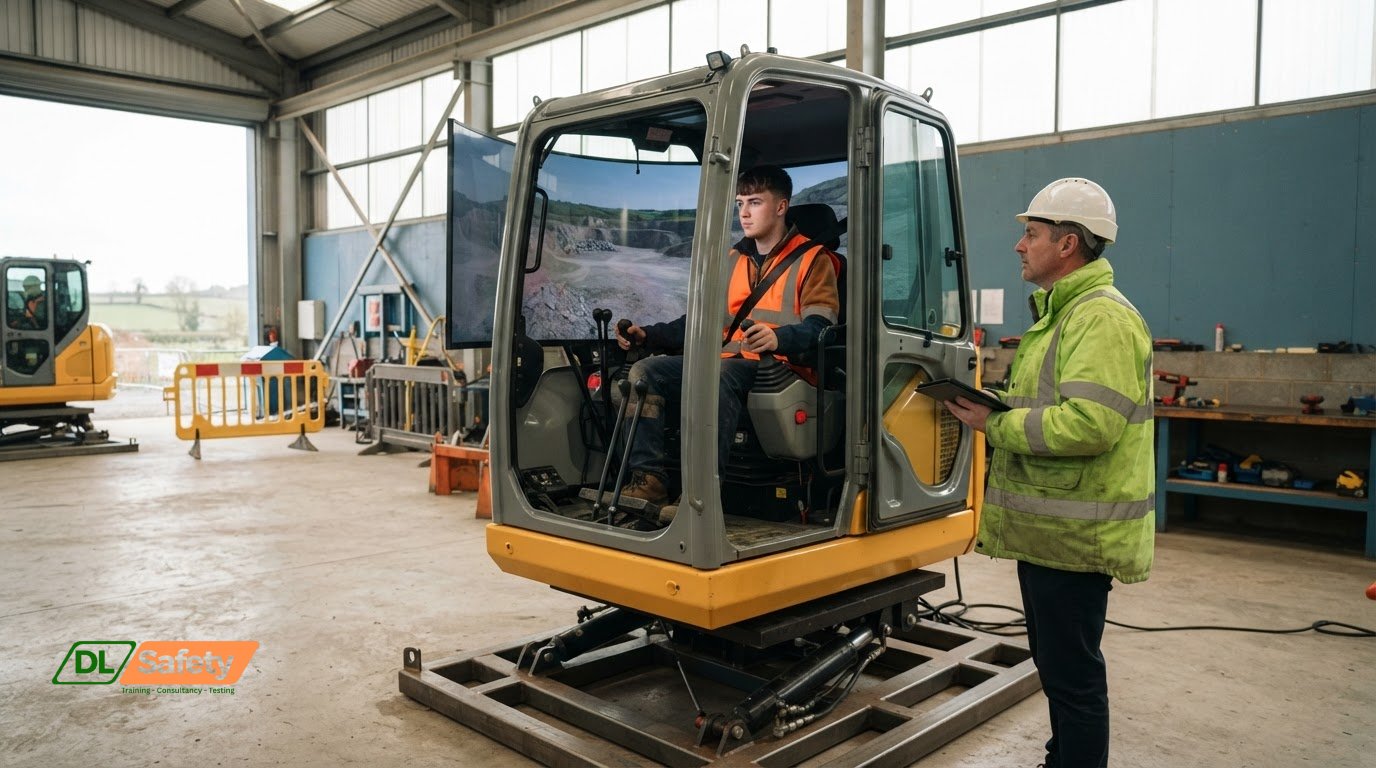
Safer heavy equipment training starts before a machine enters a live worksite. The benefits of simulation training for heavy equipment include practising hazards such as tipping, equipment failure and severe weather in a controlled environment, then repeating exercises to build proficiency. This helps identify skill gaps before they create risks during real work.
Employers naturally want new operators to gain practical experience, but using working machinery for every early lesson brings avoidable exposure, fuel use and wear. Simulation helps trainees develop decision-making and equipment skills before moving on to practical site experience.
This article explains how simulator practice can support safer operator development, strengthen training and reduce reliance on machinery during lessons. It also explores how simulation fits alongside hands-on instruction and what Irish businesses should consider when incorporating it into a wider approach to workplace safety.
Key Takeaways
- Use simulator exercises to identify skill gaps early and give operators space to practise before progressing to more complex tasks.
- Build hazard awareness by rehearsing challenging situations in a controlled setting, then connect that practice with hands-on experience.
- Assess how simulation could fit into training across construction, mining and logistics, with outcomes shaped by the programme and the task.
- Reduce reliance on working machinery during early practice, which can help limit fuel use, wear and training-related downtime.
- Support equipment training with a wider safety plan, including DL Safety’s Monthly Safety Support Packages where ongoing safety support is needed.
1. How Does Simulation Training Reduce the Likelihood of a Safety Incident?
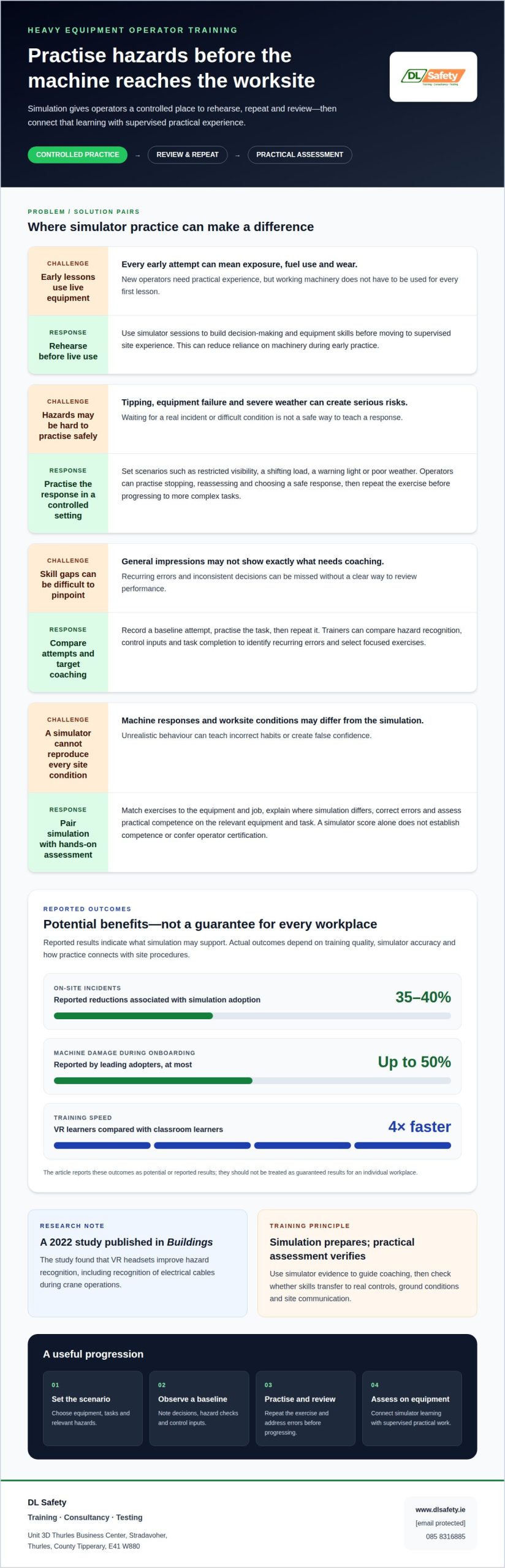
Simulation can reduce training exposure by letting operators practise before handling live machinery. Trainees can rehearse responses to tipping, equipment failure and severe weather in a controlled setting, repeating each exercise until they demonstrate proficiency before moving on to more complex tasks. Trainers can address unsafe decisions before operators reach a worksite.
That structure can support faster onboarding and help experienced operators close specific skills gaps. For example, a trainer can set a crane exercise involving overhead electrical cables, then observe whether the trainee recognises the hazard and adjusts their actions. A 2022 study published in Buildings found that VR headsets improve hazard recognition, including electrical cables during crane operations. The scenario gives both new and experienced operators a practical focus for learning.
Simulator metrics can make progress more objective. Trainers can compare how operators respond to the same scenario, identify recurring errors and choose exercises to address those gaps. A practical approach is to record a baseline attempt, practise the task, then repeat it and compare decisions. Measures might include hazard recognition, control inputs and task completion. These records help trainers target coaching instead of relying on general impressions.
There are reported safety and equipment outcomes, though they are not guarantees for every workplace. Simulation adoption is associated with reported reductions of 35–40% in on-site incidents. Leading adopters also report up to 50% less machine damage during operator onboarding. These figures indicate potential benefits, while actual results depend on training quality, simulator accuracy and how practice connects with site procedures.
Training records can support workplace assessment, but a simulator score alone does not establish practical competence or confer operator certification. Pair simulator evidence with a practical assessment using the relevant equipment and task. For Irish employers, this distinction keeps training records useful without treating simulation as a substitute for hands-on evaluation. The benefits of simulation training for heavy equipment are greatest when practice forms part of a broader competency process.
How effective is heavy equipment simulation training compared with on-the-job training? VR learners can be trained four times faster than classroom learners, and simulation provides repeatable practice before live equipment use. It complements on-the-job training by preparing operators for practical assessment, rather than replacing experience with real machinery.
What are the limitations and risks of heavy equipment simulator training? A simulator may not reproduce every machine response or site condition. Inaccurate simulation can teach incorrect habits or create false confidence. Trainers should match exercises to the equipment and tasks, review operator performance and correct errors before progressing to live practice.
2. Safer practice in a risk-free environment
A simulator lets operators make mistakes without damaging a machine or endangering nearby workers. For example, a trainee can misjudge a turn beside a virtual barrier, pause, review the result and try again. Immediate feedback makes the consequence visible while keeping the exercise controlled. The machine remains available for work instead of being used for every early learning attempt.
High-risk situations can be introduced deliberately instead of waiting for them to arise on site. A trainer might set up a reversing exercise with restricted visibility, then ask the operator to identify hazards and choose a safe response. Other scenarios could include a shifting load, a warning light or poor weather. Trainees can practise stopping, reassessing and following the correct response without real-world consequences.
Repetition helps make safe responses more familiar. Operators can repeat a manoeuvre until their control inputs and hazard checks are consistent, then progress to a harder version. For instance, the trainer can add a tighter route or pedestrian crossing after the basic exercise. This staged approach builds skills at a manageable pace before operators face changing site conditions.
Realistic scenarios can prepare trainees for worksite decisions beyond operating controls. A simulated task might require them to check the route, consider nearby people and stop if visibility changes. In a rain scenario, the operator could reduce speed, reassess stopping distance and wait for a clear view. Practising this sequence connects machine handling with safe judgement.
Simulator practice is most useful when it leads into practical work, not when treated as a substitute. After a virtual exercise, a trainer can discuss what the operator noticed, which action they took and what to change next time. A supervised task on the actual machine can then test whether those decisions transfer to real controls, ground conditions and site communication.
Simulation has limits. It cannot reproduce every vibration, surface variation or unexpected interaction on a live worksite, and unrealistic machine behaviour may teach poor habits. Trainers should match exercises to the equipment and job, explain where simulation differs and correct errors before trainees progress. This keeps practice useful without confusing it with full worksite experience.
For a practical training plan, connect simulator exercises to the equipment, hazards and tasks operators will encounter. A clear progression from basic controls to complex decisions makes practice purposeful and reviewable. Teams developing structured operator practice can use that approach to link controlled learning with supervised worksite tasks.
3. VR training outcomes in construction, mining, and logistics
VR technology can recreate tasks across construction, mining and logistics. A construction operator might practise positioning an excavator beside a trench, while a warehouse trainee rehearses moving a load through a busy route. Mining exercises could focus on confined spaces or changing ground conditions. Tailoring each scenario to the equipment, setting and decisions involved helps instructors provide relevant learning rather than identical exercises for every operator.
Reported programme results illustrate how simulation can support training outcomes. At Conewago Enterprises, integrating simulation reduced on-site crane training time from six months to seven weeks. A construction firm also reported achieving a fourfold training rate using VR simulators, helping new hires reach proficiency in weeks rather than months. These examples show potential gains in training pace, though results depend on each programme’s equipment, scenarios and teaching approach.
Logistics training can use a virtual loading area to practise turning, positioning and moving loads around obstacles. An instructor can change the route or introduce a pedestrian crossing, then review the operator’s choices. In construction, an exercise might involve approaching a lifting area and positioning equipment safely. This makes simulator learning relevant to different roles while letting trainers focus on the decisions each job requires.
A useful training programme can be organised by equipment type and task. For example, a construction course might progress from excavator controls to travelling, digging and positioning. A lifting module could focus on load movement and communication between the operator and team. Instructors can build skills in sequence, review performance and direct practice towards the tasks operators will perform on site.
Simulation can keep training moving when equipment is booked for production or weather interrupts outdoor practice. Teams can rehearse virtual controls and task decisions, then apply those lessons during supervised work on actual equipment. Agricultural exercises might cover field turns or movement around other vehicles. Scenarios can reflect the job, but virtual conditions cannot reproduce every surface or machine response.
To assess outcomes, compare operator performance against consistent task criteria before and after practice. An instructor might review control choices, route planning and responses to changing conditions, then record where further coaching is needed. This gives managers a practical way to assess progress across construction, mining or logistics teams. Simulation works best within a wider programme, with hands-on assessment showing whether learning transfers to real equipment and worksites.
4. Fuel, maintenance, and equipment downtime costs
Each training hour on an operating machine uses fuel and equipment that could support production. A simulator shifts some early practice away from actual machinery, helping reduce fuel consumption, operating hours and wear. For example, an operator can repeat basic control exercises virtually before practising on an excavator under supervision. The value depends on how much practice moves off live equipment.
Fewer training hours on working machinery can reduce training-related wear. Less use during novice practice means fewer operating hours added to the machine’s service history. It can also reduce avoidable bumps, rough handling or incorrect manoeuvres during early learning. These effects may limit training-related wear, but regular maintenance remains essential for equipment used on site.
Downtime is another cost to consider. If a machine is reserved for repeated training exercises, planned work may have to wait or another machine may be needed. Simulation lets operators rehearse scenarios without taking that machine out of production. Training managers can compare scheduled equipment hours before and after introducing simulator practice to assess whether availability improves.
Training costs go beyond fuel and machine use. Employers can also account for instructor time, operators’ time away from work, equipment preparation and maintenance related to training. A practical comparison records these costs for the existing programme, then measures them again after adding simulation. This shows whether the technology changes the overall cost of operator training, rather than simply shifting costs between activities.
Conewago Enterprises lowered its training costs by over 60% after integrating simulation into its programme. Companies typically recover their initial VR training investment within 3 to 6 months. These reported figures offer context, not a forecast for every Irish project: equipment types, training frequency, instructor capacity and simulator use all affect the financial result. A business should assess those factors against its own operations.
Project productivity can also affect the return. A more practised operator may complete tasks with fewer unnecessary movements, reducing machine time and fuel use over repeated cycles. For example, a contractor can compare the time and fuel used for a defined excavation task before and after training. Use the same machine, task conditions and measurement method to make the comparison meaningful.
To assess the health and safety case alongside the financial one, track equipment hours, fuel use, maintenance records and training-related downtime. Compare these measures with operator performance and practical assessment results. Connecting immersive scenarios with actual operating data gives managers a clearer basis for deciding how simulation fits their equipment and project needs.
5. Safe heavy equipment training
Safe training needs a clear progression from basic controls to task-specific decisions. For an excavator operator, this might mean practising travel, positioning and digging before attempting a more complex lift. Trainers should define competent performance and use the same criteria during practice and assessment. This gives both learners and instructors a clear standard to work towards.
Simulator quality matters because operators learn from the machine behaviour it presents. A high-quality safety simulator should reproduce machine behaviour and provide visual, haptic and auditory immersion. For example, the controls should respond consistently when an operator turns or raises an attachment. If simulated responses differ from those of the real equipment, learners may develop unsafe habits when they transfer to a live machine.
Scenario design should reflect hazards on the actual job. An excavator exercise could include restricted visibility, a nearby worker and a requirement to stop before moving. The learner must notice changing conditions, choose a safe action and explain the decision. Trainers can also use a fault scenario to practise stopping work, securing the machine and communicating the issue.
Simulation adds to practical instruction; it does not replace work with real equipment. After a virtual task, operators should demonstrate the same skills under supervision on the relevant machine. Trainers can compare control use, hazard awareness and communication across both settings. This helps identify what transfers well from virtual learning and where further coaching is needed.
A consistent assessment approach helps teams apply training standards across different operators. Record the exercise, decisions made and any corrective coaching. For example, if several learners miss the same hazard during a reversing task, the trainer can revisit that scenario before practical assessment. These records also help managers distinguish individual learning needs from an exercise that needs improvement.
There are risks in treating simulation as proof of readiness. Inaccurate exercises can teach incorrect lessons or give operators false confidence. Trainers should explain each scenario’s limits and compare its controls with the actual machine. They should also review exercises when equipment or work procedures change, so learners practise relevant tasks rather than outdated ones.
For safer outcomes, connect realistic scenarios, instructor feedback and supervised practice into one programme. Set the task, observe the operator, correct errors and assess the corresponding skill on real equipment. This approach helps develop capable operators while keeping training focused on the hazards their work presents. Explore support for safer operator training.
DL Safety: Monthly Safety Support Packages
DL Safety’s Monthly Safety Support Packages can help businesses maintain a consistent approach to workplace safety alongside equipment training. They’re a natural next step when operator development needs to fit within wider safety planning. For task-specific support, DL Safety also provides Lift Plans and GA1 Testing; Accident Investigation can help examine an incident and inform future safety measures.
For businesses in Ireland, this support can connect training considerations with practical workplace safety needs. Contact DL Safety by email at info@dlsafety.ie or by telephone on 085 8316885. The address is Unit 3D Thurles Business Center, Stradavoher, Thurles, County Tipperary, E41 W880.
You’re welcome to contact DL Safety or visit www.dlsafety.ie to discuss your safety needs.
Put safer training into practice
Start by identifying the operator skills that need development and where simulation can support them. Choose a task with clear training risks, define the actions operators should demonstrate, and connect simulator practice with supervised assessment on real equipment. Reviewing these steps keeps training relevant to your workforce and daily operations.
The benefits of simulation training for heavy equipment are greatest when practice fits into a consistent, wider approach to workplace safety. DL Safety’s Online Safety Courses can complement equipment-focused learning by supporting broader safety knowledge. Choose training that reflects your team’s work, then review progress and adjust the programme as tasks or equipment change.
For help discussing training needs and how they fit within your safety approach, contact DL Safety to discuss training. A considered next step can help your team build capability with safety at the centre of the process.
Frequently Asked Questions
How Does Simulation Training Reduce the Likelihood of a Safety Incident?
Simulation gives trainers an opportunity to spot unsafe decisions before operators work with live machinery. For example, a trainer can observe how a learner approaches a blind corner, then coach them to pause and reassess. Employers can also use simulator observations to identify recurring team weaknesses and target follow-up practice. The key is connecting training behaviour with the specific hazards of the operator’s role.
What are the main benefits of simulation training for heavy equipment operators?
The benefits of simulation training for heavy equipment operators include repeatable task practice, structured feedback and the chance to rehearse challenging situations without using a live machine. New starters can become familiar with controls, while experienced operators can focus on tasks they need to develop. Employers can schedule learning around work demands, so training is less dependent on machine availability.
How does heavy equipment simulation training improve safety and reduce accidents?
Simulation supports safer decisions by letting operators rehearse a response before encountering a similar hazard at work. For instance, a learner can practise stopping when visibility is obstructed, communicating the issue and resuming only when conditions allow. Trainers can discuss the sequence and reinforce site-specific procedures. This can strengthen hazard awareness, but simulator practice should connect with supervised assessment on the equipment used for the job.
Does simulator training reduce fuel use, equipment wear, and maintenance costs?
Simulation can reduce live machine time during early practice, helping limit training-related fuel use and operating hours. To evaluate the effect, compare fuel consumption, equipment hours and maintenance records before and after introducing simulation. Keep the comparison focused on equivalent tasks and training periods. Regular servicing remains important, and results depend on how much practice shifts from working equipment to a simulator.
What skills can operators practise in heavy equipment simulators?
Operators can practise control familiarisation, machine positioning, route choices and responses to hazards. A trainee might work on smooth excavator movements, then rehearse stopping when a route becomes obstructed. Exercises can also develop communication and decision-making, such as confirming a movement before proceeding. Employers should choose scenarios that reflect the operator’s actual duties, then use practical assessment to see whether those skills carry over to the worksite.
What types of heavy equipment can be trained on simulators?
Simulator options depend on the equipment and training system. Construction exercises may cover excavators or cranes, while other programmes can address transport or agricultural machinery. Before designing training, identify the machines operators use and their tasks, such as travelling, positioning or handling loads. Suitable scenarios reflect the relevant controls and decisions, with hands-on practice assessing performance on the actual equipment.
How can employers measure the return on investment of simulator training?
Compare the full cost of training with measurable operational changes over the same period. Record simulator and instructor time alongside fuel use, live equipment hours, maintenance activity and training-related downtime. Then review operator assessment results and task performance. For a fair comparison, use similar work and measurement methods before and after introducing simulation. The most useful evaluation considers both operational costs and whether operators demonstrate the required skills.
How long does heavy equipment simulator training take, and how many hours are recommended?
Trainees can practise at their own pace until proficient. One reported programme reduced crane training from six months to seven weeks, and VR learners can be trained four times faster than classroom learners.