
There’s no single annual renewal date for every health and safety course in Ireland. Under Section 10 of the Safety, Health and Welfare at Work Act 2005, employers must provide suitable instruction and training when employees start work, change tasks or encounter new equipment or systems, and periodically thereafter. The annual health and safety training requirements in Ireland therefore depend on the work, its risks and the training involved.
It’s understandable to want a clear date for each refresher, but renewing every course once a year isn’t a universal rule. This guide explains when to refresh training, what applies to manual handling and emergency preparation, and which records to keep, so you can plan around changing workplace needs and help employees work safely.
Key Takeaways
- Set training and refresher dates according to employees’ tasks, workplace risks and changes, rather than assuming every course renews annually.
- Plan manual handling refreshers around the recommended interval and revisit training sooner when work or risks change.
- Keep clear training records so you can track who attended, what they completed and when their next refresher is due.
- Include first aid, fire and evacuation arrangements in emergency preparation, with role-specific training kept current.
- Use your risk assessment to identify the training each role needs and review those needs as the workplace changes.
How Often Must Employers Renew Training in Ireland?
Irish employers must provide training suited to employees’ work and the risks identified. The law requires training when work changes and periodically thereafter, but not automatically every year.
Employer training duties
Section 10 of the Safety, Health and Welfare at Work Act 2005 requires employers to provide employees with instruction, training and supervision. Training must be adequate and appropriate to the work and its risks. Employers must provide it during working hours and at no cost to employees. This applies to occupational health, safety and welfare, not simply course attendance.
Start by identifying what each role involves, then match training to its hazards and working methods. Employees must take part in relevant instruction and follow workplace safety procedures. For example, a change in equipment may mean workers need updated instruction before using it. A course record helps managers track who has received that instruction.
Training timing and renewal
Training is required when employees start work, change tasks, or encounter new equipment, systems or technology. Employers must also provide it periodically to maintain competency. Irish law does not require every health and safety refresher course to be renewed annually. The appropriate interval depends on the course, the work and the risks identified.
Review training needs when work practices, equipment or staff change, and when competency needs attention. This gives managers a practical basis for setting refresher dates instead of applying one annual deadline to every course. Employers should also consider whether employees can still perform tasks safely and correctly.
Does Irish law require health and safety refresher training every year? No universal annual renewal rule applies to every course. Employers must provide training periodically and when work, equipment or systems change.
Finding HSA training guidance
Employers can use Health and Safety Authority (HSA) guidance on workplace information, instruction and training. The HSA recommends keeping a training register and reviewing it annually. Use that review to identify overdue refreshers, new training needs and changes affecting employees’ roles. A register supports planning, but training must still match actual work risks.
For construction workers, employers must provide instruction and training suited to the tasks and risks involved. Consider the relevant role-specific standard when deciding whether Safe Pass or CSCS training applies. A general induction alone may not address the practical hazards of a particular task.
Employers pay for mandatory training, which must take place during working hours. Managers should identify training needs and arrange suitable instruction; employees should attend and apply it. Section 10 of the 2005 Act covers these employer duties, while employee participation helps make training effective. Record the course and attendance so managers can plan future refreshers.
How often should health and safety training be refreshed?
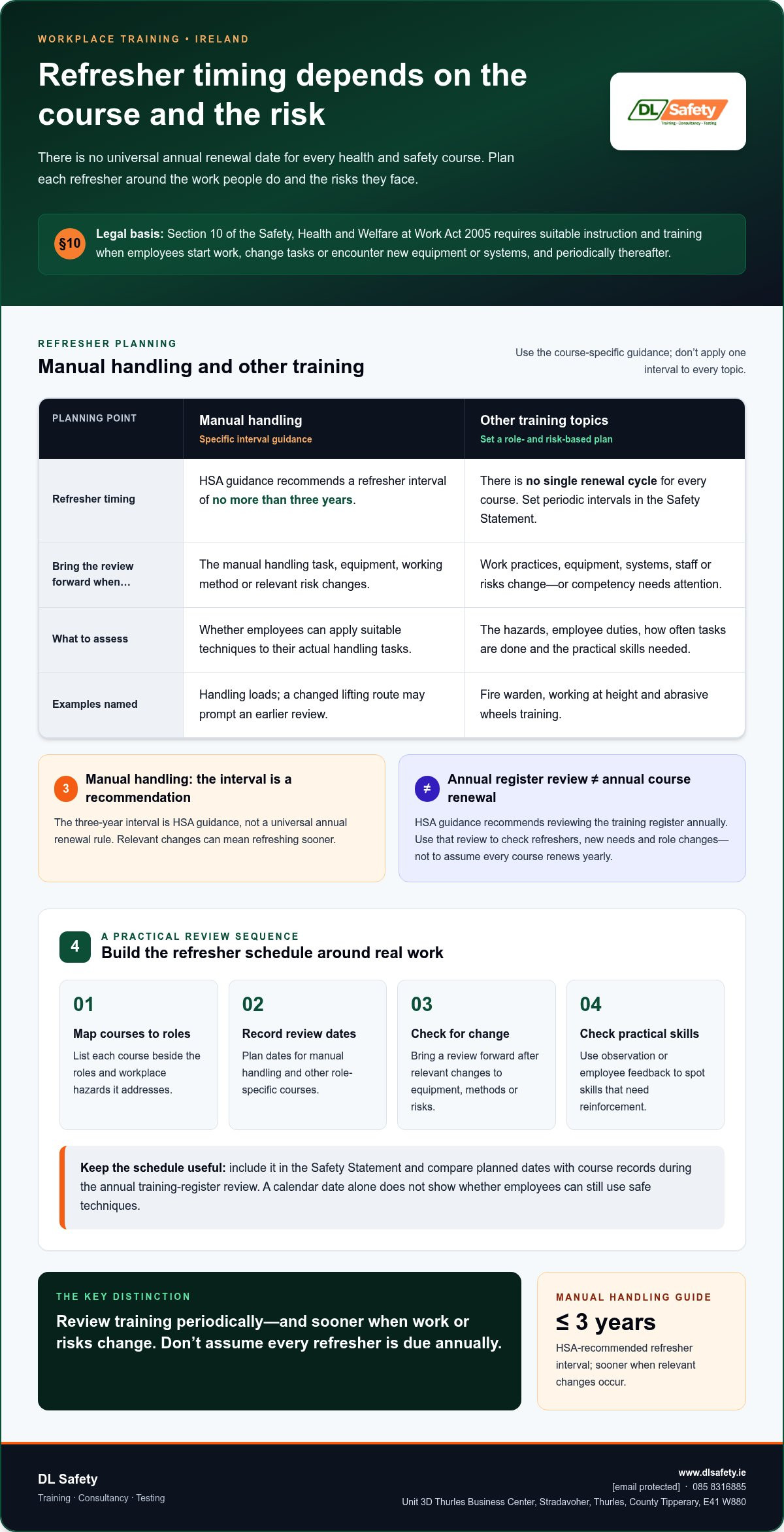
Irish employers should set refresher intervals according to the course, workplace risks and practical demands of each role. HSA guidance recommends manual handling refresher training at intervals of no more than three years, with earlier refreshers after relevant changes. Other courses do not share one universal renewal cycle, so employers need a planned review for each training topic.
Start with the hazards employees face and the skills they need to manage them. A refresher interval should reflect how often a task is performed, whether safe methods have changed, and whether employees can still apply what they learned. For example, a change to a manual handling task may prompt an earlier refresher than planned.
Manual handling has a clear recommended interval. HSA guidance recommends refreshing this training within a three-year interval, and sooner when relevant changes occur. Employers can use that recommendation when planning training for staff who handle loads, then review the interval if tasks or workplace risks change.
For other topics, set periodic intervals in the Safety Statement rather than applying the manual handling interval to every course. Consider each course separately: the hazards, the employee’s duties and the practical skills required all shape the review plan.
A workable refresher schedule can include these steps:
- List each course beside the roles and workplace hazards it addresses.
- Record a planned review date for manual handling and other role-specific courses.
- Bring a review forward after relevant changes to equipment, methods or risks.
- Use practical observation or employee feedback to identify skills needing reinforcement.
These steps distinguish a calendar reminder from an effective refresher. A date alone does not show whether employees can use safe techniques; practical observation can reveal where instruction needs reinforcing. For example, a supervisor may notice that a changed lifting route affects how employees handle loads, prompting a review before the next scheduled session.
Include the schedule in the Safety Statement and revisit it during the employer’s annual training-register review. This helps managers compare planned dates with course records and changing workplace conditions. For manual handling instruction, practical refresher training can help employees apply suitable techniques to their actual tasks. Employers looking for practical training support can explore options relevant to workplace needs.
For manual handling instruction, keep the planned refresh interval visible alongside other course dates, and review it when workplace risks or training needs change. Irish employers should set periodic refresher intervals for manual handling, fire warden, working at height and abrasive wheels training in their Safety Statements. HSE occupational safety and health refresher frequency varies by course and risk. Treat each course as its own planning decision: record the refresh plan in the Safety Statement, then revisit it during the training-register review. This keeps the schedule responsive without assuming one cycle suits every topic.
Training records
Clear records link employees, training courses and the work each person performs. A consistent register also helps managers spot missing evidence and plan reviews.
Keeping training records
Irish employers must keep records of employees’ health and safety training. HSE managers must maintain occupational health and safety training records, including each employee’s name, personnel number, training programme name and attendance date. For each course, record the employee, course title, completion date and renewal date where applicable. These details make it easier to trace training to a person’s role.
Build the register around the training process, not just certificates. Include the training need, course completed, course syllabus, trainer competence and attendance record. For example, if a worker changes role, managers can compare the new duties with recorded courses and identify a training gap. Keep the evidence together so the link between the need and the instruction remains clear.
- Record employee names and personnel numbers.
- Enter the programme or course name and attendance date.
- Note renewal dates where the course has a planned refresher.
- Keep the syllabus and evidence of trainer competence with the course record.
Use a consistent format for all training courses, whether records are digital or paper-based. Each course entry should make clear who attended, what was covered and when. If attendance was incomplete, record that accurately instead of treating enrolment as course completion.
Reviewing training records
The HSA recommends keeping a training register and reviewing it annually. Compare recorded training with current roles, course renewal dates and workplace training needs. Check that each entry identifies the employee and course, then flag missing attendance details or refreshers due under the employer’s schedule.
A practical review considers changes as well as dates. If equipment, work methods or an employee’s duties have changed, check whether existing training still fits the task. For example, a manager reviewing records after a role change can identify whether the employee needs instruction for new responsibilities. Record the review outcome and any follow-up training so the next review can track progress rather than repeat the same checks.
Training records can also show where evidence needs strengthening. Compare the course syllabus with the hazard or skill it was intended to address, and note whether the training remains relevant. For practical courses, record attendance alongside the course details so managers can connect training to the work. Review the register at the planned annual point and after relevant workplace changes, keeping dates and actions easy to follow.
Emergency and first-aid preparation
Emergency training should prepare employees for the actions assigned to them. Section 11 of Ireland’s Safety, Health and Welfare at Work Act 2005 requires employers to prepare emergency procedures and designate trained employees for first aid, fire and evacuation.
How often must first aiders receive refresher training in Ireland? First Aid Response certificates must be renewed every two years under Pre-Hospital Emergency Care Council (PHECC) rules. PHECC sets the certification standard, so employers should track each certificate’s renewal date.
First-aid arrangements should reflect the organisation’s workplace and risk assessment, which determine the number and type of workplace first aiders needed. Different tasks or hazards may call for different arrangements from those in an office, so managers should base designations on the risks employees could face.
Make emergency procedures clear in practice. Employees should know how to raise an alarm, who has first-aid responsibilities and which evacuation route applies to their work area. For example, a new starter needs to understand the relevant procedure before being expected to act in an emergency. Training should explain each designated role, not simply distribute a written plan.
What are the annual fire safety training requirements for Irish employers? The cited legislation does not set one universal annual refresher interval for every fire safety course. Employers must prepare emergency procedures and designate trained employees under Section 11 of the 2005 Act; training intervals should reflect workplace risks and role requirements.
The Fire Services Act 1981 requires commercial premises to have designated, trained fire wardens. The Safety, Health and Welfare at Work (General Application) Regulations 2007 also require employers to provide trained first aiders in every workplace. Employers should connect these responsibilities through practical instruction on alarm response, evacuation and first-aid arrangements.
Use a structured review to keep emergency preparation aligned with the workplace:
- Identify first-aid, fire and evacuation roles in the emergency procedures.
- Check First Aid Response certificate renewal dates against the two-year PHECC cycle.
- Review whether designated employees and arrangements still match the workplace risk assessment.
- Explain relevant procedures to employees whose roles or work areas have changed.
Changes matter. New work areas, revised evacuation routes or changed responsibilities can affect how employees respond. Review training when changes occur and make sure designated staff understand their current duties. A short practical exercise can show whether employees know the alarm process and route, while follow-up instruction can address confusion. Keep emergency procedures accessible, and ensure employees know where to find them before an incident.
What annual health and safety training is legally required for employers in Ireland?
Irish law does not set one annual training course for every employee. Under Section 10 of the Safety, Health and Welfare at Work Act 2005, employers must provide instruction, training and supervision suited to employees’ work and risks. Training needs depend on job tasks, workplace risk assessments, applicable regulations and role-specific standards.
Start with the hazards identified under Section 19 of the 2005 Act. Then map each risk to the employees exposed and the skills needed to work safely. For example, a role involving load handling has different training needs from one involving work at height. New equipment, changed systems or altered tasks can also create a need for instruction.
Some requirements relate to particular work:
- Under Chapter 4 of the Safety, Health and Welfare at Work (General Application) Regulations 2007, employees who lift, carry, push or pull loads require manual handling training.
- Ireland’s Work at Height Regulations 2006 require employers to ensure only competent, trained persons plan and carry out work at height.
- Part 4 of Ireland’s Safety, Health and Welfare at Work (General Application) (Amendment) (No. 2) Regulations 2016 requires people who mount, adjust or operate abrasive wheels to hold a training certificate.
These examples show why training plans should follow job requirements rather than use an identical annual schedule. Employers should identify the training required for each role, consider emergency preparedness and set periodic refreshers in the Safety Statement. Review the plan when workplace risks, tasks or equipment change, and when employees need training to maintain competency.
The Safety Statement also has an annual communication requirement: employers must bring it to employees’ attention at least annually. That does not mean every training course must be renewed annually. Keep the distinction clear in the training plan: communicating workplace hazards and delivering practical instruction serve different purposes.
Managers can organise the process with a role-based review:
- List roles and their regular tasks, including any work with loads, heights or abrasive wheels.
- Match each task to identified hazards, applicable regulations and necessary competence.
- Record required instruction and set refresher dates according to course and risk.
- Revisit training needs after changes to tasks, equipment, systems or technology.
This approach makes annual planning useful without inventing a blanket renewal rule. The HSA recommends reviewing the training register annually, while course intervals should reflect the topic and workplace risk. A practical check might compare employees’ current duties with their training records, then identify gaps before they affect safe work. The result is a plan tied to actual responsibilities, not just a calendar date.
In Ireland, the training topics and delivery methods employees need depend on their tasks, workplace risk assessment, applicable regulations and any role-specific standard. Choose training to suit the work rather than applying the same course across the organisation.
Identify health and safety training needs across all job functions and levels, including training required by legislation and for emergency preparedness. Considering these needs together helps ensure the plan covers both routine work and emergency preparation.
DL Safety: Monthly Safety Support Packages
DL Safety offers Monthly Safety Support Packages for employers who need ongoing support with workplace safety responsibilities. If training reviews, records and changing work risks are difficult to manage alongside daily operations, ongoing support can help keep these responsibilities in view. Employers can also turn to DL Safety for Lift Plans, GA1 Testing or Accident Investigation when those needs arise.
To discuss workplace safety support, contact info@dlsafety.ie or call 085 8316885. DL Safety provides nationwide support across Ireland. You can also visit dlsafety.ie to learn more about its services and how to meet annual health and safety training requirements Ireland.
Make training part of your next planning cycle
Use your next planning cycle to connect training decisions with the work employees will actually perform. A role change, new project or revised work method can prompt a useful conversation about skills, practical instruction and ongoing safety support. This turns annual health and safety training requirements in Ireland into a working plan rather than a calendar exercise.
If you need help putting that plan into practice, DL Safety offers Monthly Safety Support Packages and Online Safety Courses. Lift Plans can support work that requires lifting activities to be planned. Each service addresses a different workplace need, so consider which best fits your next step.
Contact DL Safety about training to discuss a practical way forward. A considered plan can help your team build safety into its everyday work.
Frequently Asked Questions
What Happens If You Ignore Training Legal Requirements in Ireland?
Ignoring required training can leave an employer failing to meet workplace safety duties. It can also leave employees without the instruction needed to manage hazards in their roles. If an incident occurs, incomplete training evidence may make it harder to demonstrate what instruction was provided. The Health and Safety Authority can use enforcement powers under the Safety, Health and Welfare at Work Act 2005, including improvement directions, prohibition notices and fixed-payment notices.
What records must employers keep to prove health and safety training in Ireland?
Keep a clear record linking each employee to their training and attendance. Include the employee’s name and personnel number, the programme or course name, and the date attended. Keep supporting evidence of the identified training need, course syllabus and trainer competence. If a worker moves into a role with different hazards, these records help managers show what training was completed and identify any instruction still needed.
What penalties can Irish employers face for failing to provide required safety training?
Serious health and safety offences in Ireland can result in fines of up to €3 million. That figure describes the stated maximum for serious offences, not an automatic fine for every training failure. The Health and Safety Authority also has enforcement powers under the 2005 Act, including improvement directions, prohibition notices and fixed-payment notices. Employers should address identified training gaps and keep evidence of the steps taken.