Could a routine refurbishment project on a pre-2000 building jeopardise your health for decades simply because of a regulatory update you haven’t had time to study? With asbestos-related diseases still claiming over 100,000 lives worldwide annually, the need for robust asbestos awareness for construction workers has never been more critical. You’ve likely felt that familiar sense of unease when stripping back old insulation or floor tiles, wondering if the materials in front of you are truly safe or a hidden hazard waiting to be disturbed.
We understand that keeping up with the Directive (EU) 2023/2668 requirements transposed into Irish law for 2025 and 2026 feels like a burden on top of your actual trade. Our goal is to provide a clear, pragmatic path through these complexities so you can focus on your work with total peace of mind. This guide will show you how to identify high-risk materials, master the protocol for suspected exposure, and ensure your site remains fully compliant with the latest safety mandates.
At DL Safety, we act as your personable expert to ensure your team stays protected and your projects stay on track. Based at Unit 3D Thurles Business Centre, Stradavoher, Thurles, County Tipperary, E41 W880, we offer everything from bespoke training to monthly safety support. If you’re unsure about a site’s safety status, call us on 085 8316885 or email info@dlsafety.ie. You can also explore our full range of safety solutions at www.dlsafety.ie.
Key Takeaways
- Learn why buildings constructed before 2000 remain a primary hazard and how to recognise the specific materials that pose the greatest risk to your long-term health.
- Understand the mandatory 2025-2026 Irish training requirements to ensure your site remains legally compliant and your team is fully authorised to work.
- Master the “Stop, Cordon, Report” protocol to maintain effective asbestos awareness for construction workers when encountering suspected hazardous fibres on-site.
- Discover the practical differences between friable and non-friable materials to accurately categorise risks during complex demolition or refurbishment projects.
- Explore how professional site audits and monthly support packages can simplify complex regulatory documentation while ensuring your safety protocols remain up to date.
The Ongoing Risk: Why Asbestos Awareness Still Matters in 2026
Asbestos awareness for construction workers isn’t just about ticking a box on a compliance form; it’s a life-saving skill set that allows you to recognise and avoid disturbing hazardous fibres. While the material was largely banned in Ireland by the end of 1999, the legacy of its use remains a daily reality for tradespeople. Asbestos was once valued as a miracle mineral for its heat resistance and durability, but we now know it as a hidden killer because its fibres are invisible to the naked eye. You won’t see them in the air, and you won’t feel them in your lungs until the damage is already done.
When these microscopic fibres are inhaled, they can cause devastating conditions like mesothelioma, asbestosis, and lung cancer. The real danger lies in the latency period. Symptoms often don’t appear for 20 to 50 years after the initial exposure. This means the risks you take on a site today could dictate your health decades down the line. It’s a silent threat that requires a proactive, disciplined approach to safety every single day.
The Scale of Asbestos in Modern Refurbishment
Ireland’s industrial and residential landscape is heavily populated with structures built during the peak asbestos years. If you’re working on a building constructed or renovated before 2000, you should assume ACMs (Asbestos Containing Materials) are present until proven otherwise. Modern refurbishment and demolition projects are the primary triggers for exposure. When you drill, sand, or break through older materials, you risk releasing millions of fibres. Negligence doesn’t just lead to severe health consequences; it carries heavy legal liabilities and the potential for immediate site closure.
Common Misconceptions Amongst Construction Workers
Misinformation can be as dangerous as the material itself. Many workers still believe a little bit of dust won’t hurt, but there’s no safe level of exposure. Another common myth is that buildings from the early 2000s are automatically safe. In reality, stockpiled materials were sometimes used after the official ban. Crucially, completing a training course doesn’t mean you’re licensed to remove the material. Awareness training is designed to help you stop work and stay safe, not to turn you into an abatement specialist.
At DL Safety, we help site managers and tradespeople stay on the right side of the law through our online safety courses and site audits. For expert guidance, contact our team at Unit 3D Thurles Business Centre, Stradavoher, Thurles, County Tipperary, E41 W880. You can reach us at info@dlsafety.ie, call 085 8316885, or visit www.dlsafety.ie to learn more about our support packages.
Understanding the 2025-2026 Asbestos Training Regulations
The regulatory framework governing site safety has shifted significantly with the introduction of the Safety, Health, and Welfare at Work (Exposure to Asbestos) Regulations 2006 to 2025. These updates, which reflect the transposition of Directive (EU) 2023/2668 into Irish law, set a rigorous new benchmark for site entry and worker protection. The Health and Safety Authority (HSA) is actively enforcing these 2026 standards, moving beyond simple guidance to strict site inspections. For every tradesperson, maintaining up-to-date asbestos awareness for construction workers is now a non-negotiable part of modern site life.
Mandatory training is the primary tool used to manage these risks. If your daily tasks involve any possibility of disturbing Asbestos-Containing Materials (ACMs), you’re legally required to hold a valid training certificate. Whilst an OSHA Asbestos Overview provides an excellent international perspective on the health hazards and mitigation methods, Irish regulations require a specific tiered approach. This ensures your level of knowledge directly matches the specific risks associated with your trade and the materials you’re likely to encounter.
Mandatory Training Tiers for Construction
There are three distinct levels of training designed to cover different roles on a site. Awareness Training is the baseline for anyone who might encounter ACMs but won’t intentionally handle them, such as electricians or carpenters. Non-Licensable Work training is required for minor, low-risk maintenance tasks where materials might be disturbed but are unlikely to release high levels of fibres. Specialist Licensed Training is the most intensive tier, strictly reserved for high-risk removal and demolition work that requires HSA notification and specialised equipment.
Certification and Compliance Validity
Verifying a safety training certificate is now a standard part of the site induction process. We recommend annual refreshers to ensure your knowledge remains sharp and your documentation stays site-ready. If you’re looking for a practical way to meet these requirements, our online safety courses offer a flexible solution that doesn’t require you to take days away from the project. At DL Safety, we act as your trusted advisor, helping you stay compliant whilst you focus on the job at hand.
To discuss your training needs or our monthly safety support packages, visit our office at Unit 3D Thurles Business Centre, Stradavoher, Thurles, County Tipperary, E41 W880. You can also reach us at info@dlsafety.ie, call 085 8316885, or explore our full range of services at www.dlsafety.ie.
Identifying Asbestos-Containing Materials (ACMs) on Site
Effective asbestos awareness for construction workers begins with the understanding that you cannot identify asbestos by sight alone. Because the material was integrated into thousands of different building products, it often hides in plain sight, disguised as ordinary insulation, ceiling tiles, or decorative finishes. Before you pick up a tool, your first priority is to determine if the area has been surveyed and what specific materials have been flagged as hazardous. This isn’t about guesswork; it’s about following a methodical process to ensure you don’t accidentally disturb fibres that have been dormant for decades.
One of the most important distinctions you’ll need to make is between friable and non-friable materials. Friable asbestos is any material that can be easily crumbled or reduced to powder by hand pressure, such as old pipe lagging or loose-fill insulation. These are high-risk because they release fibres into the air with the slightest touch. Non-friable materials, like asbestos cement roof sheets or vinyl floor tiles, are more stable because the fibres are bonded into a solid matrix. However, these become just as dangerous the moment you use a power tool to cut, sand, or drill them. For practical, task-specific guidance on handling different materials, HSE’s Asbestos Essentials provides a wealth of downloadable factsheets that help clarify these risks.
High-Risk Areas: Where to Look
Whilst asbestos can be found almost anywhere in a pre-2000 building, certain areas are notorious for containing ACMs. You should be particularly cautious when working around the following:
- Thermal Insulation: Often found as lagging on pipes and boilers, or as loose-fill insulation in wall cavities and lofts.
- Asbestos Insulating Board (AIB): Frequently used for internal partitions, ceiling tiles, and fireproofing around structural steel.
- Textured Coatings and Flooring: Decorative finishes like Artex often contain small amounts of asbestos, as do many heavy-duty vinyl floor tiles and their associated adhesives. If you are planning a renovation, consulting expert carpet fitters Doncaster can ensure that your new flooring is installed to the highest professional standards once the site is safe.
The Role of Asbestos Surveys
A professional survey is the only way to confirm the presence of asbestos. A Management Survey is designed for the day-to-day occupation of a building, but it isn’t enough for construction work. If you’re involved in any intrusive tasks, a Refurbishment and Demolition (R&D) Survey is a legal requirement. This is a more aggressive inspection that looks behind walls and under floors. You should never start work on an older property without first reviewing the results of the R&D survey in the site safety file.
At DL Safety, we specialise in site audits and safety statements to ensure your project starts on a solid, compliant foundation. If you need help interpreting a survey or want to arrange bespoke training for your team, contact us at Unit 3D Thurles Business Centre, Stradavoher, Thurles, County Tipperary, E41 W880. You can reach our experts on 085 8316885, email info@dlsafety.ie, or visit www.dlsafety.ie for more information on our monthly support packages.
Emergency Protocols: What to Do if You Suspect Asbestos
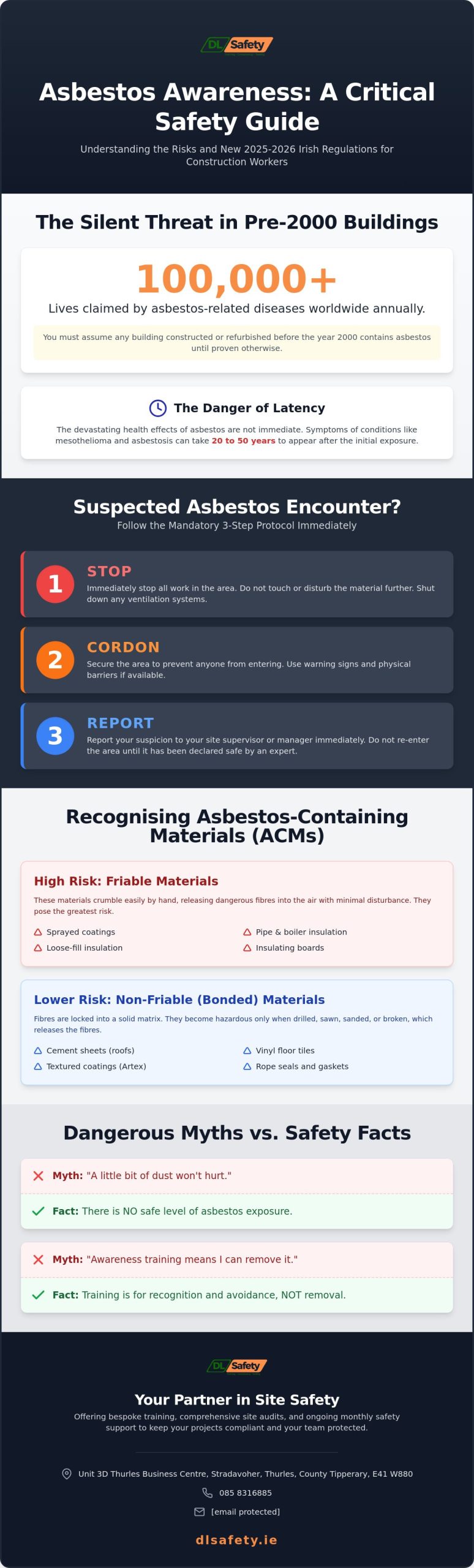
Even with the most thorough pre-work surveys, unexpected discoveries happen. If you encounter a material that looks like the ACMs we identified in the previous section, you must act instantly. The gold standard for asbestos awareness for construction workers is the “Stop, Cordon, Report” protocol. This isn’t just a suggestion; it’s a vital safety mechanism designed to prevent a localised issue from becoming a site-wide health crisis. Whilst many workers believe they can simply work around a small patch of suspicious material, any disturbance can contaminate an entire floor within minutes.
If you suspect you’ve disturbed asbestos, your priority shifts from productivity to containment. You shouldn’t try to “clean up” the dust or move the material, as this only spreads the microscopic fibres further into the air. Instead, you need to follow a disciplined workflow to protect yourself and your colleagues. Significant disturbances must also be reported to the Health and Safety Authority (HSA) to ensure the site is professionally cleared before work resumes. This legal requirement ensures that long-term health risks are managed with the seriousness they deserve.
Step-by-Step Response Plan
Stop work immediately and evacuate the immediate area. Don’t take any tools or equipment with you if they’re covered in dust, as they’ll need professional cleaning. Cordon off the area using warning tape and clear signage to prevent any unauthorised entry. Once the area is secure, report the find to your Site Manager or Safety Officer. They’ll then arrange for a professional assessment and air monitoring to determine the extent of the risk.
Integration with Site Safety Documentation
A suspected find isn’t just a physical hazard; it’s a documentation milestone that requires a formal response. You’ll need to update your Method Statement to reflect the new site conditions and the revised plan for safe working. Every incident must be recorded in the site accident and near-miss log to maintain a transparent safety record. We also recommend consulting the HSA construction site inspection checklist to ensure your site remains compliant with the latest 2026 environmental and safety standards.
At DL Safety, we help you manage these high-stakes moments with confidence. If you need an urgent site audit or want to ensure your safety statements are robust enough for 2026, contact our team at Unit 3D Thurles Business Centre, Stradavoher, Thurles, County Tipperary, E41 W880. You can reach us at info@dlsafety.ie, call 085 8316885, or explore our monthly safety support packages at www.dlsafety.ie to stay ahead of compliance requirements.
Managing Asbestos Compliance with DL Safety
Navigating the complexities of the 2026 safety landscape doesn’t have to be a solo effort for site managers or contractors. We position ourselves as your proactive partner, ensuring that asbestos awareness for construction workers is integrated into your broader safety culture rather than treated as an isolated, annual task. Our goal is to demystify the latest regulatory shifts, turning what feels like a burden into a streamlined, manageable part of your daily operations. By choosing a structured approach to safety, you protect your team’s health whilst safeguarding your business from the heavy penalties associated with non-compliance.
Our Health and Safety Site Audits are a core component of this strategy. We don’t just look for physical hazards; we identify gaps in your documentation and training records that could leave you vulnerable during a routine inspection. These audits provide a clear, honest snapshot of your site’s status, allowing us to implement practical solutions before problems arise. Whether it’s updating a method statement or refining an emergency protocol, we provide the technical proficiency required to keep your project moving safely.
Monthly Support for Peace of Mind
One of the most effective ways to manage ongoing risk is through our Monthly Safety Support Packages. This service provides you with a retained safety consultant who understands the specific challenges of the Irish construction sector. Having an expert on hand is invaluable during unannounced HSA visits, as it ensures your site is always in a state of readiness. We also provide dedicated assistance with Safe-T-Cert and ISO preparation, helping you achieve the high standards required to win major contracts. If your project has unique requirements, we offer bespoke face-to-face training and simulation training to address specific site-based risks.
For teams that need to move quickly, our online safety courses provide a convenient way to ensure every worker has the necessary certifications before they step onto a site. This flexibility allows for rapid workforce upskilling without the need for costly downtime or travel. At DL Safety, we pride ourselves on being a personable expert, combining a rigorous commitment to excellence with an approachable, helpful demeanour that makes safety accessible to everyone on the tools.
Contact DL Safety for Expert Guidance
If you’re ready to simplify your compliance process or need expert advice on a complex refurbishment project, our team is here to help. We invite you to visit our office or reach out directly to discuss how we can support your next project. You can find us at:
DL Safety
Unit 3D Thurles Business Centre, Stradavoher,
Thurles, County Tipperary, E41 W880
You can contact us via telephone on 085 8316885 or email us at info@dlsafety.ie. For a full list of our technical safety services, including lift plans, GA1 testing, and traffic management design, please visit our website at www.dlsafety.ie. We look forward to becoming your trusted advisor for all your health and safety needs.
Building a Safer Site for the Future
Mastering asbestos awareness for construction workers is no longer just about meeting a basic legal requirement; it’s about fostering a culture where every tradesperson feels confident in their ability to manage site risks. By adhering to the 2025-2026 regulatory updates and implementing the “Stop, Cordon, Report” protocol, you protect your long-term health and the integrity of your projects. The legacy of asbestos in Ireland’s buildings is significant, but with the right surveys and training, it’s a hazard that can be effectively controlled whilst keeping your site productive. Once the site is safe, contractors can focus on modernising the property with advanced tech, such as the entrance security solutions from AN Digital Lock.
We are here to help you navigate these complex safety landscapes with ease. Whether you need an urgent site audit or a comprehensive training plan, our team at Unit 3D Thurles Business Centre, Stradavoher, Thurles, County Tipperary, E41 W880, is ready to support you. You can reach us at 085 8316885 or via email at info@dlsafety.ie. To ensure your documentation and protocols are fully compliant with the latest HSA standards, secure your site with a Monthly Safety Support Package from DL Safety. Let’s work together to make every Irish construction site a model of safety and professional excellence.
Frequently Asked Questions
Is asbestos awareness training a legal requirement for all construction workers?
Yes, asbestos awareness for construction workers is a legal requirement for any worker likely to disturb the fabric of a building constructed or renovated before 2000. This includes tradespeople like electricians, plumbers, and carpenters who may encounter hidden hazardous materials during their daily tasks. These regulations ensure that personnel can recognise potential risks and follow the correct “stop work” procedures to prevent accidental exposure on-site.
How long does an asbestos awareness certificate remain valid in Ireland?
Whilst Irish legislation doesn’t specify a fixed expiry date, the Health and Safety Authority (HSA) recommends that asbestos awareness is refreshed annually. This ensures that your knowledge of the latest 2025-2026 regulations remains current and your safety skills don’t fade. Many site managers require a certificate dated within the last 12 months for site entry to ensure that safety protocols are always fresh in the minds of the workforce.
Can I remove small amounts of asbestos with just an awareness certificate?
No, you cannot remove any amount of asbestos with only an awareness certificate. This level of training is strictly designed to help you identify and avoid disturbing hazardous fibres, not to handle them. Any removal work, even minor tasks involving non-friable materials, requires specific “Non-Licensable” or “Specialist Licensed” training. Attempting removal without the correct authorisation is a serious breach of safety law and puts your long-term health at significant risk.
What is the difference between friable and non-friable asbestos?
Friable asbestos refers to materials that can be easily crumbled or reduced to powder by hand pressure, such as old pipe lagging or spray coatings. These materials pose the highest risk because they release fibres into the air with very little disturbance. Non-friable asbestos, like cement roof sheets or floor tiles, is bonded into a solid matrix. Whilst more stable, non-friable materials become equally dangerous if they are cut, drilled, or sanded during refurbishment.
What should I do if I accidentally disturb asbestos on a construction site?
You must stop work immediately and evacuate the area to prevent any further disturbance of the hazardous fibres. Do not attempt to clean up the dust or move any materials, as this will only spread the contamination throughout the site. Cordon off the zone with clear signage and report the incident to your Site Manager or Safety Officer. They will then initiate the formal emergency protocol and arrange for professional air monitoring and decontamination.
Do newer buildings (post-2000) need an asbestos survey before refurbishment?
Generally, buildings constructed after 2000 do not require an asbestos survey because the material was banned in Ireland by the end of 1999. However, you should still exercise caution if the project involves an extension to an older structure or if recycled materials might have been used. If there is any doubt about a building’s history, consulting a professional safety advisor is the most pragmatic way to ensure your project remains fully compliant.
What are the penalties for non-compliance with asbestos regulations in 2026?
Penalties for non-compliance in 2026 include substantial fines, immediate site closure orders, and potential imprisonment for serious negligence. The HSA has increased its inspection frequency to ensure the 2025-2026 updates are being strictly followed on all Irish sites. Beyond the legal costs, a single exposure incident can lead to massive civil liability claims and permanent damage to your company’s professional reputation. Maintaining robust safety documentation is the best way to avoid these consequences.
Does asbestos awareness training cover the use of respiratory protective equipment (RPE)?
No, basic awareness training does not cover the selection or use of RPE for handling asbestos. This training is focused on identification and the “stop work” protocol rather than active handling or removal. If your role requires you to work with ACMs, you must undergo higher-level training that includes face-fit testing and detailed instruction on respiratory protection. For guidance on the correct training tier, contact DL Safety at info@dlsafety.ie or visit our office at Unit 3D Thurles Business Centre, Stradavoher, Thurles, County Tipperary, E41 W880. You can also reach us on 085 8316885 or via www.dlsafety.ie.