Could your current site management withstand the scrutiny of a 2026 HSA inspector focused on the latest environmental mandates? With fines for non-compliance now potentially exceeding €50,000, the stakes for Irish contractors have never been higher. We understand that keeping up with the Planning and Development Act 2024 whilst managing subcontractor behaviour can feel like a moving target. It’s often stressful to balance tight project deadlines with the fear of receiving an improvement notice due to overlapping regulations or new dust monitoring requirements.
This guide provides you with a definitive HSA construction site inspection checklist tailored for 2026, ensuring you can master every environmental standard and approach your next audit with absolute confidence. We will break down the specific requirements for greenhouse gas assessments, water protection under the 2027 framework, and how proactive site audits can turn compliance into your competitive advantage. By the end of this article, you will have a clear, actionable roadmap to ensure your site remains both legal and efficient in an increasingly regulated landscape.
Key Takeaways
- Understand how the HSA’s 2026 risk-based strategy shifts focus towards environmental health hazards and stricter enforcement across all Irish construction sites.
- Learn how to implement a comprehensive HSA construction site inspection checklist that prioritises daily air quality monitoring and weekly waste management reviews.
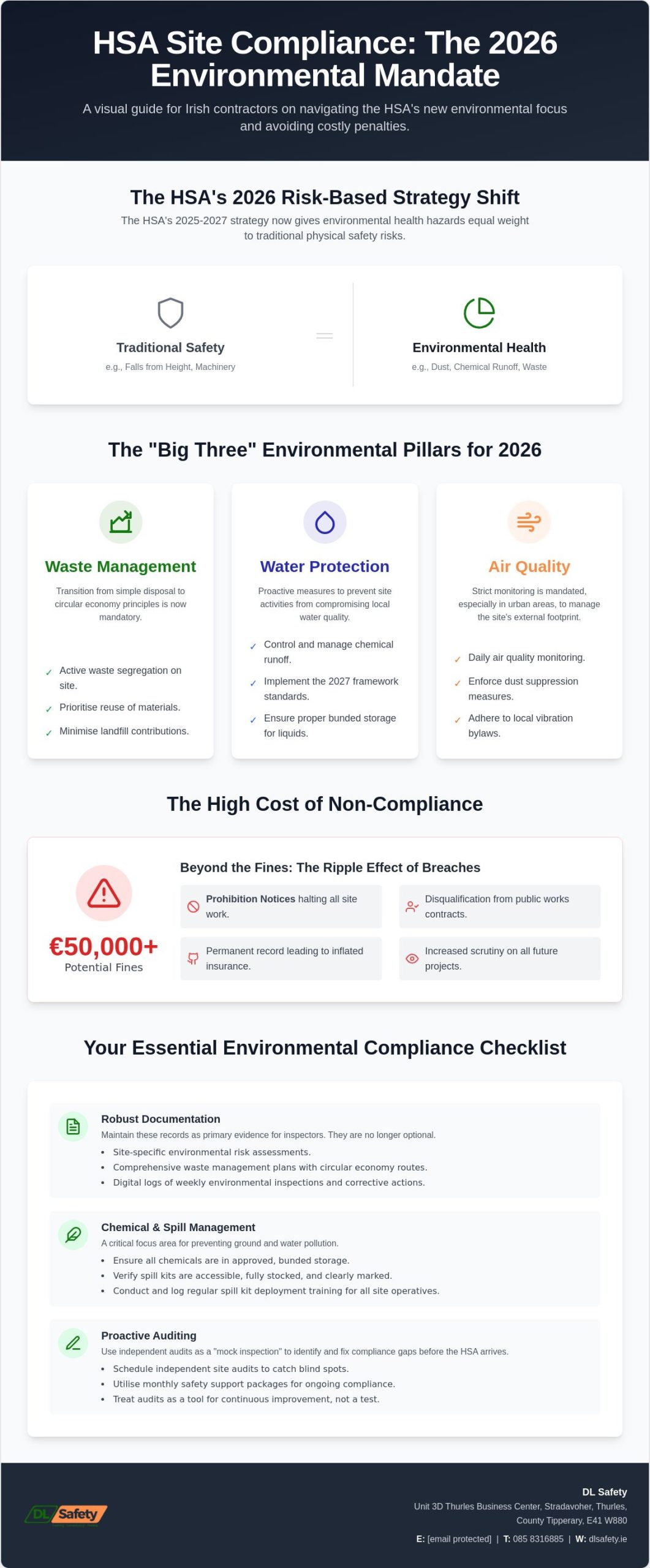
- Identify the “Big Three” environmental risks-waste, water, and air-and how circular economy principles are reshaping site requirements for 2026.
- Discover the essential standards for bunded chemical storage and why spill kit deployment training is now a critical requirement for site operatives.
- Explore how independent site audits and monthly safety support packages act as a proactive “mock inspection” to catch compliance blind spots.
HSA Compliance and Environmental Stewardship in 2026
The HSA 2025-2027 strategy has fundamentally altered the landscape for Irish contractors. In 2026, the Authority’s risk-based inspection programme treats environmental health hazards with the same weight as traditional safety risks like falls from height. This shift isn’t just about protecting the countryside; it’s about safeguarding workers from high-risk substances and ensuring site activities don’t compromise local water or air quality. When an inspector arrives, they won’t just look at your scaffolding. They’ll be checking your HSA construction site inspection checklist to see how you’re managing dust, chemical runoff, and waste.
Environmental stewardship for site managers in 2026 means moving beyond mere box-ticking to actively protecting the local ecosystem through disciplined resource management and proactive risk mitigation. A failure to demonstrate this stewardship often serves as a red flag for inspectors. Mismanagement in one area, such as improper waste storage, frequently leads to a deeper dive into your entire safety management system. This scrutiny often results in site-wide enforcement notices that could have been easily avoided with the right oversight and professional guidance. For instance, ensuring high hygiene standards in site offices through Pink Lady Cleaning Services can further demonstrate a culture of site-wide excellence.
The Legal Framework for Site Managers
The Project Supervisor Construction Stage (PSCS) carries the legal burden of ensuring environmental controls are integrated into the daily workflow. It’s no longer sufficient to have a generic Safety Statement gathering dust in the site office. Your documentation must now incorporate specific environmental risk assessments that reflect the unique challenges of your project. The Construction Phase Plan serves as your primary evidence of environmentally responsible construction, detailing exactly how you intend to mitigate noise, vibration, and pollution throughout the project lifecycle. Without these documented controls, your HSA construction site inspection checklist remains incomplete and legally vulnerable. Essential records to maintain include:
- Site-specific environmental risk assessments for high-risk activities.
- Waste management plans detailing circular economy disposal routes.
- Digital logs of weekly environmental inspections and corrective actions.
Consequences of Non-Compliance in Ireland
Ignoring these standards leads to more than just a slap on the wrist. The HSA has the power to issue Improvement Notices or, in severe cases, Prohibition Notices that can shut down a site instantly. Beyond the immediate legal fines, which can exceed €50,000, these breaches create a permanent record that can inflate insurance premiums and disqualify firms from lucrative public works contracts. Investing in professional health and safety compliance Ireland ensures you avoid these regulatory frictions and maintain a reputation for excellence. For expert guidance, you can contact the team at DL Safety at Unit 3D Thurles Business Center, Stradavoher, Thurles, County Tipperary, E41 W880, via email at info@dlsafety.ie, or by calling 085 8316885.
Core Environmental Pillars: Waste, Water, and Air Quality
Effective environmental management on a modern Irish construction site rests on three critical pillars: waste, water, and air quality. These “Big Three” are no longer secondary concerns but are central to any robust HSA construction site inspection checklist. Inspectors are increasingly looking at how a site interacts with its surrounding environment, particularly in urban areas where 2026 Leinster-region bylaws now mandate strict dust and vibration monitoring for all projects. It’s not enough to manage what happens inside the hoarding; you must be proactive about your site’s external footprint.
Waste management in 2026 has transitioned from simple disposal to circular economy principles. This means your site must demonstrate active waste segregation and, where possible, the reuse of materials to minimise landfill contributions. For exchequer-funded projects over €5 million, the June 2026 deadline for Whole Life-Cycle Greenhouse Gas Emissions assessments has already set a high bar for transparency and resource efficiency. Managing the behaviour of subcontractors is often the most challenging aspect of this pillar. You must ensure every team on-site understands that a single instance of improper chemical disposal or a neglected skip can trigger an enforcement notice for the entire project. If you need assistance in standardising these behaviours, our Monthly Safety Support Packages provide the consistent oversight needed to keep everyone aligned with your environmental goals.
Dust and Air Quality Management
Controlling Respirable Crystalline Silica (RCS) remains a top priority for the HSA chemical inspection programme. In 2026, inspectors expect to see on-tool extraction or water suppression as the default for all cutting and grinding activities. Beyond the technical controls, you must ensure that every operative using respiratory protective equipment (RPE) has undergone documented Fit Testing. Furthermore, monitoring air quality at your boundaries is essential to avoid nuisance complaints from neighbouring properties, which often serve as the catalyst for an unannounced HSA visit. Professional monitoring ensures you have the data to prove your site is operating within safe limits. For refurbishment projects on older buildings, robust asbestos awareness for construction workers is equally critical, as disturbing hidden asbestos-containing materials during stripping or cutting activities poses a severe respiratory risk that must be identified and controlled before work begins.
Water Runoff and Silt Control
Silt and hydrocarbon runoff pose significant legal risks, especially as Ireland moves toward the 2027 goals of the Water Framework Directive. Preventing silt from entering local watercourses or drainage systems requires more than just a few sandbags. You need a dedicated temporary drainage plan that can handle heavy Irish rainfall events without failing. Best practices include bunded concrete washout stations and designated vehicle wheel washing areas that are regularly maintained. If you’re unsure if your current setup meets the 2026 standard, a Health & Safety Site Audit from DL Safety can identify potential “blind spots” before they become a problem. You can reach our team at 085 8316885 or visit us at Unit 3D Thurles Business Center, Stradavoher, Thurles, County Tipperary, E41 W880.
In addition to managing surface runoff, ensuring that site-based wastewater systems are properly maintained is essential for environmental compliance. Resources provided by CH Enviro offer valuable insights into the necessary upkeep of septic tanks and drainage facilities, helping managers avoid overflows that could trigger an unannounced HSA inspection.
The Essential HSA Environmental Compliance Checklist for Construction Sites
Transitioning from theoretical compliance to daily site reality requires a structured approach that leaves no room for ambiguity. A robust HSA construction site inspection checklist serves as your primary defence against the stress of unannounced audits, transforming complex 2026 regulations into manageable tasks. For the Project Supervisor Construction Stage (PSCS), the priority is distinguishing between immediate daily hazards and broader weekly oversight. Daily checks should focus on volatile factors like dust suppression and spill tray integrity, whilst weekly reviews should audit the more static elements of your environmental management system, such as skip segregation and documentation accuracy.
Before the clock strikes 8 AM, every site manager should confirm that dust suppression systems are primed, bunded areas are secure from overnight rainfall, and all site boundaries are free from debris or obstruction. Maintaining a “living” Site Safety File is the only way to prove ongoing diligence during a 2026 inspection. Inspectors now look for evidence-based compliance, meaning your logs should be supplemented with dated photographs of silt traps, noise barriers, and waste areas. This digital trail provides a narrative of care that a simple tick-box cannot match, demonstrating that your team is proactive rather than reactive. If you find your documentation is lagging, the team at DL Safety can help you organise your records from our base at Unit 3D Thurles Business Center, Stradavoher, Thurles, County Tipperary, E41 W880.
Waste and Resource Management Checklist
Effective waste management is a cornerstone of the circular economy principles that the HSA now monitors closely. Your HSA construction site inspection checklist must verify that waste skip areas are clearly labelled and segregated by material type to prevent cross-contamination. Hazardous waste transfer notes (WTNs) must be filed and immediately accessible, as these are often the first documents an inspector will request. Additionally, ensure there is a designated, protected area for storing salvaged materials intended for reuse, which signals a commitment to resource efficiency.
Site Boundary and Nuisance Checklist
Your site’s impact on its neighbours is a primary trigger for regulatory scrutiny. Ensure noise-dampening measures, such as acoustic blankets, are in place for any high-decibel plant or machinery operating near the boundary. Site lighting must be carefully positioned to avoid light pollution amongst residential properties, particularly during winter months. For projects involving piling or heavy excavation, confirm that vibration monitors are active and that the data is being reviewed regularly to ensure compliance with 2026 urban bylaws. For expert support in managing these site-specific challenges, contact us at info@dlsafety.ie or call 085 8316885.
Preventing Pollution: Chemical Storage and Emergency Spill Response
Pollution prevention starts with how you house your site’s most hazardous liquids. On any Irish construction site, the integrity of storage containers is constantly challenged by harsh weather conditions, from driving rain to fluctuating temperatures. Using bunded storage for all fuels, oils, and chemicals is not just best practice; it’s a non-negotiable part of your HSA construction site inspection checklist. A bund must be able to hold 110% of the largest container’s capacity, ensuring that even a total tank failure doesn’t result in an environmental disaster or a costly cleanup operation.
Integrating a chemical risk assessment Ireland into your daily routine ensures that hazards are identified before work begins. In 2026, the HSA has made Chemical Awareness Training a requirement for site operatives to ensure everyone understands the substances they handle and the risks they pose to the local ecosystem. This knowledge is your first line of defence against accidental spills that could lead to heavy fines or site closures. It’s about building a culture where every worker feels responsible for the chemicals they use.
Spill Kit Deployment and Maintenance
Selecting the correct spill kit type for your specific site needs, whether Oil, Chemical, or General Purpose, is vital for an effective response. These kits shouldn’t be tucked away in a locked container in the site office. They must be strategically placed near high-risk areas like refuelling stations and chemical stores for immediate access. Ensuring every operative is familiar with your 2026 spill response plan for chemicals means they can act with speed and precision if an incident occurs. Regularly check your kits to ensure they haven’t been raided for general cleaning and that all absorbent materials remain dry and ready for use.
COSHH and SDS Management
Maintaining a central register of Safety Data Sheets (SDS) is a fundamental requirement for modern site management. These documents provide the essential information needed to protect your team and the environment, yet they are often overlooked until an inspector asks to see them. Your COSHH assessments must be site-specific, reflecting the actual conditions and volumes present on your project. This level of detail is exactly what an inspector looks for when reviewing your HSA construction site inspection checklist. Communicating these hazards through regular toolbox talks ensures that safety remains a priority for every subcontractor on-site. If you need help developing these site-specific controls, our Chemical Awareness Training incl. Spill Kit Deployment ensures your team is fully prepared. You can contact DL Safety at Unit 3D Thurles Business Center, Stradavoher, Thurles, County Tipperary, E41 W880, or call 085 8316885.
Professional Site Audits and Monthly Compliance Support
Maintaining a perfect HSA construction site inspection checklist whilst juggling subcontractors and tight deadlines is a heavy burden for any site manager. This is where our Monthly Safety Support Packages act as a vital safety net, providing consistent oversight that catches minor oversights before they escalate into regulatory issues. By having a dedicated partner who understands the nuances of Irish legislation, you can shift your focus back to project delivery without the constant fear of an unannounced audit. It’s about building a culture of reliability where compliance is a natural part of the daily workflow rather than a last-minute scramble.
Independent Health & Safety Site Audits are particularly effective at identifying environmental “blind spots” that internal teams might overlook through sheer familiarity with the site. These audits aren’t just about finding faults; they are a proactive tool designed to help you achieve Safe-T-Cert requirements through demonstrated environmental excellence. Closing the loop between audit findings and implemented site improvements is what separates high-performing contractors from those who merely react to problems. We believe that transparency and honesty in these audits create an atmosphere of trust, ensuring your team feels supported rather than policed.
The DL Safety Approach to Site Audits
We conduct unannounced “mock inspections” to test how your site operates under real-world conditions, providing a true reflection of worker and subcontractor behaviour. Following the audit, you’ll receive an actionable report that prioritises high-risk environmental gaps with clear, practical steps for remediation. This data is invaluable for the PSCS, who must regularly update the Construction Phase Plan to reflect the evolving risks on a live site. By using your HSA construction site inspection checklist as a living document, we ensure that every finding leads to a measurable improvement in site safety and environmental stewardship.
Get Started with DL Safety in 2026
If you’re ready to strengthen your site’s compliance and remove the stress of inspections, David and the team are here to help. You can visit us at Unit 3D Thurles Business Center, Stradavoher, Thurles, County Tipperary, E41 W880. To discuss your specific site needs or to book an audit, please reach out via email at info@dlsafety.ie or call us directly at 085 8316885. You can also explore our full range of technical testing and training services at www.dlsafety.ie. We look forward to becoming your trusted advisor in navigating the complex landscape of 2026 health and safety standards.
Future-Proof Your Site Compliance for 2026 and Beyond
Environmental stewardship has evolved from a secondary duty into a core pillar of Irish construction management. By now, you should recognise that a robust HSA construction site inspection checklist must go beyond physical safety to include rigorous monitoring of silica dust, water runoff, and circular economy waste practices. Maintaining a digital trail of evidence through your Site Safety File isn’t just about avoiding fines; it’s about demonstrating a professional commitment to excellence that resonates with both inspectors and clients.
DL Safety is here to alleviate the burden of these shifting regulations through specialised GA1 and PAT testing, expert accident investigation, and professional training in Spill Kit Deployment and Chemical Awareness. Our team, based at Unit 3D Thurles Business Center, Stradavoher, Thurles, County Tipperary, E41 W880, is dedicated to your project’s success. You can reach us at 085 8316885 or info@dlsafety.ie to discuss your specific site needs.
Secure your site with a DL Safety Monthly Support Package today and approach your next unannounced audit with absolute confidence. You have the skills to build Ireland’s future; let us provide the expert guidance to keep your site safe, legal, and efficient.
Frequently Asked Questions
What are the most common environmental failures found during HSA inspections?
Improper chemical storage and poor waste segregation are the most frequent failures identified by inspectors on Irish sites. Many contractors fail to provide adequate bunding for fuels; while others neglect silt controls during periods of heavy rainfall. Inspectors also commonly find that spill kits are either missing or have been depleted without being replenished; which signals a lack of emergency preparedness.
Does the HSA inspect noise pollution on construction sites?
Yes; the HSA monitors noise as both an occupational health hazard for workers and a nuisance for the local community. Under 2026 urban bylaws; inspectors expect to see noise-dampening measures and evidence of monitoring on sites near residential areas. Failure to manage high-decibel machinery can lead to complaints that trigger unannounced inspections and potential improvement notices for the project.
How often should a construction site environmental audit be carried out?
A comprehensive environmental audit should be conducted at least monthly to ensure your HSA construction site inspection checklist remains accurate and effective. For high-risk projects or large-scale urban developments; more frequent fortnightly reviews may be necessary to manage rapidly changing site conditions. Regular audits help you identify “blind spots” before they are spotted by a regulatory inspector.
What is the difference between a Safety Statement and an environmental plan?
A Safety Statement focuses on protecting workers from physical injury; while an environmental plan focuses on protecting the surrounding ecosystem from pollution. In 2026; these documents must be closely integrated. This ensures that hazards like chemical spills or dust emissions are managed both as risks to worker health and as threats to local air and water quality.
Are subcontractors responsible for their own environmental compliance on site?
Subcontractors are legally responsible for their own behaviour; but the PSCS holds the ultimate duty to coordinate and monitor all activities on-site. You must ensure every team follows the project’s specific environmental controls. A single subcontractor’s failure to store chemicals correctly can lead to an enforcement notice that impacts the entire project’s timeline and reputation.
What should I do if a HSA inspector finds an environmental breach on my site?
You must immediately stop the offending activity and implement the corrective actions specified by the inspector. It is vital to document the resolution with dated photographs and update your Site Safety File accordingly. Demonstrating a proactive and honest response can often prevent a minor breach from escalating into a more serious legal prosecution or a prohibition notice.
Is silica dust considered an environmental hazard or a safety hazard?
Silica dust is both a safety hazard for workers’ respiratory health and an environmental hazard for local air quality. Because it is a priority in the 2026 HSA chemical inspection programme; you must manage it through on-tool extraction and boundary monitoring. These dual controls are a critical component of any modern HSA construction site inspection checklist to ensure full compliance.
How can I prove environmental compliance to the HSA without a full-time officer?
You can prove compliance by maintaining a rigorous digital log of weekly inspections and using external experts for monthly site audits. DL Safety provides Monthly Safety Support Packages that act as your “safety net”; ensuring your documentation is always audit-ready. For assistance; contact our Tipperary office at 085 8316885 or email info@dlsafety.ie to discuss our support options.