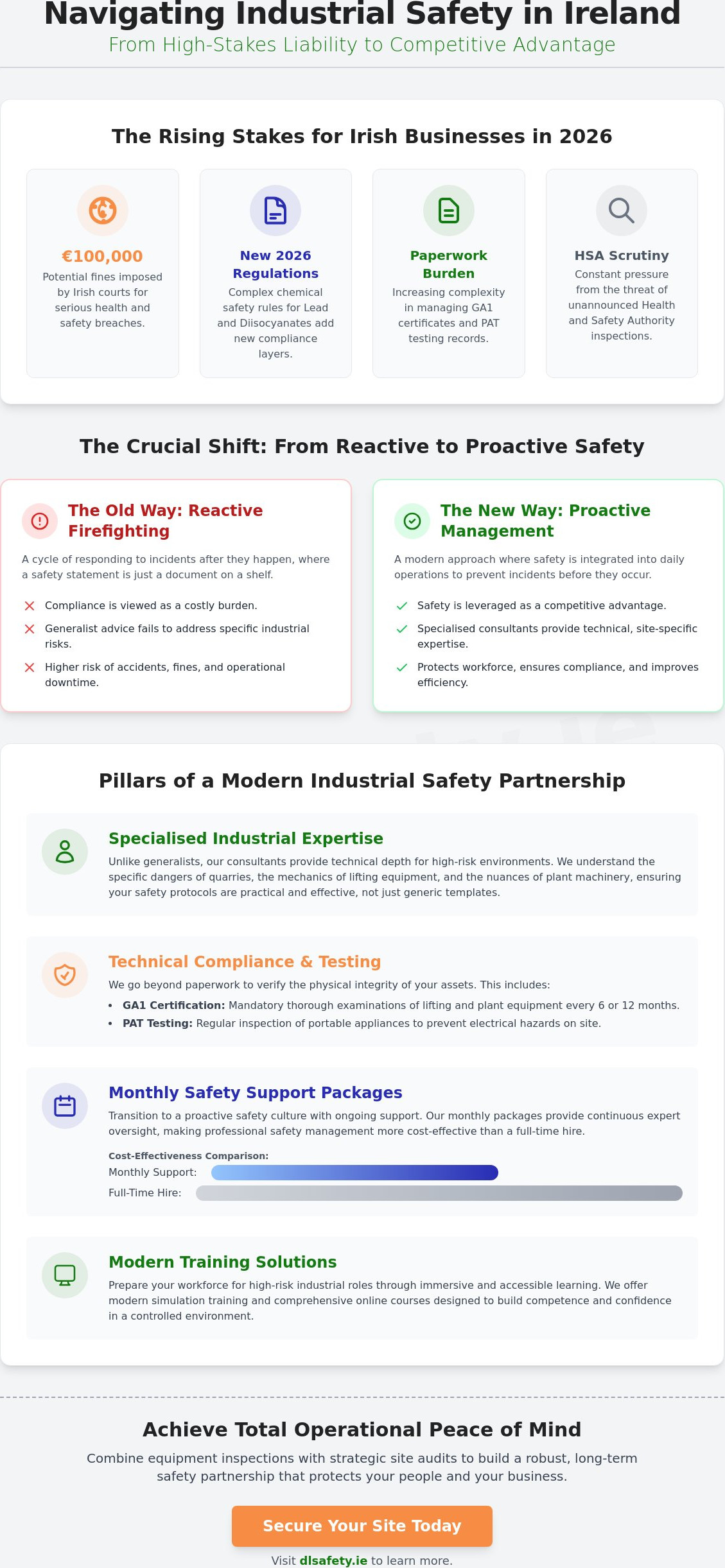
In 2026, a safety statement that simply sits on a shelf is no longer a shield; it’s a liability. With Irish courts recently imposing fines as high as €100,000 for health and safety breaches, the stakes for your business have never been higher. Finding the right industrial safety consultants Ireland has become less about ticking boxes and more about finding a technical partner who understands the grit of a quarry or the precision of a lifting plan. You’re likely feeling the weight of mounting GA1 and PAT testing paperwork, whilst the new 2026 chemical safety regulations for lead and diisocyanates have added a fresh layer of complexity to your daily operations.
We understand that the fear of a surprise HSA inspection can be draining, especially when you’re struggling to find experts who truly grasp specific lifting or quarrying requirements. This guide will show you how expert industrial safety consultancy protects your workforce, ensures technical compliance, and streamlines Irish regulatory requirements without causing operational friction. We’ll explore the shift toward proactive safety management systems, the importance of digital record-keeping, and how a single point of contact for audits and equipment can transform your safety culture. It’s time to turn compliance from a burden into a competitive advantage.
Key Takeaways
- Understand why generalist safety advice often falls short in high-risk environments and how specialised industrial safety consultants Ireland provide the technical depth required for complex sites.
- Discover why GA1 certification and rigorous equipment testing are essential for site managers to maintain plant safety and meet mandatory regulatory standards.
- Learn how monthly safety support packages allow you to transition from reactive firefighting to a proactive safety culture whilst remaining more cost-effective than a full-time hire.
- Explore the benefits of modern simulation training and online courses designed to prepare your workforce for high-risk industrial roles through immersive learning.
- Gain insights into building a long-term technical partnership that combines equipment inspections with strategic site audits for total operational peace of mind.
The Role of Industrial Safety Consultants in Ireland
In the context of the Irish legal system, the role of industrial safety consultants Ireland is defined by their ability to translate the Safety, Health and Welfare at Work Act 2005 into practical, on-site protection. They aren’t just auditors; they’re technical partners who ensure that your daily operations align with both national legislation and global standards in occupational safety. For many firms, a consultant acts as the essential bridge between the high-level expectations of the Health and Safety Authority (HSA) and the complex reality of a working site.
As we move through 2026, we’re seeing a distinct shift amongst Irish firms. The days of reactive “firefighting” following an accident are being replaced by proactive safety management systems. This change is driven partly by the significant fines seen in early 2026, including a €100,000 penalty for a fatal workplace incident, and partly by a growing realisation that a safe site is a more efficient site. A consultant’s job is to demystify these requirements, taking the stress out of compliance whilst building a culture where safety is second nature. They provide the clarity needed to manage risk without slowing down your core business activities.
Navigating the HSA Regulatory Landscape
Under the 2005 Act, the primary responsibility for safety rests with the employer. This includes the mandatory requirement to prepare and maintain a written Safety Statement. A consultant helps you organise this documentation so it actually reflects your specific risks, rather than being a generic template. For the construction and quarrying sectors, this advice must be industry-literate. You don’t need a lecture on office ergonomics; you need a partner who understands the risks of heavy plant machinery and can help you implement the April 2026 Chemical Agents Regulations regarding lead and diisocyanates.
Why Specialised Industrial Expertise Matters
Generic safety audits often fail because they lack the technical depth required for complex environments. If a consultant doesn’t understand the mechanics of a lifting chain or the pressure systems in a quarry, they can’t identify the true points of failure. Specialised expertise means your consultant can spot a worn lifting sling or an incorrectly positioned shackle before it becomes a reportable incident. By integrating technical testing with strategic advice, you establish your business as a centre of excellence for safety. This approach doesn’t just satisfy the HSA; it protects your most valuable asset: your people.
Technical Compliance: GA1 Testing and Specialised Inspections
Compliance in a high-risk environment involves much more than just the Safety Statement; it requires a deep, technical understanding of the physical assets that power your daily operations. This is where industrial safety consultants Ireland prove their worth by moving beyond office-based paperwork and into the practicalities of the plant floor. Unlike generalist advisors, technical consultants examine the actual integrity of your machinery, ensuring that every bolt and hydraulic line meets the necessary standards for safe operation.
GA1 testing remains the cornerstone of plant safety across the country. Under the Safety, Health and Welfare at Work (General Application) Regulations 2007, a thorough examination by a competent person is mandatory every 6 or 12 months, depending on the specific equipment. This is a non-negotiable requirement monitored by the Health and Safety Authority (HSA) to prevent mechanical failure. Securing professional GA1 certification is a vital task for any site manager, as it provides the documented proof of safety that protects both the workforce and the business from legal exposure.
Electrical safety is another critical pillar of a secure site. Regular PAT testing ensures that portable appliances, often used in harsh industrial conditions, don’t pose a fire or shock hazard to your team. It’s a straightforward process that identifies faults before they cause injury, maintaining a safe electrical environment amidst the constant movement of a busy site.
Lifting Equipment Standards and Planning
Complex projects demand more than just heavy-duty gear; they require meticulous lift plans that account for every variable. A consultant helps you design these plans, ensuring that all components, including lifting shackles, chains, and slings, are fit for purpose and fully compliant with Irish safety standards. This technical scrutiny doesn’t just prevent accidents; it directly improves long-term asset reliability by catching minor wear before it leads to a breakdown. You can explore our technical inspection services to see how we help businesses manage these complex lifting requirements.
Quarry and Heavy Plant Safety
The Irish quarrying sector faces specific safety challenges that standard audits often miss. Large-scale vehicles operating on challenging terrain require specialised on-site quarry vehicle brake testing to ensure they can stop safely under load. Implementing these rigorous brake testing protocols is a key part of any modern safety strategy. By scheduling regular technical safety audits, you can identify potential issues early, significantly reducing the risk of downtime caused by equipment failure or HSA intervention. This methodical approach ensures that heavy plant safety is a constant, measurable reality on your site.
Strategic Benefits of Monthly Safety Support Packages
Many businesses only call for expert help after a close call or a mechanical failure. This “firefighting” approach is inherently stressful and often leads to the high penalties seen in early 2026, such as the €95,000 fine recently imposed for a fatal workplace incident. By partnering with industrial safety consultants Ireland on a monthly basis, you transition your business into a proactive safety culture. This model ensures that risk control is an ongoing, manageable process rather than a panicked reaction to a scheduled audit or a surprise inspection. It allows your management team to stay focused on project delivery, knowing that the regulatory heavy lifting is being handled by a dedicated professional.
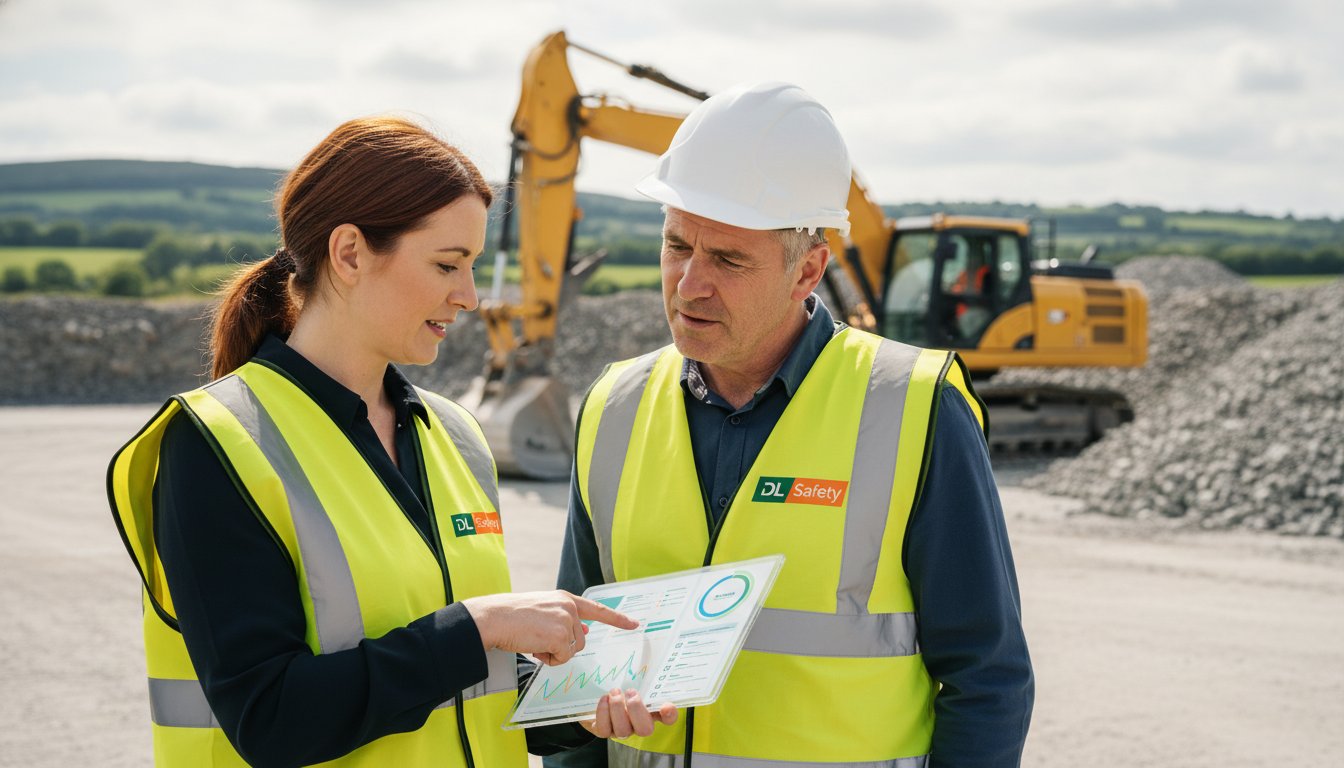
Choosing a retained consultancy is often a more pragmatic financial decision than hiring a full-time safety officer. You gain immediate access to high-level expertise and specialised testing equipment without the significant overheads of a permanent salary, benefits, and ongoing training. This flexibility is vital for firms scaling up for large infrastructure projects or those operating in the high-stakes quarrying sector. When the HSA arrives for an unannounced inspection, having a consultant who knows your site inside out provides an immediate layer of professional reassurance. It’s about having a partner who is as invested in your site’s safety as you are.
What to Expect from a Safety Support Package
A comprehensive support package isn’t just about a monthly site visit; it’s about having a technical safety department at your fingertips. This usually includes regular site audits to catch hazards early and immediate accident investigation support if an incident occurs. You also gain expert assistance with complex tasks like traffic management design and professional lift planning, ensuring these critical safety documents are always current and compliant. Investing in monthly safety support Ireland provides a predictable compliance framework that integrates seamlessly with Ireland’s OSH system and its evolving national safety strategy.
The ROI of Long-term Safety Partnerships
The financial benefits of a long-term partnership extend well beyond avoiding HSA fines. Documented safety excellence is a powerful tool when negotiating insurance premiums, as it proves to underwriters that you’re a low-risk, well-managed operation. You also avoid the massive hidden costs associated with site closures, legal fees, and equipment damage that inevitably follow a serious incident. Beyond the balance sheet, consistent oversight significantly improves workforce morale. When employees see a genuine, daily commitment to their well-being, retention rates improve and safe behaviour becomes a shared value amongst the entire team.
Modern Safety Training: Online Courses and Simulation
Training in 2026 has moved far beyond the static classroom. As industrial safety consultants Ireland, we’ve seen that the most effective programmes are those that blend digital convenience with immersive practice. This dual approach ensures that safety knowledge isn’t just memorised for a test but is actually applied on the shop floor or in the quarry. It’s about building a resilient workforce that knows how to act when things go wrong, ensuring your team is truly competent rather than just certified.
This shift towards more interactive learning aligns with the HSA’s recent focus on proactive Safety Management Systems. By moving away from purely reactive training, firms can demonstrate ongoing risk control and a genuine commitment to worker well-being. Modern training methods allow you to meet these high legal standards whilst keeping your production schedules on track. It’s a pragmatic way to manage safety in a fast-paced industrial environment.
Simulation Training for High-Risk Environments
Simulation training is a game-changer for high-risk industrial roles. It allows workers to practice emergency responses in a controlled, virtual environment where mistakes don’t lead to injuries or costly plant damage. This immersive approach creates a deeper psychological impact, leading to safer long-term behaviour on the actual site. By allowing operators to experience high-stress scenarios in a virtual setting, you significantly reduce the likelihood of real-world equipment damage. Better operator competency directly translates to fewer accidents and increased equipment longevity.
The Convenience of Online Safety Courses
Online safety courses offer the flexibility a mobile industrial workforce needs. Employees can complete mandatory modules at their own pace, which helps you meet legal training requirements without halting production for a full day. Digital platforms also make it simple to track progress and manage certifications, providing the digital record-keeping that the HSA increasingly expects during audits. This is particularly useful for ensuring subcontractors meet your site’s safety standards before they even set foot on the property. You can explore our online safety courses and simulation training options to see how we can help upgrade your team’s skills.
Integrating these modern methods into your business doesn’t just satisfy a legal checklist. It creates a centre of excellence where every team member, from the site manager to the newest apprentice, understands their role in maintaining a safe environment. When training is engaging and relevant, it stops being a chore and starts being a core part of your operational success.
Choosing DL Safety as Your Industrial Partner
Selecting the right industrial safety consultants Ireland involves finding a team that doesn’t just point out problems but actually provides the tools to solve them. At DL Safety, we distinguish ourselves by bridging the gap between high-level strategic advice and the technical reality of your site equipment. We don’t believe in cold, corporate distance; instead, we offer a personable approach rooted in honesty and transparency. This ensures you receive pragmatic solutions that actually work in the grit of a quarry or the complexity of a construction site. Our national coverage means that whether you’re operating in Tipperary or across the country, your safety standards remain consistent and rigorous across every location.
We’ve built our reputation on being a single-source provider for businesses that can’t afford to manage multiple contractors for different safety needs. By handling everything from GA1 testing and PAT testing to the design of complex traffic management plans, we simplify your compliance journey. You won’t have to chase different entities for your equipment certification and your safety audits. We provide a steady, logical flow of support that moves your business from a state of regulatory uncertainty to one of total confidence.
Integrated Safety Solutions
Our methodology is unique because we understand the “big picture” of industrial operations. We don’t just tell you that your lifting gear is worn; we supply the certified lifting equipment, including lifting slings, chains, and shackles, to ensure your operations continue without delay. This integrated approach combines technical testing with the provision of high-quality gear, ensuring that your lift plans are supported by the best possible hardware. From immersive simulation training to precise accident investigation, our focus remains on modern efficiency and proactive problem-solving that protects your long-term interests.
Getting Started with a Site Audit
The first step toward a more secure project in 2026 is often a comprehensive health and safety site audit. These audits are designed to identify hidden risks that generalist inspections might miss, providing a clear roadmap for improvement. Once we understand your specific challenges, we tailor our monthly safety support packages to fit your industrial needs exactly. This isn’t a one-size-fits-all service; it’s a dedicated partnership that evolves alongside your business. Taking this initial step allows you to focus on your core project delivery, safe in the knowledge that your technical compliance is in expert hands.
Building a Resilient Safety Culture for 2026
Navigating the complex landscape of Irish health and safety doesn’t have to be a source of constant stress for your management team. It’s about clarity. By moving away from reactive firefighting and embracing a technical partnership, you’ve seen how proactive oversight protects both your workforce and your bottom line. Whether it’s ensuring your lifting equipment meets mandatory standards or implementing modern simulation training, the right approach turns compliance into a streamlined part of your daily operations.
As dedicated industrial safety consultants Ireland, we’re here to help you bridge the gap between rigorous HSA requirements and the practical demands of a busy site. From expert GA1 technical testing and certification to specialised quarry vehicle brake testing, we provide the technical depth that generalist advisors often lack. Our team is ready to support you with comprehensive traffic management and lift planning design, ensuring every aspect of your project is as safe as it is efficient.
Secure your site’s future with DL Safety’s expert industrial consultancy today. We look forward to helping you build a safer, more compliant workplace where your team can truly thrive.
Frequently Asked Questions
What are the primary responsibilities of industrial safety consultants in Ireland?
Industrial safety consultants Ireland help businesses manage their legal obligations under the Safety, Health and Welfare at Work Act 2005. They translate complex HSA regulations into practical site operations, organise Safety Statements, and conduct technical inspections. Their role is to identify risks before they cause accidents, ensuring the business remains compliant whilst protecting the workforce from harm.
How often is GA1 testing required for lifting equipment on Irish sites?
GA1 testing for lifting equipment is mandatory every 6 or 12 months, depending on the specific type of machinery and its application. Under the 2007 General Application Regulations, a competent person must conduct a thorough examination to ensure the equipment remains fit for purpose. Regular certification is essential for maintaining site safety and providing documented proof of compliance during HSA inspections.
Can a safety consultant help with traffic management design for a new project?
Yes, a safety consultant can design professional traffic management plans to manage the movement of vehicles and pedestrians on-site safely. This service is vital for new projects where heavy plant machinery and delivery vehicles interact with workers. A well-designed plan reduces the risk of collisions and ensures that site traffic flows efficiently without compromising safety standards.
Is online safety training legally recognised by the HSA in Ireland?
Online safety courses are recognised by the HSA provided they are high-quality, relevant to the specific risks of the job, and supplemented by practical competency checks where necessary. Digital platforms allow for efficient tracking of employee progress and certification, which is increasingly important for modern record-keeping. It’s a pragmatic way to meet legal training requirements without halting production for a full day.
What is included in a monthly health and safety support package?
A monthly safety support package typically includes regular site audits, accident investigation support, and ongoing access to expert advice. It often covers the maintenance of Safety Statements and assistance with technical documents like lift plans or traffic management designs. This model provides a predictable compliance framework, giving you peace of mind that a professional is overseeing your site’s safety culture.
Why is quarry vehicle brake testing a specialised requirement?
Quarry vehicle brake testing is specialised because these heavy machines operate under extreme loads on challenging, uneven terrain. Standard inspections aren’t enough to guarantee that a fully loaded vehicle can stop safely in an emergency. On-site brake testing uses specific equipment to measure deceleration and stopping distances, ensuring that large-scale plant machinery meets the rigorous safety standards required in the quarrying sector.
How does simulation training improve safety outcomes on construction sites?
Simulation training allows workers to practice emergency responses and high-risk manoeuvres in a virtual environment without the danger of real-world injury. This immersive learning method significantly improves safety behaviour by allowing operators to experience high-stress scenarios safely. On construction sites, it leads to better operator competency, which reduces the risk of accidents and prevents costly damage to expensive plant machinery.
What should I look for when choosing a safety consultant for an industrial project?
When choosing industrial safety consultants Ireland, look for technical expertise in your specific sector, such as quarrying or heavy lifting. It’s important to find a partner who offers integrated services, combining strategic consultancy with practical testing like GA1 or brake inspections. Look for a consultant who prioritises transparency and honesty, offering pragmatic solutions that fit your operational reality rather than just generic paperwork.