
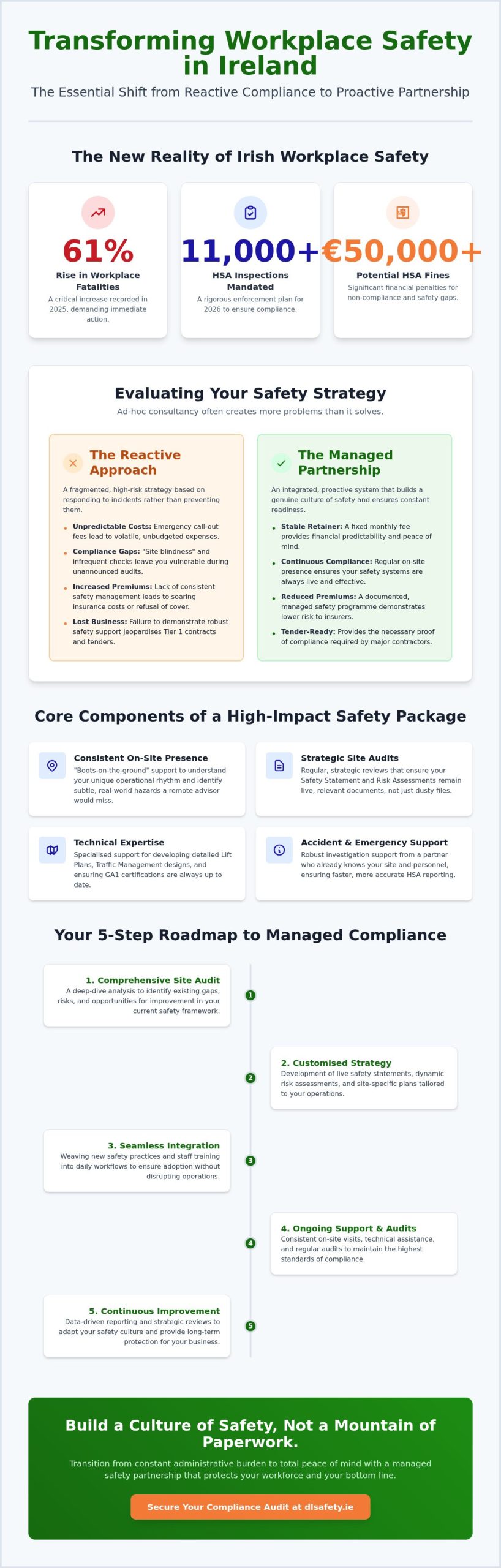
With workplace fatalities in Ireland rising by 61% in 2025, the Health and Safety Authority has responded with a rigorous 11,000-inspection mandate for 2026. If the thought of an unannounced inspector arriving at your gate causes genuine anxiety, you aren’t alone. Most site managers struggle to balance GA1 certifications and staff training whilst searching for reliable monthly safety support Ireland can trust. It’s a fragmented approach that often leaves your business vulnerable to HSA fines exceeding €50,000.
We agree that safety should be a source of confidence, not a constant administrative burden. This guide shows you how to transition from reactive compliance to a managed safety partnership that protects your workforce and your bottom line. We will explore how consolidating your technical needs into a single point of contact reduces insurance premiums and provides total peace of mind during audits, ensuring your safety culture is as disciplined as your operations.
Key Takeaways
- Understand why leading Irish firms are moving away from ad-hoc audits toward integrated partnerships to meet the HSA’s stricter 2026 enforcement standards.
- Identify the essential pillars of a monthly safety support Ireland package, prioritising consistent on-site presence over basic remote advice.
- Evaluate the financial benefits of replacing unpredictable emergency consultancy fees with a stable retainer that helps protect your bottom line.
- Master a five-step implementation roadmap designed to help site managers transition to a managed compliance model without disrupting daily operations.
- Explore the advantages of an integrated approach that combines strategic safety leadership with technical requirements like GA1 testing and site-specific lift plans.
The Evolving Landscape of Monthly Safety Support in Ireland
In the past, many Irish businesses treated health and safety as a box-ticking exercise completed once a year. This “one-and-done” approach usually involved a dusty safety statement sitting in a drawer, but modern HSA inspections require a much more dynamic approach. Choosing monthly safety support Ireland has evolved into a structured, recurring partnership where safety management is integrated into daily operations rather than treated as an occasional interruption. This shift amongst Irish firms reflects a growing understanding that the Safety, Health and Welfare at Work Act 2005 demands continuous proactive management, not just a reactive response to an incident.
Modern compliance isn’t about having a document; it’s about having a living system. When an inspector walks onto a site in 2026, they aren’t just looking for your signature on a page. They’re looking for evidence of ongoing risk assessment, equipment inspections, and staff engagement. A managed safety package ensures that these elements are handled systematically, moving your organisation from a state of constant worry to a position of professional readiness.
Why Irish Industrial Firms are Outsourcing Compliance
Maintaining a high-level Health and Safety officer in-house is often cost-prohibitive for many industrial firms. Beyond the salary, the sheer breadth of technical requirements, including GA1 testing, PAT testing, and specialised vehicle brake testing, requires a level of constant training that is difficult to sustain internally. By outsourcing, firms align themselves with global standards in occupational safety whilst gaining an objective, “fresh eyes” perspective on site hazards. An external partner doesn’t suffer from “site blindness,” which means they’re more likely to spot the subtle risks that long-term employees might overlook during their daily routines. For firms considering this transition, our complete guide to outsourced health and safety Ireland provides a detailed overview of what to expect in 2026.
The Legal and Financial Risks of Gaps in Support
Gaps in your safety framework carry heavy penalties that go far beyond the immediate threat of HSA fines. While financial penalties can exceed €50,000, the secondary impacts of a poor safety record often prove more damaging to the business. Insurance providers are increasingly scrutinising compliance history during renewals; firms that cannot demonstrate consistent, managed support often face soaring premiums or a total refusal of cover. This directly affects your ability to win tenders, as most Tier 1 contractors now require proof of robust monthly safety support Ireland before allowing a sub-contractor on site. For company directors, a monthly support package acts as a vital “compliance insurance policy,” providing documented evidence that they have fulfilled their personal legal obligations to provide a safe place of work. Understanding how to select the right external expert is equally important, and our definitive guide to choosing a health and safety advisor Ireland outlines exactly what qualifications and capabilities to look for.
Core Components of a High-Impact Safety Support Package
A high-impact safety support package is defined by its ability to close the gap between written policy and daily practice. While many consultants offer remote advice, a truly effective model for monthly safety support Ireland relies on a consistent physical presence. This on-site engagement allows a safety partner to understand the unique rhythms of your facility, from the way plant machinery moves across a yard to how staff interact with high-risk equipment. It’s this boots-on-the-ground approach that identifies the subtle hazards a remote advisor would simply never see.
Comprehensive packages should scale alongside your business. A smaller manufacturing unit might only require quarterly audits, whilst a large-scale quarry or construction site needs monthly interventions to keep pace with changing environments. Regardless of scale, your retainer should include robust accident investigation and emergency support. If an incident occurs, having a trusted advisor who already knows your site and personnel ensures a faster, more accurate investigation that satisfies the Health and Safety Authority (HSA) requirements and protects your legal position.
Strategic Oversight and Site Auditing
The foundation of any managed service is the regular Health & Safety site audit. These aren’t just inspections; they are strategic reviews that ensure your Safety Statement and Risk Assessments remain live, relevant documents. For firms involved in complex movements, a managed service provides the technical expertise to develop detailed lift plans and traffic management designs. This level of oversight ensures that your site stays organised and compliant as projects evolve. If you’re looking to move away from fragmented compliance, choosing integrated monthly safety support packages provides a clear roadmap for long-term site safety.
Technical Testing and Certification Integration
One of the biggest headaches for site managers is tracking various expiration dates for equipment and infrastructure. A high-quality support partner takes ownership of this by integrating technical testing directly into the monthly workflow. This includes managing GA1 testing for all lifting equipment, alongside essential PAT testing and on-site quarry vehicle brake testing. By centralising these certifications, you eliminate the risk of using non-compliant machinery, as every chain, shackle, and vehicle is tracked and tested before its certification lapses.
Workforce Competency and Training
Compliance is only as strong as the people on the floor. A modern safety partnership integrates online safety courses Ireland employers trust into the regular work schedule, making it easy for new hires to get up to speed without delaying operations. For high-risk industrial roles, the inclusion of simulation training offers a safe environment for workers to hone their skills before operating heavy machinery. By maintaining digital training records within your support framework, you can prove 100% workforce competency the moment an inspector requests it.
Working with an established provider like Guardian Safety ensures that these training modules are delivered by experts, reinforcing the overall safety culture of your organisation.
Evaluating the ROI: Ad-hoc Consultancy vs. Monthly Retainers
Many Irish firms view safety as a variable cost, hiring consultants only when a new project begins or an incident occurs. However, this ad-hoc approach hides significant “onboarding” costs that drain your budget over time. Every time a new consultant steps on site, you pay for their learning curve as they familiarise themselves with your specific hazards, machinery, and personnel. In contrast, monthly safety support Ireland provides a fixed, predictable investment that eliminates these repetitive costs. By choosing a retainer, you aren’t just buying hours; you’re investing in a partnership that deeply understands your site’s unique safety culture.
The common objection “we can do this ourselves” often fails to account for the true cost of management time. When a Site Manager spends several hours each week chasing GA1 certifications or updating risk assessments, that’s time taken away from production and operational growth. According to the European Agency for Safety and Health at Work, proactive safety management is a cornerstone of sustainable business performance. Transitioning these tasks to a dedicated partner allows your leadership team to focus on their core competencies whilst ensuring that compliance never slips through the cracks during busy periods. Businesses that are weighing up their options can benefit from understanding the full scope of outsourced health and safety Ireland services before committing to a model.
Predictability and Budget Control
One of the most immediate benefits of a managed package is the stabilisation of your health and safety budget. Instead of facing unpredictable invoices for project-specific audits, you benefit from a clear, recurring fee that aids cash flow management. This model offers several financial advantages:
- Elimination of the “emergency premium” often charged by consultants when called in at short notice to handle an accident investigation.
- Better overall value by bundling technical services such as GA1 testing, PAT testing, and on-site quarry vehicle brake testing into a single managed fee.
- Reduced administrative overhead by dealing with one invoice and one point of contact for all safety needs.
The Value of Immediate Expert Access
When an HSA inspector arrives at your gate or a complex lifting operation requires an urgent lift plan, the value of a retainer becomes undeniable. You aren’t just another name in a database; you hold “favoured client” status. This means your advisor can respond faster to urgent queries, providing the professional support your team needs exactly when they need it. This immediate access provides a level of peace of mind that a “pay-as-you-go” service simply cannot match. Your partner is already “on call” and fully briefed on your site’s history, allowing them to provide nuanced advice that protects your workers and your legal standing without delay.
Implementing Your Safety Support Framework: A Manager’s Roadmap
Transitioning to monthly safety support Ireland isn’t an overnight switch; it’s a deliberate integration process. For a Site Manager, the primary goal is to shift the burden of compliance tracking to a specialist whilst maintaining full visibility of site operations. This begins with a structured onboarding phase where your safety partner spends time on the ground to understand the specific mechanical and human hazards unique to your facility. Clear communication with your existing workforce is vital during this period. Employees should view the safety partner as a supportive resource designed to keep them safe, rather than an external inspector looking to find fault.
To ensure the partnership delivers long-term value, you must establish clear Key Performance Indicators (KPIs) from the outset. These might include reducing the time taken to close out audit actions, maintaining 100% up-to-date GA1 certifications, or achieving a specific completion rate for online safety courses. By setting these benchmarks, you can move away from vague “safety feelings” and toward measurable, data-driven compliance. If you are ready to begin this transition, you can enquire about our managed safety packages to see how we can align with your specific site requirements.
Step 1: The Comprehensive Site Audit
The roadmap begins with identifying the “compliance gap” between your current site behaviour and the required legal standards. This initial audit focuses on prioritising high-risk areas such as lifting gear condition, traffic management routes, and specific quarry operations. By establishing a baseline for safety performance, your advisor can create a remedial action plan that addresses the most critical risks first. This ensures that your initial investment is directed where it is needed most, providing immediate protection for your workforce.
Step 2: Customising the Support Schedule
Every industrial site has a different rhythm, so your support schedule must be personalised. This involves deciding on the frequency of site visits and determining the appropriate intervals for technical testing like PAT testing or quarry vehicle brake testing. You should also align your training calendar with project milestones or anticipated new hires to ensure that no worker starts a task without the necessary competency. Integrating this schedule with your existing site management software ensures that safety remains a seamless part of your operational workflow.
Step 3: Establishing the Reporting Loop
A successful framework relies on a transparent communication loop between the manager and the consultant. You need a system where findings are communicated instantly and actions are tracked until completion. A key component of this is the monthly safety report. These documents are essential for providing the board of directors with a clear overview of compliance health and any emerging risks. Over time, this consistent reporting helps the “Trusted Advisor” become a natural extension of your site team, fostering a culture where safety is discussed as openly as production targets.
Why DL Safety is the Strategic Choice for Irish Industrial Firms
DL Safety stands apart in the Irish market because we bridge the gap between high-level consultancy and technical site requirements. Many firms find themselves managing a dozen different vendors for audits, equipment testing, and staff training, which creates administrative friction and leaves room for error. By choosing DL Safety for your monthly safety support Ireland, you consolidate these needs into a single, reliable partnership. Led by David and a dedicated team of professionals, our “Personable Expert” approach ensures you aren’t just getting a report; you’re getting a proactive advisor who is deeply invested in your site’s operational success.
We don’t just point out problems; we provide the tools to solve them. For our monthly clients, we offer the unique advantage of supplying high-quality lifting equipment, including lifting slings, lifting chains, and lifting shackles, alongside our inspection services. This integrated model ensures that if a piece of gear fails a GA1 inspection, the replacement is already handled, keeping your projects moving without delay. This level of responsiveness is what transforms a standard service into a genuine strategic partnership.
A Single Source for Technical and Strategic Needs
Managing technical testing shouldn’t be a logistical nightmare for site managers. Our team handles GA1 testing for lifting equipment, PAT testing for electrical safety, and specialised on-site quarry vehicle brake testing. This technical depth is paired with strategic expertise in creating complex lift plans and traffic management designs, mirroring the high standards of international consultancies like ML Traffic Engineers Australia. By centralising these services, we protect large-scale industrial sites from the risks associated with fragmented safety management. You get a single point of contact who understands the “big picture” of your compliance health and can advise on long-term safety investments.
Innovative Training and Simulation
A competent workforce is your best defence against accidents and is the foundation of the monthly safety support Ireland needs to maintain its competitive edge. We move beyond basic “box-ticking” by leveraging advanced simulation training and a suite of online safety courses Ireland businesses can rely on to meet the latest 2026 compliance standards. These tools are designed to build genuine skills in a safe, controlled environment, ensuring your team is prepared for the realities of high-risk industrial work. This commitment to modern, efficient training ensures that your safety culture is as disciplined as your production line, reducing the likelihood of incidents and the associated costs of downtime.
Enquire about our Monthly Safety Support Packages today to discover how a managed partnership can protect your workforce and your bottom line.
Secure Your Compliance and Protect Your Workforce
Transitioning to a managed safety model is about more than avoiding HSA fines; it’s about building a resilient, efficient business where compliance is a natural outcome of daily operations. By consolidating your technical testing and strategic consultancy, you eliminate the friction of managing multiple vendors and ensure that critical certifications like GA1 never lapse. This integrated approach provides the clarity and consistency needed to protect your bottom line in an increasingly regulated landscape.
Choosing the right monthly safety support Ireland allows your management team to refocus on productivity whilst we handle the complexities of risk assessments and workforce competency. As GA1 and technical testing experts with specialised industrial and quarry knowledge, we provide the national coverage and high-quality lifting gear required to maintain a gold-standard safety culture across your entire operation.
Partner with DL Safety for Comprehensive Monthly Support
We look forward to helping you move from the stress of reactive compliance to the confidence of a managed safety partnership that truly works for your team.
Frequently Asked Questions
What is typically included in a monthly safety support package in Ireland?
A comprehensive monthly safety support Ireland package typically includes regular on-site audits, the maintenance of your Safety Statement, and ongoing risk assessments tailored to your specific operations. It also encompasses technical advice on equipment and workforce competency. By having a recurring schedule, you ensure that compliance is a continuous process rather than a once-a-year event, allowing for quicker responses to new site hazards or operational changes.
How much does outsourced health and safety consultancy cost?
The cost of outsourced health and safety consultancy varies depending on the size of your workforce and the risk profile of your industry. Higher-risk sectors like quarrying or construction typically require more frequent site visits and technical testing, which influences the monthly retainer fee. Most providers offer tiered packages that allow businesses to scale their support level, ensuring they only pay for the specific technical services their operations require.
Does a monthly package cover GA1 testing and lifting gear inspections?
Yes, high-impact packages often integrate GA1 testing and lifting gear inspections directly into the monthly workflow. This ensures that all lifting slings, chains, and shackles are inspected at the required intervals without you needing to book separate vendors. Having your safety partner manage these technical certifications reduces the risk of equipment downtime and ensures your plant and machinery always meet the legal standards required for safe operation.
Can a monthly support package help with HSA accident investigations?
A monthly support package provides immediate professional assistance if an accident occurs on your site. Your dedicated advisor will lead the accident investigation process, helping you document the incident accurately and respond to HSA queries with professional authority. This support is vital for protecting your legal position and ensuring that the root causes are identified to prevent any recurrence, which is a key requirement under Irish safety legislation.
Is monthly safety support suitable for small construction sites?
Monthly safety support Ireland is highly effective for small construction sites where a full-time safety officer isn’t financially viable. It provides smaller firms with access to the same level of expertise as larger contractors, ensuring that site-specific risks are managed professionally. This outsourced model allows small businesses to demonstrate a high level of compliance during tender processes and insurance renewals, providing a competitive edge whilst keeping workers safe on fast-moving projects.
How do online safety courses integrate with a monthly support plan?
Online safety courses are integrated into your support plan to ensure workforce competency is tracked and maintained. Your safety partner can assign specific modules to new hires or existing staff based on the hazards identified during site audits. This digital approach allows for flexible learning that doesn’t disrupt production, whilst providing an easily accessible paper trail of training records that can be presented instantly during a Health and Safety Authority inspection.
What is the difference between a safety advisor and a safety officer?
A safety officer is typically an internal employee dedicated to managing health and safety on a daily basis within a single organisation. In contrast, a safety advisor is usually an external consultant who provides expert guidance, audits, and technical testing across multiple sites. Choosing an advisor through a monthly support package gives you access to a “Personable Expert” who brings a broad range of industry experience and an objective perspective to your specific site hazards. If you want to understand exactly what to look for when selecting external expertise, our guide to choosing a qualified health and safety advisor Ireland covers the key criteria in detail.
Will a monthly safety partner help with traffic management design?
Yes, traffic management design is a core strategic service included in comprehensive safety support packages. Your partner will assess vehicle and pedestrian movements on your site to create a plan that minimises the risk of collisions. This is particularly important for large-scale industrial sites or quarries where heavy machinery and staff share the same space, ensuring your layout complies with the highest standards of operational safety.