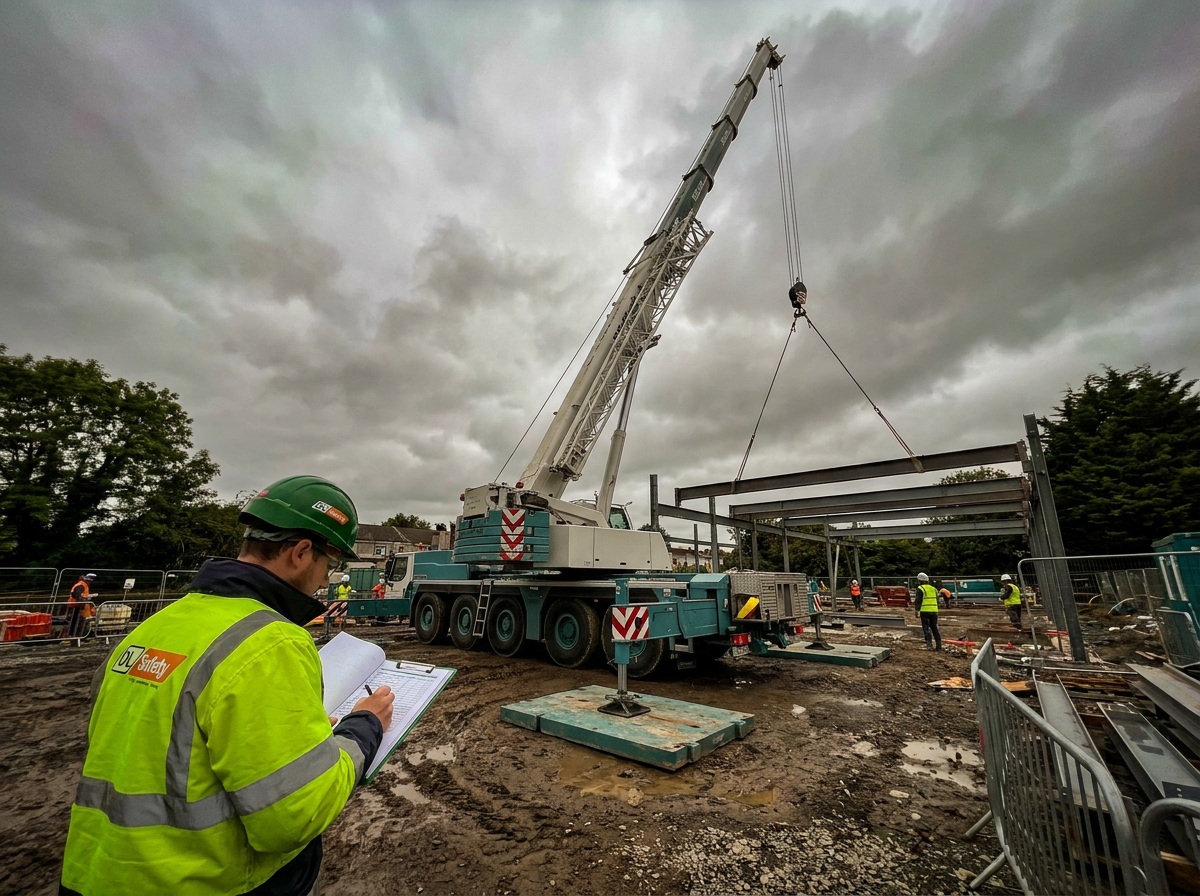
Crane lifts are among the highest-risk operations on any construction, civil, or industrial site. When something goes wrong — an overloaded crane, soft ground beneath an outrigger, a sling failure, a live power line overhead — the consequences are catastrophic and, in most cases, entirely preventable.
This guide covers everything required under Irish health and safety law, British and Irish standards, and best practice to plan and execute a safe crane lift. Whether you’re a site manager, appointed person, or safety officer, use this as your reference from initial planning through to post-lift documentation.
1. Why Crane Lifting Safety Matters: The Regulatory Landscape in Ireland
Crane lifting operations are regulated under a layered framework of primary legislation, statutory regulations, and technical standards. There is no single document that covers everything — compliance means understanding how these instruments work together.
Irish law places a general duty on every employer to ensure, so far as is reasonably practicable, the safety, health, and welfare of all employees and others who may be affected by their work. For lifting operations, that duty is given specific, enforceable form in the regulations and standards detailed below.
2. Applicable Legislation and Standards
Primary Legislation
- Safety, Health and Welfare at Work Act 2005 — the foundation of Irish workplace safety law. Imposes duties on employers, employees, designers, and suppliers. Breaches are criminal offences.
Statutory Regulations
- Safety, Health and Welfare at Work (General Application) Regulations 2007 (S.I. No. 299 of 2007), specifically Part 2, Chapter 1 — covers the minimum requirements for the use of work equipment and the safe conduct of lifting operations. Requires that lifting operations are properly planned by a competent person, appropriately supervised, and carried out in a safe manner. Equipment must be fit for purpose, regularly examined, and marked with its safe working load (SWL).
- Safety, Health and Welfare at Work (Construction) Regulations 2013 (S.I. No. 291 of 2013) — applies to all construction activities. Imposes specific duties on clients, project supervisors (PSDS and PSDP), contractors, and workers. Crane lifts on construction sites fall under these regulations.
Technical Standards
- BS 7121 series — Code of Practice for the Safe Use of Cranes — the primary technical standard for crane operations in Ireland and the UK. Covers planning, the role of the Appointed Person (AP), lift categories, operator competency, pre-use inspections, and supervision. Multiple parts cover specific crane types (mobile cranes, tower cranes, loader cranes, etc.).
- IS EN 13000 — Mobile Cranes — the Irish and European standard specifying requirements for the design, calculation, examination, testing, and marking of mobile cranes. Relevant to crane selection and manufacturer specifications.
- EN 818, EN 1492, EN 13411 — European standards covering chain slings, textile slings, and wire rope terminations respectively. These define the performance requirements and marking requirements for lifting accessories.
- LEEA (Lifting Equipment Engineers Association) standards and guidance — LEEA publishes technical guidance, codes of practice, and competency frameworks for lifting equipment and accessories. Membership of LEEA is a recognised mark of competence in the industry. The LEEA GA1 inspection regime (thorough examination of lifting equipment every six months) is the recognised standard in Ireland for demonstrating ongoing compliance.
- HSA Codes of Practice and guidance — the Health and Safety Authority Ireland publishes codes of practice and technical guidance that, while not legally binding in themselves, are admissible in enforcement and court proceedings as evidence of accepted practice. Available at hsa.ie .
3. Pre-Lift Planning
No crane lift — however routine it appears — should proceed without planning. The level of formality scales with the complexity and risk of the lift, but the principle is non-negotiable.
Appointing a Competent Person / Appointed Person (AP)
Under BS 7121, every lifting operation must be planned by a competent person. For crane lifts of any significant complexity, this person is formally designated the Appointed Person (AP). The AP:
- Is responsible for planning the lift and preparing or approving the lift plan
- Has the relevant knowledge, training, and experience in crane operations, load assessment, ground conditions, and rigging
- Is independent of commercial pressures to complete the lift unsafely
- Holds accountability for the overall safety of the operation
The AP does not need to be on-site at all times but must be contactable during the lift.
Conducting a Site Survey
Before preparing a lift plan, a thorough site survey must be carried out. This covers:
- Ground conditions and load-bearing capacity across the crane’s operating area
- Location of underground services (water, gas, electricity, telecoms)
- Proximity to overhead power lines, structures, trees, and other cranes
- Access routes and traffic management requirements
- Environmental conditions (slope, drainage, flood risk)
- Presence of members of the public or workers in adjacent areas
Preparing a Formal Lift Plan
Every non-routine lift requires a written lift plan (method statement with an integrated risk assessment). Routine repetitive lifts may use a simplified pre-approved method, but even these must be reviewed when conditions change.
Categories of Lifts
BS 7121 categorises lifts to help determine the level of planning required:
- Routine lifts — lifts that are repetitive, performed by trained personnel in consistent conditions with no significant hazards. A simplified plan may apply.
- Complex lifts — lifts involving unusual loads, restricted sites, proximity to hazards, tandem lifting, or other complicating factors. A full written lift plan is required.
- Critical lifts — lifts where the consequences of failure are catastrophic: over live infrastructure, near occupied buildings, lifts close to the crane’s rated capacity, or over water. Requires the highest level of planning, sign-off, and supervision.
4. Ground Bearing Capacity and CBR Testing
Ground failure is one of the leading causes of crane overturns. The ground must be capable of supporting the crane’s outrigger loads — and this must be verified, not assumed.
What Is CBR Testing?
CBR (California Bearing Ratio) testing measures the bearing strength of a soil or sub-base material. The result is expressed as a percentage of the bearing value of a standard crushed stone material. It is a standard method used by geotechnical engineers to characterise ground conditions.
When and Why It Is Required
CBR testing (or equivalent geotechnical investigation) is required when:
- The ground is of unknown or variable composition
- Made-up ground, fill, or disturbed ground is present
- The site is near excavations, slopes, or retaining structures
- There is evidence of underground voids, services, or basements
- The crane will be positioned on soft or waterlogged ground
- Ground improvement has been carried out and records are unavailable
How Ground Bearing Pressure Is Calculated
The outrigger reaction forces from the crane (published in the manufacturer’s load chart) must be spread over an area large enough to keep the pressure within the ground’s capacity. The formula is:
Ground Bearing Pressure (kN/m²) = Outrigger Load (kN) ÷ Pad Area (m²)
The calculated pressure must not exceed the allowable ground bearing capacity established by geotechnical assessment. A safety factor is applied.
Role of a Geotechnical Engineer
Where ground conditions are uncertain, a geotechnical engineer must be engaged to:
- Review available borehole or trial pit data
- Specify required bearing capacity
- Advise on ground improvement measures if required
- Confirm suitability after any remedial work
Special Considerations
- Soft ground and made-up ground — may require engineered matting, ground reinforcement, or piling
- Near excavations — surcharge loads from the crane must not destabilise trench or excavation faces
- Underground services — outrigger loads can collapse buried pipes, ducts, and culverts; always verify service routes before positioning
- Near water — risk of ground saturation reducing bearing capacity; specialist advice required
5. Crane Selection
The right crane for the job is determined by the lift requirements — not by what happens to be available.
Choosing the Right Crane Type
| Crane Type | Typical Use |
| Mobile (all-terrain, rough terrain) | Most common for construction and civil work; versatile, fast to mobilise |
| Crawler crane | Heavy lifts on stable ground; slow to mobilise but high capacity |
| Tower crane | Long-duration construction sites; fixed position |
| Lorry-mounted / loader crane | Lighter lifts; delivery and installation work |
Capacity Charts and Radius/Load Assessment
Every crane comes with a load chart from the manufacturer. The AP must:
- Determine the maximum load radius (horizontal distance from crane centre to load)
- Identify the load weight (including rigging, spreader beams, and all lifting accessories)
- Confirm the crane has sufficient capacity at that radius with the required outrigger configuration
- Apply a minimum 10% derating for dynamic loads and allow appropriate margin
Safe Working Load (SWL)
The SWL (Safe Working Load) is the maximum load a crane is rated to lift under specified conditions. It must never be exceeded. The SWL on the capacity chart accounts for the outrigger configuration — using extended, partially extended, or retracted outriggers changes the SWL significantly.
6. Crane Pads and Outrigger Pads
Purpose and Importance
Outrigger pads spread the point load from each outrigger foot over a larger ground area, reducing the ground bearing pressure to within the ground’s safe capacity. Without adequate pads, the ground can fail locally, causing the crane to overturn.
Calculating Required Pad Size
The required pad area is calculated from:
Minimum Pad Area (m²) = Outrigger Load (kN) ÷ Allowable Ground Bearing Capacity (kN/m²)
Both inputs must be verified — the outrigger load from the manufacturer’s chart, and the bearing capacity from geotechnical assessment.
Types of Pads
- Timber mats — traditional and widely used; must be in good condition, dry, and free from splits. Stacked mats should be of equal thickness.
- Aluminium outrigger pads — lighter than timber, durable, standardised dimensions. Suitable for most mobile crane operations.
- Polyethylene composite mats — high load-spreading ability; ideal for soft or variable ground; lightweight and reusable.
Correct Placement and Inspection
- Pads must be centred under the outrigger foot
- Ground beneath the pad must be level and free from loose material
- Pads must not rock or shift during the lift
- Inspect pads before each use for damage, deformation, or contamination
- Never use makeshift materials (pallets, bricks, loose hardcore) as crane pads
7. Formal Lift Plan
A lift plan is the core document that governs the lift. It must be prepared before the lift commences and must be communicated to all personnel involved.
Contents of a Lift Plan
A complete lift plan includes:
- Site plan / drawing showing crane position, load pick-up and set-down points, slewing arc, exclusion zones, and overhead hazards
- Load details — description, verified weight, centre of gravity, attachment points
- Crane configuration — crane type and model, outrigger spread, boom length and angle, radius, capacity used as a percentage of SWL
- Rigging arrangement — sling type, size, configuration, and all accessories with their SWLs
- Ground conditions — bearing capacity, pad sizes, any ground improvement measures
- Communication plan — who gives signals, what method (hand signals, radio), what language
- Exclusion zones — clearly defined areas no person may enter during the lift
- Emergency procedures — what to do if the lift is aborted, load becomes unstable, or equipment fails
Who Prepares and Who Approves
The lift plan is prepared by or under the supervision of the Appointed Person. On critical lifts, it should be reviewed and countersigned by a second competent person. The contractor’s safety officer and client/PSDP may also be required to approve before the lift commences.
Toolbox Talk and Briefing
Before every lift, a toolbox talk must be delivered to all personnel involved. This covers:
- The plan, sequence of events, and each person’s role
- Communication signals and procedures
- Exclusion zones and who enforces them
- Emergency procedures
- Known hazards specific to this lift
Permit to Lift
For complex and critical lifts, a Permit to Lift (PTL) should be issued. This is a formal authorisation document that confirms all pre-conditions have been checked and met before the lift begins. The PTL is typically signed off by the AP, the site manager, and — where relevant — the owner of the infrastructure being lifted over.
8. Load Assessment
Underestimating the weight of a load is a direct cause of crane failures and fatalities.
Identifying and Verifying Load Weight
- Use manufacturer’s data, structural drawings, or material schedules to establish weight
- Where weight is uncertain, weigh the load using calibrated equipment before lifting
- Include the weight of all rigging equipment, spreader beams, and attachments in the total load figure
Centre of Gravity
The centre of gravity (CoG) of the load determines how it will hang. If the rigging attachment point is not directly above the CoG, the load will tilt. For asymmetric or irregular loads:
- Identify the CoG from drawings or by trial — lift slightly off the ground and check orientation
- Adjust rigging configuration as required before completing the lift
Attachment Points
- Verify that lifting points (eyebolts, padeyes, trunnions) are rated and in good condition
- Never attach slings to structural members not designed for lifting
Dynamic Loading
When a load is accelerated (picked up sharply, swung quickly, or landed with impact), the dynamic load on the crane and rigging is greater than the static load. The load chart SWL applies to static lifts. Dynamic factors must be considered and lifting carried out smoothly with controlled acceleration and deceleration.
9. Slinging and Rigging
Role and Responsibilities of the Slinger/Signaller
The slinger/signaller is responsible for:
- Selecting, inspecting, and attaching lifting accessories to the load
- Ensuring the load is secure and correctly balanced before giving the lift signal
- Directing the crane operator using agreed signals until the load is set down safely
- Removing accessories and securing them after the lift
Competency and Certification Requirements
Slingers and signallers must be trained and competent. In Ireland and the UK, recognised qualifications include:
- CSCS (Construction Skills Competence Scheme) Slinger/Signaller
- LEEA training and assessment for lifting accessories
- Safe Pass (mandatory for all construction workers in Ireland — does not replace specific slinging competency)
- CIF (Construction Industry Federation) training programmes where applicable
Selection of Lifting Accessories
| Accessory | Typical Use | Key Standard |
| Wire rope slings | Heavy and abrasive loads | EN 13414 |
| Chain slings | High-temperature or abrasive applications | EN 818 |
| Synthetic webbing slings | General lifting, fragile loads | EN 1492-1 |
| Round slings | Fragile and precision loads | EN 1492-2 |
| Shackles | General connecting element | EN 13889 |
| Eyebolts | Attachment to fabricated components | EN 1677 |
| Hooks | General purpose with latch | EN 1677 |
SWL and WLL
- SWL (Safe Working Load) — the maximum load a piece of lifting gear is rated to carry in a given configuration
- WLL (Working Load Limit) — the European equivalent term; for practical purposes, identical to SWL
- Sling angle affects WLL: as the angle from vertical increases, the tension in each leg increases and the WLL decreases. At 60° from vertical, the WLL of each leg is 50% of its single-leg rating.
Inspection of Lifting Gear Before Use
Before every use, lifting accessories must be visually inspected for:
- Cuts, abrasions, or broken wires (wire rope)
- Twisted, kinked, or crushed links (chain)
- Cuts, tears, chemical damage, or UV degradation (synthetic)
- Deformation, corrosion, or wear on shackles, hooks, and eyebolts
- Legibility of SWL/WLL markings
If any doubt exists about an item’s condition, it must be removed from service immediately.
Register of Lifting Equipment
All lifting equipment and accessories must be subject to thorough examination at least every six months by a competent person (typically to the LEEA GA1 standard in Ireland). Records of examination must be maintained in a Register of Lifting Equipment and be available for inspection. The competent examiner issues a report; any defects found must be addressed before the equipment is returned to service.
10. Crane Operators
Minimum Competency Requirements
Crane operators must be trained, assessed, and competent. Recognised qualifications include:
- CSCS (Construction Skills Competence Scheme) — the most widely recognised standard in Ireland
- CIF operator training programmes
- Relevant QQI / FETAC awards where applicable
An operator card confirms the holder has passed a theory test and practical assessment for a specific crane type. Cards must be in date.
Operator Duties and Responsibilities
The crane operator:
- Must only operate a crane they are trained and assessed to use
- Must not commence a lift without a current, approved lift plan
- Is responsible for carrying out pre-use checks before every shift
- Must refuse to carry out a lift they believe is unsafe
- Must operate within the crane’s rated capacity at all times
- Must not leave the cab with a suspended load
Pre-Use Inspection Checks
Before first use each day, the operator must inspect:
- All fluid levels (engine oil, hydraulic oil, coolant)
- Tyres or tracks for damage and pressure
- Outriggers for hydraulic leaks and correct operation
- Boom, jib, and load line for damage or wear
- Hook block, hook latch, and load line reeving
- Load indicator and rated capacity indicator (RCI) for correct function
- All safety devices (over-hoist limit, anti-two-block)
- Cab instruments, controls, and warning systems
Communication with Slinger/Signaller
The operator and slinger/signaller must agree the communication method before the lift and use it consistently throughout. Where line-of-sight is not maintained, radio communication is required.
11. Overhead Obstructions
Identifying Overhead Hazards
Before positioning the crane and during the site survey, identify and mark all overhead hazards, including:
- Overhead power lines — the most serious overhead hazard
- Other cranes on or adjacent to the site
- Existing structures, gantries, or roof edges
- Trees and overhanging vegetation
- Communications cables, street lighting, and traffic signals
Statutory Exclusion Zones Around Overhead Power Lines
The HSA and ESB publish guidance on minimum approach distances to overhead power lines. Under no circumstances should any part of a crane, load, or rigging approach within the specified safe distances without express written consent from the line owner and appropriate isolation measures.
General safe approach distances (confirm with ESB/HSA guidance for specific voltages):
- Low voltage (up to 1kV): 3 metres minimum
- Medium/high voltage (up to 38kV): 6 metres minimum
- Extra high voltage (110kV+): consult ESB Networks
ESB and Bord Gáis Permit Requirements
Where work must take place within the exclusion zones around ESB or Bord Gáis infrastructure, a formal permit to work must be obtained from the relevant utility before any operations commence. The utility will specify conditions — which may include isolation, temporary rerouting, or supervised working. These permits must be in place before the crane is mobilised to site.
Proximity Monitoring Devices
For operations near overhead lines, proximity warning devices (tag line alarms, radar proximity systems, or voltage-sensing devices) should be fitted to the crane boom. These provide an audible and visual alert when the boom approaches a defined exclusion boundary. They are a supplementary control — they do not replace safe exclusion zones or utility permits.
12. Crane Placement and Setup
Positioning the Crane on-Site
The crane must be positioned to achieve the required radius while keeping the load line as plumb as possible throughout the lift. Consider:
- Slewing arc required to pick up and set down the load
- Proximity to hazards in all boom positions
- Direction of travel of the suspended load
- Access for delivery vehicles and other site traffic
Levelling the Crane
The crane must be levelled within the tolerances specified by the manufacturer (typically ±0.5° to ±1.0°). Out-of-level operation reduces capacity and increases the risk of structural failure. Use the crane’s built-in spirit level and outrigger controls to achieve level before commencing any lift.
Outrigger Deployment and Load Spreading
- Outriggers must be fully deployed to their rated spread unless the load chart specifically permits a reduced spread configuration
- Each outrigger pad must be in full contact with the ground and the outrigger float
- Hydraulic pressure in outrigger circuits must be confirmed before lifting
Slewing Radius and Exclusion Zones
Define and enforce exclusion zones around the full slewing radius of the crane. No person should enter the exclusion zone during a lift except those directly involved and in communication with the operator. Barriers, banksman control, or both must be used.
Traffic Management and Public Safety
Where crane operations affect public roads, footpaths, or adjacent properties:
- A Traffic Management Plan (TMP) must be prepared and approved before works commence
- Road closure, lane restriction, or footpath diversion notices must be obtained from the relevant local authority
- Signage, barriers, and traffic management personnel must be in place before the crane is mobilised
- Members of the public must never enter the operating area
13. During the Lift
Communication Protocols
- Agree hand signals in advance and confirm all parties understand them — use the standard hand signals published in BS 7121
- Where radio is used, confirm a clear channel and test before commencing
- Only one person — the designated slinger/signaller — should give signals to the crane operator
- The operator must obey the emergency stop signal from any person, regardless of who gives it
Lift Supervisor Responsibilities
On complex and critical lifts, a dedicated lift supervisor should be appointed. The supervisor:
- Is present on-site throughout the lift
- Confirms all pre-conditions are met before authorising commencement
- Monitors the lift in progress
- Has authority to halt the lift at any point
Wind Speed Limits
Crane manufacturers specify maximum wind speed limits for operation. These must not be exceeded. An anemometer should be on-site for critical lifts. As a general guide, many cranes have reduced capacity or operational restrictions above Beaufort Force 6 (approximately 25 mph / 40 km/h) — check the crane’s specific manual.
Tandem / Assisted Lifts
When two cranes lift a single load:
- A specialist tandem lift plan must be prepared — this is always a critical lift
- Load sharing between cranes must be precisely calculated
- Both cranes must be capable of taking the full load independently (in case of unplanned load transfer)
- Both operators and the signaller must be in constant communication
- One lift supervisor must be in overall control of both cranes
Emergency Procedures
The lift plan must include emergency procedures for:
- Loss of power or hydraulic failure mid-lift
- Load becoming unstable or slipping
- Crane becoming unlevel during a lift
- Structural failure or alarm activation
- Personnel entering the exclusion zone
- Weather deteriorating to beyond safe limits
14. Post-Lift
Returning the Crane to Travel Configuration
After all lifts are complete:
- Lower the boom to travel position and secure
- Retract outriggers fully
- Stow and secure all ancillary equipment
- Do not travel on a public road with the crane in an unsafe configuration
Inspection of Lifting Accessories After Use
After significant lifts, inspect all slings, shackles, and accessories for damage or deformation. Any items showing signs of distress must be removed from service and examined by a competent person before reuse.
Documenting the Lift
Record the following after each lift:
- Date, time, location, and personnel involved
- Crane details (make, model, registration)
- Load lifted (description and weight)
- Any deviations from the lift plan and the reason
- Signed confirmation from the AP that the lift was carried out as planned
Reporting Near-Misses or Incidents
Any near-miss, dangerous occurrence, or injury during a lifting operation must be:
- Reported immediately to the site manager and safety officer
- Documented in the site safety file
- Investigated to establish root cause — not to assign blame, but to prevent recurrence
- Reported to the HSA where required under the SHWW Act 2005 and the Reporting of Accidents and Dangerous Occurrences Regulations
15. Need a Lift Plan? Talk to DL Safety
Crane lifts demand precision, competence, and experience. Cutting corners — whether on ground conditions, rigging selection, or operator competency — puts lives at risk and exposes businesses to criminal liability.
At DL Safety, we’ve been preparing crane lift plans and conducting lifting equipment inspections on major Irish infrastructure projects for over 25 years. We bring hands-on, real-world experience to every project — not just a template.
Our crane lifting services include:
- Lift plan preparation for routine, complex, and critical lifts
- Risk assessment and method statement development
- GA1 thorough examination of lifting equipment (6-monthly regime to LEEA standard)
- Slinger/signaller and crane supervisor training
- Site audits for lifting operations compliance
- Competency assessments for crane operators and appointed persons
Whether you’re setting up for a single lift or need an ongoing compliance partner, we’re here to help.
Contact DL Safety today — dlsafety.ie