
Safer work can be more than a compliance exercise; it can help make your business a stronger insurance risk. Businesses asking how to reduce insurance premiums with safety protocols should focus on practical risk controls and clear evidence: relevant staff training, recorded inspections and incidents, and safety procedures that are applied consistently. Insurers are more likely to view a business as a lower risk when its safety practices are supported by a strong record.
It makes sense to look beyond shopping around. A well-managed safety programme can reduce the likelihood and impact of incidents, while complete records show the steps your business takes to control risk when cover is reviewed. The most relevant controls depend on your work and the hazards it involves.
This article explains how training and near-miss reporting can strengthen your records, which policy choices may affect premiums, and what to prepare for an insurance review with a broker. The goal is not paperwork for its own sake, but a consistent record showing hazards were identified, controls put in place and lessons acted on.
Key Takeaways
- Match safety controls to the risks of your work, and keep a clear record of how hazards are managed.
- Use relevant staff training and near-miss reports to spot recurring issues and show how lessons are followed up.
- Review policy options, payment terms and excess levels carefully, weighing any premium reduction against what you would pay in a claim.
- Keep training, inspection and incident records organised so underwriters can understand your safety practices.
- Review operational changes and insurance cover with a broker, using your safety records to support the discussion.
1. How factors affecting premiums differ in practice
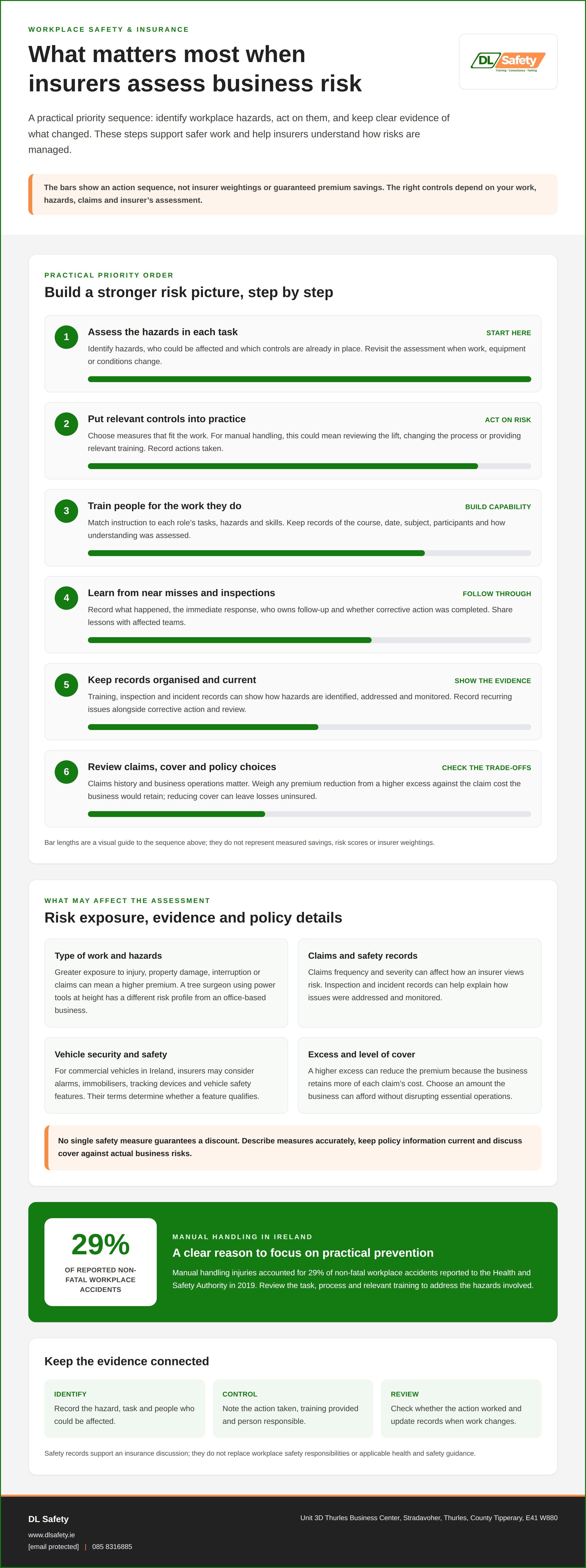
A business’s insurance premium reflects the risks the insurer agrees to cover. Greater exposure to injury, property damage, interruption or claims can mean a higher premium. A tree surgeon using power tools at height, for example, has a different risk profile from an office-based business. If you’re considering how to reduce insurance premiums with safety protocols, start by controlling relevant hazards and showing how those controls work.
Start with a workplace risk assessment. Identify hazards for each task, who could be affected and which controls are already in place. Then consider whether further measures could reduce the likelihood or impact of harm. For manual handling, this might mean reviewing the lift, changing the process or providing relevant training. Record the actions taken and revisit the assessment when work, equipment or conditions change.
Safety improvements can support lower premiums, but their costs and payback depend on the hazard, the control chosen, claims and the insurer’s assessment. Weigh a proposed measure’s cost against its wider value, including reduced disruption and damage. Don’t assume an improvement will produce a specific premium saving. To reduce insurance premiums with safety protocols, prioritise controls that address actual workplace risks.
For commercial vehicle insurance in Ireland, insurers may consider security or safety measures such as alarms, immobilisers, tracking devices and vehicle safety features. No single measure guarantees a discount. The insurer’s terms determine which features qualify and how they affect the premium, so describe vehicle measures accurately when discussing cover.
Insurers assess claims history alongside information about business operations and risk controls. Workplace inspection findings and safety records can show how hazards are identified, addressed and monitored. Records of recurring issues without follow-up tell a different story from records of corrective action and review. Claims frequency and severity can also affect how an insurer views the risk.
The Motor Insurance Transparency Code includes risk-mitigation guidance to help consumers understand how behaviour and risk profile can influence premiums. For businesses, the practical principle is to identify relevant exposures and show how they are managed. Raising the excess can reduce a premium because the business retains more of each claim’s cost. Choose an excess the business can afford without disrupting essential operations.
Reducing cover can leave important losses outside the policy, while misrepresenting safety measures can create a mismatch between stated risks and actual conditions. Keep policy information truthful and current. Safety protocols are most useful when assessment, action and evidence connect. This gives insurers a clearer basis for assessing the business and helps management focus on risks that could cause harm or interruption.
2. Employee safety training and near-miss reporting
Training is most useful when it reflects the work people actually do. A worker moving materials needs different instruction from someone operating lifting equipment or working at height. List the tasks, hazards and skills required for each role, then match the instruction to those needs. Use practical demonstrations where employees can practise safely. Job-specific training helps staff apply procedures in their actual working environment.
Training records should show competence, not just attendance. Record the course, date, subject and participating employees, as well as how understanding was assessed, such as through a practical demonstration or questions about a procedure. Managers can use this information to identify gaps, plan refresher sessions and show which workers have received relevant instruction.
Near-miss reporting creates another opportunity to learn. Make it easy for workers to report what happened, where it happened and what could have caused harm. Record the immediate response, who is responsible for follow-up and whether corrective action was completed. For example, repeated reports of unstable materials can prompt a review of storage arrangements before an injury or damaged goods result.
A constructive safety culture encourages employees to speak up without treating reports as blame. Managers should acknowledge reports, explain the actions taken and share lessons with affected teams. This creates a practical feedback loop: workers identify hazards, supervisors assess them and the business records improvements. Strong prevention supports safer, more consistent work instead of relying on claims or investigations after an incident.
In Ireland, follow applicable health and safety legislation and the Health and Safety Authority’s guidance relevant to your workplace hazards. Use guidance on risk assessment and employee instruction to shape training and controls; insurance records do not replace workplace safety responsibilities. Manual handling deserves attention: in Ireland, manual handling injuries accounted for 29% of non-fatal workplace accidents reported to the Health and Safety Authority in 2019.
Training can help reduce avoidable disruption over time and support safer work. But it won’t significantly improve risk management if procedures are unclear or equipment and working conditions contradict the instruction. Review training after a near miss, equipment change or new task. Update the material and record what changed so employees receive guidance that reflects current work.
Where a team needs practical, role-specific instruction, bespoke safety training can help connect course content to workplace tasks and hazards.
3. Discounts, annual payments and excess levels
Policy choices can change both what a business pays and what it must fund after a claim. Review the premium alongside cover limits, exclusions, payment terms and excesses, rather than judging a policy on price alone. A lower premium may be poor value, for example, if important operational risks are excluded.
In Ireland, a health and safety certificate or risk-management programme can help demonstrate how a business manages risk, but it does not automatically secure an insurance discount. Insurers set terms according to the policy, the business’s risk profile and the evidence provided. Keep programme records current so they’re ready to support a renewal discussion.
A higher excess can lower the premium because the business agrees to pay more towards a claim. Before changing it, consider how much the business could pay promptly without delaying wages, supplier payments or essential work. A renewal saving is less useful if a later claim creates a cash-flow problem.
Use previous claims to assess whether the proposed excess is manageable. If the business often has small losses, compare the likely out-of-pocket cost with the premium reduction. Don’t assume every small claim should be absorbed. The decision depends on the policy terms, the loss and the company’s ability to fund repairs or replacement.
Annual payment may avoid interest or administration fees associated with monthly instalments, depending on the insurer’s terms. Compare the total payable for each option, including any charges, with the benefit of keeping cash available throughout the year. Record the chosen payment method with the renewal documents.
Ask whether holding several policies with one insurer could qualify the business for a discount. If you bundle cover, compare the combined terms with the separate policies, including limits, exclusions and renewal dates. A discount is only worthwhile if the package still covers the business’s actual risks.
At renewal, describe safety measures accurately and provide relevant records, such as training logs or inspection findings. These details help show the controls behind the business’s risk profile. Don’t present a planned measure as already in place; inaccurate information can undermine the policy’s account of the risk.
Keep the review practical: compare the current and proposed premium, payment schedule, excess and cover, then note any changes to the business’s work. This gives decision-makers a clear basis for choosing which measures to retain, adjust or discuss at renewal.
4. Documenting safety protocols for underwriters
Organise safety evidence so an underwriter can understand the controls behind the business’s risk profile. Start with a current risk assessment, then group supporting records by hazard or activity. A construction business, for example, could keep excavation controls together with relevant procedures, inspection findings and corrective actions. Add document titles, dates and responsible roles to distinguish current measures from outdated versions.
Policies should explain how work is carried out, not just state general intentions. For each procedure, record the task covered, hazards identified, control measures and who is responsible. A safe work procedure for equipment use, for example, should link the hazard to the steps workers follow. When a process changes, update the document and record what changed, when and who approved it.
Inspection records show whether controls are applied in practice. Note the area or equipment inspected, findings and any action required. If an inspection identifies a damaged guard, record how the equipment was made safe, who arranged the repair and when it was completed. Keep the original finding with the close-out record so the evidence shows the full sequence, not just the final result.
Training records should link each person’s role to the instruction they received. Include the topic, attendance, date and any practical assessment or follow-up required. For example, a record for workers using lifting equipment can identify the relevant task and procedure covered. If more instruction is needed, document the plan and its completion instead of marking competence as achieved before it has been assessed.
Incident and near-miss records can show how a business learns from events. Record what happened, the immediate response, the cause considered and the corrective action. For a near miss involving vehicle movement, this might include reviewing the traffic route and recording the revised control. Track whether the action was implemented and whether a later inspection found it effective.
Before renewal, assemble a concise evidence pack with current risk assessments, procedures, inspection records, training logs and action close-outs. Explain significant changes to operations, equipment or staffing, and ensure the documents reflect actual practice. Clear, consistent records help underwriters assess how risks are managed. Conflicting versions or unfinished actions can make that picture harder to interpret.
5. Reviewing operational risks with a broker
A broker can help a business identify operational risks and consider how its insurance cover reflects them. Prepare for the discussion by describing the work, equipment, premises and recent changes. For example, explain the hazards and controls for any new process, or physical security upgrades like biometric access control discussed by First Emirates Computers. This gives the broker a clearer picture than a renewal conversation focused only on the premium.
Bring practical evidence to the review, including current risk assessments, inspection findings, training records, incident follow-ups and details of completed safety improvements. Explain what changed and how the change is used day to day. If a procedure was updated after a near miss, include the revised process and actions taken rather than relying on a general claim that safety has improved.
Ask the broker to assess whether the existing policies still fit the business’s activities. Discuss cover limits, exclusions, excesses and operational changes that could affect the risk. If the business has stopped a particular activity, make that clear. Likewise, new equipment or work can create exposures that need to be accurately reflected in the policy information.
To request a premium review after making safety improvements, send the broker a concise summary of the changes with supporting records. Ask the insurer to reassess the risk and explain any revised terms. Keep the request factual: identify the hazard, the control introduced and evidence that it is in use.
Plan the renewal early. Begin gathering information four months before the renewal deadline, as notices often arrive only a few weeks before the policy anniversary. This leaves time to resolve missing details, discuss changes and consider proposed terms before paying. Shops should review their insurance cover at least annually so the policy can be considered alongside changes in stock, premises or trading activities.
Use the review to consider both the premium and resilience. A higher excess, for example, changes how much the business must fund after a claim. Discuss whether that amount is manageable alongside cash flow and the losses its operations could face. Record the agreed decisions and follow-up actions so the next renewal starts with an accurate account of changes.
Clear safety evidence can make an operational-risk discussion more focused. Prepare your safety records before the next broker review, including the controls introduced and the steps taken to maintain them.
DL Safety: Safe T Cert preparation
DL Safety provides Safe T Cert preparation to help businesses organise the safety documentation and processes required for their preparation. It can be a practical next step when safety records need structure or a business is preparing for assessment. Monthly Safety Support Packages can provide ongoing support with workplace safety management, while Lift Plans and GA1 Testing address specific operational requirements.
These services support safety management, but no insurance premium reduction is guaranteed. Keep the focus on accurate records and measures that reflect how work is carried out. To discuss Safe T Cert preparation, contact DL Safety at www.dlsafety.ie, by email at info@dlsafety.ie or by telephone on 085 8316885. DL Safety delivers nationwide services to support businesses in implementing effective safety protocols and reducing insurance premiums.
Make your next renewal a practical checkpoint
If you’re considering how to reduce insurance premiums with safety protocols, connect safety improvements to clear evidence and regular reviews. Treat each renewal as a checkpoint: note changes in work, assess whether controls remain effective and ensure the information provided to the insurer reflects current operations.
This process can also help management decide where attention is needed next. A recurring issue may call for a procedure change, while a completed improvement should be reflected in the business’s records. Premium reductions aren’t guaranteed, but a clear account of risks and controls makes renewal discussions more grounded and informed.
Choose one practical action to begin, such as organising the evidence for a recent improvement or setting a date to review operational changes. If you’d like support with your safety management, contact DL Safety to discuss the next step. A steady, evidence-led approach can help your business move forward with greater clarity.
Frequently Asked Questions
Beyond shopping around, what else can I do to lower my premium?
Improve how your business controls risk, then give the insurer a clear account of the changes. If staff regularly move materials, for example, review the task and consider whether equipment or revised work arrangements could reduce strain. Record actions and outcomes. At renewal, discuss whether the business’s activities, cover limits and excess still fit its needs instead of making changes based only on the headline premium.
How do factors affecting insurance premiums make a difference in practice?
Safety measures influence how an insurer views the likelihood and potential impact of a claim. A business with machinery, vehicles or hazardous tasks may face different exposures from one with mainly desk-based work. The insurer may also consider the cover requested and previous claims. A change in operating hours or a new activity, for instance, can alter the risks being insured, so accurate policy information matters.
What influences the cost of your insurance premium?
The premium reflects the insurer’s assessment of the risk and the cover provided. Relevant details may include the business’s activities, premises, equipment, claims experience, policy limits and excess. A business’s risk profile can change when it takes on different work or introduces new equipment. Insurers set their own terms, so policies with similar names may differ in exclusions, limits and how they respond to a claim.
Which workplace safety protocols can help reduce business insurance premiums in Ireland?
Useful protocols address the hazards present in the workplace. Depending on the work, these may include task-specific training, equipment inspections, safe operating procedures, traffic controls and a clear process for reporting incidents or near misses. A team using lifting equipment, for example, needs procedures suited to its lifting tasks. Apply controls consistently and keep evidence that reflects actual work, rather than relying on generic paperwork.
How much can safety improvements reduce employers’ liability and public liability premiums in Ireland?
There is no standard reduction that applies to every Irish business. Any change depends on the insurer’s assessment, the type of work, existing cover, claims experience and safety improvements made. Employers’ liability and public liability cover different exposures, so a control relevant to one risk may not affect the other. Treat safety improvements as risk management, not a guaranteed discount or fixed payback.
How can businesses document safety protocols and incident reductions to negotiate lower premiums?
Keep dated records linking each safety measure to the hazard it addresses. A useful file might include the procedure, training attendance, inspection results, incident reports and completed corrective actions. To identify trends, compare consistent records over time, such as incident types and follow-up status. Share a concise account at renewal, including operational changes, so the broker or insurer can consider the evidence alongside the policy and claims history.
