
Not every work-related health problem is reportable to the HSA. For reporting an incident to the HSA, the key distinction is that the Safety, Health and Welfare at Work (Reporting of Accidents and Dangerous Occurrences) Regulations 2016 cover fatal and non-fatal injuries and prescribed dangerous occurrences, but not diseases, occupational illnesses or impairments of mental condition.
It can be difficult to know where the reporting threshold falls, especially when an incident needs attention but may not require formal notification. An event that is not reportable to the HSA may still need to be recorded and investigated internally. Understanding the difference helps you respond appropriately and keep internal records separate from statutory notifications.
This article explains what is excluded, who must notify the HSA when an injury or dangerous occurrence is reportable, and how the IR1 process works. It also covers the separate requirements after a fatal accident, so you can understand the immediate notification and written reporting duties that apply in Ireland.
Key Takeaways
- Diseases, occupational illnesses and impairments of mental condition are not reportable under the 2016 Regulations, but may still need internal attention.
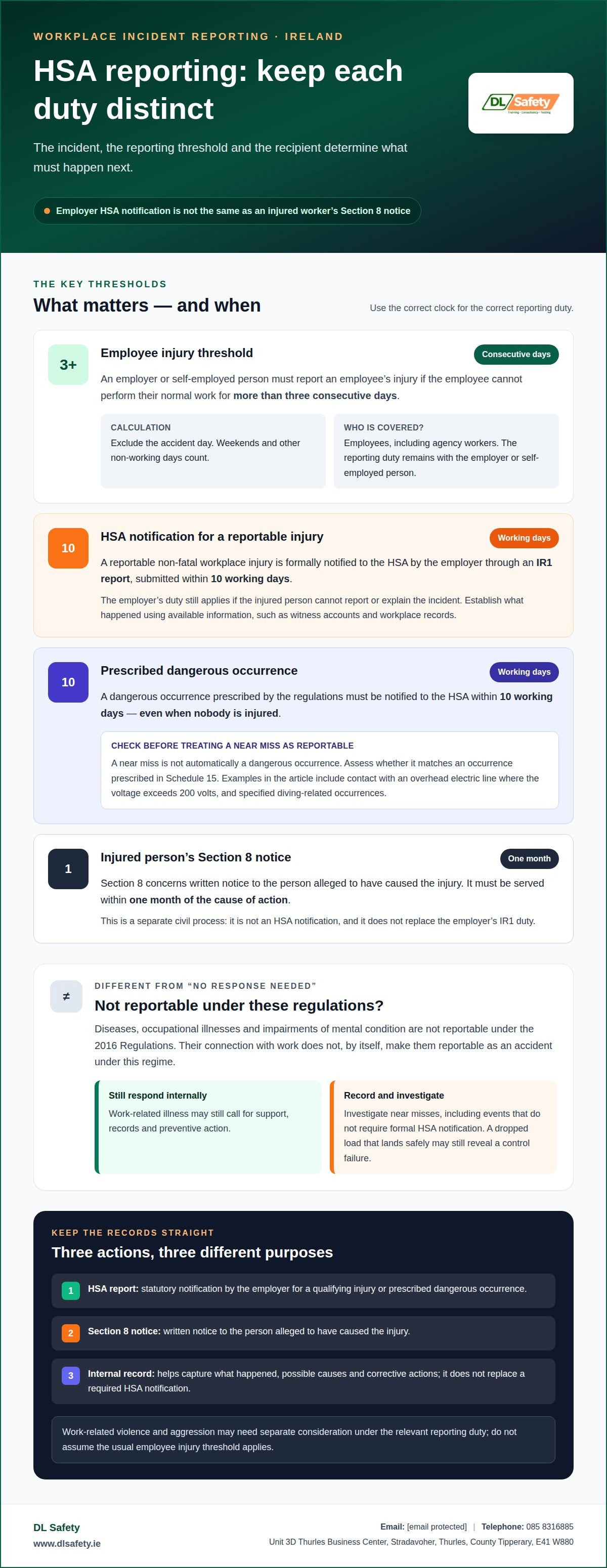
- An employee injury is generally reportable when the employee cannot do their normal work for more than three consecutive days, excluding the day of the accident.
- Reportable dangerous occurrences must be notified within 10 working days, whether or not anyone is injured.
- An injured worker’s Section 8 notice is separate from an employer’s duty to report an accident to the HSA.
- Fatal workplace accidents require immediate notification, followed by a written report within five working days.
What is NOT reportable under these regulations?
The Safety, Health and Welfare at Work (Reporting of Accidents and Dangerous Occurrences) Regulations 2016 distinguish between injuries, prescribed dangerous occurrences and other workplace concerns. Diseases, occupational illnesses and impairments of mental condition are not reportable under these regulations. Their connection with work does not, by itself, make them reportable as an accident under this regime.
That distinction concerns notification to the Health and Safety Authority, not whether an employer should respond. A work-related illness may still call for appropriate support, records and preventive action. For example, stress linked to a worker’s duties is a workplace issue, even though an impairment of mental condition is not reportable under these regulations.
Near misses also need careful distinction. A near miss is not automatically a reportable dangerous occurrence simply because someone could have been hurt. The deciding factor is whether the event falls within a dangerous occurrence prescribed by the regulations. Section 2 of the Safety, Health and Welfare at Work Act 2005 defines “dangerous occurrence”, while Schedule 15 lists prescribed occurrences.
A dangerous occurrence may be reportable even when no one is injured. In Ireland, a reportable dangerous occurrence must be notified within 10 working days. Examples include contact with an overhead electric line where the voltage exceeds 200 volts, and specified accidents or dangerous occurrences related to diving under Part 14 of the Safety, Health and Welfare at Work (General Application) Regulations 2007 to 2016.
- Near miss: record and investigate it internally; assess whether it matches a prescribed dangerous occurrence.
- Prescribed occurrence: notify the HSA within 10 working days, even if nobody was injured.
Employers are expected to investigate workplace accidents and near misses, including events that do not require formal HSA notification. A dropped load that lands safely, for example, may reveal a control failure worth addressing. Recording what happened, possible causes and corrective actions can help prevent a repeat, even when the event is not reportable.
Employees also have protection when raising safety concerns. Section 27 of the Safety, Health and Welfare at Work Act 2005 prohibits employers from penalising employees for raising those concerns or exercising workplace safety rights, according to Irish Statute Book. This protection relates to speaking up; it does not turn an otherwise non-reportable illness or near miss into a reportable event.
A separate statutory penalty provision should not be mistaken for the reporting threshold. A person guilty of an offence under section 39 (17)(e) of the Redundancy Payments Act 1967 as applied to this Act by section 29 (7), or 77 (1) is liable on summary conviction to a fine not exceeding €3,000, according to Irish Statute Book.
Employer reporting duties versus an injured worker’s Section 8 notice
If an injured person cannot report the incident, the employer’s duty still applies. The employer should establish what happened and report the injury if it meets the legal threshold.
In Ireland, employers and self-employed persons must report an employee’s workplace injury if the employee cannot perform their normal work for more than three consecutive days. The accident day is excluded from the calculation. Weekends and other non-working days count, so a rostered day off does not automatically pause the period.
This HSA duty covers injuries to employees, including agency workers. It belongs to the employer or self-employed person, not the injured worker. The employee’s account can help explain what happened, but being unable to provide one does not remove the employer’s responsibility. Witness accounts, workplace records and information about the person’s normal duties can help establish the relevant facts.
Work-related violence and aggression may need to be considered separately when assessing workplace reporting duties. The injury threshold for other employee accidents should not be assumed to apply to these incidents. For example, an assault at work must be considered under the violence and aggression reporting duty, even if the employer is also assessing absence from normal duties.
An IR1 report is the employer’s formal notification to the HSA for a reportable non-fatal workplace injury. It must be submitted within 10 working days. This is distinct from an injured person’s Section 8 notice under the Civil Liability and Courts Act 2004. Section 8 concerns written notice to the person alleged to have caused the injury, not notification to the HSA.
The Section 8 notice must be served within one month of the cause of action. It is a separate legal process, with a different recipient and purpose from an employer’s IR1. An internal accident-book entry also does not replace the employer’s statutory HSA notification. Keeping these records separate helps prevent one action being mistaken for another.
Consider a worker who is injured, cannot explain what happened immediately, and later misses normal duties. The employer should establish the circumstances, assess the absence period and make any required HSA report. The worker’s ability to give an account does not determine whether the reporting duty applies.
These obligations serve different purposes: the HSA report records a qualifying workplace incident, while a Section 8 notice addresses a separate civil claim process. Neither should be treated as a substitute for the other, and an internal record alone does not fulfil the HSA reporting duty.
IR1 reporting methods
For a reportable non-fatal injury, the employer submits an IR1 report to the HSA within 10 working days. The report should give a clear account of the event, the injured person, the injury and its consequences. Relevant workplace records can help the employer provide accurate details.
Build the account from information gathered at the time, and distinguish confirmed facts from details still being established. Record where the incident occurred, what task was underway and what happened immediately before the injury. A clear sequence explains the event without speculation.
Useful information to assemble includes:
- Incident details: the date, location, work activity and events leading to the injury.
- People involved: the injured person’s role and any witnesses who can describe what they observed.
- Injury and impact: the nature of the injury and whether the person could continue normal work.
- Supporting records: relevant accident-book entries, witness notes or workplace documents.
These records support a coherent report; they should not be treated as a substitute for the IR1 itself. If a witness saw a load shift before a worker was hurt, for instance, their account can clarify the sequence. Keep observations separate from conclusions about the cause.
The employer should also describe the work circumstances surrounding the injury. A report about a fall during access work will be clearer if it identifies the task and the immediate conditions. Avoid relying on a broad label such as “slip” when a factual description can explain what occurred.
Absence information matters when the reporting duty depends on inability to perform normal work. The threshold is more than three consecutive days, excluding the accident day, and weekends or other non-working days count. Record the person’s normal duties and the period they could not perform them, rather than assuming a scheduled rest day breaks the count.
Before submitting the report, check that dates, names and descriptions are consistent. Compare the incident account with witness notes and relevant workplace records. Correct factual errors and make clear where accounts differ. A precise report helps the HSA understand what happened and assess the notification.
Submitting an IR1 does not replace the employer’s investigation. Keep the report alongside the internal incident record, investigation findings and actions taken after the event. For example, if equipment was involved, record its role in the incident and any relevant steps taken afterwards. This preserves a useful account for follow-up and prevention.
Immediate notification and written reports for fatal accidents
A workplace fatality requires immediate notification to the Health and Safety Authority (HSA) or An Garda Síochána. The written report generally follows within five working days. An internal accident-book entry cannot replace either notification.
For urgent HSA notification, the stated phone number is 0818 289 389. The immediate call and later written report are separate duties, so completing one does not complete the other. If An Garda Síochána is notified, the employer must still meet the HSA reporting requirements.
Which workplace accidents must employers report? Reportable cases include fatalities, non-fatal employee injuries that meet the absence threshold, and prescribed dangerous occurrences. An accident involving a member of the public may also require notification if the person goes to hospital for treatment following an incident connected with a workplace or work activity.
For an employee’s non-fatal injury, the threshold is inability to perform normal work for more than three consecutive days, excluding the accident day. The employer submits an IR1 within 10 working days for a reportable non-fatal injury. Dangerous occurrences must also be reported within 10 working days, whether or not anyone was hurt.
How soon must a workplace incident be reported to the HSA? A fatality must be reported immediately, followed by a written report generally within five working days. A reportable non-fatal injury or dangerous occurrence has a 10-working-day reporting period.
Does reporting an incident to the HSA replace notifying the Gardaí or another authority? No. For a fatal accident, notify the HSA or An Garda Síochána immediately, and submit the written HSA report separately. Other authorities may have separate functions, so an HSA notification does not automatically fulfil those requirements.
Identify which category applies before treating the paperwork as complete. A fatal accident requires immediate notification, while an employee injury may depend on the person’s absence from normal work. A prescribed dangerous occurrence may require reporting even if no one was injured.
Keep the chronology clear: record when the event occurred, when immediate notification was made and when the written report was submitted. Do not confuse the HSA report with the workplace accident book. The book records the event internally but does not fulfil the separate statutory notification duty.
These reporting steps sit alongside the employer’s response to the incident. Preserve relevant information, identify the event category and make the correct notification within the applicable timeframe. Recording each action helps distinguish the immediate notification from the later report.
Incidents and conditions not reportable under the 2016 Regulations
The 2016 Regulations do not make every workplace concern reportable to the Health and Safety Authority. Diseases, occupational illnesses and impairments of mental condition fall outside their reporting requirements. For example, a worker’s work-related stress still deserves attention, but it is not reportable as an injury under these regulations.
That distinction does not mean an employer should ignore the issue. An illness report may point to a workplace hazard that needs investigation or preventive action. Consider HSA reporting separately from the employer’s response to the worker and the underlying risk.
A near miss is not automatically reportable just because it could have caused injury. The relevant question is whether the event matches a dangerous occurrence prescribed by the regulations. Section 2 of the Safety, Health and Welfare at Work Act 2005 defines “dangerous occurrence”, and Schedule 15 sets out prescribed occurrences.
For example, contact with an overhead electric line is reportable if the voltage exceeds 200 volts. Diving-related accidents and dangerous occurrences are also covered under Part 14 of the Safety, Health and Welfare at Work (General Application) Regulations 2007 to 2016. These examples show why the event itself, not just whether someone was hurt, matters.
An incident involving a member of the public may require notification if the person is taken to hospital for treatment. It must be connected with a workplace or work activity. A visitor injured during work at the premises should therefore be assessed against this specific criterion.
Employers are expected to investigate accidents and near misses even when formal HSA notification is not required. Record what happened, the task underway, any equipment involved and the actions taken. A dropped object that misses a worker, for instance, may reveal a control failure despite causing no injury.
- Illness or mental condition: not reportable under these regulations, but assess the workplace concern.
- Near miss: assess whether it is a prescribed dangerous occurrence, then investigate internally.
- Public injury: consider whether the person was taken to hospital for treatment after a work-related incident.
What are the penalties for failing to report a reportable incident to the HSA? A failure to meet a reporting duty may amount to a breach of health and safety legislation. The stated maximum penalty on indictment for a breach is €3 million and/or two years’ imprisonment.
Correct classification helps distinguish a non-reportable condition from a prescribed occurrence or reportable injury. Discuss your workplace incident reporting arrangements if you need support reviewing how incidents are assessed and investigated.
DL Safety
DL Safety’s Accident Investigation Service helps employers examine incidents, while Monthly Safety Support Packages provide ongoing health and safety support. These services can strengthen incident management and help clarify the next steps after a workplace event.
This support can be useful when an incident raises questions about its causes, records or preventive measures. Clear investigation findings can inform workplace action, alongside the separate duty to notify the HSA where required.
For support with workplace safety matters, email info@dlsafety.ie or call 085 8316885. DL Safety’s address is Unit 3D Thurles Business Center, Stradavoher, Thurles, County Tipperary, E41 W880. You can also visit www.dlsafety.ie to discuss your requirements.
Build stronger incident readiness into everyday safety
Clear reporting arrangements work best as part of a wider approach to workplace safety. Use each incident or near miss to consider whether teams know how to raise concerns and whether work is planned with risks in mind. Reporting an incident to the HSA is one part of an ongoing process, not a task to consider only after something goes wrong.
DL Safety’s Online Safety Courses and Lift Plans can support wider safety planning and awareness. The right next step depends on your workplace and the work being carried out. Contact DL Safety to discuss practical ways to address your safety needs.
Contact DL Safety for support with your workplace safety needs, and take a considered step towards stronger incident readiness.
Frequently Asked Questions
What types of workplace incidents must be reported to the HSA in Ireland?
Reportable incidents include fatal accidents, qualifying non-fatal employee injuries and dangerous occurrences prescribed by the regulations. An employee injury generally qualifies when the person cannot perform normal work for more than three consecutive days, excluding the accident day. An incident involving a member of the public may also require notification if it is work-related and the person is taken to hospital for treatment. Diseases and occupational illnesses are not reportable under these regulations.
Who is responsible for reporting an incident to the HSA?
The employer or self-employed person is responsible for reporting a qualifying employee injury, including an injury to an agency worker. The duty does not fall to the injured person. If they cannot provide an account, the employer can gather relevant details from witnesses and workplace records. The injured person may have separate rights or legal steps, but these do not replace the employer’s HSA notification responsibility.
How do I report an incident to the HSA online?
Submit the appropriate report through the HSA’s online reporting system. Use an IR1 for a reportable non-fatal injury; dangerous occurrences are reported using an IR3. Prepare a factual account of the event, the people involved, the work activity and the outcome. For an IR1, the reporting deadline is 10 working days. Keep a copy of the submitted information with the workplace’s own incident records.
Are dangerous occurrences and near misses reportable to the HSA?
A dangerous occurrence prescribed by the regulations is reportable even if nobody is injured. The serious dangerous occurrences listed for IR3 reporting are distinct from near misses generally: a near miss is not automatically reportable unless it falls within a prescribed category. For example, an event involving an overhead electric line may meet the reporting criteria depending on its circumstances. Assess what happened, not only whether someone was hurt.
How do I report a fatal workplace accident to the HSA?
Notify the HSA or An Garda Síochána immediately after a workplace fatality. The HSA’s stated phone number for reporting a workplace death is 0818 289 389. A written report must generally follow within five working days. Keep a clear record of the notification and subsequent submission; an entry in an internal accident book does not replace the separate written report to the HSA.
