A method statement is more than paperwork: it explains how a construction task will be carried out safely, step by step, and what controls will protect people affected by the work. A method statement for construction in Ireland should reflect the hazards and practical conditions of the job. The Safety, Health and Welfare at Work Act 2005 does not mention method statements, but Section 19 requires employers to identify workplace hazards and assess the risks they present, according to the Irish Statute Book.
It’s understandable to want a clear, usable document rather than a generic form that doesn’t match the work. This guide explains what a method statement covers, how it supports safe planning and sequencing, and how supervisors can approve it while workers acknowledge that they understand the measures. You’ll also see how it relates to risk assessments and safety statements, and what to consider when preparing one for a construction project in Ireland.
Key Takeaways
- Build the document around the specific task, its hazards and practical controls, rather than relying on generic wording.
- Keep the method statement distinct from the safety statement, while making sure both support safe work on site.
- Set out the work sequence clearly so the team understands what happens before, during and after each stage.
- Have a supervisor review the proposed controls, then make sure workers understand the measures they are expected to follow.
- Ongoing safety support can help businesses maintain their documentation and address changing project needs.
What is a Method Statement?
A method statement describes how a specific construction task will be completed safely. For higher-risk activities, it turns planned controls into clear instructions for the people doing the work.
High-risk construction activities
Method statements are used for high-risk operations and work where necessary controls aren’t easily identifiable or immediately obvious. Construction examples include work at height, lifting operations and chemical handling. Instructions should reflect each activity’s hazards, equipment and site conditions, rather than rely on generic wording that could apply anywhere.
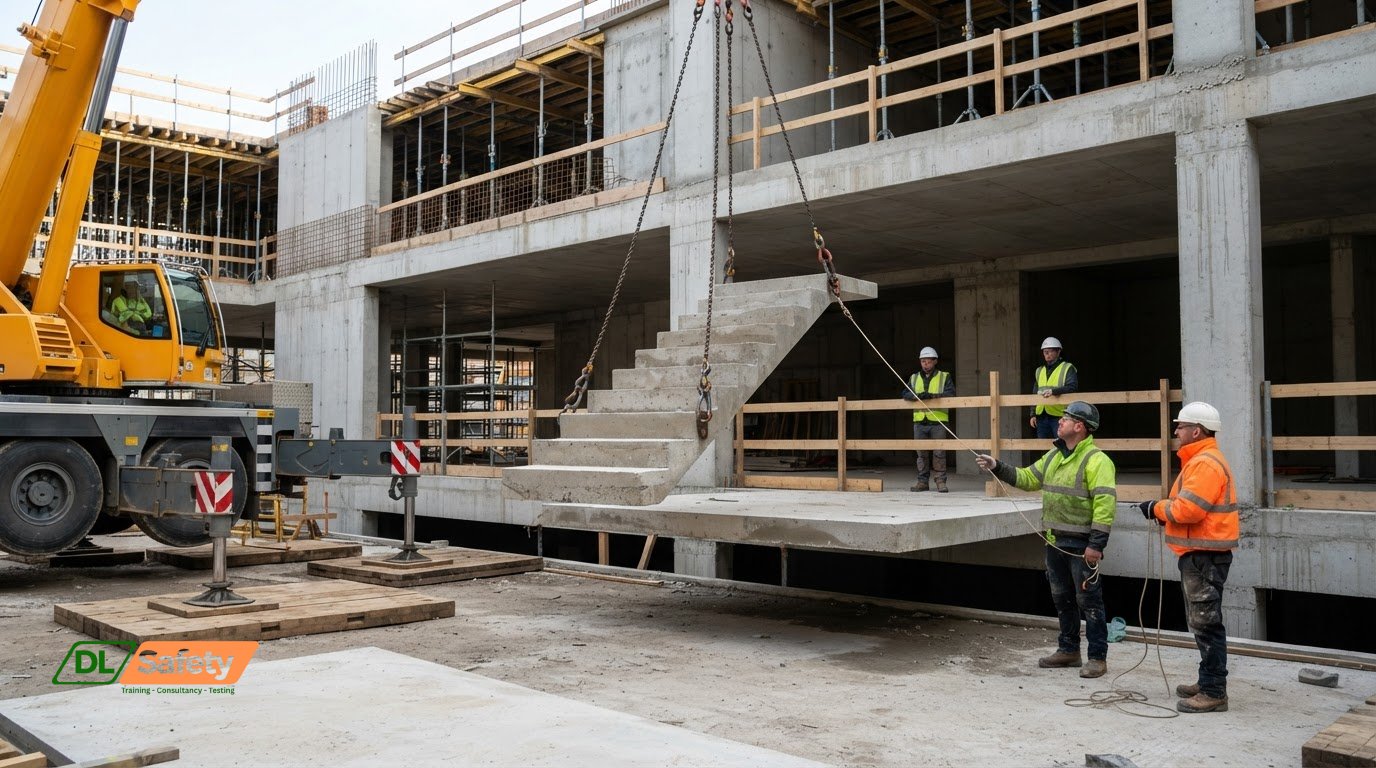
Before work starts, define the task’s limits and identify who could be affected. For a lifting operation, for example, the method statement may need to set out the work sequence and controls around the lift. For work at height, it should explain the planned approach and relevant precautions. Workers should be able to follow what happens at each stage.
Hazards and risk controls
A method statement works alongside a risk assessment: the assessment identifies hazards and considers the risks, while the method statement explains how the work will be done using controls. Section 19 of Ireland’s Safety, Health and Welfare at Work Act 2005 requires every employer to identify workplace hazards and assess the risks they present, according to the Irish Statute Book.
Start with the actual activities, then consider who could be affected and how. For chemical handling, identify exposure hazards and describe the controls workers must follow. For a lifting task, consider the operation’s hazards and specify the relevant measures. Include applicable equipment, tools and personal protective equipment, as well as necessary permits and site-access arrangements.
Controls should be practical and specific. “Take care” doesn’t tell a worker what to do; a clear instruction states the required action and when it applies. Check that each control addresses a hazard identified in the assessment. If the work sequence or site conditions change, review whether the assessment and method statement still match the job.
Irish safety requirements
The Safety, Health and Welfare at Work Act 2005 provides important context for construction safety. It doesn’t mention method statements, but its hazard-identification and risk-assessment requirements inform the planning behind them. The Health and Safety Authority’s “Using Ladders Safely” guidance from 2007 is relevant when ladder use forms part of the planned work.
Use applicable law and guidance to inform the task instructions, not as a substitute for describing the work. For ladder use, consider HSA guidance alongside the task’s hazards and controls. For other activities, identify relevant risks and explain how the crew will manage them. The document should reflect the specific job and site.
The 2005 Act does not mention method statements, so it sets no penalty specifically for an inadequate method statement. The practical risk is that unclear or unsuitable instructions can leave hazards uncontrolled and workers unsure how to carry out the task safely.
As a final review, compare the document with the planned activities: confirm that the sequence, hazards, controls, equipment and permits match the job. A method statement for construction in Ireland is useful when it gives workers instructions they can follow on site, rather than simply describing the intended work.
Definition and purpose of a method statement
A work method statement explains how a defined task or process will be completed. Its value lies in turning the planned approach into practical instructions for the people carrying out the work.
Work method statement meaning
A work method statement describes the task, the order of activities and how the work should proceed. For example, a concrete pour plan can identify preparation, delivery, placement and clean-up as separate stages. The document should explain what each stage involves, who needs to take part and which measures apply. Check that the instructions match the actual job, not just its broad title.
Method statement purpose
The purpose is to give the work team a shared account of how to complete a task. RAMS means risk assessment and method statement: the risk assessment identifies work-related risks, while the method statement sets out procedures to minimise them. For a delivery and unloading task, the documents can connect vehicle and handling risks with the planned work steps and controls.
These documents have related but distinct functions. A risk assessment asks what could cause harm and who could be affected; the method statement explains how the work will be organised in response. Keeping the distinction clear helps supervisors trace each measure back to the task. If a control changes the sequence, update the instructions so the method remains workable.
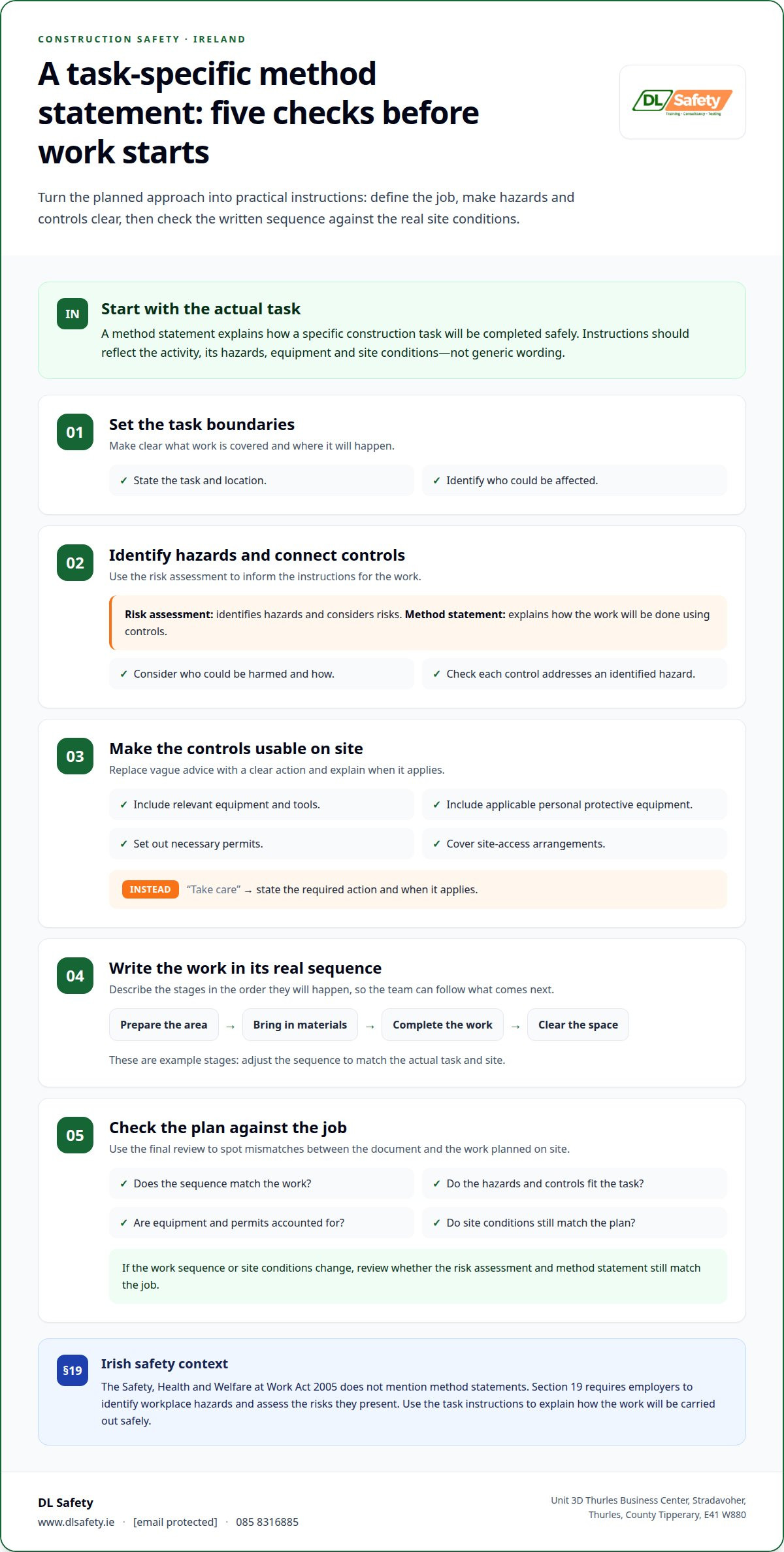
Define the scope before drafting. State the task and location, then describe the work stages in the order they will happen. A site-based activity might involve preparing an area, bringing in materials, completing the work and clearing the space. Check that the written method follows the actual sequence, rather than grouping steps so broadly that workers must guess what comes next.
Next, connect the proposed method to the project’s working arrangements. Identify the people involved, the equipment and tools required, and any relevant permits or access arrangements. For example, a delivery plan should account for how materials reach the work area and how the team handles them there. This can reveal gaps between the planned method and what the site can accommodate.
Use the final draft as a working document, not a generic template. Compare each stage with the project scope, then remove instructions that do not apply and clarify any step that could be interpreted in different ways. A focused review helps keep the method aligned with the job as planned. For support preparing project-specific documentation, explore method statement support.
Emergency procedures and safety policies
Connect emergency arrangements and site policies to the task, and check that they remain usable throughout the work. A method statement should explain how the team will follow safe procedures, respond to an incident and adapt if the planned conditions change.
Under Ireland’s Safety, Health and Welfare at Work Act 2005, every business is legally required to have a safety statement, according to the Irish Statute Book. The safety statement sets out the business’s approach to managing health and safety; a method statement focuses on how a particular task will be carried out. Use both documents consistently, so task instructions do not conflict with the wider safety arrangements.
For emergency planning, make the relevant response steps easy to find. If an incident requires an ambulance in Ireland, the method statement can identify 999 or 112 as emergency contact numbers. It should also explain how workers raise the alarm and communicate the incident on that site. Keep the arrangements relevant to the task, the people involved and the location.
Prepare the document by starting with the actual job, not emergency wording alone. Define the scope and site, list the work stages in order, then consider the hazards and controls associated with each stage. Check that the sequence accounts for equipment, tools, personal protective equipment, permits and access arrangements where relevant. This step-by-step review connects safe procedures with the actions the crew must take.
Method statements are often requested during tender processes. A clear document can explain how a contractor plans to organise the work, manage identified risks and coordinate the proposed sequence. Before submitting it, check that the scope and location match the tender, and that the measures describe the work being offered rather than a different project. Keep the explanation practical so a reviewer can follow the approach.
How should you update a method statement when site conditions or work methods change? Pause and review the affected stages, hazards and controls against the revised conditions. Update the document and communicate the changes to the people doing the work before they follow the revised method.
Are there official Irish construction method statement templates or examples? The Safety, Health and Welfare at Work Act 2005 does not mention method statements, so it does not prescribe a method-statement layout. Use a clear structure that records the task, sequence, hazards, controls and relevant emergency arrangements, then tailor each section to the project.
Before work begins, compare the final document with the site conditions and safety statement. Check that emergency contacts, task steps and control measures still apply. If the site team identifies a mismatch, revise the relevant instructions and ensure the updated version is used.
Planning and sequencing work safely
A clear sequence helps a construction team understand how the planned work should proceed. In Ireland, it must reflect the task, site and working arrangements.
Project details and work scope
Start with the project, client and contractor details, then define the work scope and timeline. Identify what the task includes and where its boundaries lie, so the instructions don’t drift into unrelated work. For example, a concrete repair scope should distinguish the repair from other nearby work. Clear limits help the team plan resources and coordinate each stage.
Step-by-step safe work guidance
Write the task sequence in the order workers will follow, from preparation through completion. Describe each stage with actions that are clear on site, rather than broad phrases such as “carry out work safely”. For example, state when materials arrive, when the work area is prepared and when the task is complete. Each step should fit the project’s actual arrangements.
Section 8 of Ireland’s Safety, Health and Welfare at Work Act 2005 requires employers to provide systems of work that are planned, organised, performed, maintained and revised as appropriate, and that are reasonably practicable, safe and without risk to health, according to the Irish Statute Book. This supports planning beyond the initial draft. The sequence should remain useful as the work is organised and carried out.
Build a practical sequence by mapping the activities and their dependencies. If one stage can begin only after another is complete, make that order explicit. Identify equipment, tools, personal protective equipment, permits and site-access arrangements where they affect the work. The crew should be able to see what must be ready before each step, rather than fill gaps with assumptions.
Ad hoc methods can emerge when instructions leave a stage unclear or no longer match site conditions. Compare the written sequence with the work planned for that day, then resolve differences before the team proceeds. If an access route changes, for example, review the affected steps and arrangements. Update the document where necessary and communicate the revised method to the workers involved.
Use the project scope to keep the document focused. For demolition, dismantling or structural alteration, arrangements must be recorded in writing before work begins. The written plan should make the work’s order and method clear to those involved. For other construction activities, a clear sequence also helps supervisors identify where coordination is needed and where one stage depends on another.
Before work starts, compare the final sequence with the site layout, work scope and planned resources. Check that every activity has a defined place in the sequence and that the instructions describe the method the team will actually use. This review helps prevent workers from having to improvise because a step, dependency or arrangement was overlooked.
Supervisor approval and worker acknowledgement
Supervisor review connects the written method with the conditions the crew will face. Before work starts, the supervisor can check that the task, sequence and controls make sense together, then workers can confirm they understand the instructions they’ll follow.
A standard RAMS provides for supervisor approval and confirmation that personnel understand and agree to follow the safety measures. Approval should follow a practical review, not just a glance at the document title. For example, if a task requires restricted site access, check that the sequence and access arrangements match the planned work.
During review, the supervisor can compare the document with the job scope and current arrangements. Useful points to examine include:
- Whether the task description matches the work the crew will perform.
- Whether the work sequence is clear and the controls appear at the relevant stages.
- Whether listed tools, equipment and personal protective equipment suit the method.
- Whether site access, permits and emergency arrangements reflect the planned activity.
- Whether workers can identify who directs each stage and how concerns are raised.
Worker acknowledgement records communication, but doesn’t replace understanding. Before signing or otherwise recording acknowledgement, each person should have the opportunity to read or hear the method, ask questions and clarify unfamiliar terms. For example, a new crew member should understand which access route applies and who to approach if site arrangements differ.
Use a short briefing to explain the work in the order it will happen. The supervisor can walk through the first stage, identify relevant controls and invite workers to describe their roles. Ask a worker to explain a key instruction in their own words. This can reveal unclear wording before the team starts.
Keep the approval and acknowledgement record with the version used for the job. Following the site’s document-control process, record the document identifier or revision, approval details and names of the personnel briefed. This makes it easier to distinguish current instructions from an earlier draft, especially on projects with multiple crews or work areas.
If a worker raises a practical concern, resolve it before relying on the method. The supervisor may need to clarify the sequence, revise an instruction or brief the team again. If changes affect the agreed approach, share the updated version with everyone involved and record their acknowledgement against that revision.
For a task-specific document and a clear review process, explore construction method statement support.
DL Safety: Monthly Safety Support Packages
DL Safety’s Monthly Safety Support Packages provide ongoing help with practical health and safety arrangements. They can support businesses where maintaining construction documentation and keeping safety planning aligned with changing work are regular responsibilities.
For project-specific needs, DL Safety also offers Lift Plans. GA1 Testing and Accident Investigation support other workplace safety requirements, each with its own focus.
Contact DL Safety at info@dlsafety.ie or 085 8316885, or visit www.dlsafety.ie. The business address is Unit 3D Thurles Business Center, Stradavoher, Thurles, County Tipperary, E41 W880.
Put your safety planning into practice
A well-prepared method statement for construction in Ireland should be treated as a working part of project delivery, not paperwork to file away. At the next project review, check that it still reflects the planned work, site arrangements and the team’s understanding. This helps keep safety planning connected to how the job is actually carried out.
For structured support, DL Safety offers Monthly Safety Support Packages, Online Safety Courses and Lift Plans. These services support ongoing safety management, workforce learning and lift planning, giving you practical options for your needs.
For support with your method statement or related safety planning, contact DL Safety about your method statement. A clear plan gives your team a stronger starting point for the work ahead.
Frequently Asked Questions
Why is RAMS important?
RAMS helps connect risk assessment with the practical instructions workers need for a particular task. For example, if a delivery overlaps with another crew’s work area, the documents can help identify the shared risk and explain how the activities will be coordinated. Section 19 of the Safety, Health and Welfare at Work Act 2005 requires employers to identify hazards and assess workplace risks, according to the Irish Statute Book.
What is a method statement in construction and what should it include?
A construction method statement records the planned way to carry out a specific job. It should provide enough project context for the crew to recognise the task, then explain the relevant stages, precautions and arrangements. For example, if a subcontractor completes one phase of a larger project, the document should make that boundary clear. This helps prevent workers from applying task instructions to work outside their scope.
When is a method statement required for construction work in Ireland?
Method statements are used for high-risk operations and activities, and where necessary controls aren’t easily identifiable or immediately obvious. RAMS documents should be completed before potentially dangerous work begins on site. The Safety, Health and Welfare at Work Act 2005 does not mention method statements, so it does not set a universal method-statement requirement for every construction task. The work’s hazards and the clarity of its controls help determine when one is needed.
How does a method statement differ from a risk assessment and a safe work method statement?
A risk assessment identifies hazards and evaluates risks; a method statement describes how the task will be carried out using suitable controls. RAMS combines both elements in one document or a coordinated set of documents. “Safe work method statement” commonly refers to a method statement focused on safe task procedures. For instance, a contractor might use the risk assessment to identify a hazard, then the method statement to explain the work arrangements for addressing it.
What steps should contractors follow to prepare a construction method statement in Ireland?
Begin by defining the project scope and identifying the people, trades and site arrangements involved. Map the activities in their actual order, note where one stage depends on another, and check that planned resources and access arrangements fit. Review the draft with someone familiar with the work, then brief the team using the version they will follow. For example, coordinate a delivery with any other activity using the same access route.
Who must write, review, approve and brief workers on a method statement?
Those preparing and reviewing the document should understand the work and its site arrangements. A standard RAMS provides for supervisor approval and confirmation that personnel understand and agree to follow the safety measures. Assign responsibility for drafting, checking the method against the job, approving it and briefing the crew. Keep a record of which version was discussed so any later changes can be clearly communicated to affected workers.
What information should a construction method statement cover for high-risk work in Ireland?
For high-risk work, make the task scope and sequence specific enough to guide the crew through the operation. Include relevant hazards and controls, along with applicable equipment, tools, PPE, permits and access arrangements. Explain how the team should raise an emergency and who needs to be informed. For example, a lifting task may need its own lift plan to clarify the operation and related arrangements.