
A safety budget is easier to justify when it addresses the risks your business needs to manage and the work it needs to keep moving. Building a business case for a retained safety consultant means showing how practical, ongoing support can meet those needs, rather than treating safety advice as a one-off expense.
It’s understandable to ask what retained health and safety support actually involves and how to explain its value to decision-makers. In Ireland, employers must identify workplace hazards and assess risks under section 19, and prepare a Safety Statement specific to their workplace under section 20 of the Safety, Health and Welfare at Work Act 2005, according to the Irish Statute Book.
This article explains how to assess the case for ongoing support, connect it to business priorities and present a clear proposal. You’ll learn how to review current arrangements, identify the work that needs attention and explain the operational, financial and organisational value of retained support in terms decision-makers can act on.
Key Takeaways
- Link safety audits to business priorities by showing how findings affect risk, day-to-day operations and planned work.
- Build a stronger proposal by connecting workforce safety with organisational resilience and reputation.
- Use Ireland’s safety requirements to identify where competent support and a workplace-specific Safety Statement matter.
- Assess whether ongoing support fits your business by considering its activities, internal expertise and changing needs.
- Estimate potential value using your own incident, absence and disruption records, then set out how you’ll track progress.
Connecting audit benefits to business priorities
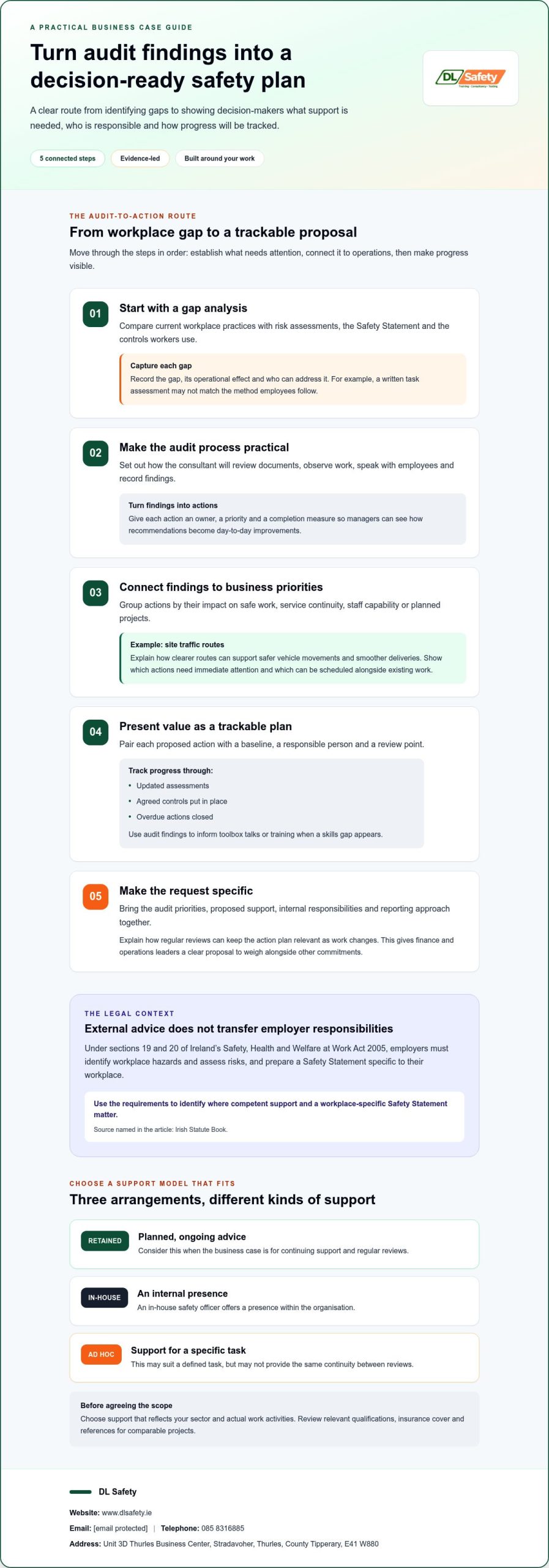
A retained consultant provides planned, ongoing advice, while an in-house safety officer offers an internal presence. Ad hoc consultancy can suit a specific task, but may not provide the same continuity between reviews.
For an Irish business, choose support that reflects your sector and actual work activities. Before agreeing the scope, review relevant qualifications, insurance cover and references for comparable projects.
External advice doesn’t transfer the employer’s responsibilities. Under sections 19 and 20 of the Safety, Health and Welfare at Work Act 2005, employers must assess risks and prepare a workplace-specific Safety Statement, according to the Irish Statute Book.
- Start with a gap analysis. Compare current workplace practices with risk assessments, the Safety Statement and the controls workers use. Section 19 requires employers to identify hazards and assess risks, according to the Irish Statute Book. For example, an audit might find that a task’s written assessment doesn’t match the method employees follow. Record the gap, its operational effect and who can address it.
- Explain the audit process in practical terms. Set out how the consultant will review documents, observe work, speak with employees and record findings. Then describe how each finding becomes an action with an owner, priority and completion measure. A clear process helps managers understand what the audit examines and how its recommendations become day-to-day improvements.
- Connect findings to business priorities. Group actions by their impact on safe work, service continuity, staff capability or planned projects. For instance, if an inspection identifies unclear site traffic routes, explain how resolving the issue supports safer vehicle movements and smoother deliveries. Show decision-makers which actions need immediate attention and which can be scheduled alongside existing work.
- Present the value as a trackable plan. Pair each proposed action with a baseline, a responsible person and a review point. Track whether assessments are updated, agreed controls are in place and overdue actions are closed. Use audit findings to inform toolbox talks or training where a skills gap appears. This gives leaders evidence of progress, not simply a report describing problems.
- Make the request specific. Present the audit priorities, proposed support, internal responsibilities and reporting approach together. Explain how regular reviews can keep the action plan relevant as work changes. A focused proposal lets finance and operations leaders weigh safety improvements against other commitments, while preserving a clear record of decisions and outstanding actions.
Presenting organisational and reputational benefits
Answer decision-makers’ main question directly: what will ongoing safety support help the organisation improve? Use evidence such as incident records, employee feedback, outstanding actions and work disruption. Link each proposed measure to a business priority, such as maintaining services, protecting workers or strengthening compliance.
- Connect safety to the organisation’s values. Explain how safer work supports employees’ ability to do their jobs with confidence and consistency. In healthcare, patient and workforce safety should be treated as core values. Show the practical connection, such as how clear procedures can help staff identify and raise concerns during routine work.
- Describe the effect on organisational resilience. Use examples from your own operations, such as an incident that interrupted a shift or an unresolved hazard that delayed a task. Explain how planned advice could help identify the underlying issue and organise corrective work. Keep the focus on continuity and prevention, rather than promising that incidents will never happen.
- Make reputational benefits specific. Explain how employees, customers and business partners experience your safety arrangements. For example, consistent induction and clear site procedures can demonstrate that safe work is part of everyday operations. Support the point with evidence you hold, such as completed training records, closed actions or feedback from workers.
- Bring safety and finance leaders together. Safety and financial leaders should collaborate when developing and presenting the case. Ask operational managers to explain where incidents or unclear procedures disrupt work, then ask finance colleagues to identify relevant internal records. This shared view helps decision-makers assess the proposal alongside other priorities.
- Choose evidence that can be tracked. Include incident and near-miss records, absence information, audit findings, action completion and employee feedback. Set out the current position, the change you propose and how you’ll review progress. For example, track whether agreed corrective actions are completed and whether the same issue reappears in later inspections.
- Present a concise decision paper. Organise it around the business need, evidence, proposed support, expected organisational benefits and the decisions required. Separate measurable indicators, such as overdue actions, from broader aims, such as stronger safety culture. State who will implement each action and report progress, so leaders can see how the plan fits existing responsibilities.
Before finalising the proposal, assess organisational readiness, gather information and data, draft the business case, and present it to decision makers. This sequence keeps the request grounded in the organisation’s capacity and available evidence, while giving leaders a basis for weighing it against other priorities. Healthcare organisations should weigh safety investments against other priorities because resources are limited; make those trade-offs clear when presenting the case.
If the proposal includes an external risk assessment in Ireland, make sure the person understands the organisation’s work activities, has relevant sector experience and can assess the specific tasks involved. These checks help ensure the advice reflects the work being done, so decision-makers can weigh the findings against operational needs and existing evidence.
Regulatory updates and competent person support
- Anchor the case in Irish law. Irish employers are required to comply with the Safety, Health and Welfare at Work Act 2005, according to the Irish Statute Book. Under section 19, employers must identify workplace hazards and assess the risks they present to safety and health at work, according to the Irish Statute Book. Explain how ongoing competent support can help keep those assessments relevant as work changes.
- Make the Safety Statement specific. Under section 20 of Ireland’s Safety, Health and Welfare at Work Act 2005, employers must prepare a Safety Statement specific to their own workplace; a generic Safety Statement does not meet that requirement, according to the Irish Statute Book. For example, a business with warehouse vehicle movements should address hazards and controls relevant to those activities, rather than rely on unrelated generic wording.
- Understand the small-employer provision. In Ireland, an employer with 3 or fewer employees may meet the Safety Statement requirement by complying with an Authority-prepared Code of Practice for the relevant sector or work activity, if one exists, according to the Health and Safety Authority. Identify whether a relevant code exists and applies to the work. This is a specific provision, not a general substitute for considering workplace risks.
- Account for formal revision directions. In Ireland, an Authority inspector who finds a Safety Statement inadequate can direct the employer to revise it within 30 days, according to the Health and Safety Authority. Include this in the business case as a reason to keep documents accurate and aligned with actual work. A timely review can help identify gaps before they require urgent corrective attention.
- Define the competent-person arrangement. Identify who within the organisation can address health, safety and welfare issues, and whether that person has the knowledge and capacity for the work. Where the business lacks access to an in-house competent person, it should obtain external services to assess and advise on its requirements. Set out how advice will connect with managers and employees.
- Build regulatory review into ongoing work. Assign responsibility for monitoring relevant changes, assessing their effect on workplace policies and updating documents or controls where needed. For example, a change in equipment or work methods may require a fresh look at related risk assessments and procedures. Record the decision, owner and follow-up action, so the safety culture develops through routine practice.
- Show decision-makers what support will deliver. Link competent advice to clear tasks: reviewing assessments, identifying document gaps, advising on controls and tracking agreed actions. Explain which work remains with managers and employees, and how advice will be recorded. This makes the case practical: the aim is not simply to hold a statement, but to keep workplace arrangements connected to real hazards and responsibilities.
Business types suited to retained support
- Match support to the work, not just headcount. Retained health and safety services can support teams of three, thirty or three hundred people. A small workshop may need help keeping procedures practical, while a larger employer may need consistent oversight across departments. In either case, identify the tasks, hazards and internal capability that shape the support required.
- Consider how often work changes. Businesses with changing tasks, equipment or work locations may benefit from a continuing review of safety arrangements. For example, a construction business moving between projects must keep site procedures relevant to the work underway. Map when changes happen, who needs to know, and how updated assessments or instructions reach workers.
- Look at the range of activities. A business combining office work, deliveries and workshop tasks faces different practical questions across its workplace. List each activity, the people involved and the controls used. A retained adviser can help the organisation review those details over time, rather than treating a single document as a complete picture of every task.
- Assess internal capacity honestly. A business may have a responsible manager but limited time to coordinate reviews, follow actions and support employees. Identify which tasks are routinely delayed, such as updating procedures after equipment changes or reviewing training needs. Ongoing external input can complement internal knowledge, while managers retain clear ownership of decisions and implementation.
- Use incident patterns to identify a need. Record accidents, near misses and recurring concerns, then look for connections between tasks, locations and procedures. For example, repeated confusion about vehicle movements may point to a process issue rather than an isolated event. Investigation can help identify causes and corrective actions, while follow-up checks show whether changes are working.
- Consider the role of legislation in your case. Different activities create different questions for an organisation to manage, so describe the work accurately before deciding what support is useful. A construction employer, for example, can map project activities, responsibilities and changing work arrangements. This gives decision-makers a clear basis for discussing relevant legislation and ongoing safety priorities.
- Set a practical test for fit. Compare the proposed support with the gaps identified in your own business. Specify what needs review, how advice will reach workers, and who will implement agreed actions. If the main need is one defined investigation, a focused assignment may be more suitable; if priorities recur, retained support may better match the pattern.
How can a business estimate the cost savings and return on investment of a retained safety consultant?
- Build a baseline from your records. Collect accident-related costs from the last 10 years and calculate a yearly average. Use figures held by your finance, insurance and operations teams. Separate recorded insurance costs, absence, replacement labour, repairs and disruption where your records allow. Keeping categories distinct helps decision-makers understand what contributes to the total and avoids relying on a single headline figure.
- Include indirect effects carefully. An incident can affect scheduling, staff availability, supervision and service delivery. For example, an absence may require colleagues to cover duties or work to be reorganised. Use payroll and operational records to estimate these effects, label assumptions clearly and avoid counting the same impact twice. This gives your estimate a clear basis without presenting assumptions as established savings.
- Link proposed work to relevant costs. For building a business case for a retained safety consultant, identify which activities could address specific business issues. If records show recurring incidents around a task, explain how reviewing its controls could help tackle the underlying problem. Separate costs the proposed support could influence from losses it cannot reasonably affect, keeping the case balanced and credible.
- Set out the full investment. Compare the proposed support with internal time needed to coordinate reviews, implement actions and monitor progress. Use the actual proposal and your own staff-cost data in euros. Include the time managers and employees will spend. This makes the comparison more useful than considering the external fee alone and shows the resources required across the organisation.
- Show your calculation clearly. Estimate potential net benefit by subtracting support and implementation costs from the cost reductions your evidence suggests. To calculate a percentage return, divide net benefit by total investment and multiply by 100. State the assumptions alongside the calculation. When building a business case for a retained safety consultant, make clear that projected savings are estimates, not guaranteed outcomes.
- Track progress against defined measures. Record incident costs alongside indicators such as open corrective actions, completed reviews and repeat findings. Compare these measures at consistent review points. For example, fewer repeat findings may indicate stronger controls, while cost records help show whether the change corresponds with reduced financial impact. Keep the measures relevant to the agreed work.
- Review scenarios as evidence develops. Present a cautious estimate based on documented costs, then show how the result changes if fewer incidents occur or implementation takes longer. Update the calculation as new costs and progress emerge. To discuss how ongoing safety support can fit your business case, connect the proposed work to the cost categories and measures you plan to track.
DL Safety: Monthly Safety Support Packages
DL Safety offers Monthly Safety Support Packages for businesses seeking ongoing safety advice. They may suit organisations with continuing priorities that need regular attention and clear follow-through. DL Safety also offers Lift Plans, GA1 Testing and Accident Investigation for specific operational requirements.
To discuss your business’s safety support needs, contact DL Safety at info@dlsafety.ie or 085 8316885, or visit www.dlsafety.ie.
DL Safety’s address is Unit 3D Thurles Business Center, Stradavoher, Thurles, County Tipperary, E41 W880.
Turn your proposal into a practical next step
Make the next step a focused discussion about the work your organisation needs to address. Bring your priorities, decision-makers’ questions and the measures you plan to track. This gives the discussion a clear starting point and connects building a business case for a retained safety consultant with the practical support your business needs.
DL Safety provides Monthly Safety Support Packages for ongoing support, as well as Online Safety Courses and Lift Plans for specific needs. Consider how these services fit your plans, responsibilities and workforce, rather than treating the proposal as a document that ends once it’s approved.
Discuss retained support with DL Safety and take the next step towards a considered, workable plan.
Frequently Asked Questions
What are retained health & safety services?
Retained health and safety support provides planned, continuing access to professional advice under an agreed arrangement. Unlike a one-off audit or investigation, it can be scheduled around a business’s ongoing needs, with priorities reviewed as work changes. For example, a company could arrange regular advice on safety documents and operational questions instead of seeking separate help whenever an issue arises.
What does a retained safety consultant do for a business in Ireland?
A retained safety consultant gives a business ongoing practical support with workplace safety. Depending on the agreed scope, this can include reviewing safety arrangements, advising on documents, carrying out site audits or investigating an incident. For example, a business changing its work process could seek advice on the safety implications and next steps, while managers remain responsible for putting agreed controls into practice.
What is typically included in a retained safety consultancy agreement?
An agreement typically defines the scope of support, how advice is delivered, expected outputs and each party’s responsibilities. Depending on the business’s needs, it may cover scheduled reviews, site visits, document support, training or incident investigations. For example, a company might specify that audit findings are recorded with recommended actions and assigned internal owners, making clear how advice leads to follow-through.
How can a business assess its health and safety risks and determine the level of consultant support needed?
Start by mapping work activities, equipment, locations and the people involved. Then review existing assessments, incident records and unresolved actions. Identify where procedures are hard to apply or internal expertise and time are limited. A business with changing site activities may need more regular input than one with stable work and capable internal oversight. Match the support to the complexity and pace of change.
What contract terms, service levels and review arrangements should a retained safety consultancy agreement include?
Define the services, deliverables, visit arrangements, communication channels and responsibilities for implementing recommendations. Agree how urgent issues are handled, what records are provided and how progress is reported, without assuming support is available outside the stated terms. Include scheduled reviews and a process for adjusting scope when work changes, such as adding a new activity or location. Clear terms help both parties understand what to expect.