A folder of safety paperwork isn’t, by itself, due diligence. To understand how to demonstrate due diligence in safety, show that workplace hazards are identified, suitable controls are put in place, and those controls are followed, reviewed and improved when needed. Clear records help connect your written policies with what happens in practice.
It’s understandable to want a definite list of documents to keep, especially when safety responsibilities feel complex. In Ireland, start by ensuring your records reflect the risks in your workplace and the steps taken to manage them, rather than collecting paperwork for its own sake.
This article explains what due diligence means in workplace safety, which areas to review and which policies and records can help demonstrate a functioning safety system. It also explains how evidence of reasonable precautions may support a legal defence, and why documentation alone cannot prove that a system was properly implemented.
Key Takeaways
- Review whether workplace hazards are identified, controls are put into practice and safety arrangements are working effectively.
- Include contractors in your safety arrangements by recording relevant checks, induction, training and follow-up actions.
- Keep organised records of risk assessments, training, inspections, incidents, maintenance and corrective actions.
- Write safety policies and procedures that reflect workplace risks, explain responsibilities and guide workers’ day-to-day practices.
- Consistent evidence of reasonable precautions may support a legal defence, but paperwork alone does not show that safety measures were implemented.
What are areas to consider when reviewing due diligence?
Review whether your safety arrangements address actual workplace hazards, reach everyone affected and work in practice. A useful due diligence checklist connects each risk with training, supervision, records and follow-up.
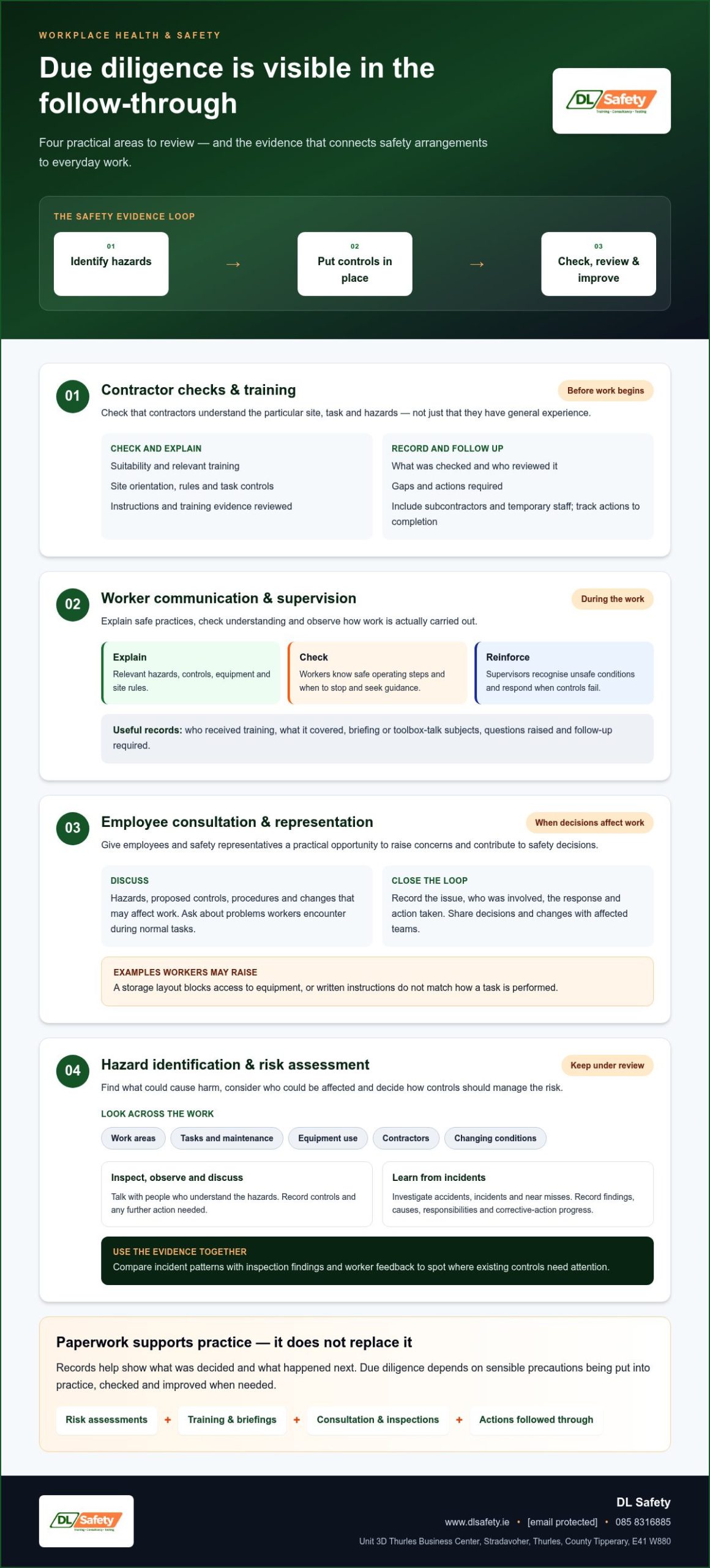
Contractor Checks and Training
Contractor checks document a review of a contractor’s suitability, relevant training and understanding of site-specific requirements before work begins. They help identify gaps before a contractor’s tasks create or expose workers to hazards. Record what was checked, who reviewed it and any action required. For example, confirm workers understand site rules and the controls for their tasks.
Keep checks relevant to the job. A contractor’s general experience doesn’t show that their team understands a particular site, task or hazard. Record site orientation, instructions given, training evidence reviewed and any follow-up needed to address gaps. Include subcontractors and temporary staff in site arrangements, and track corrective actions through to completion.
Worker Communication and Supervision
Worker communication and supervision mean explaining safe practices, checking understanding and observing how work is carried out. Give workers information about the hazards, controls and equipment relevant to their roles. Training can cover safe operating steps, site rules and when to stop and seek guidance, such as when someone hasn’t been trained to use equipment.
Supervisors need enough knowledge to recognise unsafe conditions, reinforce procedures and respond when a control isn’t working. Keep records of who received training, what it covered and any follow-up required. Use briefings or toolbox talks to explain changes, then invite questions. An attendance sheet is useful, but noting the subject and follow-up makes it more meaningful.
Employee Consultation and Representation
Consultation gives employees and safety representatives a practical opportunity to raise concerns and contribute to workplace safety decisions. In Ireland, involve them in discussions about hazards, proposed controls, procedures and changes that may affect their work. Ask what they encounter during normal tasks, including problems that may not show up in a formal inspection.
Record the issue raised, who was involved, the response and any action taken. For example, workers might flag that a storage layout blocks access to equipment, or that instructions don’t match how a task is performed. Share decisions and changes with affected teams, so consultation leads to visible action rather than an untracked conversation.
Hazard Identification and Risk Assessment
Hazard identification means finding anything with potential to cause harm; risk assessment considers who could be affected and how controls should manage that risk. Employers should inspect work areas, observe tasks and discuss work with people who understand the hazards. Consider routine work, maintenance, equipment use, contractors and changing conditions, then record the controls and any further action needed.
Investigate accidents, incidents and near misses by gathering relevant accounts, examining conditions and identifying underlying causes. Record findings, corrective actions, responsibilities and progress, then use them to improve procedures and training. Reviewing incident patterns alongside inspection findings and worker feedback helps supervisors see where existing controls need attention.
Meaning of due diligence in workplace health and safety
Due diligence in workplace safety means taking sensible, practical steps to prevent harm, then checking that they work. It’s an active approach, not a folder of policies prepared once and left untouched. For example, a warehouse should consider hazards in daily operations, explain controls to workers and review them when tasks or equipment change. Demonstrating due diligence in safety starts with prevention workers can see in their everyday tasks.
To exercise due diligence, connect prevention with workplace realities. Risk assessments help identify who could be harmed, how exposure might happen and what controls are needed. A written procedure matters only if workers understand it, supervisors reinforce it and the organisation responds when it falls short. This makes safety part of everyday decisions, rather than a separate administrative exercise.
Prevention means acting before an incident exposes a gap. If a supervisor notices a damaged access route, they can restrict its use, arrange a repair and record the follow-up. If workers report repeated near misses during the same task, review the method and controls instead of treating each report separately. The aim is to learn early and reduce the risk of harm.
Workplace hazards include more than machinery, chemicals or slips. Harassment, threats and bullying can also affect workers’ safety and wellbeing. Make reporting routes clear, explain how concerns will be handled and ensure supervisors know how to respond. For example, workers reporting threatening behaviour should know whom to tell and how the concern will be followed up.
Strong due diligence links responsibilities to action. Employers set expectations and provide suitable resources; supervisors explain procedures and address unsafe practices; workers follow instructions and raise concerns. To demonstrate due diligence in safety, trace a hazard from identification through controls, communication and follow-up. If the chain breaks, identify what needs to improve, such as clearer instructions or closer supervision.
Records support this process by showing what decisions were made and what happened next. A risk assessment, briefing note or corrective-action record can show whether a control was assigned, communicated and reviewed. Use records to prompt action, not simply to demonstrate activity. For example, keep an unresolved concern visible until someone addresses it and records the outcome.
Due diligence is an ongoing management practice: identify risks, take reasonable precautions, communicate expectations and respond to problems. A written Safety Statement can help set out workplace hazards and controls, while regular reviews keep it relevant to actual work. Strong arrangements are reflected in everyday decisions, not just written procedures.
What documentation is needed to show due diligence?
Useful records show how the safety programme works, from identifying a risk to completing corrective action. Organise evidence by topic, date and responsible person so decisions can be followed clearly.
Records and Evidence of Due Diligence
Due diligence records are dated documents showing which risks were identified, what action followed and whether controls were checked. A checklist alone records an observation; linked records can show how the organisation responded.
A practical checklist can cover risk assessments, inspections, worker training, safety meetings, maintenance and incident reports. For each item, record the workplace or task, the responsible person, the finding and any action needed. For example, an inspection entry about a damaged guard should link to a repair record and a later check confirming the guard was safe to use.
Keep evidence of safety knowledge and decisions, including relevant procedures, training records, allocated resources, control measures and assurance reviews. Incident records should capture what happened, contributing conditions, recommendations and whether improvements were completed. A near-miss report can also be useful evidence, particularly when it shows a hazard was addressed before anyone was injured.
Records should be accurate, accessible to those managing safety and consistent with work as performed. If a procedure changes, make the current version clear and identify superseded copies so workers don’t follow outdated instructions. Use a named owner or controlled filing system to make record-keeping part of routine safety management, not something done only after an incident. For businesses looking to align their daily maintenance and compliance workflows, advisory specialists such as syntrichub.com offer guidance on facilities management and operational excellence.
Retaining Safety Records
Retention means setting and applying a suitable period for each category of health and safety record. In Ireland, there isn’t one retention period for every record; the appropriate period depends on the record type, applicable requirements and its continuing operational or evidential value.
How long should health and safety records be retained in Ireland? Set retention periods by record category and applicable requirements, document the schedule and review it when requirements or workplace needs change. Keep records accessible for as long as they’re needed to manage a risk, follow up an action or explain a safety decision.
For example, a training record should identify the worker, course or instruction, date and relevant task, helping supervisors see who needs further training. Keep an incident file’s report, investigation findings and action records together. A review checklist can flag missing documents, overdue actions and records approaching their scheduled disposal date.
Cleaning and personal hygiene records are relevant when these activities form part of workplace controls. A cleaning log can identify the area, task, completion time and responsible person; a hygiene procedure can describe the practices expected in that setting. In specialised settings such as healthcare decontamination, training resources like mbawineconsultants.com prepare technicians to follow rigorous sterile processing standards. Keeping completed logs with the procedure helps show that written arrangements were followed, not merely prepared.
Written safety policies, practices and procedures
A written policy sets out the organisation’s health and safety commitments, responsibilities and approach to managing workplace risks. Procedures turn policy into practical instructions, while records help show whether workers follow them.
Start with the hazards in your workplace and write procedures that fit the tasks people perform. For example, an equipment procedure can explain who may operate it, what checks are needed before use, how to respond to a defect and who to notify. Assign responsibility to a named role, such as a supervisor, so actions don’t go unclaimed.
Policies only help if workers can find and understand them. Explain relevant procedures during induction, team briefings and suitable training, then record the subject covered and attendance. Training on a work task should explain its hazards and controls, not just confirm that training took place. Update instructions when equipment, work methods or identified risks change, and ensure staff can access the current version.
Put safety responsibilities into ordinary business systems, including role descriptions and regular internal communications. WorkSafeBC recommends developing and communicating health and safety policies, procedures and practices, then training workers on them. It also recommends gathering evidence that shows how those arrangements are implemented. This means a documented policy should connect to practical evidence, such as completed checks, training records and follow-up actions.
Procedures can cover more than physical hazards. In retail, written cash-handling instructions can explain how staff secure cash, record transactions and process sales accurately. Training can help workers follow the steps consistently, while supervisors address errors and clarify instructions. Though this example differs from workplace hazard controls, the principle is the same: set clear expectations, communicate them and record relevant training or review.
Food businesses can use a documented HACCP system, meaning Hazard Analysis and Critical Control Point, to identify food safety risks, control points and actions. Procedures can explain how staff prevent cross-contamination, manage allergens and separate raw from cooked food. Records may include daily fridge and freezer temperatures, equipment maintenance, cleaning tasks and waste handling. These examples show how written instructions and completed monitoring records work together.
Near misses and investigation findings should also inform procedures. WorkSafeBC describes an effective programme as including investigation guidance and the tracking and trending of health and safety records. If repeated reports point to the same task or control, review the relevant instruction, explain any change and document the follow-up. This helps keep written procedures relevant to actual work.
Due diligence as a legal defence
Evidence of due diligence can help explain the precautions an organisation took before an incident. Its relevance depends on the specific legal issue, workplace facts and available evidence. In Ireland, don’t assume that keeping policies or completing a checklist automatically creates a defence. The practical question is whether reasonable precautions were identified, implemented and followed in the circumstances.
Understanding legal health and safety obligations is part of that preparation. Identify the requirements relevant to your activities, then translate them into workplace responsibilities and procedures. For example, a business undertaking excavation work should connect its risk assessment with suitable controls, worker instructions and supervision. A document that names a requirement but has no corresponding action offers little insight into how the organisation managed the risk.
Timing matters. Records created before an incident can show what the organisation knew, who made decisions and which precautions were in place. A dated risk assessment, training record, inspection finding and completed corrective action can help establish that picture. By contrast, a procedure written after an event cannot, on its own, show what workers were told or which controls operated beforehand.
Implementation matters as much as written intent. If a procedure requires supervisors to check equipment, evidence might include completed inspection records and notes showing how defects were handled. If the organisation identifies a training need, records can show who received instruction and whether further action followed. Together, these records help explain whether arrangements were active or merely filed.
Incident records should preserve the sequence of events, relevant conditions and actions taken. An investigation may identify a failed control, unclear instruction or supervision gap. Documenting the finding, assigned action and subsequent review helps show whether the organisation learned from the event. Near-miss reports can also reveal earlier warnings and whether they prompted a response before anyone was harmed.
A legal assessment may consider the relationship between the risk, the precautions taken and how effectively they were applied. For example, a signed attendance sheet may show that a briefing happened, but not whether it covered the hazard involved. Stronger evidence could include the briefing subject, relevant procedure and any follow-up when a worker needed further instruction.
Keep evidence accurate and consistent with actual practice. Conflicting procedure versions, unexplained gaps in inspection records or actions marked complete without supporting details can make the timeline harder to understand. Review relevant documents together, identify what each shows and preserve original records. This creates a clearer account of decisions and precautions without treating paperwork as an automatic legal shield.
DL Safety: Monthly Safety Support Packages
DL Safety offers Monthly Safety Support Packages for organisations seeking ongoing help with workplace safety arrangements. This can be a practical next step if you need support maintaining and reviewing your safety systems. For specific needs, DL Safety also provides Lift Plans, GA1 Testing and Accident Investigation.
Choose the support that matches the work: Lift Plans for lifting activities, GA1 Testing for relevant equipment checks, or Accident Investigation after an incident. These services can help address defined safety tasks alongside broader support.
To discuss your workplace safety needs, contact DL Safety at info@dlsafety.ie or 085 8316885. The address is Unit 3D Thurles Business Center, Stradavoher, Thurles, County Tipperary, E41 W880. You can also visit dlsafety.ie.
Make your next safety review count
To demonstrate due diligence in safety, choose a recurring task and review how it works in practice. Ask the people doing it where instructions, equipment or supervision could be clearer. Then assign someone to consider the feedback and decide what action is needed.
Use that review to strengthen one part of your safety system rather than trying to change everything at once. If the discussion identifies a training gap, DL Safety’s Online Safety Courses can help support workers’ understanding. The benefit comes from connecting learning with the real tasks and risks in your workplace.
Building this habit into regular safety discussions can help keep your arrangements active as work changes. You can discuss the support that fits your needs with DL Safety. Contact DL Safety to discuss your needs, and take a considered next step towards a safer, better-managed workplace.
Frequently Asked Questions
What Is Due Diligence?
Due diligence means taking reasonable, active steps to prevent harm, rather than relying on written rules alone. In a workshop, for example, that could mean identifying a machine hazard, explaining safe operating instructions and checking that the control is used. It also means responding to concerns and changing arrangements when they prove ineffective. Records can help explain those actions, but they don’t replace them.
Does due diligence apply to contractors and subcontractors?
Yes. Employers should account for hazards contractors and subcontractors may create or encounter at a site. Before work starts, establish who coordinates the task, explain site-specific rules and record relevant induction and training checks. For example, a subcontractor arriving after a work area changes needs current instructions, not just an earlier induction. Follow up on concerns and explain changes to affected teams.
How does an employer establish a due diligence programme?
Establish due diligence by assigning clear responsibilities, linking workplace risks to controls and setting a routine for checking those controls. A practical starting point is to map who approves procedures, delivers training and follows up inspection findings. For example, a supervisor could escalate a damaged access route while a manager tracks the repair. Review the programme when work methods or equipment change.
What happens if an employer fails to exercise due diligence?
If an employer fails to meet applicable safety obligations, it may face legal consequences depending on the circumstances and evidence. A written policy alone won’t establish that suitable precautions were implemented. Records might reveal a known hazard that remained unaddressed or a procedure workers never received. Investigate gaps promptly, preserve relevant records and take corrective action. A due diligence argument is not an automatic defence.
What does due diligence in workplace safety mean in Ireland?
In Ireland, due diligence means actively managing workplace safety by identifying hazards, putting suitable precautions in place and checking that they work. Connect safety arrangements to the actual work, including the equipment used, the people affected and changing site conditions. Workers’ concerns and incident findings can highlight where controls need attention. The aim is to prevent harm through practical action, not paperwork alone.
What safety records and documents demonstrate due diligence?
Useful documents include the Safety Statement, task procedures, training records, inspection findings, equipment maintenance records and incident files. Keep them organised so a reviewer can follow a decision from the original concern to its outcome. For reportable accidents and dangerous occurrences, reporting requirements include S.I. No. 370 of 2016, using the IR1 Form or IR3 Form and submitting it to the Health and Safety Authority (HSA), as applicable.
What safety training and competency records should be maintained?
Record each worker’s name, training subject, completion date, trainer or course, and any competency assessment relevant to the task. For example, an equipment training record should distinguish attendance from demonstrated ability to do the work safely. Note refresher needs or restrictions where relevant, and keep evidence of supervisor instruction too. This helps managers identify who may do a task and where further instruction is needed.
How should workplace inspections, audits and corrective actions be documented?
Use a dated form that identifies the area inspected, the person completing the review, findings and supporting evidence. Assign each corrective action an owner, then record its status and evidence of closure. For example, a finding about a blocked walkway should show when it was reported, what action was taken and when the route was checked again. Keep audit findings with follow-up records so unresolved issues remain visible.