A health and safety audit examines how effectively your workplace manages safety in practice, not just what the paperwork says. Knowing how to prepare for a health and safety audit means reviewing facilities, records, policies, risk assessments and staff training, then identifying and addressing any gaps. The aim is to give a reliable picture of what works and where improvements are needed.
It’s understandable to think an audit means scrambling for documents or searching for faults. A more useful approach is to treat it as a structured review of how everyday work compares with your safety procedures. In Ireland, the audit’s scope depends on your workplace and the activities carried out there.
This guide explains what an audit involves and how to prepare, from organising evidence and inspecting the workplace to reviewing safety arrangements and training records. You’ll be better placed to coordinate the process, involve the right people and respond constructively to findings.
Key Takeaways
- Understand how an audit compares workplace safety arrangements with agreed standards and identifies practical improvements.
- Walk through the workplace to spot issues with equipment, facilities and everyday tasks before the audit.
- Organise relevant records so procedures, incident information and training evidence are easy to review.
- Check that your Safety Statement, policies and risk assessments reflect the work people actually do.
- Use audit findings to prioritise follow-up actions, assign responsibility and strengthen ongoing safety management.
What is a health and safety audit?
A health and safety audit objectively compares workplace arrangements with an agreed standard. It can identify effective controls, gaps and practical improvements across an organisation.
- Set the purpose and scope before reviewing records or entering the workplace. Decide which locations, activities and parts of the safety management system the audit will cover. For example, a construction site review may focus on site procedures and work activities, while an office review may have different priorities. A clear scope keeps the evidence relevant and helps the auditor assess safety performance consistently.
- Plan audit intervals around the organisation’s needs and applicable standards. Many organisations conduct comprehensive health and safety audits annually. ISO 45001 Clause 9.2 requires internal audits at planned intervals, but does not set one universal schedule for every organisation. Where an organisation seeks independent verification or formal management system certification, international assessment bodies such as ia-uk.com can provide external auditing. Use the audit’s purpose, scope and workplace activities to determine a workable programme. Knowing how to prepare for a health and safety audit starts with setting that scope and timetable.
- Identify the Irish requirements and standards relevant to the work being assessed. The Safety, Health and Welfare at Work Act 2005 is cited as the statutory basis for safety committee audits in Ireland, according to the Irish Statute Book. ISO 45001 is a recognised standard organisations may use as a basis for health and safety audits, according to the International Organization for Standardization. The standard helps frame a systematic assessment, rather than replacing workplace-specific criteria.
- Match audit criteria to actual hazards and work activities. The Construction Regulations 2013 may be considered in an Irish workplace audit depending on the workplace and work activities, according to the Irish Statute Book. The Chemical Agents Regulations 2001 may also be considered, according to the Irish Statute Book, where chemical work makes them relevant. Selecting criteria based on tasks helps prevent an unrelated checklist from obscuring important risks.
- Include confined-space work in the scope where those tasks occur. The Confined Space Regulations 2001 may be considered in an Irish workplace audit depending on the workplace and work activities, according to the Irish Statute Book. Where potentially explosive or hazardous atmospheres exist, auditors will expect appropriate controls such as certified ventilation, with guidance available on exsafe.shop. Compare written controls with workers’ explanations and observed practice. This makes the assessment more objective than relying on paperwork alone.
- Record each finding alongside its evidence, location and practical significance. An audit report can summarise strengths, areas for improvement and recommended actions. For example, if a procedure differs from how a task is performed, document the discrepancy clearly so the organisation can investigate why and decide what needs to change.
- Turn findings into a corrective action plan with an owner, priority, target date and review point. A spreadsheet or audit software can track progress and highlight overdue actions. An inspection finding does not by itself set a fixed penalty. Employers may face fines or prosecution for failing to ensure adequate safety training and documentation under the Safety, Health and Welfare at Work Act 2005. A sound understanding of how to prepare for a health and safety audit helps teams use findings to improve controls, not assign blame.
Inspecting workplace equipment and facilities
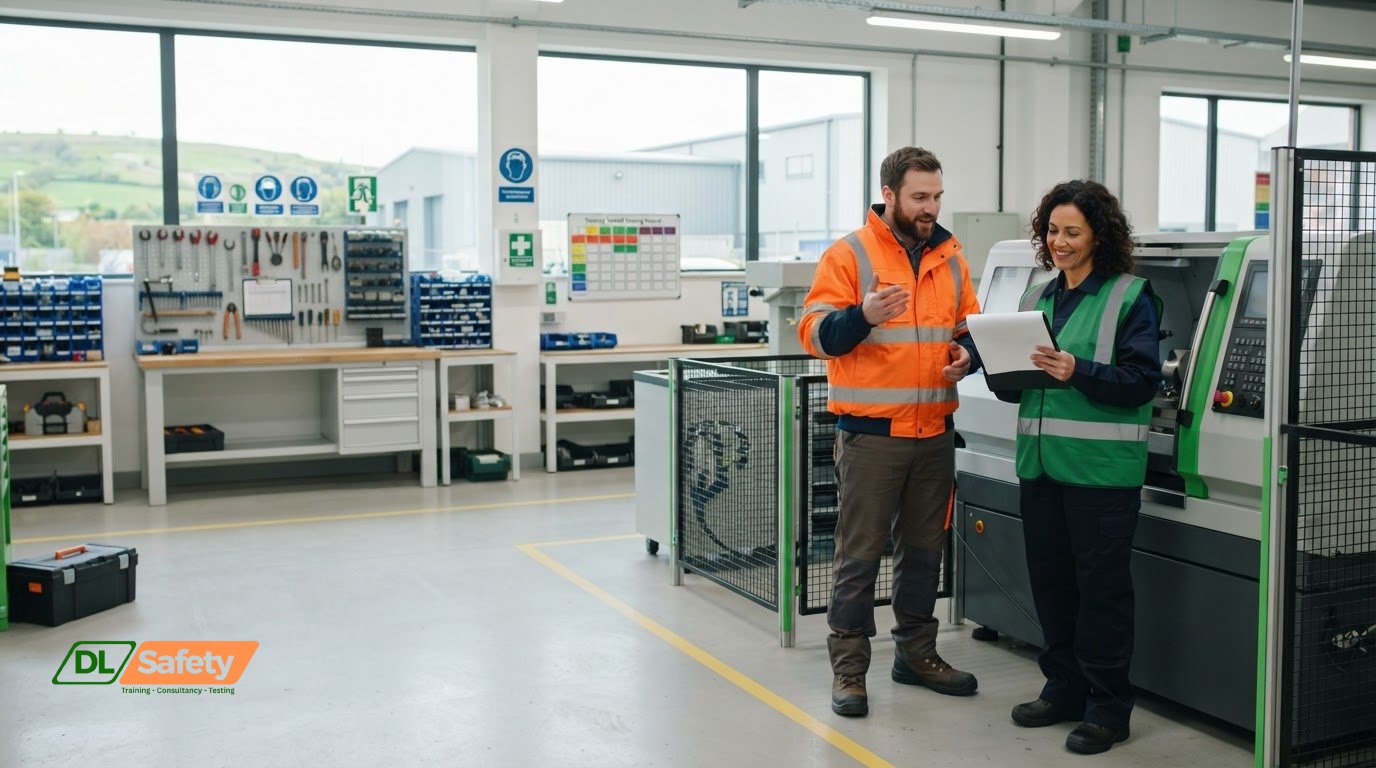
Plan a site walk to compare equipment, facilities and working practices with the audit criteria. This helps turn observations into clear recommendations.
- Map the areas and activities the audit will cover before entering the workplace. Include work areas, storage spaces, access routes and shared facilities. Note where machinery operates and where people handle materials. A simple site plan helps auditors record observations accurately and identify areas that need closer review.
- Observe tasks as they normally happen rather than relying only on written procedures. Watch how workers use equipment, move materials and access workstations. Ask them to explain any differences between the documented method and actual practice. Record the task, location and relevant equipment so each observation has useful context.
- Check machinery against the work activity and the audit’s agreed criteria. The Machinery Regulations 2008 may be considered in an Irish workplace audit depending on the workplace and work activities, according to the Irish Statute Book. Record the machine’s location and the specific concern, such as a damaged guard or unclear operating instructions.
- Review equipment condition and the evidence available at the point of use. Look for visible damage, missing labels or signs that equipment is difficult to operate safely. Where relevant, compare the item with its maintenance or inspection record. If a concern needs attention, note who should assess it and how follow-up will be tracked.
- Inspect facilities from the perspective of people using them during a normal shift. Check whether walkways are clear, work areas orderly and access points usable. Consider how lighting, housekeeping and storage affect specific tasks. For example, materials stored across a route may obstruct movement and should be recorded as a finding.
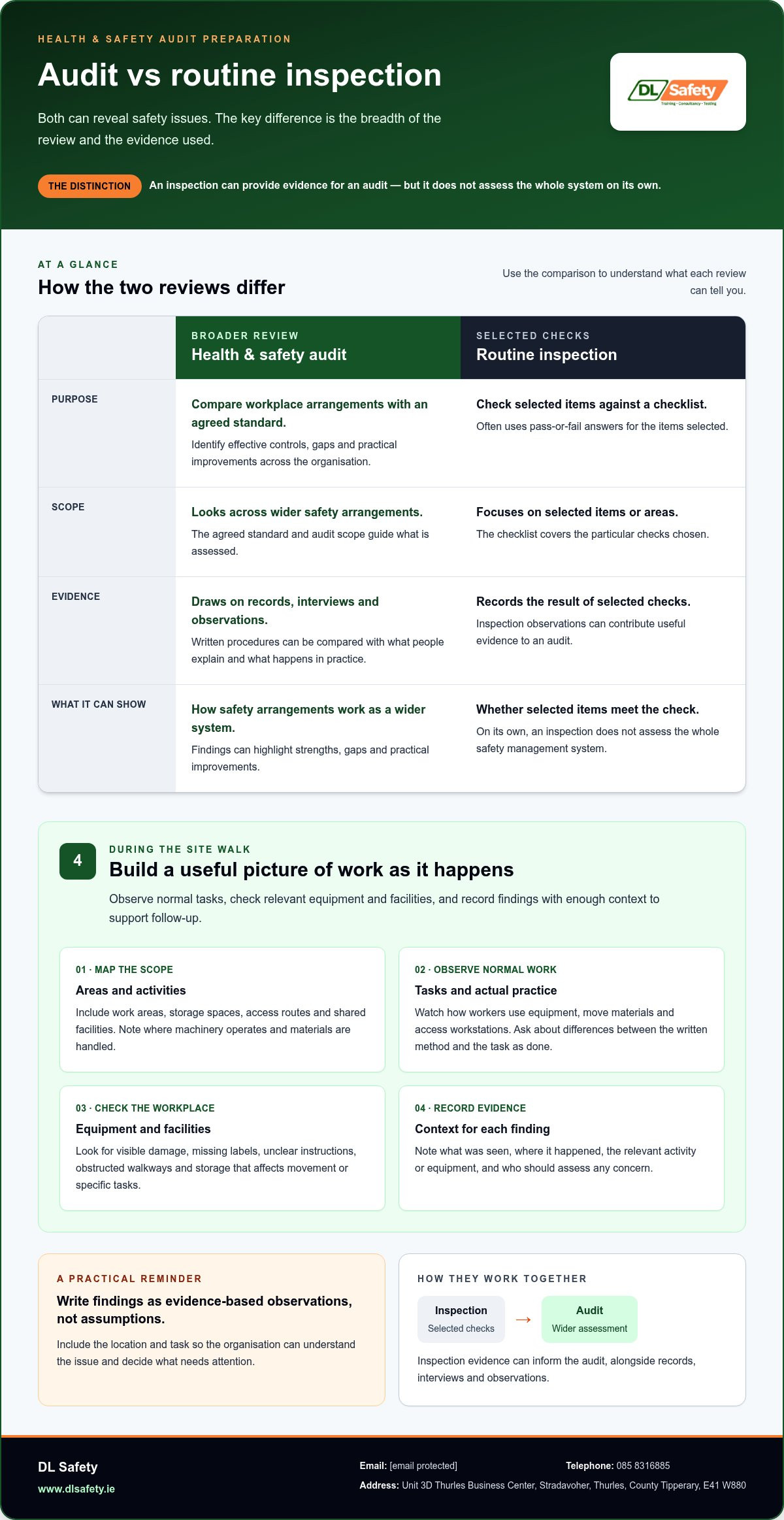
- Keep audits distinct from routine inspections. An inspection often uses a checklist with pass-or-fail answers for selected items. An audit compares wider workplace safety arrangements against an agreed standard, drawing on records, interviews and observations. An inspection can provide evidence for an audit, but it does not assess the whole system on its own.
- Write findings as evidence-based observations, not assumptions. Record what was seen, where it happened and which activity or item was involved. Separate immediate concerns from recommendations for system improvements. This makes it easier for employers to prioritise follow-up and assign responsibility. A structured workplace safety audit can bring these checks together.
Review of supporting documentation and records
Prepare a clear trail of evidence before the auditor reviews your records. Organise documents, examine workplace evidence and make findings easy to follow.
Gather documents and workplace evidence
Collect records that explain how work is planned, controlled and reviewed. Depending on the audit scope, include training records, health and safety committee minutes, incident reports, procedures and inspection records. For construction work, organise evidence by project or activity so the auditor can follow the paperwork alongside the work observed.
Ask for the audit plan in advance, then organise evidence by its topics or locations. Check that files are readable, current and easy to retrieve, and identify who can explain each record. Avoid presenting unrelated documents in one folder. A maintenance record, for example, is more useful when it can be matched to the equipment concerned.
Review incident records
Review incident reports, near-miss records and investigation notes for patterns, not just individual events. Check that each entry describes what happened, where it occurred, the work involved and the response. Compare the documented response with later records, such as a revised procedure or completed corrective action, to confirm that follow-up is documented.
Keep the original account separate from later analysis, and note any missing information that needs clarification. For example, a report describing a manual handling injury should connect the event to the task and document the follow-up. Consistent records help the auditor assess whether lessons were considered and similar findings have recurred.
Organise records for efficient review
Create an index linking each audit topic to its supporting evidence. Group training registers, committee minutes and equipment records under clear headings, and label electronic files consistently. If a document is held by a manager or department, record its location and who is responsible for providing it during the audit.
Make sure dates, versions and sign-offs are clear. If a procedure has changed, keep the current version prominent and retain older records separately when they provide relevant history. This helps keep the review focused and prevents superseded guidance being confused with current arrangements.
Document and prioritise findings
Record each finding with its source, location and supporting evidence. Distinguish between a missing record and a control that exists but isn’t followed, as they require different corrective actions. Prioritise issues according to the risk they present, whether they recur and whether earlier actions remain open.
Assign each action to a named role, set a target date and state what evidence will demonstrate completion. Use a spreadsheet or audit-tracking system to monitor progress and flag overdue items. At a follow-up meeting, review completed actions and check whether the change addressed the original finding.
Reviewing safety policies, safety statements and risk assessments
Compare your written arrangements with current work, staff feedback and site evidence. In Ireland, review the Safety, Health and Welfare at Work Act 2005 and the regulations relevant to your activities. The General Application Regulations 2007 are among the minimum legal requirements considered in a health and safety audit in Ireland, according to the Irish Statute Book.
Assess the safety management system
Assess how your occupational health and safety management system works in practice, not just how it reads on paper. Check whether responsibilities are clear, workers are involved, hazards are managed and improvement actions are reviewed. Compare documented processes with workplace observations, such as whether a supervisor follows the stated procedure during a routine task.
Use this assessment to identify strengths and gaps across the audit process. For example, a policy may assign responsibility for reviewing risk controls, but meeting records should show whether that review happens. Record the evidence behind each conclusion so the audit provides an objective view of safety performance.
Review policies and risk assessments
Review the Safety Statement, policies and risk assessments alongside the work people actually perform. Check that the tasks, hazards and controls described match current equipment, materials and working methods. For example, a manual handling risk assessment should reflect how loads are moved in the relevant work area, rather than rely on a generic description.
Check that workers can access the relevant instructions and understand the controls expected of them. Note unclear responsibilities, outdated procedures or controls that are difficult to apply. The Safety, Health and Welfare at Work Act 2005 requires employers’ systems of work to be planned, organised, performed, maintained and revised as appropriate.
Match requirements to the workplace
Identify the Irish laws and regulations that relate to the work being assessed. The General Application Regulations 2007 form part of the minimum legal requirements considered in an audit, according to the Irish Statute Book. Other applicable requirements depend on the workplace and its activities, so map each relevant requirement to a procedure, risk assessment or control.
For example, construction activities may call for consideration of the Construction Regulations 2013, while chemical use may make chemical-agent requirements relevant. Use the audit criteria to show how each applicable requirement is addressed. Avoid treating one checklist as a complete legal review for every workplace.
Use an audit tool to test your preparation
Choose a self-assessment tool suited to the workplace and its purpose. The HSE Level 1 health and safety audit tool is intended for self-assessment at ward and department level. The HSE safety committee audit tool can also help assess workplace safety, health and welfare safeguards.
Use the tool to identify gaps, then verify the answers against documents, worker input and site observations. Record supporting evidence rather than relying on a tick alone. Add each gap to an action plan with an owner and review point, so the assessment supports practical improvements to the safety management system.
Checking training and certification records
Training evidence should show who received instruction, what it covered and how it relates to their work. A key part of preparing for a health and safety audit is checking that training records match current roles. Review the evidence, prepare staff and connect training needs with audit findings.
- Match each worker’s training record to their current duties. Check the course title, attendance, completion date and any recorded assessment. For example, a worker assigned manual handling tasks should have evidence relevant to those tasks. Group records by role or department to make gaps easier to identify across different industries and work activities.
- Check that training content reflects workplace procedures and current hazards. Compare course records with the Safety Statement, risk assessments and site instructions. If a worker’s tasks have changed, review whether their existing training is still relevant. A record alone doesn’t demonstrate competence, so consider how workers apply what they learned in their duties.
- Review refresher training arrangements and identify dates that need attention. Schedule workplace safety refresher training every 12 months. Treat this as a planning interval, not a substitute for checking role-specific needs. Changes to equipment, materials or work processes can prompt a review sooner, particularly where a worker’s responsibilities have shifted.
- Check certification records for activities that require documented evidence of training or competence. Make sure each record is legible, linked to the relevant worker and easy to retrieve. Compare certificates with assigned tasks and any internal authorisation process. Don’t assume a certificate covers every activity just because its subject sounds similar.
- Prepare staff by explaining the audit’s purpose, planned areas and likely interview process. Auditors may ask workers about their roles and input, so encourage clear, honest answers about normal work. Don’t coach scripted responses. Ask managers to ensure relevant workers can access procedures and explain how they raise safety concerns.
- Review training records alongside incident reports and corrective actions. Check whether an incident identified a knowledge or skills gap, and whether follow-up training was recorded. For example, an incident investigation may lead to revised instruction for a specific task. Under the Safety, Health and Welfare at Work Act 2005, employers may face fines or prosecution for failing to ensure adequate safety training and documentation.
- Organise the audit plan around training evidence, staff availability and the activities being examined. Keep a record index showing where certificates, attendance records and course materials are stored. When preparing for a health and safety audit, link each identified gap to a corrective action, responsible person and evidence of completion.
- Address identified skills gaps with training suited to the work. For example, arrange relevant manual handling training when task reviews show that workers need further instruction. Keep the resulting attendance and assessment records with the relevant training file, so future reviews can trace the action taken.
DL Safety: Monthly Safety Support Packages
DL Safety’s Monthly Safety Support Packages can help organisations maintain their focus on health and safety between audits. They’re a practical next step when you need ongoing support to review arrangements, address findings and keep improvement actions moving.
For a specific technical need, DL Safety also offers Lift Plans, GA1 Testing and Accident Investigation. These services address distinct requirements, while monthly support is suited to businesses seeking continuing safety assistance.
To discuss your workplace needs, contact DL Safety at info@dlsafety.ie or 085 8316885, or visit dlsafety.ie.
Make audit preparation part of everyday practice
Keep safety arrangements active between audits rather than treating preparation as a one-off exercise. Regularly consider whether workplace changes, new tasks or staff responsibilities call for a fresh review. This helps your organisation respond promptly to changing needs and keeps safety management connected to daily work.
If you need support beyond preparing records, DL Safety offers Health & Safety Site Audits and Online Safety Courses. A site audit can provide an independent view of workplace arrangements, while relevant training can help workers build knowledge for their roles. The right support depends on the practical challenge you want to address.
For help deciding on a useful next step, contact DL Safety about audit support. With a clear plan and steady follow-through, you can approach your next audit with purpose and keep improving workplace safety.
Frequently Asked Questions
What documents are needed for a workplace health and safety audit in Ireland?
Organise records so the auditor can trace how a safety decision was made and followed up. Alongside policies and risk assessments, prepare training evidence, incident reports, committee minutes and relevant procedures. An index matching each document to the audit topic and responsible manager can help. For example, link a revised work procedure to its approval record so the auditor can follow the change without searching unrelated files.
How do you conduct a health and safety risk assessment before an audit?
Start by observing a real work task, then identify its hazards, who could be affected and which controls are in place. Compare those controls with the written assessment and ask workers whether they reflect normal practice. For example, if a task has moved to a different location, check whether access or nearby activities change the exposure. Record any gap clearly, identify a practical corrective measure and decide how its effect will be reviewed.
How can you prepare staff and managers for a health and safety audit?
Tell staff what the audit covers, when it will take place and who is coordinating each area. Managers should know where relevant evidence is held and be ready to explain how safety decisions are made. Workers may be interviewed, so explain that auditors need honest descriptions of everyday tasks, not rehearsed answers. A short team briefing can also clarify how employees can raise concerns during the visit.
What areas and equipment are typically inspected during a workplace safety audit?
The areas covered depend on the work being audited, but may include workspaces, access routes, storage and equipment used for daily tasks. Auditors may observe a job in progress and ask workers how they use machinery or move materials. Before the visit, walk the planned route and note the activity in each area. This helps you explain site-specific hazards without staging or changing normal work.
How should audit non-compliances be prioritised and corrected?
Address findings that indicate serious risk or ineffective controls first, then assess recurring issues and gaps affecting several tasks. Assign each action to a responsible role and record a target date, any interim control needed and the evidence required for closure. At a follow-up review, check whether the change resolved the issue in practice. If not, revise the action rather than marking it complete simply because the paperwork changed.
What are common health and safety audit findings in Irish workplaces?
Common findings include procedures that don’t match actual work, damaged machinery guards or unclear operating instructions, obstructed walkways, and gaps in training, incident or inspection records.