
Course completion alone can’t show whether someone understands how to work safely. A practical way of engaging employees in online safety training is to use knowledge checks, realistic scenarios and feedback on incorrect answers, then follow up on gaps rather than treating a completed module as proof of competence. This makes it harder to rely on guesswork and gives learners a clearer path to improvement.
It’s understandable to want a straightforward way to deter cheating, especially when training must fit around busy work. But the goal is not simply to catch people out. It is to build genuine understanding, accountability and confidence to speak up about safety.
This article covers practical ways to make online training more meaningful, from role-relevant examples and hands-on practice to giving employees a part in safety leadership. You’ll also learn how assessments and feedback can show what is working, where learners need support and how to make future training more useful.
Key Takeaways
- Use knowledge checks and meaningful feedback to spot guessing and help learners understand incorrect answers.
- Build accountability by making it easy to raise safety concerns, responding to them and learning from incident and near-miss reports.
- Bring procedures to life with realistic scenarios, practical exercises and drills that let employees practise decisions.
- Give employees an active role in safety learning by inviting them to share experience, lead discussions and suggest improvements.
- Tailor examples and assessments to employees’ roles, experience and workplace risks, then use their feedback to refine future training.
2. Encouraging incident prevention and accountability
Accountability grows when employees connect course knowledge with hazards in their daily tasks. Present a workplace scenario and ask learners to identify the risk, the decision point and a safer response. For example, a delivery team could review a near miss involving a vehicle reversing near pedestrians. Ask what should happen before the vehicle moves again, who needs to be alerted and how to make the route safer. This encourages practical discussion without assigning blame.
Case studies work best when they focus on decisions employees can influence. For example, present a worker finding a damaged ladder before starting a job. Ask learners what they should do, how they would report the hazard and whether the task can continue safely. Keep the case factual and focused on the relevant procedure. Employees can then consider the consequences without unfamiliar legal cases or details outside their workplace.
A consistent review method turns incidents into useful learning. Begin with a factual account from an incident report or near-miss record. Invite employees to distinguish observed facts from assumptions, identify contributing hazards and suggest preventive controls. Then explain the follow-up action and how the lesson applies to their work. For example, a report about an obstructed walkway could prompt a review of storage practices and routes through the work area.
Employees need a clear, safe way to raise health and safety concerns. Explain how to report an issue, whether through a manager, a safety meeting or an agreed reporting channel. Make clear that concerns can be raised without fear of reprisal. When someone reports a hazard, acknowledge it, assess the concern, explain the response and communicate any controls. Visible follow-up shows workers that reporting leads to action.
Incident reports, near-miss data and compliance trends can reveal where training needs attention. Look for recurring themes, such as missed equipment checks or confusion about a site procedure. If several reports concern the same task, update the relevant learning example and assess whether employees can apply the safer method. Share the change with the team so reports do not disappear into a file without a response.
Build the review into an online case exercise. Present a realistic scenario, ask employees to choose a response, then explain why it reduces risk. Follow up by asking what they would report and who should receive it. Managers can compare answers with incident trends and use comments to clarify confusing instructions. This connects learning, reporting and corrective action in one practical process.
Close each review by recording the lesson, who owns the action and how progress will be communicated. For example, after revising an equipment-check procedure, tell the team what changed and where to find the updated guidance. This follow-through shows employees the value of reporting hazards and gives managers a clear way to strengthen prevention.
3. Hands-on practice, simulations and drills
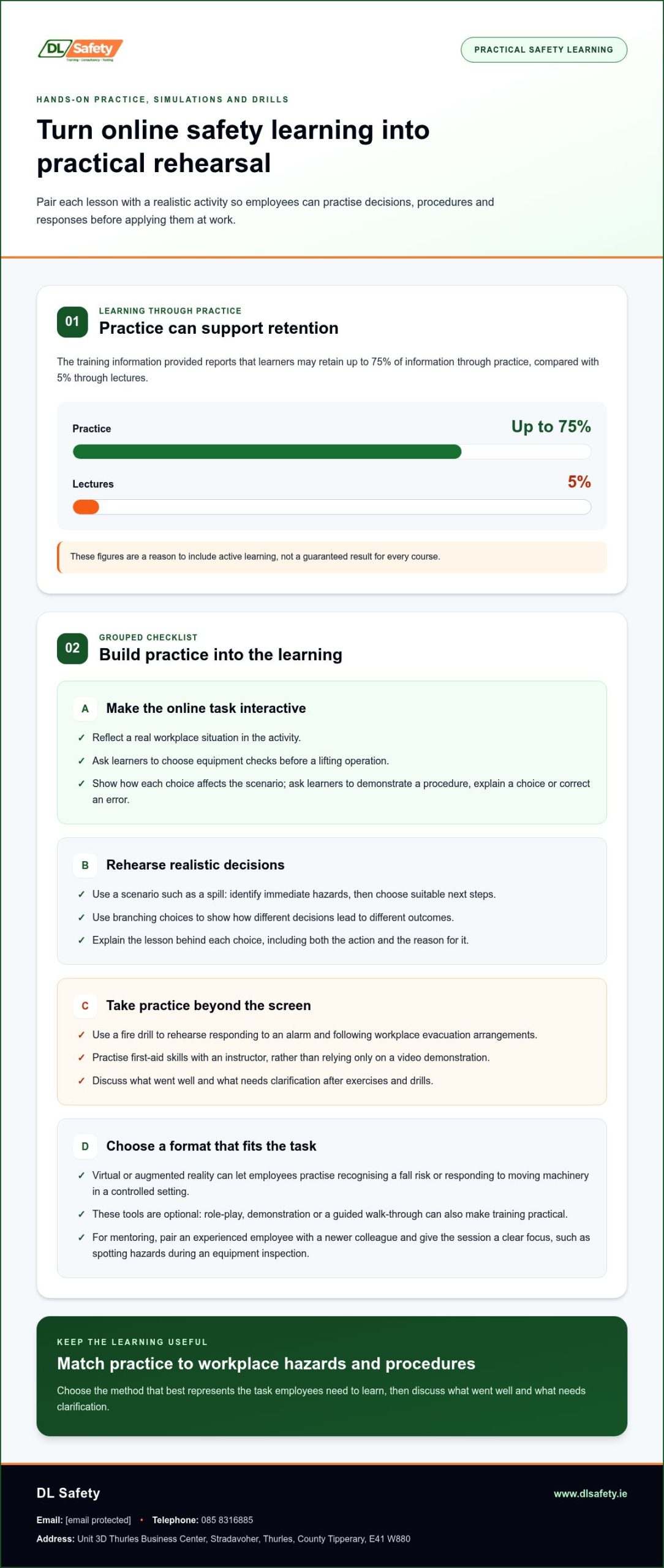
Online courses can explain a safe method, but practical exercises help employees rehearse what to do. Pair each lesson with an interactive task that reflects a real workplace situation. For example, a learner could select the correct equipment checks before a lifting operation, then see how each choice affects the scenario. This lets employees practise decisions before applying them at work.
Practice can support retention more effectively than passive listening alone. The training information provided reports that learners may retain up to 75% of information through practice, compared with 5% through lectures. Treat those figures as a reason to include active learning, not as a guaranteed result for every course. Ask learners to demonstrate a procedure, explain their choice or correct an error in a simulated task.
Scenario-based exercises give employees a safe way to work through realistic problems. A course might present a spill, ask the learner to identify immediate hazards and then prompt them to choose suitable next steps. Digital learning specialists such as Knowledgefront often design branching scenarios to show how different decisions lead to different outcomes. Tie each choice to a clear lesson so employees understand both the action and the reason for it.
Simulations and drills can extend practice beyond the screen. A fire drill lets employees rehearse how to respond to an alarm and follow workplace evacuation arrangements. First-aid practice with an instructor gives learners a chance to rehearse skills, rather than relying only on a video demonstration. Match exercises to workplace hazards and procedures, then discuss what went well and what needs clarification.
Virtual reality and augmented reality can present hazards in a controlled setting. For example, a simulated environment could let an employee practise recognising a fall risk or responding to moving machinery without entering a live hazard area. These tools are an option, not a requirement. Role-play, demonstration or a guided walk-through can also make training practical. Choose the method that best represents the task employees need to learn.
Mentoring adds a human element to repeated practice. Pair an experienced employee with a newer colleague to demonstrate a procedure, observe a practice task and discuss questions. Give the mentor a clear focus, such as identifying hazards during an equipment inspection, rather than leaving the session as an informal chat. This helps transfer workplace knowledge and makes it easier for newer workers to raise uncertainties.
Link online learning with a planned practical exercise. Before the session, ask employees to complete the relevant course module. During practice, observe how they apply the steps; afterwards, note recurring errors and adjust the next lesson. This cycle connects learning with real tasks and gives employees useful opportunities to practise, ask questions and build confidence.
4. Involving employees in safety leadership and training
Workers engage more when they help shape safety procedures, rather than simply receiving instructions. Invite employees to identify one task-specific hazard, suggest a control and agree how the team will communicate it. A survey cited on workplace safety initiatives found that 81% of workers feel more committed and involved when they better understand their company’s safety initiatives. Explain how each procedure supports their daily work, not just organisational targets.
Leadership behaviour sets the tone. Managers who attend the same training, follow site procedures and discuss their own decisions show that safety applies at every level. A study by the American Psychological Association found that a positive workplace culture can enhance learning and performance by up to 30%. Managers can reinforce that culture by asking workers to raise concerns, listening without blame and acting on suggestions.
Give employees a visible role in learning. A worker with relevant experience can lead a short discussion, demonstrate a safe method or deliver a toolbox talk. Use a realistic scenario, such as a change in site access, and ask the group to identify hazards and agree on practical steps. This values employees’ knowledge while helping managers see where instructions need clarification.
Gamification can add structure and interest to online courses. Use points for completing scenario questions, team challenges for identifying hazards, or a leaderboard that tracks participation. A workplace learning survey cited on gamified training found that 83% of employees who experienced it felt motivated to learn, while 61% felt more engaged. Keep rewards focused on learning and contribution, rather than speed alone. Recognise thoughtful answers and improvements, not just perfect scores.
Give workers ways to contribute beyond the course. Ask employees to suggest a safety goal, share a lesson from a task or review an unclear procedure. Seventy-five per cent of safety professionals identified employee indifference as the top barrier to excellent safety training. A short prompt after a module, such as “Which step is hardest to apply on site?”, gives managers a specific issue to discuss and address.
How often should employees complete online health and safety training in Ireland? Set refresher timing according to the hazards, role, work changes and learning needs. Revisit material when procedures change or a knowledge gap appears, and use completion records and employee feedback to plan the next session.
What are Irish employers’ legal obligations for workplace safety training? Training should address the hazards, risks and compliance requirements relevant to the organisation’s work and each employee’s role. Managers should make procedures clear and assess whether workers can apply them in practice.
What are typical costs of online employee safety training in Ireland? Costs depend on course scope, learner numbers, delivery method and role-specific content. A price is provided after a quote request.
5. Training assessments and employee feedback
A completion record shows that someone finished a module, not what they can apply at work. Assess understanding with a short quiz, a practical evaluation or a scenario-based test. For example, after a manual handling lesson, ask employees to identify the safer way to move a load. Compare answers with the procedure taught, then note which steps need clearer explanation.
Place knowledge checks throughout training instead of relying on one final test. After explaining a procedure, ask what the next action should be in a realistic situation. Give immediate feedback on incorrect answers, explaining the reason and the safer choice. This helps learners correct misunderstandings as they arise and shows managers which topics need reinforcement before the course ends.
Use assessments to understand reasoning, not just scores. A multiple-choice question can test whether someone recognises a hazard, while a branching scenario can reveal how they respond to changing conditions. If an employee chooses an unsafe option, explain the consequence and invite them to try again. This makes the test a learning exercise and helps distinguish a knowledge gap from a careless click.
For a practical task, use a clear observation guide. During an equipment inspection exercise, for example, record whether the learner follows the relevant steps, identifies visible concerns and knows how to report them. Give specific feedback on each action rather than a general pass or fail. A trainer can then suggest one improvement and invite the employee to repeat the step.
Employee feedback can reveal issues that quiz results miss. After a course, ask what felt relevant, which instruction was unclear and what workplace example would make the lesson more useful. Keep questions focused. “Which step would be hardest to use during a busy shift?” gives employees a concrete prompt and managers an actionable response.
Separate responses by role when it helps identify different needs. The Safety Engagement Survey has distinct question sets for management and employees, and provides custom results. For an internal review, compare supervisors’ and frontline workers’ comments on the same procedure. Differences may point to unclear communication, limited opportunities to practise or a gap between written instructions and daily work.
Close the feedback loop. After reviewing answers and comments, choose one improvement, explain what will change and include it in the next training session. If several learners misunderstand a reporting step, revise the explanation and test it again. Record the issue, action taken and later assessment result. This turns feedback into a repeatable way to improve training, rather than a survey with no follow-through.
5. How can employers tailor safety training to different roles and experience levels?
Engaging employees in online safety training starts with matching course examples to the hazards and decisions in each role. A warehouse operative may need learning about vehicle routes and moving loads, while an office worker might focus on workstation setup and digital protection. For organisations also reviewing access control and data protection across different roles, CyberOne provides managed identity and cybersecurity services. This helps employees see how lessons apply to their work, instead of completing identical material that may not address their responsibilities or daily environment.
Separate shared learning from role-specific instruction. Everyone may need to know how to report a hazard, but machinery operators need guidance relevant to their equipment and tasks. Use job descriptions, task observations and employee feedback to identify the differences. Organise modules so workers receive essential shared information alongside examples that reflect their actual duties and workplace procedures.
Experience should shape the level of explanation and practice. New starters may need plain-language introductions to site procedures and unfamiliar terms. Experienced workers may benefit from updates about changed tasks, new equipment or recurring errors. A tailored approach to engaging employees in online safety training can meet these different needs without assuming that long service means complete understanding. Use a short scenario or practical check to identify where further guidance would help.
Consider language, literacy and learning preferences when preparing materials. Explain technical terms in plain English, use a clear diagram where helpful, then ask learners to choose an appropriate response to a work-related scenario. Keep screens uncluttered and break longer material into manageable sections. These choices make learning easier to follow for employees with different levels of familiarity and confidence.
Use situations workers recognise. A maintenance worker could consider a lock-off scenario, while a delivery worker explores hazards around a loading area. Training related to personal experience can be easier to apply; a cited study found employees who related material to their own experiences were about 20% more likely to apply the training. Invite workers to suggest relevant examples, then adapt them into course activities.
Review results by role and experience level. Compare assessment answers and employee comments, looking for recurring misunderstandings within a team. If new starters struggle with a procedure, add clearer introductory guidance while retaining useful detail for experienced workers. Update examples when tasks change, then use follow-up questions to check whether employees can apply the revised learning at work.
For support shaping learning around different roles, discuss your training needs.
DL Safety: Monthly Safety Support Packages
DL Safety’s Monthly Safety Support Packages are a practical next step for organisations seeking ongoing help with workplace safety. They may suit businesses reviewing how training, incident learning and safety processes fit together over time. For a specific task, DL Safety also offers Lift Plans, GA1 Testing and Accident Investigation.
To discuss whether a Monthly Safety Support Package fits your needs, contact DL Safety at info@dlsafety.ie or call 085 8316885. You can also visit dlsafety.ie or get in touch online for further assistance across Ireland.
Make the next training cycle count
Use your next training cycle to improve how safety learning works across the organisation. Choose a course to review, decide what employees should be able to do afterwards and plan how you’ll gather their views. A lasting approach to engaging employees in online safety training treats feedback as part of the work, not an optional extra.
Set a clear follow-up point after the course. Consider whether employees can use what they’ve learned in daily tasks and identify any barriers they encounter. Share the changes you make in response so people can see that their input has practical value. This helps build a steady learning habit instead of treating each course as a standalone event.
Start with a manageable change, learn from the response and keep refining your approach. If you’d like to discuss training support for your organisation, contact DL Safety. Thoughtful improvements can help make safety learning a more useful part of everyday work.
Frequently Asked Questions
How can I prevent cheating in H&S online training courses?
Reduce answer-sharing by assessing applied judgement, not just recall. Use question pools and vary scenario details between attempts, then ask learners to explain a decision in a short follow-up discussion. Make clear that course completion reflects the learner’s own work. If results look unusually similar or someone finishes without demonstrating understanding, follow up privately with a practical check rather than assuming misconduct.
What makes online safety training engaging for employees?
Employees are more likely to take part when they understand why a lesson matters to their role. Explain its practical purpose at the outset, use plain language and focus each screen on one learning task. Show clear progress and offer opportunities to ask questions. For example, a shift worker could complete a module during a planned break and bring a workplace question to the next team discussion.
What are the most effective formats for online workplace safety training?
The right format depends on the subject and what employees must demonstrate afterwards. A short video can introduce a process, while a decision-based module can test how someone responds to a changing situation. For tasks requiring physical skill, pair online instruction with a supervised practical assessment. Consider device access, work schedules and the complexity of the procedure when choosing how to deliver training.
How can employers measure engagement and learning outcomes in online safety training?
Look beyond course completion to check whether employees can use what they have learned at work. Compare assessment answers with observations during relevant tasks, and review whether learners revisit material or leave activities unfinished. Ask supervisors to record recurring questions after training, then compare those themes with employee comments. For instance, repeated uncertainty about a form may signal that its instructions need improvement.
How do gamification and interactive scenarios improve safety training engagement?
Interactive scenarios give learners choices and show the consequences, making it easier to connect a decision with its likely outcome. A scenario can pause at a decision point, ask the learner to choose a response and explain the result. Gamification can recognise steady participation or thoughtful contributions. Keep competition supportive, and avoid rewarding speed when careful judgement is the skill employees need to practise.
What are the risks of relying only on online workplace safety training?
Online learning can explain a procedure, but it cannot by itself show whether someone performs a physical task correctly at work. Learners may also encounter site conditions that a course example does not cover. Pair digital lessons with relevant supervision, demonstrations or practical checks, and give employees a way to raise questions. This helps managers identify where more guidance is needed before employees apply their learning to unfamiliar situations.