
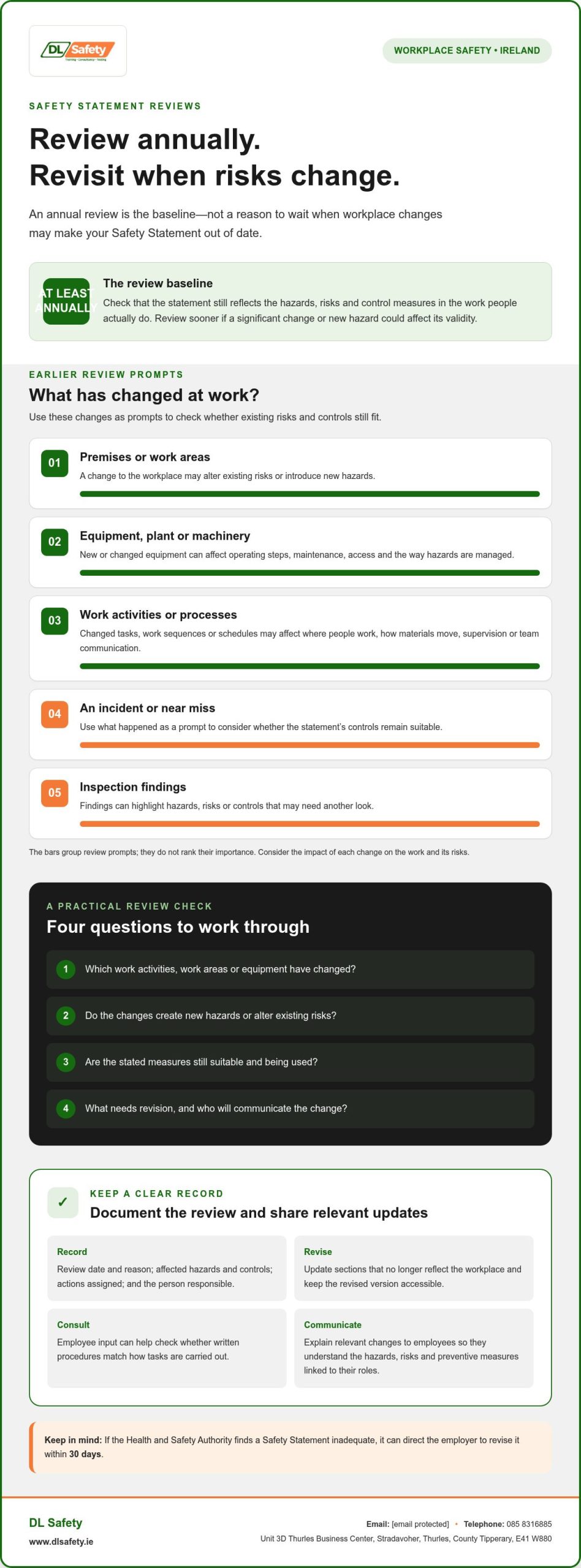
In Ireland, a Safety Statement should be reviewed at least annually, and sooner if a significant change or new hazard means it may no longer be valid. If you’re wondering how often a Safety Statement should be reviewed, the annual review is the baseline, not a reason to wait when workplace risks change. The statement sets out workplace hazards, the risks they pose and the measures in place to manage them.
A Safety Statement can become outdated between annual reviews. New equipment, changes to work activities, an incident or a near miss may all call for an earlier check to ensure the document still reflects how work is done. This guide explains what a Safety Statement is, why an annual review matters and which changes should prompt an update. It also shows how keeping the statement current helps ensure safety information remains relevant to employees and others exposed to workplace risks.
Key Takeaways
- Use the Safety Statement to reflect the hazards, risks and controls that apply to the work people actually do.
- Consider whether changes to premises, equipment, work activities or processes have altered existing risks or introduced new ones.
- Use incidents, near misses and inspection findings as prompts to consider whether the statement’s controls remain suitable.
- Make sure employees can access the statement and understand the parts relevant to their roles.
What is a Safety Statement ?
A Safety Statement is a written document setting out workplace hazards, the risks they create and the measures used to protect health and welfare. In Ireland, employers prepare one for their place of work, using their own activities and conditions rather than relying on a generic document. It connects risk assessment to practical action, so employees can understand what could harm them and how risks are managed.
Section 19 of the Safety, Health and Welfare at Work Act 2005 requires employers to identify workplace hazards and assess the risks they present, according to the Irish Statute Book. Section 20 requires employers to prepare a Safety Statement based on that hazard identification and risk assessment. For example, a workshop statement might address vehicle movements, machinery, substances and the controls relevant to each task. The content should describe the actual workplace, not an imagined typical one.
Who is responsible for reviewing a safety statement in Ireland? The employer is responsible for preparing the Safety Statement and keeping it relevant, including arranging reviews when workplace risks or operations change. A manager or competent person may help, but responsibility remains with the employer. Employees can contribute practical knowledge about how tasks are carried out and where controls may need attention.
Communication matters as much as the written document. Employers must bring the Safety Statement to employees’ attention at least annually and whenever it is amended. Newly recruited employees should be informed when they start work. Staff also need access to the statement and an explanation of the sections relevant to their roles, including the hazards, risks and preventive measures linked to their duties.
Consultation helps employers check whether written procedures match the work people actually do. Ask employees about task steps, changes they have noticed and whether the stated measures work in practice. For example, a worker who uses cleaning chemicals can explain how products are stored and handled. Recording this input gives the review a practical basis and can reveal gaps a desk-based document check might miss.
Are there different review requirements for small businesses or high-risk workplaces in Ireland? The Health and Safety Authority says an employer with three or fewer employees may meet the Safety Statement requirement by complying with an Authority-prepared Code of Practice that applies to their sector or activity. Workplace hazards still need to be assessed, and controls must reflect the work being done. For higher-risk tasks, the relevant hazards and risks should guide what the statement covers.
For official guidance, Irish employers can use the Health and Safety Authority’s material on Safety Statement requirements, employer duties, risk assessment and employee consultation. Its applicable Code of Practice also provides the route for qualifying small employers. If an inspector finds a Safety Statement inadequate, the Health and Safety Authority can direct the employer to revise it within 30 days. That makes a clear, workplace-specific document and a recorded review process important parts of practical safety management.
Reviewing statements after major operational changes
A significant operational change can make existing safety controls inaccurate before the next scheduled review. Assess the impact when work, equipment or the workplace changes, and update the statement where necessary.
Changes to processes and equipment
A change to a process, plant, piece of equipment or machine can alter how a hazard arises and how it should be managed. For example, a new production sequence may change where employees work, how materials move or which tasks happen at the same time. Review the risks and controls affected by the change instead of assuming existing measures still apply.
Consider both the equipment and the work around it. A new machine may require different operating steps, maintenance arrangements or access controls. A changed work schedule may also affect supervision and communication between teams. These changes can make parts of the Safety Statement inaccurate, even when the overall activity seems familiar.
Revising and documenting changes
Revise the Safety Statement by changing the sections that no longer reflect the workplace, then record what prompted the review and what action followed. This gives managers and employees a clear record of the decision, rather than leaving them to rely on an outdated version.
How should safety statement reviews and revisions be documented? Record the review date, reason, affected hazards and controls, actions assigned and the person responsible. Keep the revised version accessible and explain relevant changes to employees.
For each change, note what was assessed and whether existing measures remain suitable. If a new delivery route affects pedestrian movement, for example, record the assessment, any revised controls and how workers were informed. A clear version history helps management identify the current statement and shows how safety management responded to the operational change.
Section 19 requires employers to review a risk assessment when a significant change occurs or another reason suggests it is no longer valid. Since the Safety Statement is based on hazard identification and risk assessment, changes to those findings may also require a revision. The key test is whether the document still reflects the work being done and the risks employees face.
Include relevant changes in the management system so operational decisions and safety records stay aligned. A practical review can consider:
- Which work activities, work areas or equipment have changed?
- Do those changes create new hazards or alter existing risks?
- Are the stated measures still suitable and being used?
- What needs revision, and who will communicate the change?
Documenting these points helps turn a review into a traceable management action, not just an edited document. For support with workplace safety arrangements, explore the relevant information online.
Recommended annual review of safety statements
Reviewing a Safety Statement annually gives employers a regular opportunity to check whether it still reflects the work and risks at their workplace. An annual review is a useful planning interval, not a reason to delay action after a significant change. Even if a business remains in the same premises, changes to tasks, responsibilities or working arrangements can make parts of the document inaccurate.
Employers often ask, “How often should a Safety Statement be reviewed?” In Ireland, Section 20 of the Safety, Health and Welfare at Work Act 2005 requires a review when a significant change affects the workplace or another reason suggests the statement is no longer valid. The annual check is a practical routine for identifying whether that trigger has arisen. It does not replace a review prompted by changing risks.
Build the annual review into the organisation’s safety management system. For example, assign someone to lead it and schedule it alongside an existing management review. Set aside time to examine the document itself, rather than simply changing its date. A current date does not make outdated content accurate, and recording the outcome helps show what was considered.
During the review, compare the statement with current risk assessments, work arrangements and employee feedback. Check that responsibilities still match the people carrying them out and that controls remain practical. If a task no longer takes place, consider whether removing it affects other procedures. If a hazard or measure has changed, record the action needed instead of treating the review as a paperwork exercise.
The Health and Safety Authority provides guidance on Safety Statement requirements, risk assessment obligations and employee consultation. Use that guidance to inform the review while keeping the assessment specific to the workplace. Ask whether:
- The document describes the activities employees currently perform.
- Risk assessments support the hazards and measures recorded.
- Responsibilities and safety arrangements remain workable.
- Employee observations or inspection findings have exposed gaps.
Risk assessments also need review at a frequency suited to the business. A review every 12 months may make sense, depending on the risk profile, industry, regulatory standards and internal management systems. For healthcare providers operating under UK health and social care standards, specialist support from CQC Consultancy can assist with meeting statutory registration and inspection requirements. Ultimately, higher-risk work or changing operations call for closer attention to relevant assessments and controls.
If you’re asking, “How often should a Safety Statement be reviewed?”, use an annual check as your scheduled baseline and review sooner when circumstances change. At the end of each review, record whether the statement remains suitable, needs revision or requires follow-up. Make the current version accessible to employees so the review leads to practical action, not just a date change.
Adapting to new hazards, equipment and processes
A new hazard, piece of equipment or work process can change the risks employees face. Review the relevant assessment and Safety Statement so the controls reflect how the organisation now operates.
What should an Irish workplace Safety Statement review include? Consider changed work activities, new or altered hazards, the risks involved and whether existing measures remain suitable. For example, introducing a new cleaning product calls for an assessment of how it is stored, handled and used.
Start with the change itself. A new production method may introduce different tasks, materials or work locations, while a changed process may remove some risks and create others. In each case, identify who could be affected and compare the new conditions with the controls already recorded. This keeps the assessment specific to the work instead of treating a document template as a complete answer.
Equipment can also change how people interact with the workplace. If an organisation introduces a powered cutting tool, for instance, consider the task, the people using it, nearby workers and how the equipment is maintained. A new chemical may require attention to handling, storage and spill response. These are prompts for assessment, not automatic conclusions about which controls suit every workplace.
Section 19 of the Safety, Health and Welfare at Work Act 2005 requires employers to identify workplace hazards and assess the risks they present, according to the Irish Statute Book. A significant change, or another reason to believe an assessment is no longer valid, calls for review. The updated findings can then inform any changes needed to the Safety Statement.
Use a consistent method to consider and record changes clearly. For each new process, item of plant or piece of equipment, consider:
- What is different from the previous working arrangement?
- Which employees or other people could be exposed?
- Have the hazards or the level of risk changed?
- Do existing measures still address the current work?
- What improvement or follow-up action is needed?
Employees can help check whether the assessment reflects real working conditions. Someone who uses new equipment daily may identify a practical issue that a written specification will not reveal. Record relevant observations, decisions and actions, then revise the affected sections. This makes the Safety Statement a working part of the organisation’s safety management, rather than a static template.
Keep the review proportionate to the change. Replacing equipment with a similar model may call for a focused check, while changing a process or introducing unfamiliar hazards may require a broader assessment. Either way, document what was considered and ensure affected employees understand revised measures before relying on them at work.
Reasons to review a Safety Statement sooner
An annual review is a useful routine, but a new risk can make an existing statement outdated sooner. In Ireland, employers should review it after a significant operational change or whenever there is reason to believe it no longer reflects workplace risks.
What events require an employer to review or revise a Safety Statement? Triggers include changes to premises, machinery, work activities or chemicals, as well as accidents, near misses, inspection findings, insurance recommendations and relevant legislative changes. Review the affected risk assessment and procedures, then revise the statement if its information or controls no longer fit.
An accident or near miss can reveal a gap between written procedures and work as it happens. For example, if a worker is injured while moving materials, consider whether the risk assessment covered the task and whether the stated controls were followed and effective. A near miss involving a reversing vehicle can also prompt a review of traffic routes and pedestrian separation. Record what happened, what was learned and whether measures need to change.
Changes to the workplace can alter who is exposed to a hazard. A new storage area might change how people and vehicles move through a site, while a new chemical may introduce different handling or spill risks. Review the relevant assessment when these changes arise. Don’t wait for the annual review if existing controls no longer address the work.
Inspection findings and insurance recommendations can also highlight weaknesses in current arrangements. Compare each finding with the hazards, controls and procedures in the Safety Statement. A recommendation does not automatically determine the action required, but it can show that an assessment deserves renewed attention.
Legislative changes may affect the measures or responsibilities described in a statement. Review relevant changes and decide whether the document still accurately reflects the organisation’s work and risks. Under Section 20 of the Safety, Health and Welfare at Work Act 2005, employers must review the statement when a significant change occurs or another reason indicates it may no longer be valid.
Use a simple, trigger-based approach to keep the response focused:
- Identify the event, such as an incident, new equipment or changed work activity.
- Assess which hazards, people and existing controls it affects.
- Decide whether procedures or the Safety Statement need revision.
- Record actions and communicate relevant changes to employees.
Prompt reviews make it easier to connect new information with practical action, before outdated procedures continue to guide work. For help reviewing or preparing a workplace Safety Statement, get support with your Safety Statement.
Keep the review process active between scheduled checks. Review Irish Safety Statements after incidents, following operational changes, when new hazards arise and periodically as part of ongoing safety management.
In Ireland, employers should update a Safety Statement after an accident or near miss to reflect lessons learned or new measures, ensuring the documented approach accounts for what the event has shown.
DL Safety: Monthly Safety Support Packages
DL Safety offers Monthly Safety Support Packages for businesses that need ongoing support with workplace safety management. If operational changes, incidents or review actions make it difficult to keep safety arrangements current, this service can provide a practical next step. DL Safety also offers Accident Investigation to help examine incidents and inform follow-up safety actions.
Discuss your workplace safety needs with DL Safety by email at info@dlsafety.ie or by telephone on 085 8316885. You can also visit www.dlsafety.ie to find out more about our nationwide services and professional safety support.
Turn your review into practical next steps
A useful review should lead to clear ownership, not just a revised document. Decide who will carry out each action, how employees will be informed and how changes will become part of everyday work. This follow-through helps make safety arrangements practical instead of leaving improvements on paper.
Deciding how often a Safety Statement should be reviewed is only one part of managing workplace safety. DL Safety offers Monthly Safety Support Packages for ongoing support, alongside Online Safety Courses and Lift Plans for specific workplace needs. The right next step depends on the work your organisation is planning and the support it needs to manage it effectively.
Talk to DL Safety about support that fits your workplace. Contact DL Safety to discuss your safety needs, and take the next step with confidence.
Frequently Asked Questions
What happens if you do not have a Safety Statement?
An employer without a required Safety Statement may face Health and Safety Authority inspection and enforcement action. This can include improvement or prohibition notices, depending on the circumstances. An inspector may also request the document during an inspection. If a statement is found inadequate, the Authority can direct the employer to revise it within 30 days. A missing or unsuitable statement can also leave employees without clear written information about workplace risks and controls.
How often must a Safety Statement be reviewed in Ireland?
Plan to review it at least annually, and review it sooner if a significant change or another reason suggests it may no longer be valid. Section 20 of the Safety, Health and Welfare at Work Act 2005 sets the legal trigger for review, whilst annual review is the recommended routine. Risk assessments may also need review at an interval suited to the business’s risk profile, work activities and management system.
How should employees be involved in a Safety Statement review?
Invite employees to describe how tasks are actually carried out, including workarounds, handovers and recurring difficulties with controls. A brief discussion with people who use equipment or handle materials can reveal practical issues that documents may miss. Give employees a way to raise concerns, consider their feedback during the review and explain any resulting changes relevant to their work. This makes consultation useful and connects written arrangements with day-to-day practice.