
Online training is most useful when it supports the work learners actually do. In Ireland, HSA approved online courses can help learners build knowledge of workplace health and safety topics. HSA Learning courses are designed for workplaces here and are self-directed, so learners can study in their own time and at their own pace.
A course title alone is not enough: you need to know what the learning covers, how access works and what proof of completion you’ll receive. After successfully completing an entire HSA Learning course, learners can download a completion certificate from the My Certificates section of their account. This article explains what these courses can support, how enrolment and online access work, and what certificates do and don’t demonstrate. It also covers how online learning fits alongside the training your workplace needs, helping you make a practical choice for yourself or your team.
Key Takeaways
- Match training to workplace risks and employees’ tasks; Ireland does not prescribe one universal list of mandatory health and safety courses.
- Understand the legal context: according to the Irish Statute Book, the Safety, Health and Welfare at Work Act 2005 underpins employers’ workplace health and safety training duties.
- Look beyond a course title to its scope. The chemical product imports course covers responsibilities under REACH and CLP.
- Distinguish course completion certificates from Choose Safety digital badges, which recognise participating post-primary and further education students’ achievements.
- Treat online learning as part of a wider training plan, not a substitute for workplace-specific instruction where it is needed.
Course registration and completion certificates
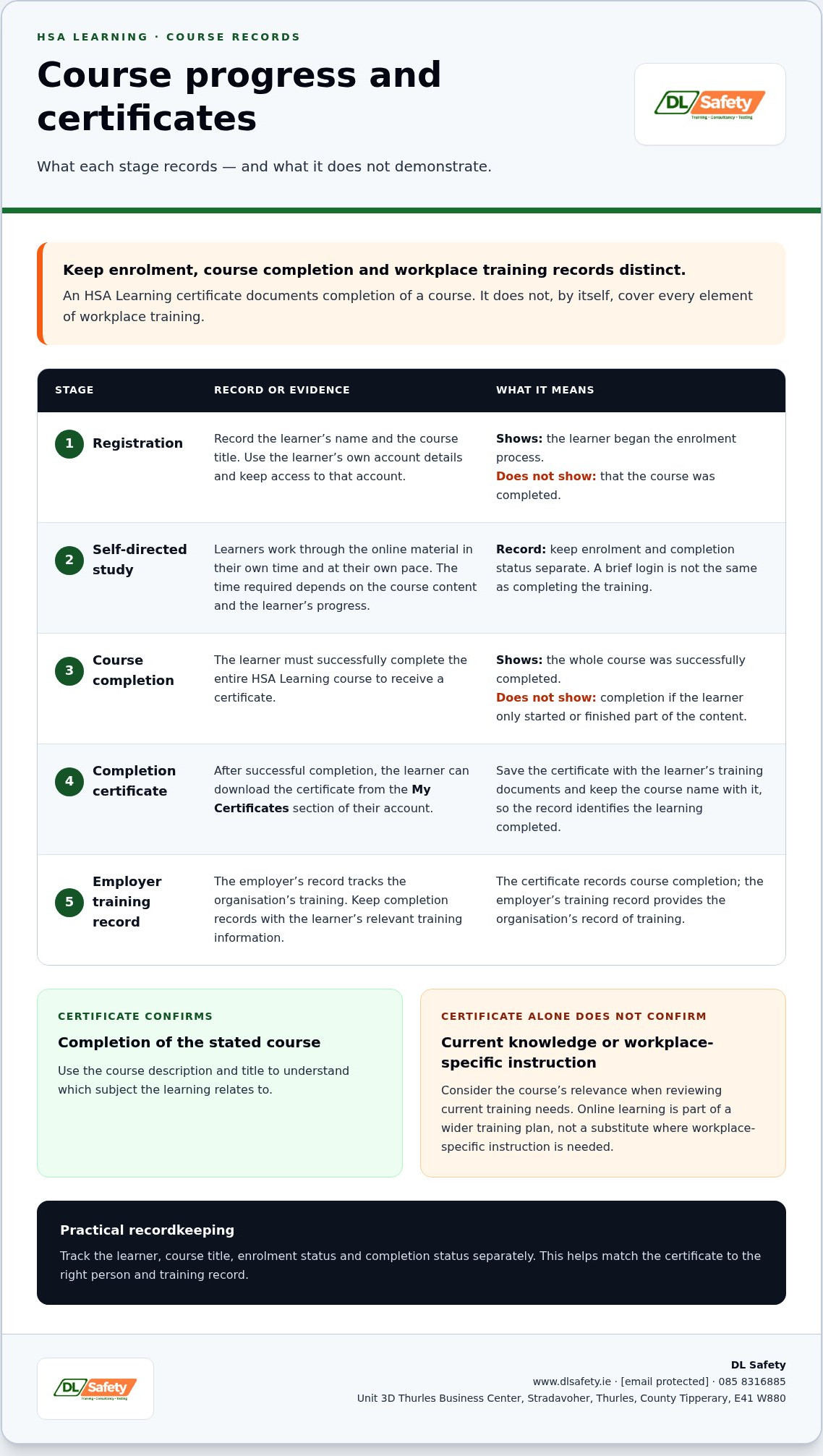
Before enrolling, identify the learning goal and decide how you’ll record completion. An HSA Learning certificate documents completion of a course, not every element of workplace training.
Before you enrol
Match the course title and content to the learner’s role or training need. For example, an employee who needs knowledge about chemical products should choose a course that covers that topic. Record the course name alongside the learner’s details so you can match the record to the right person later.
During registration, use the learner’s own account details and keep access to that account. HSA Learning stores certificates in the account’s My Certificates section. If you’re organising training for an employer, decide in advance who will record completion and where the record will be kept. This makes it easier to retrieve the certificate when updating an individual training record.
Keep enrolment and completion records separate. Registration shows that a learner began the process, not that they completed the course. A simple tracking sheet can record the learner, course title, enrolment and completion status without confusing these steps.
Training duration and certificate validity
HSA Learning courses are self-directed, so learners study at their own pace. The time required depends on the course content and the learner’s progress. Allow enough time to complete every part, rather than treating a brief login as completed training.
A completion certificate records that the learner finished the course. Keep its issue details with the training record and consider the course’s relevance when reviewing current training needs. The certificate alone doesn’t show that the learner’s knowledge remains current or that workplace-specific instruction has been covered.
Course delivery and digital certificates
HSA Learning delivers courses online for self-directed study. Learners can work through the material in their own time and at their own pace, then download a completion certificate after finishing the entire course. The certificate is stored in the learner’s account under My Certificates.
For practical recordkeeping, download the certificate after completion and save it with the learner’s training documents. Keep the course name with the certificate so the record shows which learning it relates to. An online certificate is convenient to retrieve, but it should still be filed with the employer’s relevant training information.
Certificates and course results
Learners must successfully complete the entire HSA Learning course to receive a certificate. Starting a course or completing only part of its content does not meet that requirement. Once finished, the learner can download the certificate from My Certificates.
University of Galway staff who complete relevant HSA courses should have their completion records added to their Unit’s health and safety training records. This example shows the different roles of a learner’s certificate and an employer’s training record: the certificate documents course completion, while the employer’s record tracks the organisation’s training.
Course accreditation and HSA compliance claims
Find course information through HSA Learning, then compare its scope with the training need. An “HSA-approved” label alone doesn’t show that a course covers every workplace requirement or situation.
In Ireland, HSA Learning’s course listings are the practical place to identify its online courses. An online course advertised as HSA-approved without a matching HSA Learning listing may not meet the workplace’s training needs.
Finding the official approved course list
Use HSA Learning’s own course listings to identify courses on its platform. Read the title and description, then compare the topics with the task or risk the learner needs to understand. HSA Learning courses are specific to workplaces in Ireland, making it easier to distinguish them from general courses aimed at another country’s rules or practices.
Record the course title and its stated subject. For example, the course on EU chemical product imports covers the responsibilities of companies importing chemical products from outside the EU and placing them on the EU market under REACH and CLP. That scope helps employers judge whether the course relates to their work.
HSA approval and training scope
The Health and Safety Authority, commonly called the HSA, is the organisation named in HSA Learning. Its online courses cover particular subjects, so read a course listing as information about that course, not as a blanket statement about all workplace training.
According to the Irish Statute Book, Ireland’s Safety, Health and Welfare at Work Act 2005 is the legislation underpinning employers’ workplace health and safety training duties. The course selected still needs to suit the work and its risks. A course on workplace bullying prevention, for example, isn’t intended to replace workplace-specific information and training required by health and safety legislation.
This distinction matters when evaluating compliance claims. Course completion can provide evidence of learning on a stated topic, but the course’s scope determines what that learning addresses. Compare the course description with the actual activity, workplace and learners’ responsibilities before assigning it.
Checking compliance claims and course risks
Read claims carefully. “HSA-approved” may sound like a complete compliance solution, but the course subject and learner’s role still matter. A course outside HSA Learning’s listings may not provide the specific HSA course content its advertising implies. Even a relevant course can leave gaps if it doesn’t address the workplace’s own procedures and conditions.
Before relying on a claim, take three steps:
- Find the course in HSA Learning’s listings and compare its title with the advertised wording.
- Read the description to understand the topic and intended scope.
- Match that scope to the work, then record any additional workplace-specific instruction needed.
If the course doesn’t match the need, its certificate could document learning that isn’t relevant to the task. Treat the course as one part of a training plan, not proof that every compliance responsibility has been met.
Course registration and enrolment
For HSA Learning, enrolment involves a straightforward sequence: select a relevant course, register using accurate learner details, and decide how participation will be recorded. Employers can make the process clearer by agreeing on these steps before inviting staff to begin.
Start with the course listing and description. Match the subject to the learner’s work rather than choosing by title alone. For example, a worker handling chemical products may need learning about chemical-related responsibilities, while another role may require a different topic. This check helps avoid enrolling someone in a course that doesn’t fit the intended learning need.
Next, identify who will take the course and how their details will be recorded. Individuals should use consistent personal information during registration and later recordkeeping. If you’re arranging training for a team, prepare a learner list with each person’s name, role and selected course. This makes it easier to distinguish colleagues with similar names or different training assignments.
- Choose the course. Read its description and relate the subject to the learner’s tasks.
- Prepare learner details. Use the same name and contact information for registration and internal records.
- Follow the registration instructions. Complete the steps shown for the selected HSA Learning course.
- Record the assignment. Note the course and learner so progress can be tracked appropriately.
For a team, an employer can assign one coordinator to maintain the training list while each learner completes their own registration. For example, a supervisor could record which staff need a particular course, then update the list as each person enrols. Keeping assignments separate from enrolment avoids treating an invitation as evidence that learning has started.
HSA Learning courses are self-directed, so plan enrolment around the learner’s available study time. A worker with changing shifts may need a suitable opportunity to access the course, while an employer can explain how training fits into work planning. Don’t set an internal completion expectation without considering the learner’s workload and the course content.
Before registration, explain the course’s purpose, who should take it and how completion will be recorded. For instance, tell staff whether the course supports role-specific knowledge or forms part of a broader training plan. This helps learners understand why they’ve been assigned it and helps managers connect the course to workplace needs.
After enrolment, update the employer’s tracking record and keep it separate from course completion information. If a learner selects the wrong subject or enters inconsistent details, correct the record promptly through the relevant course or account process. A clear sequence helps employees and employers organise online learning without confusing selection, registration and completion.
Online course access and flexibility
HSA Learning courses are self-directed, so learners can study in their own time and at their own pace. Online learning has limits for high-risk work and practical skills: course material can support knowledge, but it doesn’t by itself demonstrate someone performing a hands-on task.
This flexibility helps employees fit learning around shifts and other duties. Learners can return to course material when it suits their schedule, rather than attending a set classroom session. Employers can support that flexibility by allocating suitable study time and setting clear expectations for completing the learning.
For example, an employee working changing shifts can plan study for an appropriate quiet period. A manager can coordinate assignments across a team so staff aren’t expected to train while handling competing tasks. Plan access around the work rather than assuming that online delivery automatically creates time for learning.
Self-directed learning also asks learners to manage their own progress. Employees should work through the course in sequence, make time to understand the material and avoid treating a brief visit as meaningful participation. Managers can explain the course’s purpose before assigning it, such as building awareness of a topic relevant to the learner’s role.
For practical or higher-risk tasks, distinguish the course’s learning purpose from the skills needed to do the work. An online module can introduce information about a subject, but a screen-based lesson alone doesn’t show how someone handles equipment or responds to workplace conditions. Employers should consider what evidence of learning suits the task, including whether workplace instruction or practical demonstration is needed.
This distinction matters for topics such as lifting activities or spill response. Reading course material can build understanding, while applying a procedure involves the actual work environment and equipment. Choose a format that fits the learning outcome, rather than making convenience the only selection criterion.
Use these steps to make online access more effective:
- Set the purpose. Explain what the course covers and why it relates to the employee’s role.
- Plan study time. Consider shift patterns and workload when setting an internal schedule.
- Review the learning outcome. Decide whether online material addresses the knowledge required.
- Consider practical needs. Identify whether the task also calls for workplace instruction or demonstration.
Ireland’s Safety, Health and Welfare at Work Act 2005 underpins employers’ workplace health and safety training duties, according to the Irish Statute Book. Online learning can form part of a considered training approach, but its fit depends on the topic, the learner’s role and the work involved. Planning access alongside those factors helps employees use flexible study time purposefully.
What is the HSA in Ireland and what training courses does it approve?
The Health and Safety Authority, or HSA, is Ireland’s workplace health and safety authority. Its HSA Learning courses cover specific subjects for workplaces in Ireland, not every training need an employer may have.
This distinction helps explain what people mean by “HSA approved”. HSA Learning provides courses associated with the Authority, but the course topic still matters. A listing relates to its stated subject; it doesn’t mean one course covers every role, hazard or workplace procedure.
Examples show how specific these subjects can be. The course on EU chemical product imports covers responsibilities for companies importing chemical products from outside the EU and placing them on the EU market under REACH and CLP. It applies to that subject, not to all chemical handling or workplace safety.
HSA Learning also includes a workplace bullying prevention course. It isn’t intended to replace workplace-specific information and training required by health and safety legislation. Employers should distinguish learning about bullying prevention from the separate instruction employees may need for their own workplace and tasks.
The HSA’s Choose Safety Programme has a different purpose. The HSA issues digital badges to students in post-primary schools or colleges of further education in the Republic of Ireland who participate. A Choose Safety digital badge is an online indicator of an accomplishment, skill, competency or interest. It is not the same as a completion certificate for an HSA Learning course.
For employers, course selection starts with the training need. Identify the work or topic, then compare it with the course description. For example, a company importing chemical products from outside the EU may find the imports course relevant to its responsibilities. A learner seeking information about workplace bullying prevention should note the course’s stated limits.
According to the Irish Statute Book, Ireland’s Safety, Health and Welfare at Work Act 2005 underpins employers’ workplace health and safety training duties. That context makes it important to distinguish a course’s subject from an employer’s broader training arrangements. An HSA Learning course can address its particular topic, while workplace procedures and task-specific instruction may need separate attention.
Use these questions to interpret an HSA course listing:
- Who is it for? Check the intended learners and setting described for the course.
- What does it cover? Match the stated subject to the actual learning need.
- What does it represent? Separate a course certificate from a Choose Safety digital badge.
- What else is needed? Consider whether workplace-specific information or practical instruction also applies.
This keeps the label in perspective: HSA Learning courses are specific to workplaces in Ireland, and their usefulness depends on how closely the subject matches the learner’s needs.
DL Safety: Monthly Safety Support Packages
DL Safety’s Monthly Safety Support Packages can help employers who need ongoing support with workplace safety responsibilities. They sit alongside focused services such as Lift Plans, GA1 Testing and Accident Investigation, giving businesses options for different safety needs.
Consider ongoing support when you need more than a single course or one-off task. A specific lifting project may call for a Lift Plan, while an incident may require Accident Investigation. The right next step depends on the issue you need to address.
Contact DL Safety at info@dlsafety.ie or 085 8316885. For more information, visit DL Safety’s website.
Make your next training decision count
Turn course selection into a practical plan for the people and work involved. Decide which roles need learning first, what knowledge each role needs, and how managers will make time for it. A short priority list can prevent training from becoming a collection of disconnected courses.
Use HSA approved online courses as one element of the plan, with the intended learning outcome kept clear. Consider what employees need to understand before starting and how that learning connects with their day-to-day responsibilities. Review the plan as tasks or workplace needs change, so training stays relevant instead of being carried forward by habit.
If you need help organising ongoing safety priorities, DL Safety offers Monthly Safety Support Packages alongside online safety training. The packages provide businesses with ongoing health and safety management and compliance support.
Take the next step at a pace that suits your organisation. Contact DL Safety about online courses and keep building a considered approach to workplace learning.
Frequently Asked Questions
What can it be used for?
Online health and safety learning can build knowledge about a defined workplace topic. For example, an employee involved in importing chemical products may need to understand responsibilities under REACH and CLP. Employers can use relevant learning to support staff development, then consider whether other instruction is needed for the employee’s specific tasks. Choose a course to meet the actual learning need, not simply because it’s available online.
Who is it for?
These courses can suit employees who need subject knowledge and employers organising learning for their teams. The relevant audience depends on the course: a chemical imports topic, for instance, applies to people whose work involves those products and responsibilities. Students in post-primary schools or further education colleges may participate in the HSA’s Choose Safety Programme, which issues digital badges rather than workplace course certificates.
Which online health and safety courses are HSA-approved in Ireland?
HSA Learning provides courses on specific workplace subjects in Ireland. The course on EU chemical product imports covers relevant responsibilities under REACH and CLP, while the workplace bullying prevention course addresses a distinct topic. These examples aren’t a complete catalogue of all training an employer might need. Match the subject to the work, and distinguish HSA Learning courses from other online training with similar-sounding claims.
Are online manual handling courses approved or recognised by the HSA?
Don’t assume an online manual handling course is HSA-approved simply because it covers manual handling. HSA Learning’s course listings are the reference point for identifying its own online courses. Also consider what the job involves: a course may provide information, while workplace instruction may be needed to address how tasks are performed. Keep the course’s stated scope separate from any broader claim about recognition.
What requirements must an online course meet to be HSA-approved?
Use the HSA Learning listing and course description to establish whether a course is provided through that platform and what subject it covers. Don’t infer approval from a certificate design or promotional wording alone. Then assess whether the course content suits the learners’ roles and workplace risks. Ireland’s Safety, Health and Welfare at Work Act 2005 underpins employers’ training duties, according to the Irish Statute Book.
How can I verify that a provider or online course is HSA-approved?
Search HSA Learning’s own course listings for the exact course name, then compare the listed subject with the provider’s description. For example, check a course advertised as covering chemical product imports against the stated scope concerning products brought from outside the EU. Keep a record of the listing and course title used for selection so the reason for assigning that learning is clear.
Do HSA-approved online course certificates have expiry dates or renewal requirements?
A completion certificate records that the learner completed its course; it doesn’t by itself establish that their knowledge remains current for every future task. Review training needs when duties, work processes or workplace risks change. The Safety, Health and Welfare at Work Act 2005 underpins employers’ training duties, according to the Irish Statute Book, so renewal planning should reflect the training relevant to the work rather than assume one certificate covers every situation indefinitely.