
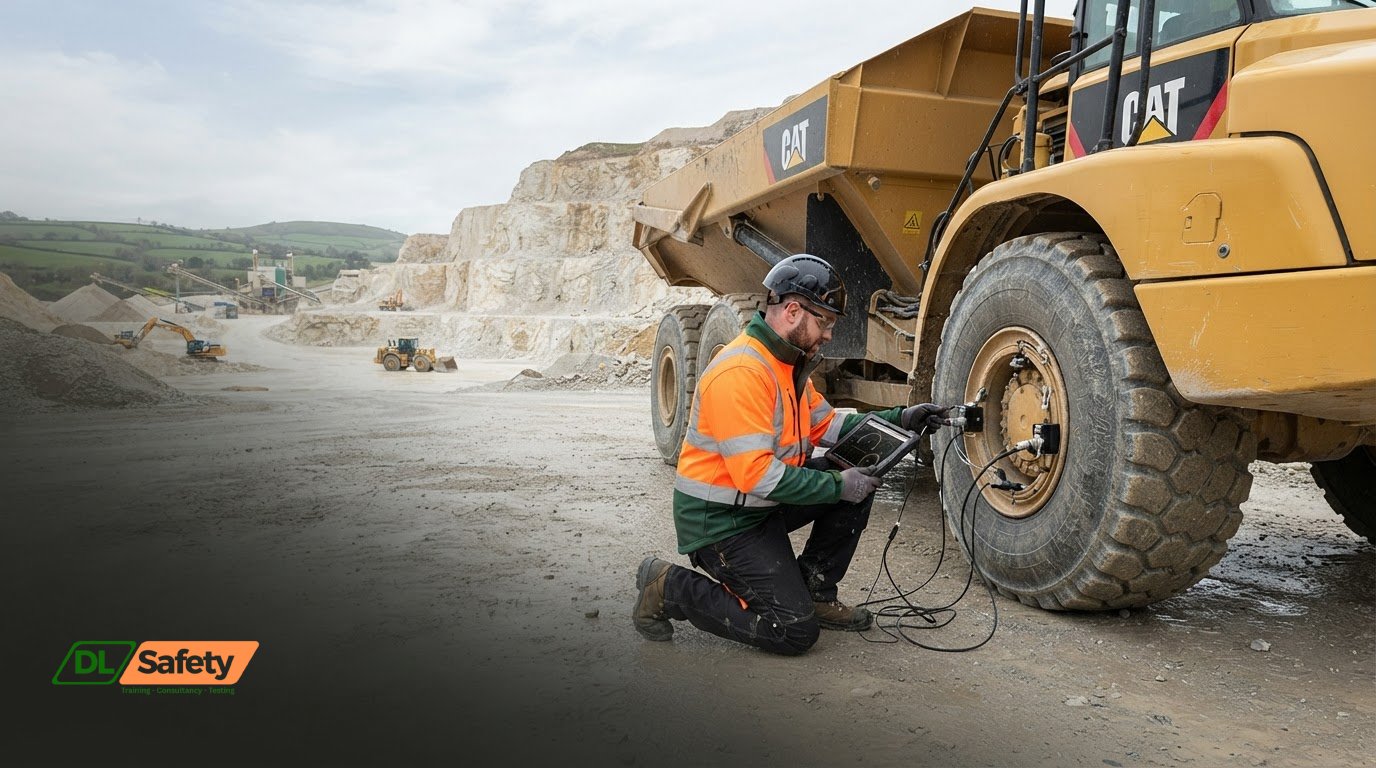
Could a vehicle pass its daily check and still leave gaps in your brake-testing process? Quarry vehicle brake testing requirements can be difficult to interpret when routine operator checks, planned maintenance and formal instrumented tests are treated as if they’re the same thing. They serve different purposes. Keeping them distinct helps you plan testing, respond to defects and maintain useful records.
Clarity starts with deciding which vehicles to include, how to prepare them for testing and what evidence to retain. This guide explains how to approach the process in an Irish quarry without assuming that a routine check replaces a formal test, or that a test report replaces ongoing maintenance. It covers defining scope, coordinating testing with site operations, recording results and following up on issues.
DL Safety provides on-site quarry vehicle brake testing to help managers plan assessments alongside quarry operations. Visit www.dlsafety.ie, email info@dlsafety.ie or call 085 8316885.
Key Takeaways
- Define which vehicles need consideration by looking at their use and the requirements that apply, rather than assuming one blanket rule covers every machine.
- Build a practical process for quarry vehicle brake testing requirements, from agreeing the scope through to reviewing results and recording follow-up actions.
- Keep routine operator checks distinct from formal instrumented testing. Each serves a different purpose in managing vehicle safety.
- Organise records so vehicle details, test results and subsequent maintenance actions can be traced over time.
- Consider on-site testing as a practical way to coordinate brake assessments with quarry operations.
Quarry vehicle brake testing requirements in Ireland: what managers need to establish
Quarry vehicle brake testing is a planned assessment of a machine’s braking performance. It provides objective information to support safety and maintenance decisions. The requirements that apply depend on the vehicle, how it is used and the current Irish rules and guidance. A test result describes performance at the time of testing. It does not replace sound maintenance or safe operation.
Featured snippet definition: Quarry vehicle brake testing measures a vehicle’s braking performance to help assess its condition and inform safety and maintenance decisions.
Which quarry vehicles may need consideration?
Start with an inventory and review vehicles individually rather than assuming one list covers every site. Loading shovels and dumpers are familiar examples, but they are not a definitive statement of legal scope. Consider each machine’s type and role, where it operates, and the conditions it encounters, including gradients, surfaces and routine loads.
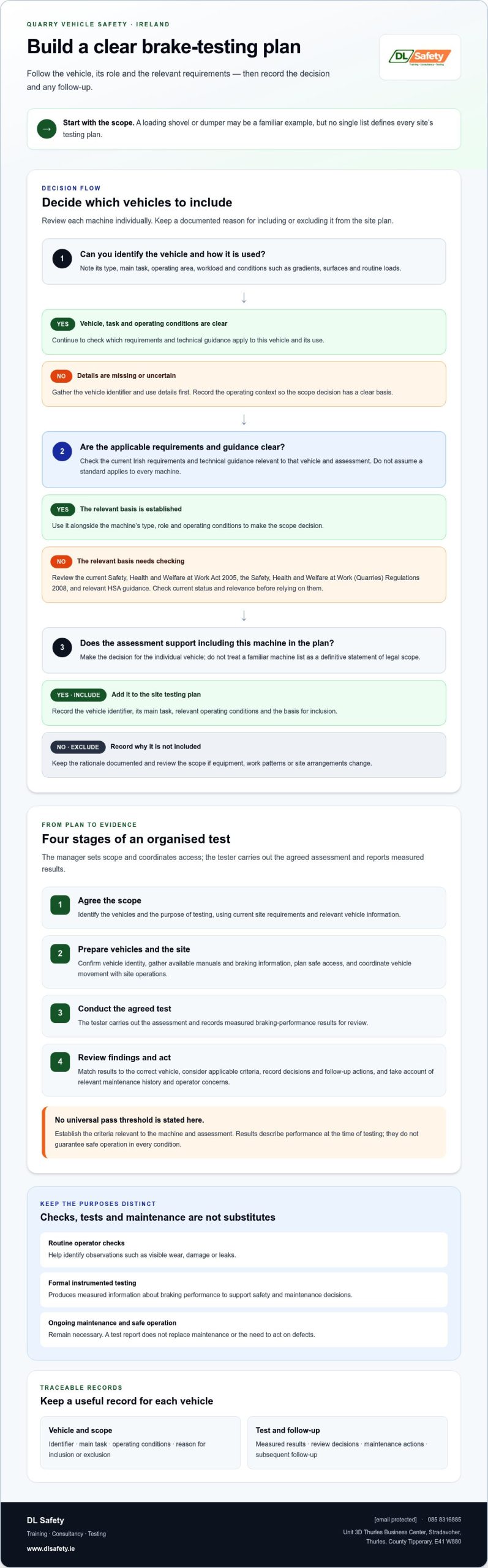
A documented scope review gives managers a clear reason for including or excluding each machine from the site’s testing plan. Record the vehicle identifier, its main task and relevant operating conditions, then note the basis for the decision. This makes the plan easier to review when equipment, work patterns or site arrangements change. The wider setting of quarry operations and safety can help explain why site activities and equipment vary, but it is not a source for Irish testing rules.
- Vehicle and function: identify the machine and the work it performs.
- Use and conditions: consider its operating area, workload and typical surfaces.
- Applicable guidance: establish which current Irish requirements and technical guidance apply to that vehicle and use.
For the regulatory picture, review the current Safety, Health and Welfare at Work Act 2005, the Safety, Health and Welfare at Work (Quarries) Regulations 2008 and relevant Health and Safety Authority (HSA) guidance. Do not assume a standard applies to every machine simply because it appears in general industry material. Check its current status and relevance to the vehicle and test before relying on it.
What does a brake test establish?
An instrumented brake test produces measured results about braking performance. This gives managers evidence to review rather than relying only on a visual impression. The results are distinct from observations such as visible wear, damage or leaks, which may come to light during inspections or maintenance. Each source of information is useful, but neither automatically replaces the other.
Interpret results in context. They relate to the vehicle and conditions assessed, so record them clearly and consider them alongside maintenance history and concerns reported by operators. A measured test can inform decisions, but it does not establish that a machine is safe in every operating condition or remove the need to act on defects. Keeping this distinction clear helps managers assess findings and plan suitable follow-up.
How quarry vehicle brake testing works: from preparation to measured results
A well-organised test involves more than making a vehicle available for assessment. The manager sets the scope, gathers useful vehicle information and coordinates safe access. The tester carries out the agreed assessment and reports the measured results. A clear sequence makes those results easier to interpret and act on.
Instrumented brake testing measures a vehicle’s braking performance and records results for review against applicable criteria. The measurements provide evidence for a decision, not a guarantee that the vehicle is safe in every condition.
- Agree the scope: identify the vehicles to be assessed and the purpose of the testing, using current site requirements and relevant vehicle information.
- Prepare vehicles and the site: gather available details, plan access and coordinate vehicle movement with the people managing site operations.
- Conduct the test: the tester carries out the agreed assessment and records the results.
- Review and act: consider the findings against applicable requirements, then record decisions and follow-up actions.
Preparing vehicles and the site for testing
Make sure each vehicle can be identified clearly before the test. Gather available manuals and braking information, along with details that could help explain the machine’s use or condition. Agree how it will be accessed and moved safely within the site, taking account of operational activity and local arrangements. If a vehicle is unavailable, has a reported defect or presents another preparation issue, record that context so it can be considered when reviewing the results.
Use preparation to resolve practical questions before testing begins. Confirm which vehicles are ready, who will coordinate their movement and how testing fits around site work. Arrangements depend on the site and the agreed scope, so make sure everyone involved understands the plan. Good preparation helps the tester work from reliable vehicle information and reduces the risk of a result being linked to the wrong machine.
Understanding results and follow-up
After testing, match each result to the correct vehicle and review it against the criteria that apply to that machine and assessment. Do not assume there is a universal pass threshold. Establish the relevant requirements and technical criteria for the test in question. If anything is unclear, record the question and how it was resolved.
Test findings can inform maintenance decisions or prompt further investigation, particularly if results raise concern or differ from what the site expected. Record the action, who is responsible and how completion will be tracked. A test result is one part of the vehicle’s safety evidence. It does not replace inspection, maintenance or a decision about whether the machine should continue in use.
DL Safety provides on-site quarry vehicle brake testing to support practical planning around site operations. For information about the service, see on-site quarry vehicle brake testing.
Do daily checks replace formal quarry vehicle brake testing?
No. Routine operator checks and formal instrumented testing serve different purposes. An operator’s observations can flag an apparent problem during everyday use, while a formal test provides measured information about braking performance. Neither should be treated as a substitute for maintenance or for the other activity. Use the current Irish guidance that applies to establish the site’s approach.
This distinction matters when interpreting quarry vehicle brake testing requirements. A vehicle may appear to respond normally during a routine check, but that observation is not the same evidence as measured testing. Equally, a formal test result reflects the assessment at that time. It does not remove the need to monitor vehicle condition or respond to a defect reported later.
| Activity | Purpose | Typical evidence | People involved |
|---|---|---|---|
| Routine operator checks | Notice apparent changes or defects during everyday vehicle use. | Completed site records and reports of concerns, where these form part of site procedures. | Operator, with concerns passed through the site’s reporting process. |
| Instrumented brake testing | Assess braking performance using measured results. | Test report linked to the vehicle and assessment. | Tester and the manager responsible for reviewing findings. |
| Maintenance and repair | Investigate or address identified condition issues. | Maintenance records and details of actions taken. | Relevant maintenance personnel and the person overseeing follow-up. |
Routine operator checks and defect reporting
Routine checks are part of everyday condition monitoring. They help operators notice changes such as unusual brake response or visible damage. Their value depends on timely reporting: an observation can be logged, assessed and passed to the person responsible under site procedures. Follow the site’s own arrangements rather than treating an example checklist or stated frequency as a universal legal rule.
A useful report identifies the vehicle and describes the concern clearly enough for follow-up. If the issue could affect safe use, site procedures should guide the immediate response. A check sheet can show that an observation was made, but it does not measure braking performance in the way an instrumented assessment does.
Instrumented testing and maintenance records
Measured results give managers a basis for review that differs from an operator’s observation. Link each report to the relevant vehicle, record the outcome and note any decision, maintenance action or further investigation—for which specialist providers like International Testing Services Ltd can provide non-destructive testing and detailed inspection solutions. This creates a traceable account of how findings were considered, rather than leaving a test result separate from the work it prompted.
For broader legal context, refer to DL Safety’s quarry brake-testing compliance guide alongside current Irish requirements and HSA guidance. Keep the distinction clear: checks may raise a concern, testing supplies measured evidence, and maintenance records show how the concern was addressed. Together, these controls support a considered review of vehicle condition.
How to organise quarry brake testing records and follow-up actions
A useful record tells a clear story: which vehicle was assessed, what the test found, who reviewed the result and what happened next. This traceability connects test evidence with maintenance decisions, assigned actions and later review.
For a mixed fleet, give each machine a consistent identifier and keep its testing information together, whether records are digital or paper-based. The aim is not to create unnecessary administration. It is to make relevant information easy to retrieve when a manager reviews a vehicle’s history or checks whether an action is complete.
What information should a useful test record capture?
Build each record around the details needed to identify the vehicle, understand the assessment and follow up its findings. Check current Irish rules and relevant guidance for exact information and retention requirements. The fields below are practical prompts, not a statement of a prescribed format.
- Vehicle identification: use the site’s identifier and enough detail to distinguish the machine from others in the fleet.
- Test information: record the date, the assessment undertaken and the person or service that carried it out.
- Results and context: retain the report and relevant information needed to interpret it, such as a preparation issue or vehicle detail.
- Review and response: note who considered the result, the decision made and any action assigned.
- Supporting evidence: link related maintenance records, defect reports or later test information where applicable.
Use a consistent naming system so each record can be found by vehicle identifier as well as by date. Give access to people who need the information for their roles, and make sure the person overseeing the process knows where the current record is held. For digital records, use a controlled location and a clear update process. For paper records, file test results with related actions so the evidence stays together.
Turning a test result into a managed action
A report supports effective follow-up only if someone reviews it and decides what it means for the vehicle. Assign each action to a responsible person or role, describe what needs to happen and set a review point in line with site procedures. Track progress until the action is complete, or document why the plan has changed.
If a result or reported defect raises concern, escalate it through the site’s established safety procedures. Connect the test finding to the maintenance decision, then retain evidence of the work and any subsequent review. This creates continuity between assessment and response rather than leaving an unresolved note in a file.
Clear records can help managers apply the quarry vehicle brake testing requirements relevant to their operation. Check exact obligations against current Irish rules and guidance. DL Safety’s on-site testing can be included in a planned site process. Find details about on-site quarry vehicle brake testing.
Arrange on-site quarry vehicle brake testing with DL Safety
On-site testing can help a quarry organise brake assessments around its fleet and operating arrangements. DL Safety provides on-site quarry vehicle brake testing, supporting managers as they plan the work, coordinate vehicle access and connect test information to the site’s wider safety process. Testing contributes evidence to that process, but it does not promise a particular result or establish compliance on its own.
Before arranging a test, consider which vehicles are in scope and what information will help the assessment. A clear vehicle list and a practical outline of site operations make initial planning more straightforward, especially when machines have different tasks or access needs.
What to prepare before arranging a test
Gather vehicle identifiers and relevant documentation, such as manuals, braking information, previous test records or maintenance notes. These details help link the assessment to the correct machine and provide context for reviewing results. You do not need to resolve every question in advance. A clear summary of what is known and what needs discussion is a useful starting point.
Also outline site access and coordination needs. Explain how vehicles can be made available, who will coordinate their movement and which site arrangements may affect testing. This keeps planning focused on practical details rather than assumptions about how the site operates. If a vehicle has a known issue or is unavailable, include that information in the scope discussion.
Contact DL Safety about on-site testing
Discuss your vehicle scope and operating arrangements with DL Safety when planning on-site quarry vehicle brake testing. Consider the quarry vehicle brake testing requirements relevant to your operation alongside current Irish rules and guidance, rather than relying on a general example. For broader compliance context, refer to the quarry brake-testing guide elsewhere in this article.
Have your vehicle list and available supporting information to hand. This gives the team a practical starting point for discussing how testing can fit with vehicle access and site operations. Contact DL Safety at www.dlsafety.ie, email info@dlsafety.ie or call 085 8316885.
Make your next testing decision part of the plan
Use your next review to turn the quarry vehicle brake testing requirements relevant to your operation into a clear, workable site process. Keep responsibilities visible, record decisions and revisit the plan when vehicle use or site arrangements change. This keeps testing connected to how the quarry works, rather than leaving a report apart from day-to-day safety management.
DL Safety provides on-site quarry vehicle brake testing alongside technical safety testing and audit services. Discussing your vehicle scope and site operations can help you plan how the testing fits into the wider process.
Discuss on-site quarry vehicle brake testing with DL Safety and take the next step towards a more organised testing process. Keep the plan, results and follow-up actions connected as part of your ongoing safety management.
Frequently Asked Questions
What are the requirements for quarry vehicle brake testing in Ireland?
Managers should establish which vehicles are in scope, what testing is appropriate and how findings will be followed up, using current legislation and Health and Safety Authority (HSA) guidance. The quarry vehicle brake testing requirements depend on the equipment and its use, so avoid relying on a generic list or an old interval claim. Review the Safety, Health and Welfare at Work (Quarries) Regulations 2008 and relevant HSA material when setting the site approach.
How often should quarry vehicles undergo brake testing?
Do not choose a testing interval solely from a generic online figure. Set and review the site’s schedule against current Irish requirements and HSA guidance, taking account of the machines and how they are used. Record the basis for the schedule and revisit it if operating patterns, vehicle condition or relevant guidance changes. The person responsible for vehicle safety can review the approach as part of the site’s process.
Can daily vehicle checks replace an instrumented brake test?
No. A driver’s routine check can flag a change such as a brake warning, unusual response or visible leak, but it does not provide measured test results. Record and report concerns through site procedures so they can be assessed promptly. Do not wait for a planned test to report a defect. Daily monitoring and formal testing provide different evidence, and both form part of a managed approach to vehicle safety.
Which vehicles should be included in quarry brake testing?
Start with an inventory of mobile plant used in quarry activities, then assess each machine in context. A loading shovel and a dumper, for example, may have different work cycles, routes and loads, which inform the scope review. Include hired or contractor-operated machines used on site in that review, as well as the regular fleet. Treat examples as prompts, not a complete legal list, and use current Irish guidance to establish scope.
What does an instrumented quarry vehicle brake test measure?
An instrumented test records measured information about a vehicle’s braking performance, rather than relying on a driver’s impression of how it stops. Read the report alongside the vehicle identification and criteria relevant to that machine and assessment. Results can help identify matters for review, but they do not establish how a vehicle will perform in every operating condition or replace inspection and maintenance. Keep these limits in mind when deciding next steps.
What records should a quarry keep after brake testing?
Keep a retrievable record for each vehicle, linking its identifier to the test date, report, reviewer and any resulting maintenance or investigation. Add evidence that an action was completed, or cross-reference it clearly, so an open item is not mistaken for a closed one. Use a consistent naming system across paper or digital files. Check current requirements for the exact records and retention arrangements that apply to your operation.
Can quarry vehicle brake testing be carried out on site?
Yes. DL Safety provides on-site quarry vehicle brake testing. Before arranging it, gather vehicle identifiers and available braking or maintenance documents, then outline site access and coordination needs. This gives the planning discussion a practical starting point and helps fit testing around quarry activity. Review the results and manage any follow-up through the site’s own safety and maintenance processes.