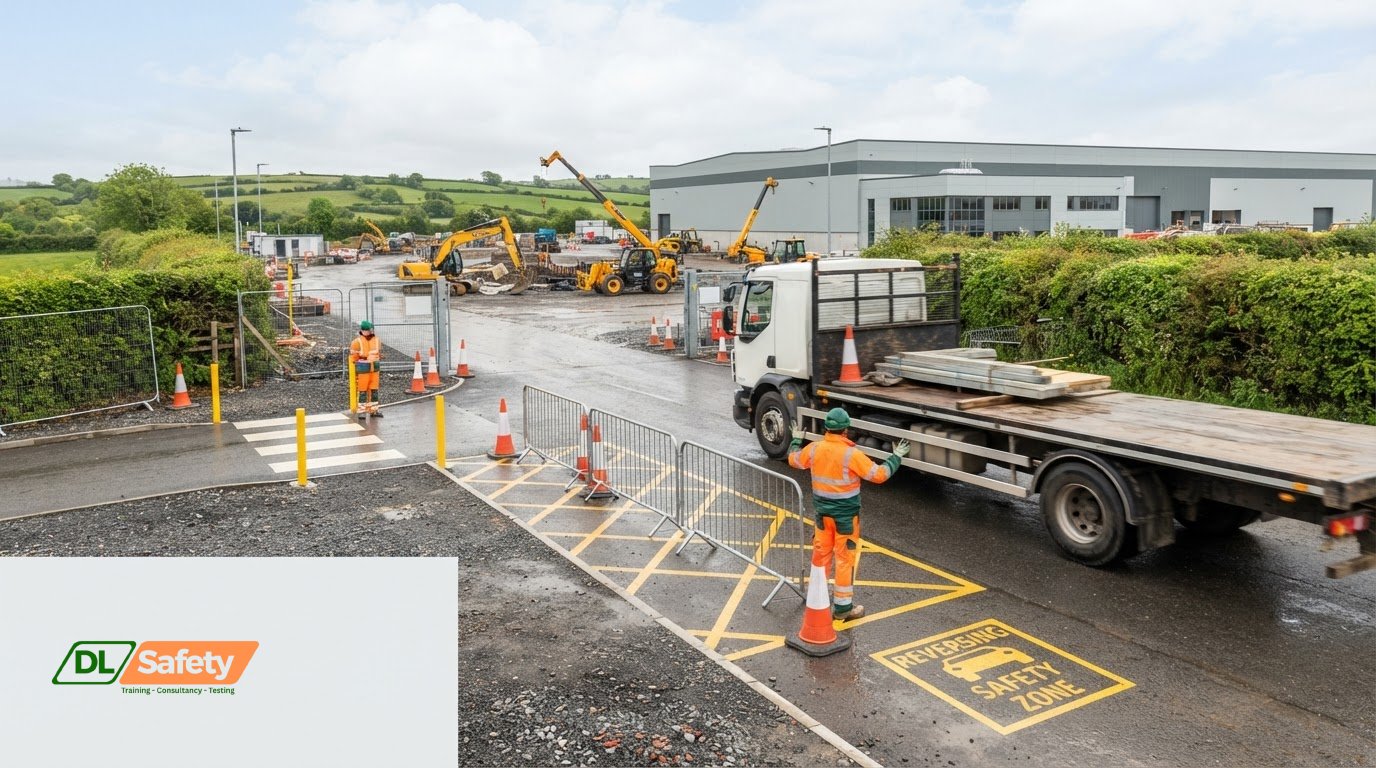
A delivery arrives just as a work phase changes, while pedestrians are still using the same access route. A site traffic management plan Ireland project teams can use must do more than mark vehicle routes: it should coordinate people, vehicles and day-to-day site activity.
It can be difficult to know what to include, particularly when reversing, deliveries and changing conditions affect how the site operates. A practical plan sets out clear arrangements for vehicles and pedestrians, identifies where routes may meet, and explains how changes will be communicated and reviewed.
This guide covers the core parts of a useful plan, ways to organise vehicle movements and deliveries, and how to keep arrangements relevant as work progresses. It also explains how site-specific traffic management design can turn safety planning into workable on-site arrangements.
DL Safety provides traffic management design and health and safety support across Ireland. Visit www.dlsafety.ie, email info@dlsafety.ie or call 085 8316885.
Key Takeaways
- A site traffic management plan Ireland projects can use should reflect the site’s actual layout, access points, work activities and constraints.
- Map how vehicles, pedestrians and deliveries move around the site to identify where routes may conflict.
- Choose traffic controls to suit the movements and conditions on site, rather than relying on a generic checklist.
- Brief workers, visitors and delivery personnel so they understand the arrangements and what to do if routes change.
- Review the plan when the site layout, work phase or movement patterns change, and adjust arrangements where needed.
What is a site traffic management plan, and why does it matter in Ireland?
A site traffic management plan is a site-specific set of arrangements for guiding vehicles, mobile plant, deliveries and pedestrians safely through a work area. Its practical purpose is to make routes and potential points of conflict clear, so people know where to travel, where to expect vehicles and how access is managed as work proceeds.
A plan should reflect what will actually happen on site, not just display a proposed layout. A drawing may show routes, entrances and barriers, but the working plan connects these details to site activities: who uses each route, when deliveries arrive, how vehicles turn or reverse, and what changes when work moves to another phase. It should be clear enough to brief people and useful enough to guide everyday decisions.
Which site movements should the plan consider?
Consider the full range of movement, including cars and vans, delivery vehicles, site vehicles, mobile plant and people travelling on foot. Look for routes that cross or converge, such as a pedestrian walkway meeting a vehicle entrance. Note restricted visibility near corners, stored materials or temporary structures, and check whether those conditions change during different work phases.
- Mark entrances, exits, internal routes and any shared access points.
- Identify crossing points, turning areas, loading locations and places where visibility is limited.
- Consider interfaces with people outside the work area, including passers-by or other site users near an access point.
These details can reveal where a route that looks straightforward on paper may become unclear during a busy delivery or a change in work activity. General traffic-management principles, such as organising routes and managing interactions between road users, are outlined in the Wikipedia article on traffic management. On a work site, adapt those principles to the actual layout and tasks.
Why does a site-specific plan matter?
Sites differ in size, access, layout and work activities, so the same route arrangement won’t suit every project. A confined site with one entrance presents different movement challenges from a larger site with several work areas and changing delivery needs. Account for those conditions rather than relying on a standard diagram.
Unclear arrangements can leave drivers unsure where to go, pedestrians uncertain which routes to use and delivery personnel searching for a safe place to stop or unload. That confusion can disrupt work and create avoidable exposure to risk, particularly where vehicles and people share space. A site-specific plan makes expectations visible and supports coordination between site operations and people approaching or passing the work area.
For projects in Ireland, use a practical test: can the people who use the site understand how movement is meant to work in the conditions they face? DL Safety’s traffic management design considers site-specific movement and interface risks, helping develop arrangements around project needs.
How to develop a site traffic management plan step by step
A useful plan starts with the work as it will actually happen, rather than a standard site diagram. For a site traffic management plan Ireland projects can put into practice, observations of access points, work phases and site constraints should shape every route and control.
Start with the site layout and work activities
Walk the site and compare what you see with any available layout drawings. Mark entrances and exits, internal routes, pedestrian areas, delivery and unloading locations, and restricted or narrow sections. Note where visibility is limited and where vehicle, plant or pedestrian movements could intersect. Let what you observe on site determine what the plan shows and how people will move.
Keep the layout easy to interpret. A simple sketch can show routes with arrows, crossings, loading areas and places where access is restricted. Add a clear key and identify which work phase the sketch represents. Consider how excavation, lifting, material storage or temporary works might occupy space and affect routes. If a route changes between phases, show which arrangement applies at each stage.
Turn identified risks into practical arrangements
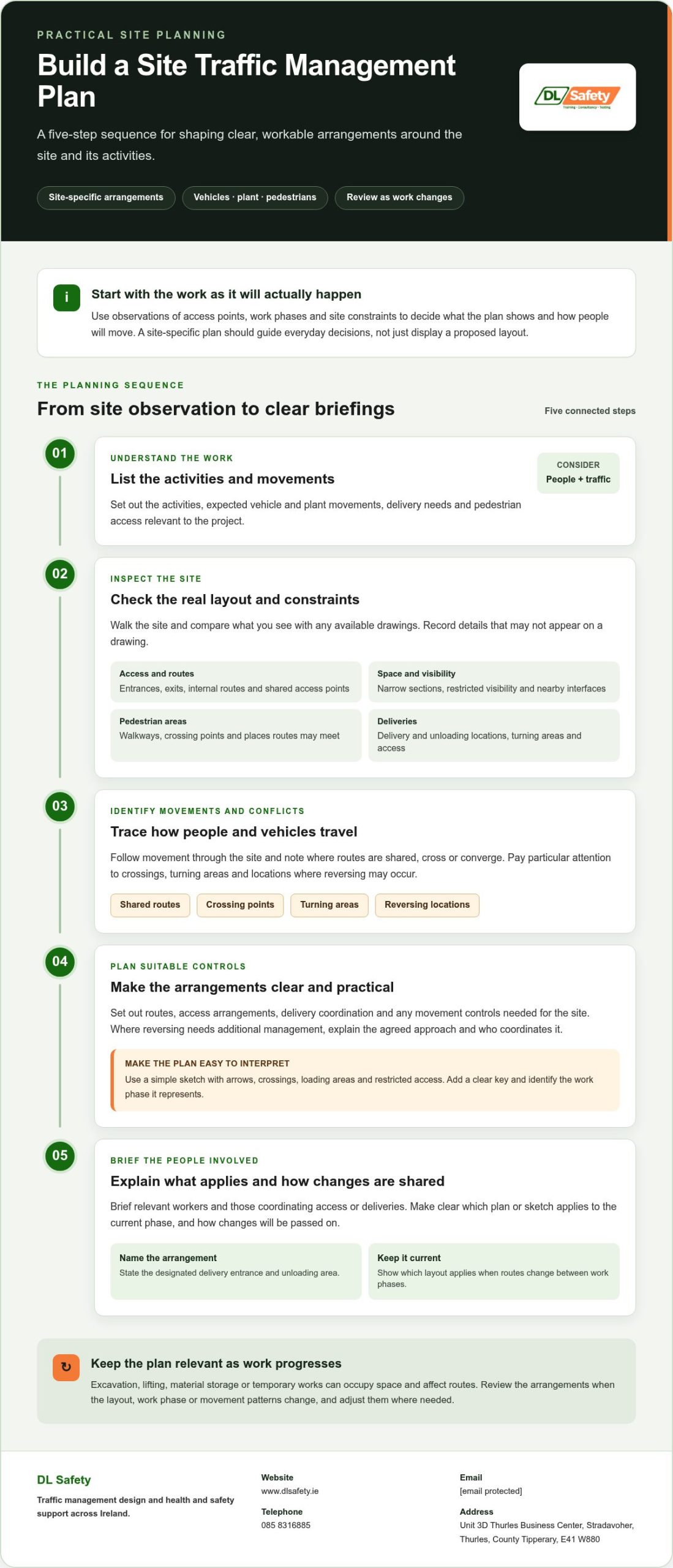
Once you understand the layout, use a clear sequence to develop and communicate the arrangements:
- Understand the work. List the activities, expected vehicle and plant movements, delivery needs and pedestrian access relevant to the project.
- Inspect the site. Check the actual entrances, exits, routes, visibility, space constraints and nearby interfaces. Record details that may not appear on a drawing.
- Identify movements and conflicts. Trace how people and vehicles travel through the site. Pay particular attention to shared routes, crossings, turning areas and locations where reversing may occur.
- Plan suitable controls. Set out routes, access arrangements, delivery coordination and any movement controls needed for the site. Where reversing requires additional management, explain the agreed approach and who coordinates it.
- Brief the people involved. Explain the arrangements to relevant workers and those coordinating access or deliveries. Make clear which plan or sketch applies to the current phase and how changes will be passed on.
Use plain, direct instructions. State the designated delivery entrance and unloading area, for example, rather than relying on a vague note such as “deliveries as agreed”. For reversing, describe the site’s agreed method and identify the coordinating role, without assuming one arrangement suits every project. Allocate responsibilities to appropriate site roles so people understand who communicates updates and oversees the arrangements.
Check the plan against site conditions before putting it into use. If a route shown on the sketch is blocked by a work activity or storage, revise the arrangement and tell the people affected. This practical approach is central to DL Safety’s traffic management design, which develops arrangements around site needs.
Which traffic controls suit your site’s vehicles, pedestrians and deliveries?
The right controls depend on who needs to move, where they need to go and what is happening around them. A site traffic management plan Ireland project teams can use should match controls to observed conditions, not apply the same checklist to every site. A barrier, sign or marked route may help in one location but be impractical or insufficient in another.
Separate pedestrian and vehicle movements where practicable
Designated pedestrian and vehicle routes make expected movements easier to follow. Where the layout allows, physical separation can help keep people away from vehicle paths. Barriers, clear signs or marked walkways can also define routes. Check that crossing points are visible and usable, and review them if work areas or stored materials change sightlines.
Some routes will still intersect. Make crossing points clear and agree how teams will communicate and manage movements there. Match the arrangement to the location and activity rather than assuming signs or barriers alone will resolve every conflict.
Coordinate deliveries, reversing and site access
Plan arrival and unloading arrangements around active work, available space and the route vehicles need to take. Where reversing or restricted visibility makes a movement more complex, specify how it will be coordinated and who communicates with those affected. Consider access for site vehicles, visitors and emergency access when reviewing routes and temporary restrictions.
| Site situation | Planning considerations |
|---|---|
| Pedestrians and vehicles share an area | Consider whether routes can be separated; make any necessary crossings clear and visible. |
| Vehicle routes cross pedestrian paths | Identify the crossing point and agree how movements will be communicated and managed. |
| Deliveries use a busy access route | Set out arrival, access and unloading arrangements that fit around site activity. |
| Reversing or limited visibility is expected | Describe the coordination arrangements and account for people who may be nearby. |
| Work or storage changes the layout | Review whether routes remain clear, visible and suitable for current site movements. |
Use the table as a prompt for assessment, not a ready-made control schedule. A designated crossing may work if it remains visible and clear, but a layout change could make it unsuitable. Delivery timing can reduce overlap with busy site activity, but timing alone does not address every access or reversing concern.
Record the selected arrangements in plain language and make sure the people affected understand them. An effective control fits the site, can be followed during the relevant work phase and can be adjusted when conditions change. DL Safety’s traffic management design considers these movement interfaces when developing arrangements for a project.
How to brief workers and review the plan as site conditions change
A plan only helps if people can understand and follow it. A site traffic management plan Ireland teams rely on needs to be communicated in ways that suit the people using the site, including workers, new starters, visitors and delivery personnel. Briefing is not a one-off task: information must stay clear when arrangements change.
Make routes and responsibilities understandable
Use a current site plan alongside plain-English instructions. Point out the routes people should use, any access restrictions and who to speak to if the arrangements are unclear. Signs can reinforce key directions at decision points, but should not be expected to explain complex arrangements on their own. Keep messages practical and relevant to each person’s activities.
Consider how people will receive the information. Workers may be briefed during site induction or a task briefing; visitors and delivery personnel may need a concise explanation before entering the work area. A named site contact gives people a clear way to raise concerns, such as a route that is blocked or difficult to follow. Treat this feedback as useful evidence of how the arrangements work in practice.
- Show people the relevant route on the current site plan, rather than relying on verbal directions alone.
- Explain any temporary restrictions and the alternative route or access arrangement.
- Make clear how to report an unclear instruction, unexpected obstruction or movement conflict.
Keep briefings proportionate. A visitor may need to know how to reach a meeting point and which areas to avoid, while workers carrying out a specific activity may need a fuller explanation of how their movements fit with nearby operations. Give delivery personnel instructions about arrival, access and unloading before those movements begin.
Review the plan when the site changes
Set a practical review routine and revisit the arrangements whenever there is a meaningful change. A new work phase, shifted storage area, altered access point or different traffic pattern can affect how people move. Observations during site activity and reports from workers or drivers can also reveal that a route is confusing, obstructed or no longer workable.
When a review identifies a change, update the plan and any associated sketch or signs so they match the current arrangement. Note what has changed and share the revised information with the people affected. Remove superseded versions from circulation so they cannot be mistaken for the current plan. This simple document control helps keep briefings aligned with site conditions.
Structure the plan around the information people need to use: the current layout, routes, access and unloading arrangements, relevant controls, responsibilities and how updates will be shared. A project’s own assessment and ongoing reviews determine what the plan needs to say.
If you need practical support developing arrangements around your site’s movement and communication needs, discuss traffic management design with DL Safety.
Getting practical traffic management design support from DL Safety
Some projects are straightforward to organise; others involve several vehicle types, pedestrian routes, deliveries and work areas that change over time. Where those movements overlap or access is constrained, design support can help the team consider how the arrangements fit together before they are put into practice. A useful site traffic management plan Ireland project teams can work with makes intended routes and interfaces clear in the context of the actual site.
When can design support help a site team?
Design support can help when a layout has multiple access points, several movement types or limited space for vehicles and pedestrians. It is also useful where excavation, lifting, storage or a new work phase affects the routes people have been using. The task is not simply to draw lines on a plan, but to consider how proposed arrangements will work alongside site activities and the people who need to use them.
A considered design helps teams communicate intended routes, access arrangements and movement interfaces in a way that reflects project needs. For example, a plan may need to account for delivery access near active work or explain how a temporary layout change affects a pedestrian route. The appropriate approach depends on the site and its activities; no single arrangement suits every project.
DL Safety provides traffic management design, bringing practical safety expertise to the development of site-relevant arrangements. This support helps project teams consider the movement picture and communicate the intended approach clearly, without treating a generic layout as a substitute for assessing site conditions.
How to take the next step with DL Safety
If your project has complex routes, changing work phases or movement interfaces that are difficult to coordinate, start by setting out the site’s needs. Outline the work, the access arrangements and the traffic-planning challenges the team is working through. This gives the discussion a practical focus: how the intended arrangements relate to the site and the people who use it.
To discuss your project, Discuss traffic management design with DL Safety. You can also email info@dlsafety.ie or call 085 8316885.
For further information, visit www.dlsafety.ie.
Make your next site movement decision a considered one
Start by identifying the point where your site’s movement arrangements feel least clear. It might be an access route that gets busy, a delivery that interrupts other work or a planned change that will affect how people move. Use that practical concern to focus the team’s attention and decide whether the current arrangements still fit.
Keep the plan connected to the way work is carried out. As the project develops, clear communication and timely review can help prevent yesterday’s layout from being treated as today’s instruction. That is the difference between a document kept on file and a site traffic management plan Ireland teams can use as work progresses.
To address your project’s traffic arrangements, discuss traffic management design support with DL Safety and start a practical conversation about your site’s needs.
With thoughtful planning and a willingness to adapt, your team can make site movement clearer and respond to changing conditions with greater confidence.
Frequently Asked Questions
What should a site traffic management plan include?
A site traffic management plan should set out the movement arrangements relevant to the project, including vehicle and pedestrian routes, access points, delivery arrangements, crossings and how changes or instructions will be communicated. For a site traffic management plan Ireland teams can use, the detail should reflect the activities and actual layout, not simply reproduce a generic document. Treat these points as planning prompts, not a definitive legal checklist, and verify applicable requirements using current Irish guidance.
Who is responsible for preparing a site traffic management plan in Ireland?
Responsibility depends on how the project is organised and which site roles have been assigned coordination tasks. Make ownership clear by identifying who gathers information about the layout and work activities, who coordinates the plan and who passes updates to the people affected. A short discussion between relevant project and site personnel can clarify these roles early, helping prevent gaps between the plan on paper and the arrangements being used on site.
How often should a site traffic management plan be reviewed?
Review the plan when a work phase, access point, site layout or traffic pattern changes, or when observations suggest the arrangements are not working as intended. For example, recurring congestion at an entrance may show that the current access instructions need reconsideration. There is no fixed review interval suggested here. If an update affects routes or instructions, communicate the revised arrangements to the people who use them before relying on the change.
Does a small construction site need a traffic management plan?
A small site still needs its vehicle, pedestrian, delivery and access movements to be considered together. A confined work area, for example, may have little room to separate an entrance used by workers from one used by delivery vehicles. The amount of detail should suit the activities and risks. Do not assume a written plan is or is not compulsory based on size alone; check current Irish guidance for specific obligations.
How can a site manage deliveries safely?
Plan delivery arrangements around the site’s access and active work. Before a vehicle arrives, make the intended entrance, route and unloading location clear, and consider whether the delivery could coincide with other movements in a constrained area. Share practical access instructions with delivery personnel, including where to go if the expected route or unloading area is unavailable. The right approach depends on the layout and schedule, so assess each site rather than applying one method universally.
What should happen if the site layout changes after the plan is prepared?
Review the parts of the plan affected by a change to access, work phases, storage or routes. For example, new storage beside a walkway may affect the route people can use or what drivers can see. Record the practical update, amend relevant drawings or instructions, and brief affected people before relying on revised arrangements. Remove superseded copies from circulation so they cannot be mistaken for the current plan and everyone is working from consistent information.