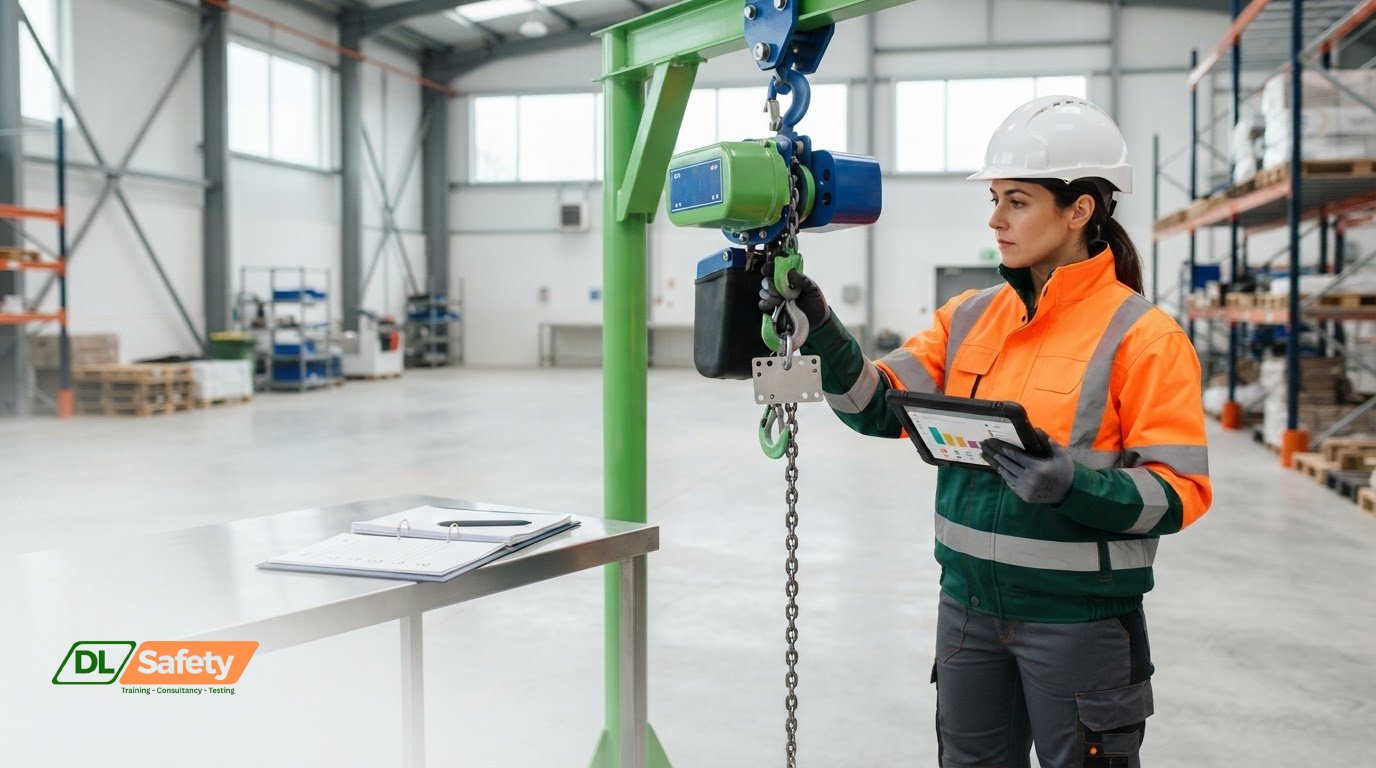
What if the word “certified” isn’t enough to show whether an inspector is right for your lifting equipment? Finding a certified GA1 inspector in Ireland can feel uncertain, particularly when there’s no official government-maintained register to settle the question. The practical test is evidence: relevant knowledge, hands-on experience with your equipment and a clear, useful examination report.
Different lifting equipment calls for different experience, and an unclear report can make it harder to organise inspection records and plan follow-up. A label on its own doesn’t answer those questions.
This guide explains how to assess an inspector’s competence, match their experience to the equipment you use and prepare the right information before arranging GA1 testing. You’ll also learn what a clear report should record, so you can approach the examination with greater confidence and keep your equipment documentation in order.
Key Takeaways
- For finding a certified GA1 inspector, look beyond the label and consider evidence of relevant competence and experience.
- Match the inspector’s practical experience to the equipment and examination task you need covered.
- Compare the examination scope, how findings and follow-up are reported, and how communication is handled.
- Prepare equipment identification, previous reports, usage details and access arrangements before booking to help the examination run smoothly.
- DL Safety provides GA1 testing to help businesses plan examinations and maintain organised equipment records.
Finding a certified GA1 inspector: what should you look for?
Keeping inspection records organised matters, but so does having confidence in the person carrying out the examination. A report may be neatly filed yet leave important questions if the inspector’s experience doesn’t match the equipment or the findings aren’t clearly explained. When finding a certified GA1 inspector, focus on evidence of competence and a well-defined examination, rather than relying on a title alone.
A GA1 is a report of thorough examination for lifting equipment. In Ireland, the requirement sits within the Safety, Health and Welfare at Work (General Application) Regulations. This section focuses on choosing an inspector. The separate GA1 testing information provides broader service details, while statutory requirements should be checked against current Irish sources. The Health and Safety Authority (HSA) is Ireland’s workplace health and safety regulator.
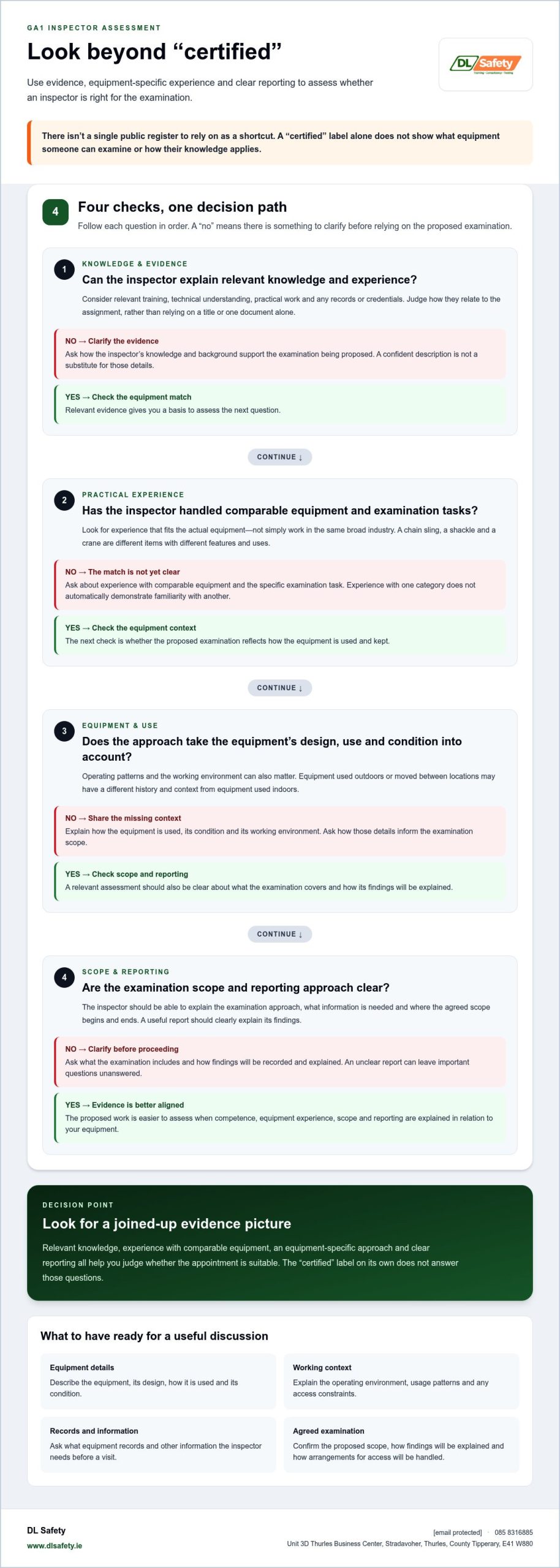
Use four practical tests to guide your decision: relevant competence, a fit between the inspector’s experience and your equipment, clear reporting, and straightforward arrangements for scope and access. Together, these help you judge whether the appointment is suitable before the examination begins.
What does “certified GA1 inspector” mean in practice?
“Certified” can be used as a provider’s description, but the label alone doesn’t show what equipment the person can examine or how their knowledge applies to the task. Rather than treating it as proof, look for relevant technical knowledge, practical experience and a clear explanation of the proposed examination scope. There isn’t a single public register to rely on as a shortcut, so assess the evidence in relation to your equipment and its intended use.
Which businesses need an equipment-specific approach?
Construction and industrial workplaces can both use lifting equipment, but their inventories and working conditions may differ. One site might rely on lifting accessories such as chains or shackles; another may use machinery as part of regular production or material handling. Even businesses in the same sector can have different equipment, operating patterns and access constraints, so frame the appointment around the actual items on site.
Equipment type is only part of the picture. How it’s used, its condition and the environment in which it operates can all inform what the examination needs to address. For instance, equipment that works outdoors or is moved between locations may have a different history and context from an item used in a controlled indoor setting. Sharing those details helps make the scope more relevant and the resulting report more useful.
A competent person is someone with the practical and theoretical knowledge and experience to identify defects and judge their significance, while acting with sufficient independence and impartiality. This description captures why equipment-specific experience matters: the inspector needs to recognise issues relevant to the task, not simply complete a form. With these criteria in mind, you can compare the evidence, scope and reporting approach in the next step.
How to assess a GA1 inspector’s competence and experience
A useful assessment goes beyond asking whether someone is “certified”. Look for evidence that relates to the examination you need, then consider whether the inspector can explain the proposed scope in plain terms. Training records, work history and sample reporting can all help you build a picture, but none should be treated as automatic proof of suitability or as a universal qualification requirement.
Evidence that helps demonstrate relevant competence
Evidence is most useful when it connects technical knowledge with practical inspection work. Consider the details together, rather than relying on one document or title:
- Relevant training: Ask what learning or instruction relates to lifting equipment examination and how it supports the work being proposed.
- Technical understanding: Look for an ability to explain how the equipment’s design, use and condition inform the examination.
- Practical experience: Consider whether the inspector has handled comparable equipment and examination tasks, not simply worked in the same broad industry.
- Records or credentials: These may help demonstrate a person’s background, but their relevance depends on what they cover and how they relate to the assignment.
A capable inspector should be able to describe the examination approach, the information they need and where the agreed scope begins and ends. Clear explanations help you understand what the appointment covers and make it easier to provide useful equipment records before a visit. A confident sales description isn’t a substitute for those details.
Credential and legal requirements can change or depend on the specific circumstances. Verify any claimed formal requirement, qualification or recognised scheme against current Irish sources before relying on it. The aim isn’t to create a checklist of certificates that applies to every situation, but to establish whether the person’s knowledge and experience are appropriate for the work.
Why equipment-specific experience matters
Lifting equipment varies in construction and function. A chain sling, a shackle and a crane are not interchangeable items; each has different features, uses and potential points of concern. Experience with one category may be relevant, but it doesn’t automatically demonstrate familiarity with another or with every examination task.
Familiarity with the equipment helps an inspector focus the examination on its design, use and condition, making the assessment more meaningful. For example, the information that helps explain how a lifting accessory is used may differ from what’s needed to understand a machine used to lift or move loads. Share equipment identification, available instructions and previous examination reports so the proposed scope can be discussed with context.
Before scheduling, agree which items are included, what examination is intended and what information or access will be needed. If your inventory includes several equipment types, group them clearly rather than assuming one description covers everything. This preparation helps establish a shared understanding before the appointment and supports clearer records afterwards.
DL Safety provides GA1 testing for construction and industrial businesses. If you’re organising an examination, GA1 testing support can be part of a practical plan for defining the scope and keeping equipment records in order.
Comparing GA1 inspectors: reporting, scope, and service fit
A useful comparison looks past labels and headline claims to the details of the work: what equipment is included, how the examination is documented and how findings are communicated. This makes finding a certified GA1 inspector a more practical decision, because you can compare what each proposed service will deliver against your site’s needs.
Use the framework below to organise your assessment. It’s a guide to service fit, not a substitute for checking formal requirements against current Irish sources.
| What to compare | What to look for |
|---|---|
| Relevant competence | Evidence of knowledge and practical experience connected to the examination and equipment involved. |
| Equipment scope | A clear description of which items are included, so the agreed work matches your inventory. |
| Reporting | A legible record that identifies the examined equipment, presents findings clearly and explains any follow-up indicated. |
| Communication | Plain explanations of the examination process, the agreed scope and how findings will be shared. |
| Scheduling | Practical arrangements that account for equipment access, site operations and the information needed before the examination. |
What should a clear GA1 report help you understand?
A report should let the people responsible for equipment records identify what was examined and understand the outcome without having to interpret vague notes. Check that equipment identification and findings are easy to follow, and that any required follow-up is clear. The specific information a report must contain depends on current requirements, so verify formal content against authoritative Irish sources rather than assuming every template is sufficient.
Clear records help a site team connect a finding to the correct item, assign follow-up and retain examination information in an organised way. A report is an important record, but it doesn’t by itself guarantee that equipment is safe or that every compliance responsibility has been met. Findings need appropriate attention, and records should sit within the business’s wider safety processes.
How do you compare service fit without relying on labels?
Start with your equipment list and operating context. A service scope that names the equipment to be examined is easier to assess than a general promise to inspect “all lifting equipment”. For example, if your inventory includes both accessories and machinery, the scope should make clear how each is addressed. Also distinguish the examination and report from separate work such as repairs, routine maintenance or equipment supply. These are different activities and shouldn’t be assumed to form part of a GA1 examination.
Consider the whole working arrangement: how access will be organised, what information should be ready, how findings will reach the relevant person and how records will be filed. Clear communication before the examination can prevent uncertainty about what’s included. Readable reporting afterwards helps keep actions visible.
DL Safety provides GA1 testing for construction and industrial businesses in Ireland. The service offers a practical route to arranging an examination around a defined scope and maintaining organised equipment records, with clear reporting and follow-up in view.
Preparing to appoint a GA1 inspector: a practical checklist
A little preparation can make the appointment clearer and help the examination fit the way your workplace operates. Use this sequence to move from an equipment inventory to a filed report, without assuming that every site needs the same arrangements.
Information to gather before arranging the examination
Before discussing the scope, bring together what you know about the equipment. Separate confirmed details from assumptions, so the examination can be planned around reliable information and uncertainties can be assessed appropriately.
- 1. Create an inventory. Record equipment descriptions and identification details, such as a serial or asset number where available. Note each item’s location within the workplace.
- 2. Collect existing records. Gather previous examination reports and relevant equipment documentation. If a record is missing or unclear, mark that as unknown rather than filling the gap with a guess.
- 3. Describe the operating context. Note how each item is used, where it operates and any known changes or concerns. Keep observations distinct from conclusions about condition.
- 4. Identify access arrangements. Consider where equipment is kept, how the inspector can reach it and whether a site contact needs to coordinate access around work activities.
- 5. Agree the scope and timing. Discuss which items are included, what information is available and how the appointment can be arranged around site requirements. Plan timing with operations in mind, without relying on assumed lead times.
What to do with findings after the examination
Once you receive the report, file it against the relevant equipment records and make sure the appropriate people can find it. If findings or follow-up actions are recorded, enter them into your normal safety process, assign responsibility and track progress in line with your organisation’s procedures. Don’t infer that a particular result automatically allows or prevents use; interpret findings through the applicable requirements and competent advice.
For broader background on Irish GA1 requirements and examination cycles, consult the GA1 testing guide. Keeping that explanation separate from your site’s own action tracking helps teams distinguish general guidance from equipment-specific findings.
Where DL Safety fits into the appointment process
DL Safety provides GA1 testing for construction and industrial businesses in Ireland. A prepared inventory, available reports and clear access details give the appointment a practical starting point, while an agreed scope helps keep the examination and resulting records focused on your equipment.
Once you’ve gathered the information, discuss your GA1 testing requirements with DL Safety. If your organisation also needs continuing help to keep safety processes and records organised, ongoing safety support can provide relevant context beyond a single examination.
Arrange GA1 testing with DL Safety
A sound appointment starts with a defined scope, relevant competence for the examination, clear reporting and a plan for handling follow-up. Those are the practical points to keep in view when finding a certified GA1 inspector. DL Safety provides GA1 testing for construction and industrial businesses, supporting a clear route from discussing your equipment to arranging testing and keeping the resulting records organised.
What happens when you contact DL Safety about GA1 testing?
Start by describing the equipment you need examined and the support you’re looking for. An inventory or a short list of equipment types is useful. Include identification details, existing reports, how the equipment is used and where it is located. If some information is unavailable, say so rather than making assumptions.
Share practical considerations that may affect access or coordination, such as where the equipment is kept or how the site contact can help arrange access. These details help frame a practical discussion about the testing requirement and the scope to be considered. They also make it easier to distinguish what’s already known from points that may need to be assessed as part of the examination.
Before making arrangements, keep your priorities clear: which equipment you want included, what records you have, how the findings will be documented and who in your organisation will manage follow-up. The specific arrangements can then be discussed in context, without relying on assumed prices, lead times or guarantees.
Make the next step straightforward
DL Safety’s GA1 testing service gives businesses a direct way to discuss examination support. Having your equipment information and site arrangements to hand can make that conversation more focused, while a clear understanding of scope and reporting helps you plan how records will be filed and findings handled.
Use the contact details below to reach DL Safety.
Website: www.dlsafety.ie
Email: info@dlsafety.ie
Telephone: 085 8316885
Describe the equipment and examination support you need, and take the next step towards a clearly scoped GA1 testing appointment. Contact DL Safety about GA1 testing.
Make your next inspection easier to manage
Turn your selection into a clear plan by deciding who in your organisation will coordinate access, receive the report and track any actions. That way, important details are less likely to get lost between the examination and day-to-day operations. A named point of contact can also help keep equipment records connected as your inventory or site arrangements change.
Finding a certified GA1 inspector is less about choosing the strongest-sounding label and more about making an informed appointment that fits your equipment and workplace. Keep the equipment information you’ve gathered together and use it to start a focused conversation about the testing support you need.
DL Safety provides GA1 testing as a specialist technical safety service. If you’re ready to discuss your requirements, contact DL Safety about GA1 testing. A clear starting point can make the next step straightforward and help you manage your equipment records with greater confidence.
Frequently Asked Questions
Does a GA1 inspector need to be certified in Ireland?
The key requirement is that the examination is carried out by a competent person; the word “certified” alone doesn’t establish that. Ireland doesn’t have an official government-maintained register of GA1 inspectors, so employers need to consider the person’s suitability for the examination. If someone refers to a particular qualification or certification scheme, check what it covers and verify any formal requirement against current Irish sources before relying on it.
How can I check whether a GA1 inspector is competent?
Ask for an explanation of how their background relates to the equipment and examination you need, then consider whether the answer is specific and clear. When finding a certified GA1 inspector, you might also review relevant training records, examples of previous work or a suitably redacted report. These are indicators to assess, not automatic proof; the important question is whether the evidence supports the proposed examination scope.
Can one GA1 inspector examine every type of lifting equipment?
Don’t assume that experience with one type of equipment automatically covers every other type. A lifting chain, a shackle and a crane differ in design and function, so relevant familiarity should match the items and examination task in question. For a mixed inventory, identify the equipment categories individually and clarify how the proposed scope addresses them. Check any formal competence requirements against current Irish sources.
What information should a GA1 report include?
A report should identify the equipment examined, state its safe working load (SWL), record the examination date, note defects found and be signed by the competent person. These details help connect a finding to the right item and make the document easier to file and retrieve. The HSA provides a template, but reports can use other formats; verify the current formal requirements rather than relying on appearance alone.
How often should I arrange a GA1 examination?
Under the intervals set out in the Irish requirements, lifting accessories and equipment used to lift people are examined at least every six months. Other lifting equipment is generally examined at least every twelve months. The correct interval depends on the equipment category and applicable circumstances, so don’t apply one cycle to an entire mixed inventory without checking. Confirm the current requirements and keep examination dates visible in your records.
Is a GA1 report the same as a maintenance certificate?
No. A GA1 report records the outcome of a thorough examination by a competent person; maintenance records relate to servicing or repair work. They serve different purposes, so one shouldn’t be filed as a substitute for the other. For example, a maintenance note showing that a component was adjusted doesn’t, by itself, document a thorough examination. Keep both types of records where relevant and make their purpose clear in your files.
Can DL Safety provide GA1 testing for businesses across Ireland?
Yes. DL Safety provides GA1 testing for construction and industrial businesses, serving customers nationally across Ireland. If you’re planning an examination, have a list of the equipment and any existing reports ready to help explain what support you need. Equipment identification and workplace access arrangements can make the initial discussion more focused. The examination scope should be considered in relation to the equipment and information available. Contact DL Safety to discuss GA1 testing.