

What if your safety system looks complete on paper but doesn’t change what happens at work? A safety management system Ireland-based organisations can rely on connects responsibilities, risk controls, training and records to everyday decisions, rather than leaving documents unused in a folder.
It can be difficult to coordinate all the moving parts. A written safety statement is important, but it needs to reflect workplace risks and support practical action. In Ireland, the Safety, Health and Welfare at Work Act 2005 requires employers to prepare a written safety statement based on risk assessment.
This guide explains what a safety management system does, which elements help it work in practice, and how to implement, monitor and improve it. It also covers how to keep the focus on preventing harm rather than producing paperwork, and when external safety support may strengthen your organisation’s internal capability.
Key Takeaways
- See how a safety management system connects policy, responsibilities and risk controls, rather than relying on a single document.
- Learn which elements can help shape a safety management system Ireland organisations can put into practice.
- Use the Plan-Do-Check-Act cycle to organise safety activity and identify practical evidence of how it is working.
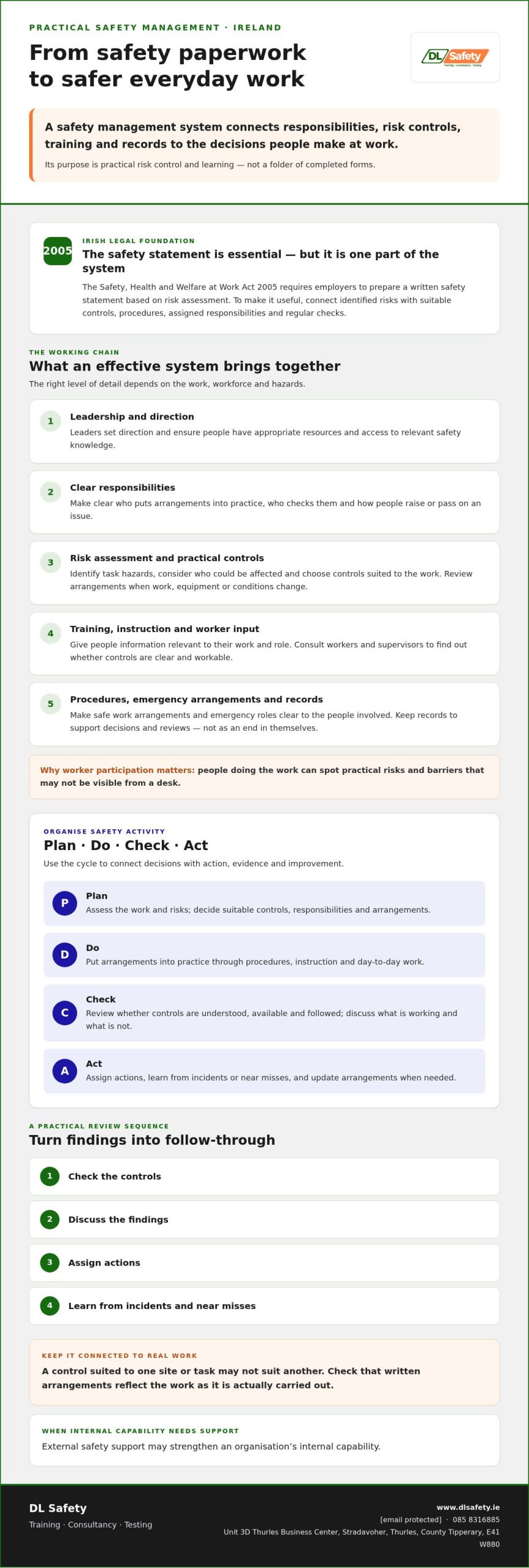
- Follow a clear review sequence: check controls, discuss findings, assign actions and learn from incidents or near misses.
- Understand when external safety support could strengthen your team’s internal capability.
What is a Safety Management System in Ireland?
A safety management system is the organised way a business identifies workplace risks, chooses controls, assigns responsibility and checks whether its arrangements work. It brings policies, procedures and review together, helping people connect management decisions with the work carried out each day. The general concept is also outlined in this Occupational safety and health management system overview.
An active safety management system is the routine that turns safety decisions into consistent action, not a folder of completed forms. For a safety management system Ireland businesses can use in practice, arrangements should reflect the organisation’s activities, workforce and hazards. They also need to be reconsidered when work, equipment or conditions change. A control suited to one site or task may not suit another.
How does a safety management system differ from a safety statement?
A safety statement is an important document, but it is only one part of the wider management approach. Ireland’s Safety, Health and Welfare at Work Act 2005 requires employers to prepare a written safety statement based on risk assessment. To put that statement into practice, connect identified risks with suitable controls, procedures, assigned responsibilities and a process for checking whether the arrangements remain relevant.
A document on its own cannot show whether a control is understood, available or followed during the work. Review and follow-up help keep written arrangements connected to actual tasks, especially when work methods, equipment or hazards change.
Who needs a system, and what should it help them do?
Owners and managers need a clear view of priorities and responsibilities. Supervisors need to know how decisions apply at work, while workers need to understand the controls relevant to their tasks and how to raise concerns. This connection is particularly important in construction and industrial settings, where planned work and conditions on the ground can differ.
A useful system makes clear what each person is responsible for, what action to take and how to raise or pass on an issue. Its value lies in supporting practical risk control and learning, not in producing the largest volume of paperwork. Records should help people make and review decisions, rather than become an end in themselves.
What should an effective Irish safety management system include?
There is no single checklist that suits every organisation. An effective system connects leadership, worker involvement, clear responsibilities and practical controls. The right level of detail depends on the work, workforce and hazards involved. The Health and Safety Authority guidelines provide an Irish reference point for the elements of a safety and health management system.
Think of these elements as a working chain. Leaders set direction and make sure people have appropriate resources and access to relevant safety knowledge. Responsibilities clarify who puts arrangements into practice and who checks them. Workers contribute practical knowledge of the tasks, helping identify where a planned control may be unclear or difficult to follow.
Worker participation makes controls more relevant because the people doing the work can identify practical risks and barriers that may not be visible from a desk. Give people a clear way to raise concerns, and ensure those concerns inform decisions.
How do risk assessment and safe work arrangements fit together?
Start with the work as it is actually carried out. Identify the hazards associated with the task, consider who could be affected, then select controls suited to the risks. For example, excavation work may require task-specific arrangements that explain the sequence of work and how risks will be controlled. A method statement can communicate those arrangements to the people involved, provided it reflects the job as planned and is reviewed if conditions change.
Controls also need to account for the materials and substances used. Where chemical risks are relevant, organisations can use a construction risk assessment guide as a starting point for considering them. Link emergency planning to credible workplace scenarios, and make roles and arrangements clear to those who may need to act.
How should responsibilities, training and consultation connect?
People need to know what they are expected to do, where to find suitable information and when to seek help. Training and instruction should be relevant to the work and each person’s role. An attendance record is less useful than checking whether people understand the controls and can apply them.
Consultation helps managers test whether procedures make sense in practice. Ask workers and supervisors what makes a control difficult to follow, whether equipment or conditions have changed, and what would make an arrangement clearer. Their feedback can guide focused improvements instead of adding paperwork for its own sake.
When internal teams need additional capacity, DL Safety’s safety support may be one option to explore. External input can complement internal knowledge, while the organisation remains responsible for its own decisions and arrangements.
How does an Irish safety management system work in everyday operations?
A safety management system is useful when it guides routine decisions, not just formal reviews. Plan-Do-Check-Act (PDCA) offers a practical way to organise this cycle. It is a framework for managing and improving work, not a replacement for checking which legal and other requirements apply to your organisation. For broader context, see this Irish health and safety compliance explainer.
What does Plan-Do-Check-Act look like at work?
Use the questions and examples below to connect each stage with real tasks. Evidence should help you understand whether arrangements work, rather than exist simply to fill a file.
| Stage | Practical question | Possible evidence |
|---|---|---|
| Plan | What could cause harm during this work, and who is responsible for the controls? | Risk assessments, assigned responsibilities, task plans and identified resources. |
| Do | Have the arrangements been explained and put into practice? | Relevant instructions, briefings, completed checks and observations of work. |
| Check | Are the controls suitable and being followed as intended? | Audit findings, inspection notes, worker feedback and incident or near-miss records. |
| Act | What needs to change, who will do it, and has the change been followed up? | Assigned actions, revised arrangements and follow-up records. |
Consider an industrial task planned around a particular piece of equipment. If the equipment, work area or sequence changes, the original controls may no longer fit. The team should pause to assess the changed conditions, communicate any revised arrangements and check that people understand them. The same principle applies on a construction site when work interfaces or site conditions shift.
How should contractors, incidents and changing risks be handled?
When contractors or separate teams share a work area, coordination helps clarify responsibilities and how the work connects. Agree who communicates changes, which controls affect more than one team and how concerns should be raised. This helps prevent one group from relying on an arrangement another group does not know about.
When an incident or near miss occurs, record what happened and look beyond the immediate event. Consider relevant contributing factors, such as the task plan, equipment, communication or work conditions. Then decide whether controls or instructions need attention. Follow up actions to check they have been completed and remain useful.
For additional support connecting documentation, site audits and ongoing oversight, explore DL Safety’s safety support.
How can you monitor and improve a safety management system?
Monitoring helps turn a documented safety management system into something managers can test against real work. Keep the review focused: check the controls, gather evidence, discuss what it shows, assign actions and follow up. A consistent process can reveal where arrangements work well and where they need attention.
Monitoring only improves safety when findings lead to action and someone checks whether that action has made a difference.
What should regular monitoring and an audit examine?
Proactive checks look for gaps before an incident occurs. Observe the work, speak with the people doing it and check whether agreed controls are understood, available and being used. For example, a site review might compare the current arrangements for a task with what workers are actually doing, then record any mismatch for discussion.
Check whether responsibilities, procedures and training records still reflect current activities. A structured audit can bring this evidence together, but it should support practical learning rather than become a paperwork exercise. Confirm any legal or formal audit requirements that apply to your organisation using current authoritative guidance. For information on records and evidence that may be relevant during an HSA inspection, see this HSA inspection preparation guide.
How can findings become measurable improvements?
Reactive monitoring begins after an incident, near miss or another event raises a safety concern. Record what happened and consider relevant contributing factors, such as the task, equipment, instructions or work conditions. Compare these lessons with proactive observations and feedback. Recurring themes may point to a control or procedure that needs closer attention.
For each finding, record:
- The issue: what was observed or reported, stated clearly.
- The action: what will change or be checked next.
- The owner: who is responsible for progressing it.
- The follow-up: how the organisation will confirm the action was completed and whether it helped.
For instance, if workers repeatedly report that an instruction does not match the task as carried out, review the arrangement with the people involved, update it where appropriate and check that they understand the revised version. Look for patterns across records and discussions, but avoid setting arbitrary targets that are not grounded in your organisation’s risks and needs.
If you need help building a practical review cycle, ask DL Safety about its monthly safety support packages, which provide ongoing management and compliance support.
When can external safety management support help an Irish business?
External support may be useful when internal staff need additional time, specialist knowledge or consistent oversight to keep safety arrangements relevant. For a business developing a safety management system, outside expertise can help review procedures, identify gaps and connect findings with practical improvements. It should strengthen internal capability, not replace management’s own decisions and responsibilities.
What should you look for in external safety support?
Choose support that starts with your organisation’s activities, workforce and existing arrangements, rather than applying a generic template. Ask how the adviser will understand the work and make recommendations usable by managers, supervisors and workers.
- Relevant experience: How familiar are they with the type of construction or industrial work you carry out?
- Practical availability: How will support fit your needs, and how should you raise questions or share changes in work?
- Clear review methods: How will advice, documentation and site audit findings connect to your current arrangements?
- Follow-up: How will actions be recorded, responsibilities clarified and progress reviewed?
Be clear about what the support includes and how information will be communicated. Advice, site audits, training or documentation support can contribute to a wider review cycle when they address a real need. No outside provider can guarantee that a business is compliant in every circumstance or take over the organisation’s responsibilities.
DL Safety’s monthly safety support packages provide ongoing management and compliance support, including expert advice and dedicated safety oversight. If your business needs a regular source of safety input, this may be an option to consider alongside your internal capability.
What is a practical next step if your system has gaps?
Start with one area that needs attention. Check whether a procedure reflects current work, responsibilities are clear, or audit findings are being followed through. Involve the people who manage and carry out the work, then decide what information or expertise would help you make a sound improvement.
If ongoing support may suit your organisation, contact DL Safety to discuss your safety management support needs. A clear conversation about your activities and priorities can help you assess whether the available support fits, without treating external advice as a substitute for your own management arrangements.
Make your safety system work for the long term
A practical safety management system is more than a set of documents. It connects responsibilities, risk controls and safe work arrangements to everyday tasks, then uses monitoring and follow-up to keep them relevant as work changes.
Start by checking whether people understand their roles and can put agreed controls into practice. Use observations, records and worker feedback to identify what needs attention, assign actions and review their outcomes. This keeps the focus on learning and prevention, rather than paperwork for its own sake.
When your team needs additional capacity, external expertise can support internal arrangements without replacing management’s responsibilities. DL Safety’s Monthly Safety Support Packages include ongoing expert advice and dedicated safety oversight. DL Safety also provides site audits, accident investigation and safety training.
Discuss ongoing safety support with DL Safety. You can also visit www.dlsafety.ie, email info@dlsafety.ie or call 085 8316885. With clear priorities and consistent follow-through, your system can become a useful part of how work is planned and carried out.
Frequently Asked Questions
What is a safety management system?
A safety management system is an organised way to manage workplace health and safety through connected responsibilities, risk controls, communication and review. It is more than a policy or collection of forms: people need to understand and use its arrangements in their work. The system should reflect the organisation’s activities, workforce and risks, so its practical detail will differ between workplaces rather than follow a one-size-fits-all template.
Is a safety management system a legal requirement in Ireland?
There is no simple answer that applies to every system or certification. Irish employers have health and safety responsibilities, and the Safety, Health and Welfare at Work Act 2005 includes a requirement for a written safety statement based on risk assessment. The arrangements that suit your organisation depend on its work and applicable requirements. Check current Health and Safety Authority guidance and relevant legislation for your circumstances. Do not assume a particular certification is required for every business.
What should a safety management system include?
It should connect management commitment and clear responsibilities with hazard identification, risk controls, communication, competence, relevant emergency arrangements, monitoring and review. The details depend on the work and risks. For a safety management system Ireland businesses can use in practice, people need to understand the arrangements and apply them to everyday tasks. A completed statement or procedure is not enough on its own if it is not communicated, followed and reviewed.
How does Plan-Do-Check-Act apply to workplace safety?
Plan means identifying relevant risks, responsibilities and controls. Do means communicating and putting those arrangements into practice. Check means gathering evidence to see whether they work, such as observations, records or worker feedback. Act means addressing gaps and improving arrangements, then checking progress. This cycle is a practical way to organise safety management, not a legal formula or guarantee of compliance. Keep a record of actions and review what changed as a result.
Can a small business have a simple safety management system?
Yes. The approach can be proportionate to the business’s activities, size and risks, while still giving people clear responsibilities, suitable controls and practical ways to communicate and review safety arrangements. Keep the system understandable and useful instead of copying a complex template that does not fit the work. A smaller organisation should still identify and manage relevant risks. Check current official Irish guidance to confirm which requirements apply to your business and activities.
How often should a safety management system be reviewed?
There is no universal review interval that suits every organisation. Review arrangements when changes to work, incidents, audit findings or other evidence suggest they may need attention, and establish a planned review process suited to your risks and requirements. Record relevant findings, assign actions to named people and follow up to confirm completion. Consider whether the changes have improved how work is managed and whether the arrangements remain relevant as activities develop.
Can an external safety consultant manage our safety management system?
An external consultant can provide advice, technical input, site audits or ongoing support, depending on the agreed service. This can strengthen internal capability, but it does not transfer the organisation’s responsibilities or replace management and worker involvement. Before engaging support, ask about experience relevant to your sector, what the service includes, how findings will be communicated and how actions will be followed up. Clear scope and practical communication help ensure advice connects with the work being done.
