Did you know that the document most site managers call a “GA1 Certificate” doesn’t actually exist in Irish law? While the term is used across every construction site and quarry in the country, the Health and Safety Authority officially recognises it as a Report of Thorough Examination. Getting the terminology wrong is one thing, but failing to meet the actual ga1 certificate requirements ireland can lead to summary convictions and fines of up to €5,000 per offence. We understand that keeping track of which excavator needs a twelve-month check and which MEWP requires a six-month inspection feels like a full-time job in itself.
It’s frustrating when legal jargon gets in the way of practical safety, yet staying compliant shouldn’t be a source of constant stress. This 2026 guide is designed to demystify the statutory requirements so your lifting equipment remains legal, safe, and ready for any site audit. At DL Safety, we’ve spent years helping firms across Ireland master these standards. We’ll provide a clear list of equipment requiring inspection, explain the role of a competent person, and share a straightforward system to manage your digital records. By the end of this article, you’ll have a professional roadmap to maintain high standards without the fear of unexpected shutdowns.
Key Takeaways
- Clarify the legal terminology to ensure your site documentation reflects the official “Report of Thorough Examination” rather than just a common misnomer.
- Categorise your plant correctly to meet specific ga1 certificate requirements ireland, ensuring every chain, sling, and excavator is accounted for.
- Differentiate between the 6-month rule for accessories and people-lifting gear versus the 12-month rule for general plant.
- Implement a preparation checklist to ensure structural welds are visible and maintenance logs are ready before your inspector arrives.
- Learn how a proactive safety support system can automate your compliance tracking and prevent the stress of expired certifications.
Understanding GA1 Certificate Requirements in Ireland (2026)
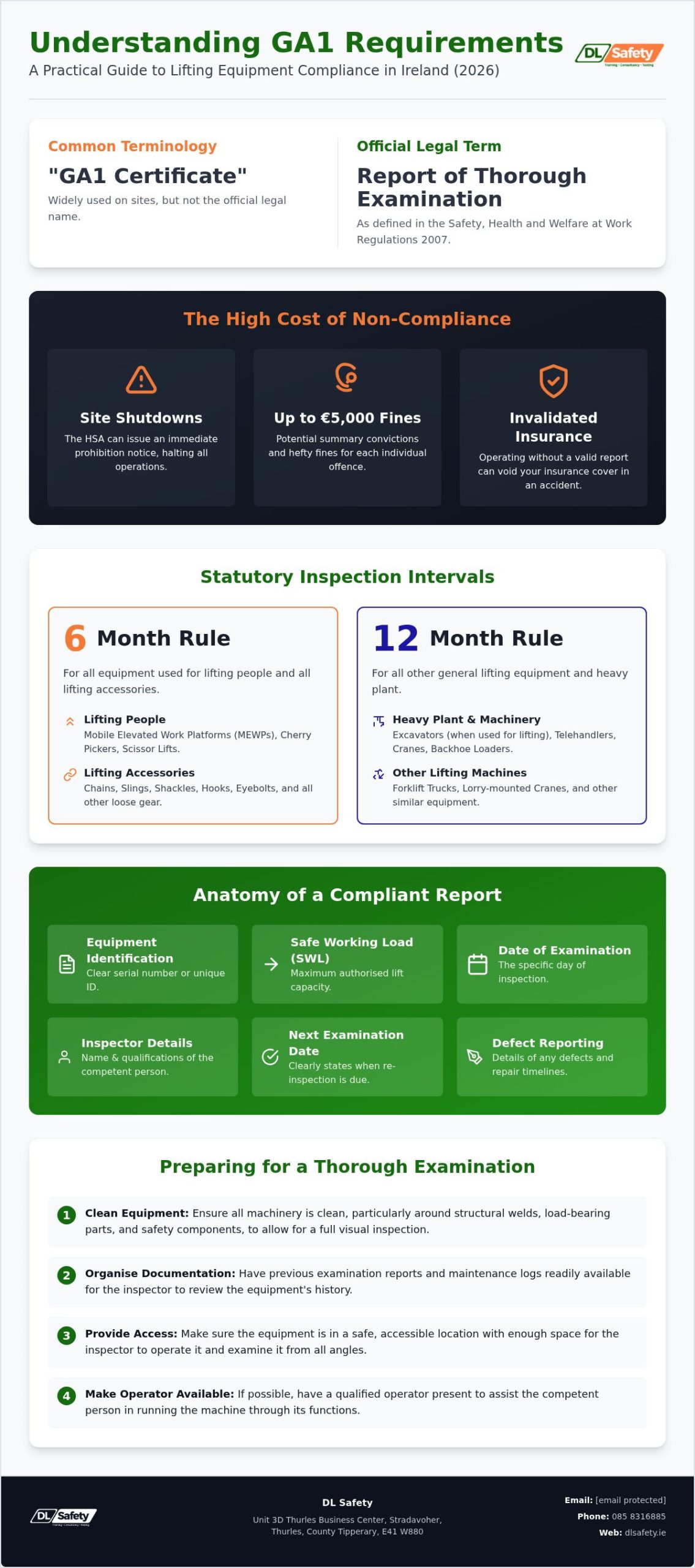
In the world of Irish plant and construction, the term “GA1” is ubiquitous, yet its formal definition is often misunderstood. Legally, what most people call a GA1 certificate is actually a “Report of Thorough Examination.” This document is mandated by the Safety, Health and Welfare at Work (General Application) Regulations 2007, specifically Regulations 30 and 52. Historically, the industry relied on “Form 91,” but modern ga1 certificate requirements ireland have evolved to provide a more rigorous safety record. Operating without a valid report doesn’t just put your team at risk; it leaves you vulnerable to HSA fines of up to €5,000 per offence and can completely invalidate your insurance cover in the event of an accident.
The Legal Framework for Thorough Examinations
Employers have a statutory duty to ensure that all work equipment is safe and fit for purpose. It’s vital to distinguish between a standard pre-use visual check, which an operator performs daily, and a “thorough examination.” The latter must be carried out by a competent person who possesses the practical and theoretical knowledge to detect defects. This framework is conceptually similar to the UK Lifting Equipment Regulations (LOLER), which also emphasises the need for independent, expert inspections to confirm the integrity of lifting gear. If a machine is found on site with an expired report, the HSA has the authority to issue an immediate prohibition notice, effectively shutting down your operations until compliance is proven.
What Must a Valid GA1 Certificate Contain?
A compliant report is more than a signed piece of paper; it must serve as a detailed technical record of the equipment’s condition. For a report to be legally valid under current ga1 certificate requirements ireland, it must include several specific data points:
- Equipment Identification: A clear serial number or unique ID that matches the machine or accessory.
- Safe Working Load (SWL): The maximum weight the equipment is authorised to lift.
- Date of Examination: The specific day the inspection took place.
- Inspector Details: The name, signature, and professional qualifications of the competent person.
- Defect Reporting: A clear section detailing any defects found and the timeline for required repairs.
At DL Safety, operating from our base at Unit 3D Thurles Business Center, Stradavoher, Thurles, County Tipperary, E41 W880, we ensure every report we issue meets these stringent standards. If you’re unsure if your current documentation is up to scratch, you can reach our team at info@dlsafety.ie or call 085 8316885 for expert guidance. We believe in transparency and helping you maintain a site that’s both safe and fully compliant.
Mandatory Equipment Categories Requiring GA1 Testing
Understanding the full scope of equipment that falls under the Safety, Health and Welfare at Work (General Application) Regulations 2007 is the first step toward a compliant site. In practice, gear is split into two distinct groups: lifting machines and lifting accessories. A lifting machine is the primary unit, such as a crane or telehandler, whilst accessories are the components used to connect the load to the machine. Both require rigorous oversight to meet ga1 certificate requirements ireland, and omitting even a single shackle from your register can lead to significant legal liability.
Heavy Plant and Earthmoving Machinery
Excavators are perhaps the most common piece of plant on Irish sites, but their certification needs change depending on how they’re used. If an excavator is used for lifting operations, it must be fitted with check valves and have a valid GA1 report. This rule also extends to backhoe loaders and telehandlers. Meeting the ga1 certificate requirements ireland for plant means verifying that the machine’s safe working load (SWL) is clearly marked and that all safety devices are functional. During an inspection, a competent person doesn’t just look for rust; they examine hydraulic safety valves, load-bearing structures, and the integrity of the quick hitch.
Mobile Elevated Work Platforms (MEWPs), including scissor lifts and cherry pickers, occupy a high-priority category. Because these machines are designed to lift people, the safety margins are much tighter. Any failure here is catastrophic, which is why they are subject to the strictest inspection regimes. Ensuring these machines have visible, up-to-date documentation is a non-negotiable part of modern site management. Even equipment like site dumpers, while not primarily lifting machines, require regular thorough examinations to ensure the tipping mechanism and structural chassis remain sound under load.
Lifting Accessories and Loose Gear
It’s easy to remember the big machines, but the “loose gear” is where many sites fall down on compliance. Every chain, wire rope sling, and synthetic webbing strap must have its own individual certification. These items are often subject to the most wear and tear, yet they are frequently found stuffed in the back of a van without proper paperwork. Shackles, eye bolts, and spreader beams are equally critical; if it’s part of the “lifting string,” it needs a report.
Managing a vast inventory of small accessories can be daunting. Many firms find that a GA1 testing Ireland specialist can help organise this gear into a manageable digital register. If you’re looking to refresh your inventory with high-quality, pre-certified equipment, you might consider browsing our range of LEEA-standard lifting gear to ensure your site starts on the right foot.
Statutory Inspection Intervals: The 6 and 12-Month Rules
Timing isn’t just about efficiency; it’s a legal safeguard. Under ga1 certificate requirements ireland, the frequency of your thorough examinations depends entirely on the risk profile of the equipment. If you’re lifting people or using high-wear accessories, the window for inspection narrows significantly. Missing a date means missing work. Sticking to a rigid schedule ensures that your gear is never the reason for an HSA-ordered site shutdown.
When is a 6-Month Inspection Mandatory?
Any equipment designed to lift personnel must be examined every six months. This category includes MEWPs, scissor lifts, cherry pickers, and even safety harnesses. The stakes are simply too high for a longer interval. This strict six-month rule also applies to all lifting accessories, such as chains, wire slings, and webbing. These items are the “front line” of any lift and are prone to rapid wear, chemical exposure, or structural fatigue. In high-utilisation environments like quarries, these components can degrade quickly. You must also perform a thorough examination “after installation” if the equipment’s safety depends on how it was set up on-site.
The 12-Month Schedule for General Plant
For general lifting machines that don’t carry people, the statutory interval is typically twelve months. This applies to telehandlers, cranes, and forklifts used for standard material handling. Many site managers choose to align these dates with their broader plant maintenance schedule to minimise downtime. However, if a machine is involved in a “significant incident,” such as an accidental overload or a collision, the existing GA1 report becomes void immediately. You’ll need a new thorough examination before the machine returns to service, regardless of the date on the previous cert. Managing these intervals for hired-in plant requires extra diligence; whilst the owner provides the initial cert, the hirer is legally responsible for ensuring it stays valid during the hire period.
It’s vital to distinguish between these statutory GA1 reports and the operator’s weekly inspections. A weekly check is a surface-level verification of safety, whereas a GA1 is a deep-dive technical audit by a competent person. At DL Safety, we help businesses across Ireland stay ahead of these deadlines through our expert testing services. If you’re struggling to track different dates for various gear, reach out to our team at Unit 3D Thurles Business Center, call 085 8316885, or email info@dlsafety.ie. We provide the clarity you need to keep your fleet site-ready and fully compliant.
Preparing Your Site for a GA1 Thorough Examination
Effective preparation is the difference between a seamless inspection and a wasted day of downtime. To meet ga1 certificate requirements ireland, your equipment must be in a condition that allows for a meaningful technical audit. This starts with basic cleanliness. If an excavator boom or a telehandler carriage is caked in dried mud, an inspector cannot adequately check the structural welds for cracks or fatigue. Ensuring that all serial numbers and Safe Working Load (SWL) tags are wiped clean is equally vital. If an ID tag is unreadable, the inspector cannot legally link the machine to its documentation, often resulting in a failed report before the physical testing even begins.
Logistics play a massive role in site efficiency. You should gather all loose lifting accessories, such as slings, chains, and shackles, in a central, well-lit location. This prevents the common “van-search” delay where half of your gear remains uncertified because it couldn’t be found during the visit. Additionally, ensure that previous GA1 reports and maintenance logs are accessible. Inspectors often need to verify that “timed” defects from previous examinations have been rectified. If your equipment requires a functional load test, you must provide a clear, cordoned-off area where the machine can operate safely without endangering other site personnel.
Defining the “Competent Person” in 2026
In the eyes of Irish law, “competent” is a specific legal designation rather than a general description of skill. A competent person must possess the practical and theoretical knowledge, as well as the specialised equipment, to detect defects that an operator might miss. Independence is the cornerstone of this role. Whilst your own site mechanic may be highly skilled, they lack the impartiality required by the HSA. This is why many firms partner with third-party experts like DL Safety, located at Unit 3D Thurles Business Center, Stradavoher, Thurles, County Tipperary, E41 W880. Relying on “self-certification” is a dangerous gamble; in the event of a liability claim, insurers will immediately scrutinise the independence of the person who signed the report.
Common Pitfalls That Void GA1 Compliance
Compliance often fails on the smallest details. A frequent pitfall is the missing “Declaration of Conformity” for brand-new equipment. Many owners assume a new machine is “born” with a GA1, but you must keep the original manufacturer’s declaration as part of the legal trail. Illegible serial numbers on lifting chains or shackles are another common issue; if the identity of the gear cannot be proven, it must be removed from service. Finally, always check your previous reports for minor defects that were given a timeline for repair. If those repairs haven’t been documented and completed, the equipment will fail its next thorough examination.
If you want to ensure your fleet meets every statutory standard without the guesswork, you can book your professional GA1 testing with our team. For direct enquiries, feel free to call us on 085 8316885 or email info@dlsafety.ie to discuss your site requirements.
Streamlining Compliance with Monthly Safety Support
Managing ga1 certificate requirements ireland shouldn’t feel like a constant race against the clock. Many site managers find themselves trapped in a reactive cycle, only booking inspections when a cert has already expired or an HSA inspector is at the gate. By moving to a retained safety model, you eliminate these surprises. A structured approach ensures that every piece of plant is tracked on a rolling schedule, allowing you to focus on project delivery rather than paperwork. This proactive method transforms safety from a checklist into a strategic asset.
In 2026, the trend is firmly towards digital accessibility. We provide our clients with 24/7 access to their reports through a secure portal. This means that if an HSA inspector asks for a specific machine’s record at the start of a shift, you can produce it on your phone or tablet instantly. This level of transparency builds immediate trust with regulatory bodies and demonstrates a high-level commitment to workplace safety. It removes the panic of searching through physical files in a site office whilst an inspector waits.
Proactive Management vs. Reactive Testing
The real value of a Monthly Safety Support Package lies in its ability to catch issues before they become failures. When a consultant visits your site regularly, they identify signs of fatigue or damage that might not yet void a cert but will certainly cause a breakdown in the near future. This proactive stance saves money by reducing emergency repair costs and preventing the downtime associated with a failed thorough examination. It also lifts the administrative burden, as your safety partner manages the digital records and reminds you of upcoming deadlines well in advance.
The DL Safety Approach to National Compliance
At DL Safety, we look beyond the single inspection. Our approach integrates ga1 certificate requirements ireland into a wider safety culture that includes on-site training, accident investigation, and bespoke lift planning. We don’t just test your gear; we can also supply LEEA-standard lifting slings, chains, and shackles, ensuring a closed loop of quality from procurement to inspection. This holistic view ensures that your equipment isn’t just legal on paper, it’s safe in practice. We understand the specific pressures of the construction and quarry sectors because we’re on those sites every day.
If you’re ready to move away from the stress of reactive testing, our team is here to help. You can find us at Unit 3D Thurles Business Center, Stradavoher, Thurles, County Tipperary, E41 W880. For a comprehensive site review or to discuss how we can support your ongoing compliance needs, call us on 085 8316885 or email info@dlsafety.ie today. Let’s work together to keep your site legal, safe, and productive.
Securing Your Site’s Future with Proactive Compliance
Mastering the ga1 certificate requirements ireland doesn’t have to be a source of operational friction. By understanding the distinction between lifting machines and accessories, and adhering strictly to the six and twelve-month inspection intervals, you protect both your team and your business reputation. Preparation is the key to a smooth audit; clean equipment and accessible digital records ensure your site stays compliant at all times. Transitioning from reactive testing to a managed safety system allows you to focus on project delivery without the fear of HSA fines or sudden shutdowns.
At DL Safety, we’re dedicated to being your trusted advisor in technical safety. Whether you need a one-off inspection or a comprehensive monthly support package, our team provides the expert oversight required to keep your plant legal. Visit us at Unit 3D Thurles Business Center, Stradavoher, Thurles, County Tipperary, E41 W880, or email info@dlsafety.ie for more information. For immediate nationwide assistance, call 085 8316885.
Book Your GA1 Statutory Inspection with DL Safety Today. We’re here to help you build a safer, more efficient workplace every day.
Frequently Asked Questions
How long is a GA1 certificate valid for in Ireland?
The validity depends on the type of equipment and its application. Any gear used for lifting personnel, such as MEWPs or safety harnesses, requires an inspection every six months. This same six-month rule applies to all lifting accessories like chains and slings. General lifting plant that doesn’t lift people, such as telehandlers or excavators, typically requires a thorough examination every twelve months.
Do I need a GA1 cert for a brand new machine?
A brand new machine doesn’t require an immediate GA1 report if it’s accompanied by a valid EC Declaration of Conformity from the manufacturer. This document legally covers the machine for its first twelve months of service, or six months if it’s used to lift people. Once this initial period has passed, you must meet the ga1 certificate requirements ireland by arranging a statutory thorough examination by a competent person.
Can my own mechanic sign off on a GA1 certificate?
It’s highly unlikely that an in-house mechanic meets the legal criteria for independence. The law requires the competent person to be sufficiently independent of the people responsible for the equipment’s maintenance. This ensures the inspection is impartial and unbiased. Most Irish firms hire third-party specialists like DL Safety to ensure their reports carry the necessary legal weight and professional authority during an audit.
What happens if a HSA inspector finds an expired GA1 cert on my site?
The consequences of non-compliance are both immediate and expensive. An inspector can issue a prohibition notice, which stops the machine from working until a valid exam is completed. You could also face summary convictions with fines reaching €5,000 per offence. Perhaps most importantly, operating with expired paperwork can invalidate your insurance cover, leaving your business exposed to massive liability if an accident occurs on-site.
Is a GA1 certificate required for small lifting tackle like shackles?
Yes, every individual item used in a lifting operation must have its own proof of thorough examination. This includes small items like shackles, eye bolts, and hooks. Each piece of tackle must have a legible serial number or unique ID tag that links it directly to its corresponding report. If the inspector can’t identify the specific item, they can’t certify it as safe for use.
What is the difference between a GA1 and a GA2 form?
A GA1 is the official Report of Thorough Examination, which is a statutory technical audit conducted by an independent expert. In contrast, a GA2 is a Report of Weekly Inspection. The GA2 is usually completed by the machine operator or a site supervisor to confirm the equipment is in good working order between professional visits. Both are essential parts of a complete safety management system.
Does hired equipment come with a GA1 certificate?
The hire company is legally obligated to provide a valid GA1 report when the equipment is delivered. However, the responsibility for ensuring that the gear is compliant sits with the person using it on-site. You must check that the certificate is current and that it won’t expire whilst the machine is under your control. Never allow a hired machine to start work without first verifying its documentation.
How should I store my GA1 certificates for a HSA audit?
Digital storage is the most practical and secure way to manage your records. Storing your reports in a cloud-based portal allows you to produce them instantly on a smartphone or tablet during an unannounced HSA inspection. This demonstrates a proactive approach to safety and prevents the stress of searching for lost paper files. DL Safety provides digital reports to all clients to help streamline this administrative process.