
Could a simple terminology mix-up be the reason your site fails its next unannounced HSA inspection? While many site managers search for a COSHH assessment for construction materials, using UK-specific templates in Ireland is a common trap that leads to non-compliance and potential fines. We understand that the transition from British standards to the Irish Chemical Agents Regulations 2001 to 2026 feels overwhelming, particularly when you’re buried under a mountain of Safety Data Sheets (SDS) for everything from adhesives to concrete dust.
This guide is designed to provide you with total confidence during HSA audits by demystifying the new 2026 Code of Practice that became effective on 9 April 2026. You’ll learn how to implement the updated occupational exposure limits for lead and diisocyanates whilst creating safer working conditions for your subcontractors. At DL Safety, located at Unit 3D Thurles Business Center, Stradavoher, Thurles, County Tipperary, E41 W880, we’re dedicated to helping you move from paperwork stress to proactive safety. If you need direct support, you can reach us at www.dlsafety.ie, email info@dlsafety.ie, or call 085 8316885. We’ll start by clarifying exactly how Irish law differs from the UK framework you might be used to.
Key Takeaways
- Learn to navigate the transition from UK terminology to the Irish Chemical Agents Regulations 2001 to 2026 to stay ahead of HSA requirements.
- Identify high-risk substances like crystalline silica and wood dust amongst common site materials to implement effective exposure controls.
- Discover how to conduct a compliant COSHH assessment for construction materials by correctly deciphering the specific hazard data and exposure limits found within a Safety Data Sheet.
- Follow a practical five-step process to organise an inventory of all subcontractor materials and evaluate the true risk to your workforce.
- Explore how Monthly Safety Support Packages from DL Safety, based at Unit 3D Thurles Business Center, Stradavoher, Thurles, County Tipperary, E41 W880, can alleviate the stress of managing site paperwork.
COSHH Assessment for Construction Materials: Understanding the Irish Framework
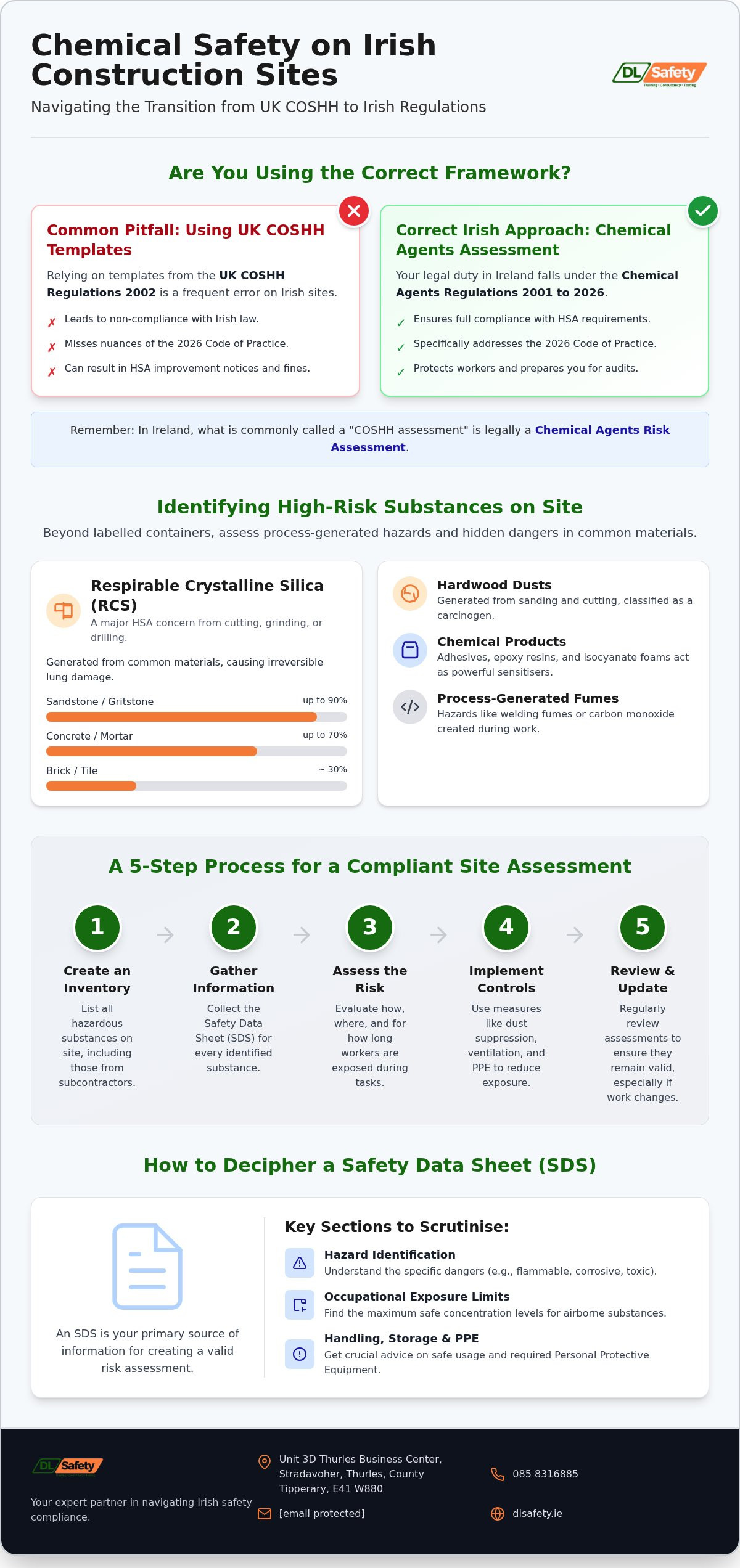
Walk onto any building site in Ireland and you’ll hear the term “COSHH” used daily. It’s the industry shorthand for managing hazardous substances, yet it’s technically a British import. The acronym comes from the UK COSHH Regulations 2002. Whilst the term has stuck because of historical ties and cross-border contractors, your legal obligations in Ireland are governed by the Safety, Health and Welfare at Work (Chemical Agents) Regulations 2001 to 2026. If you’re tasked with creating a COSHH assessment for construction materials for an Irish project, you’re legally performing a Chemical Agents Risk Assessment.
COSHH vs. Chemical Agents Regulations: What is the Difference?
The fundamental goals of both frameworks are identical: protecting workers from ill health caused by substance exposure. However, the specific statutory instruments differ significantly. Relying on UK templates is a common mistake that often results in HSA improvement notices during unannounced inspections. These templates frequently miss the nuances of Irish law, such as the specific requirements of S.I. No. 127/2026. At DL Safety, based at Unit 3D Thurles Business Center, Stradavoher, Thurles, County Tipperary, E41 W880, we help clients swap confusing foreign terminology for compliant Irish site files. You can reach our team at info@dlsafety.ie or 085 8316885 to ensure your documentation matches the 2026 Code of Practice that became effective on 9 April 2026.
Why a Generic Risk Assessment is Not Enough
A broad safety statement is a good starting point, but it lacks the granular detail needed for high-risk materials. Construction materials are rarely static; they change state throughout the day. A bag of mortar is a dusty solid when poured, a corrosive paste when mixed, and a source of respirable crystalline silica when the finished wall is chased. A specific COSHH assessment for construction materials tracks these changes. It’s particularly vital for “process-generated” hazards. These are dangerous substances that don’t arrive in a branded container, such as welding fumes or wood dust. If you don’t assess how these materials behave when your team actually uses them, you’re leaving a massive gap in your site safety. Our Monthly Safety Support Packages at www.dlsafety.ie are designed to close these gaps, ensuring every material is accounted for from delivery to disposal.
Identifying Hazardous Substances Amongst Common Building Materials
Managing a modern site in 2026 requires more than just checking labels on buckets. A thorough COSHH assessment for construction materials must account for substances in every physical state, from solid blocks to the invisible vapours released by spray-applied insulation. Whilst traditional hazards like cement remain a constant threat, modern high-performance materials introduce complex chemical risks that are often poorly understood by site teams. You must also consider process-generated hazards, such as carbon monoxide from plant operation or welding fumes, which don’t arrive in a package but are created during the work itself.
The Hidden Dangers: Silica and Hardwood Dusts
Silicosis remains a critical concern for the Health and Safety Authority (HSA) because the lung damage it causes is both irreversible and entirely preventable. When your team cuts concrete, stone, or mortar, they release respirable crystalline silica (RCS) into the air. Similarly, hardwood dust produced during sanding or cutting is classified as a known carcinogen. Identifying these risks is the first step in understanding how to carry out a COSHH risk assessment that actually protects your people. Use this checklist to identify materials with high silica content:
- Sandstone and gritstone (often up to 90% silica)
- Concrete, mortar, and screed (typically up to 70% silica)
- Brick and tile (roughly 30% silica)
- Slate and granite
Chemical Products: Adhesives, Resins, and Sealants
Modern sites rely heavily on epoxy resins and isocyanate-based spray foams. These materials are powerful sensitisers; once a worker is sensitised, even a tiny future exposure can trigger a severe allergic reaction. The 2026 Code of Practice has introduced stricter Occupational Exposure Limits (OELs) for diisocyanates, setting the 8-hour limit at 0.01 mg/m³. This change reflects a growing European trend toward tighter accountability for chemical safety on construction projects. It’s no longer enough to just have the paperwork; you must actively manage these exposure levels.
Wet cement also continues to cause significant issues, particularly occupational dermatitis, which can be career-ending for a tradesperson. Ensuring your team can spot these hazards before they become injuries is vital. Our Chemical Awareness Training provides your staff with the practical skills to identify these substances onsite. For more comprehensive support, visit us at Unit 3D Thurles Business Center, Stradavoher, Thurles, County Tipperary, E41 W880, or contact DL Safety at info@dlsafety.ie or 085 8316885. Managing a COSHH assessment for construction materials is a continuous process that we can help you simplify through our expert site audits and training programmes.
How to Decipher Safety Data Sheets (SDS) for Construction
Receiving a thirty-page technical document for a simple tin of floor sealer can feel like a bureaucratic hurdle. However, the Safety Data Sheet (SDS) is the foundation of any COSHH assessment for construction materials. It is vital to remember that an SDS is not a risk assessment; it’s a raw data source provided by the manufacturer. It tells you what is in the product, but it doesn’t know how you intend to use it on a windy roof in Donegal or in a basement in Dublin. Your job is to extract the relevant data and apply it to your specific site conditions.
The 16-Section SDS: Where to Look First
You don’t need to memorise all sixteen sections, but you must know where the critical information lives. Section 2 is your first port of call. This section contains pictograms and signal words that immediately communicate the level of threat. A “Danger” signal word indicates a more severe hazard than “Warning”. It’s a quick way to prioritise which materials need the most robust controls. For emergency planning, Sections 4 and 6 are essential, as they detail first aid measures and accidental release procedures. If a spill occurs, you won’t have time to read thirty pages; having these sections summarised in your site files is a hallmark of a well-organised project.
Section 8 is perhaps the most important for daily operations. This is where you’ll find specific PPE requirements. Don’t just settle for “wear gloves”; Section 8 will specify the exact material, such as nitrile or butyl rubber, required to prevent breakthrough. This section also lists Occupational Exposure Limit Values (OELVs). When performing a COSHH assessment for construction materials in 2026, you must ensure these limits align with Irish statutory instruments. Using an SDS older than 2022 or 2023 is a major risk, as it likely won’t reflect the updated 2026 limits for substances like lead or diisocyanates.
Translating SDS Data into Site Reality
The “Exposure Scenario” at the end of some modern SDS documents can be complex. You must determine if the manufacturer’s tested scenario actually matches your site task. If the SDS assumes the product is used in a factory with local exhaust ventilation, but your team is using it in a confined crawl space, your risk level is significantly higher. In a construction context, a hazard is the inherent potential of a material to cause harm, whilst risk is the likelihood of that harm occurring based on how your team actually handles the substance on site.
At DL Safety, we help site managers move beyond merely collecting sheets to actually understanding them. Our team, based at Unit 3D Thurles Business Center, Stradavoher, Thurles, County Tipperary, E41 W880, can review your documentation to ensure it’s audit-ready. You can contact us at info@dlsafety.ie or 085 8316885. If you’re struggling with a mountain of paperwork, our Monthly Safety Support Packages at www.dlsafety.ie provide a streamlined way to keep your site compliant and your workers safe.
Five Steps to Organise an Effective Site Assessment
Performing a COSHH assessment for construction materials requires a methodical approach that goes beyond simply filing paperwork. The first step is to create a comprehensive inventory of every material brought onto the site by all subcontractors; a project manager cannot control what they haven’t identified. Once you’ve listed the substances, you must evaluate who is exposed and for how long. Duration matters significantly in 2026, as even low-level exposure over an eight-hour shift can exceed the new Occupational Exposure Limit Values (OELVs) for substances like lead or diisocyanates.
The third step is control, where you apply the Hierarchy of Controls to reduce risk. Documentation follows in step four, ensuring findings are recorded in a format that is truly accessible to the workforce, rather than hidden in a folder in the site office. Finally, you must review the assessment whenever work methods or materials change to ensure your controls remain effective throughout the project’s lifecycle. This five-step cycle ensures that your site remains compliant with the Safety, Health and Welfare at Work (Chemical Agents) Regulations whilst protecting your team’s long-term health.
Implementing the Hierarchy of Controls
Respiratory Protective Equipment (RPE) should always be your last resort. Practical substitution, such as choosing water-based paints over solvent-based alternatives, eliminates the hazard at the source. Engineering controls like Local Exhaust Ventilation (LEV) or on-tool extraction are far more reliable than relying on a worker to wear a mask correctly for an entire shift. We often see sites where high-spec masks are provided, but the lack of face-fit testing renders them ineffective, which is why engineering controls are the preferred standard in 2026.
Recording and Communicating the Findings
Your chemical risk findings must be integrated into your Method Statements: Developing Robust Systems of Work. This ensures that the safe system of work includes specific instructions for handling hazardous materials during specific tasks. Regular Toolbox Talks are the most effective way to communicate these assessments to subcontractors, ensuring they understand the practical steps needed to stay safe. If you find the volume of site assessments overwhelming, our Health & Safety Site Audits provide a professional second pair of eyes to ensure your site remains fully compliant.
DL Safety is located at Unit 3D Thurles Business Center, Stradavoher, Thurles, County Tipperary, E41 W880. For expert guidance on managing your site documentation, email us at info@dlsafety.ie or call 085 8316885. Our team is dedicated to simplifying compliance so you can focus on the build.
Professional Support: Streamlining Site Compliance
Managing a complex construction project in 2026 involves more than just coordinating trades and timelines. The administrative burden of maintaining a compliant COSHH assessment for construction materials can quickly become overwhelming when you’re dealing with fifty or more separate Safety Data Sheets. Whilst individual subcontractors often provide their own documentation, the responsibility for ensuring these materials are correctly assessed and controlled on-site rests with the project management team. A single unassessed hazardous substance can lead to significant project delays or costly HSA improvement notices during an unannounced inspection.
Outsourcing the Paperwork Mountain
DL Safety provides a pragmatic solution to this administrative challenge through our professional management services. We don’t just collect documents; we organise your entire chemical inventory into a structured, audit-ready system. By outsourcing this task, site managers reclaim valuable time whilst ensuring that every substance, from high-performance resins to process-generated dust, is fully accounted for under the latest Irish regulations. Investing in professional oversight offers a clear return on investment by preventing the legal complications and work stoppages associated with non-compliance. For a deeper look at how these services function, read our Monthly Safety Support in Ireland: The Complete Buying Guide for 2026.
Our Monthly Safety Support Packages are designed to be a proactive shield for your business. We conduct regular Health & Safety Site Audits to identify any new or unassessed materials that may have slipped through the gates. This “big picture” approach ensures your site files remain dynamic and accurate, reflecting the actual work happening on the ground rather than just what was planned in the initial safety statement.
Contact DL Safety for Expert Guidance
Safe chemical management requires both robust documentation and a workforce that knows how to react in an emergency. We provide specialised Chemical Awareness Training including Spill Kit Deployment to empower your team to handle hazardous substances with confidence. This bespoke training is tailored to the specific materials found on your site, ensuring your subcontractors are protected from the risks of sensitisation or long-term respiratory illness. It’s always better to be proactive before an inspector arrives on your site.
If you’re ready to simplify your compliance process and ensure a safer working environment, the team at DL Safety is here to help. You can visit us at Unit 3D Thurles Business Center, Stradavoher, Thurles, County Tipperary, E41 W880. For direct enquiries, please reach out via our website at www.dlsafety.ie, email us at info@dlsafety.ie, or call us on 085 8316885. Let us take the stress out of your next COSHH assessment for construction materials so you can focus on delivering your project on time and within budget.
Securing Your Site for a Safer 2026
Transitioning from UK terminology to the Irish Chemical Agents Regulations is more than just a paperwork exercise; it’s a commitment to your team’s long-term health. By mastering the COSHH assessment for construction materials, you’ve taken the first step towards total audit confidence. You now know how to extract vital data from Section 8 of an SDS and how to address process-generated hazards like silica dust before they become a liability. Compliance doesn’t have to be a mountain of stress that pulls you away from the build.
Whether you need specialised Chemical Awareness Training including Spill Kit Deployment or regular site audits, we’re here to support your project. Our team is based at Unit 3D Thurles Business Center, Stradavoher, Thurles, County Tipperary, E41 W880. Contact DL Safety today for a Monthly Safety Support Package and let us handle the administrative burden whilst you focus on delivering results. Reach us at info@dlsafety.ie or call 085 8316885. Your path to a safer, fully compliant site is just a conversation away.
Frequently Asked Questions
Is a COSHH assessment legally required on Irish construction sites?
Yes, although under Irish law, this is technically known as a Chemical Agents Risk Assessment. It is a mandatory requirement under the Safety, Health and Welfare at Work (Chemical Agents) Regulations 2001 to 2026. Every employer is legally obligated to identify hazardous substances and evaluate the risks they pose to staff. Failing to maintain a compliant COSHH assessment for construction materials leaves your project open to HSA enforcement and potential fines.
How often should construction material risk assessments be reviewed?
You should review your assessments whenever there is a significant change in your work processes or the materials being used on-site. At a minimum, an annual review is considered best practice to ensure all data remains current. If new regulatory information emerges, such as the updated exposure limits in the 2026 Code of Practice, you must update your records immediately. Regular Health & Safety Site Audits can help identify when these updates are necessary.
Do I need a separate assessment for every single material on site?
Not necessarily, as you can often group similar materials together if they pose identical risks and require the same control measures. For example, several brands of standard masonry mortar can usually be covered by one comprehensive assessment. However, high-risk or unique substances, such as specific epoxy resins or modern spray foams, typically require individual attention. The objective is to ensure every hazard is accounted for without creating a redundant mountain of paperwork.
Who is responsible for assessing subcontractor materials?
The primary responsibility for worker safety lies with their direct employer, but the main contractor has a legal duty to coordinate safety across the entire site. Subcontractors must provide assessments for any materials they bring onto the project. As the site manager, you must verify that these assessments are suitable and sufficient for the specific environment. Our Monthly Safety Support Packages help managers oversee this influx of data from multiple different subcontractors.
What is the difference between an SDS and a risk assessment?
A Safety Data Sheet (SDS) is a technical document from the manufacturer describing the inherent hazards of a chemical product. In contrast, a risk assessment is a site-specific document explaining how you will control those hazards during a particular task. An SDS tells you that a substance is toxic; the risk assessment explains how your team will use it safely whilst considering factors like local ventilation, weather conditions, and specific PPE requirements.
What happens if a HSA inspector finds unassessed chemicals on my site?
The inspector may issue an Improvement Notice or a Prohibition Notice, which can instantly halt work on a specific task or even the entire project. In 2026, the HSA has increased its focus on chemical safety, making unassessed materials a high-priority finding during inspections. Beyond legal penalties, you face significant project delays and potential damage to your professional reputation. Proactive Chemical Awareness Training helps your team identify and assess materials before an inspector arrives.
Can I use a UK COSHH template for my Irish project?
No, using UK-specific templates is a common mistake that often leads to non-compliance during a HSA audit. Whilst the safety principles are similar, Irish legislation references different statutory instruments and exposure limits, such as those found in S.I. No. 127/2026. Your documentation must specifically reference the Irish Safety, Health and Welfare at Work framework. Using the correct national standards ensures your COSHH assessment for construction materials meets all current legal requirements.
What specific training do workers need for hazardous materials?
Workers require training that is directly relevant to the hazards they encounter, covering both the risks and the specific control measures in place. This includes instruction on reading labels, using PPE correctly, and responding to emergency spills. DL Safety offers specialised Chemical Awareness Training including Spill Kit Deployment to provide practical, hands-on skills. This bespoke training ensures your workforce is competent to handle dangerous substances safely under real-world construction site conditions.