What if the more cost-effective choice for health and safety isn’t hiring a full-time officer, but gaining access to a wider team of specialist expertise? For Irish businesses weighing salary costs against compliance demands, the benefits of outsourcing health and safety go beyond day-to-day support. They can include practical help with inspections, risk management and technical work that a single in-house generalist may not cover.
It’s understandable to be concerned about HSA inspections, changing legislation and the responsibilities directors can carry under the Safety, Health and Welfare at Work Act 2005. The HSA conducted 11,974 inspections and investigations in 2025, so clear, active safety arrangements matter. Outsourcing won’t remove an employer’s legal duties, but the right support can help you manage them more systematically.
This article explores how a Monthly Safety Support Package can provide ongoing oversight, alongside specialist services such as lift plans, GA1 testing and traffic management design. It also explains how to compare costs, organise compliance work and decide what expertise your business needs. Visit www.dlsafety.ie, email info@dlsafety.ie or call 085 8316885 to discuss support from DL Safety.
Key Takeaways
- See how the benefits of outsourcing health and safety can extend beyond compliance, helping businesses access broader expertise without relying on one in-house generalist.
- Compare the full demands of an in-house role with external support, including recruitment, administration and ongoing professional development.
- Understand how organised safety records and practical management systems can help directors oversee their responsibilities, while legal duties remain with the employer.
- Learn how specialist technical support can complement general safety management when a task calls for focused expertise.
- Contact DL Safety at www.dlsafety.ie, info@dlsafety.ie or 085 8316885.
Why Irish Firms are Choosing to Outsource Health and Safety in 2026
For a small or medium-sized business, health and safety can become a second job: keeping records current, arranging training and checking that workplace controls still match the work being done. Outsourcing means working with a health and safety consultancy for practical support with compliance, audits and training, rather than relying solely on an internal employee to manage every requirement. The aim is to add expertise and structure, not to transfer the employer’s responsibilities.
That distinction matters in 2026. The Safety, Health and Welfare at Work Act 2005 remains central legislation, while recent changes have added detail in areas such as chemical safety. The Quarries Regulations 2025 also came into effect on 1 January 2026. For businesses operating in construction, industrial or quarry environments, keeping procedures aligned with changing work and requirements takes active attention. The wider discipline of Occupational safety and health (OSH) draws on multiple areas of expertise, which helps explain why one generalist may not cover every technical need.
Demystifying regulatory compliance
External support can help a business review its safety arrangements as requirements and workplace risks evolve, while owners and managers focus on operations. A Safety Statement should set out the organisation’s hazards and the practical measures used to manage them. Treat it as a working document: review it when work changes, check that the controls described are in place, and make sure staff can understand what they need to do. Clear, plain-English guidance helps supervisors and employees connect written procedures with everyday tasks.
The burden of in-house safety management
Safety administration is ongoing. Training records, relevant documentation and follow-up actions all need to be organised and kept useful. If these tasks sit with an employee who already has another role, routine pressures can push them down the list. Over time, staff may start to see safety as paperwork to complete rather than a working part of the job. Structured external oversight can help keep attention on implementation as well as documentation.
Support is most useful when it is practical and specific to the work. An adviser can help identify what a requirement means for the workplace, who needs to act and how to record follow-up. DL Safety’s Monthly Safety Support Packages provide ongoing expert oversight, while lift plans, traffic management design and GA1 testing bring specialist technical capability beyond general advice. For businesses considering the benefits of outsourcing health and safety, that combination of continuity and technical depth can be valuable. Explore health and safety support from DL Safety.
For enquiries, visit www.dlsafety.ie, email info@dlsafety.ie or call 085 8316885.
The Financial Advantages of External Health and Safety Support
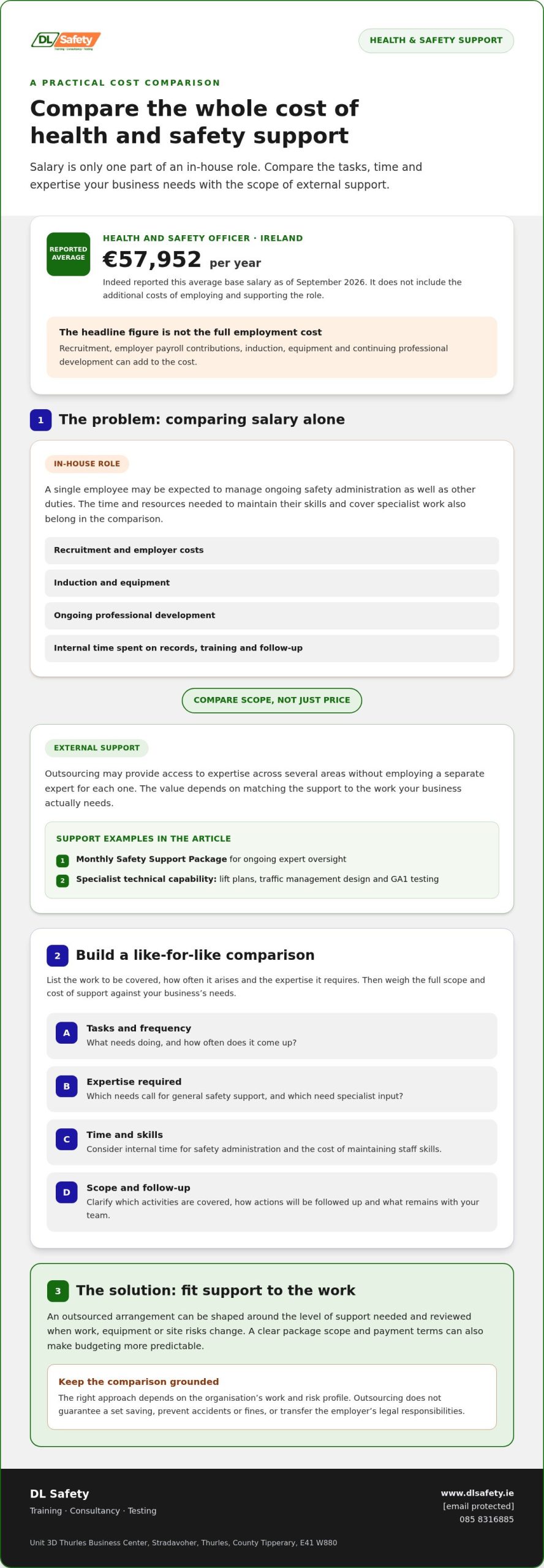
Comparing a full-time health and safety officer with outsourced support means looking beyond salary alone. Indeed reported an average base salary of €57,952 per year for Health and Safety Officers in Ireland as of September 2026. That figure doesn’t include the wider costs of recruitment, employer payroll contributions, induction, equipment or continuing professional development. A support package has a different structure, so compare its actual scope with the role your business needs rather than treating the options as like-for-like.
For a useful comparison, list the tasks your business needs covered, how often they arise and the expertise they require. Then consider the time internal staff spend on safety administration, the cost of maintaining their skills and any specialist work that would need separate support. Outsourcing may provide access to expertise across several areas without employing a separate expert for each one. The value depends on matching the support to the work, not assuming every business will save a set amount.
Build a practical business case
Assess the value of support by comparing its cost and scope with the risks and resources it helps manage. Consider time spent maintaining records, arranging training and addressing audit findings, alongside the potential disruption and expense of an incident. No consultant can promise to prevent accidents or fines, but a stronger, actively managed safety system can help identify gaps and support timely action. Before agreeing a package, clarify which activities it covers, how actions will be followed up and what remains the responsibility of your team. A Monthly Safety Support Package can also make budgeting more predictable when its scope and payment terms are clear. For a useful framework, see DL Safety’s health and safety support.
Scale support to business activity
Workloads can change across projects and seasons. An outsourced arrangement can be shaped around the level of support needed, helping a business access additional expertise during demanding project phases without adding a permanent role that may be less useful during quieter periods. This flexibility can help manage overheads, though the right approach depends on the organisation’s work and risk profile. Review the arrangement when work, equipment or site risks change so that support remains relevant.
There can be practical value in bringing related needs together, too. Rather than coordinating separate arrangements for every safety requirement, businesses can draw on a broader set of services and equipment, including lifting slings and chains. The University of Illinois State describes the contribution of safety professionals to efforts to protect us from harm in the workplace, while effective prevention can also help limit disruption and associated losses. These wider considerations make the benefits of outsourcing health and safety a business-planning question, not simply a comparison of salaries.
DL Safety’s Monthly Safety Support Packages provide ongoing expert oversight. Visit DL Safety’s health and safety support, email info@dlsafety.ie or call 085 8316885.
Reducing Director Liability and Managing HSA Inspections
Outsourcing can strengthen how a business manages health and safety, but it doesn’t transfer the employer’s legal responsibilities to a consultant. Under Section 80 of the Safety, Health and Welfare at Work Act 2005, directors, managers and similar officers may be held personally liable for an offence committed by a company where it occurred with their consent or connivance, or was attributable to their neglect. External support can help establish a more organised framework for identifying risks, recording actions and reviewing controls. Directors still need to ensure that safety arrangements are put into practice.
A health and safety consultant can bring an informed, independent perspective to site audits and help a business prepare to respond clearly during an HSA inspection. An inspection doesn’t automatically mean a fine or prosecution: the HSA may provide advice or issue an Improvement Notice or Prohibition Notice, depending on its findings. Keeping relevant records organised, briefing responsible staff and tracking corrective actions helps the business explain how safety is managed. A consultant’s role should support, not replace, the employer’s cooperation and decision-making.
Prepare for an HSA inspection
Good preparation is part of everyday management, not a last-minute paperwork exercise. Keep the Safety Statement, risk assessments, training records and evidence of completed actions organised and accessible. DL Safety supports businesses with Safety Statement work, Health & Safety Site Audits, and Safe T Cert and ISO preparation. These activities help structure evidence of management practices; preparation alone doesn’t certify a business or guarantee a particular inspection outcome. For a closer look at the process, read guidance on managing health and safety.
Protect your reputation with practical controls
Clients and project partners want confidence that safety risks are taken seriously. Clear, current Method Statements and Risk Assessments can help show that planned work has been considered and teams understand the relevant controls. This can support tender discussions and strengthen trust, although it can’t guarantee a contract or a particular commercial result.
An independent audit may identify a mismatch between written procedures and what’s happening on site, such as a documented control that isn’t consistently followed. If an incident occurs, an Accident Investigation can help establish what happened, identify contributing factors and inform corrective action. A factual, well-organised report may help the business explain its response, but it isn’t a substitute for legal advice or a guaranteed defence. These are practical benefits of outsourcing health and safety: clearer oversight, better records and a more considered response to problems.
DL Safety provides ongoing support through Monthly Safety Support Packages. Visit health and safety support from DL Safety, email info@dlsafety.ie or call 085 8316885.
Specialist Skills and Technical Testing: Beyond the Generalist
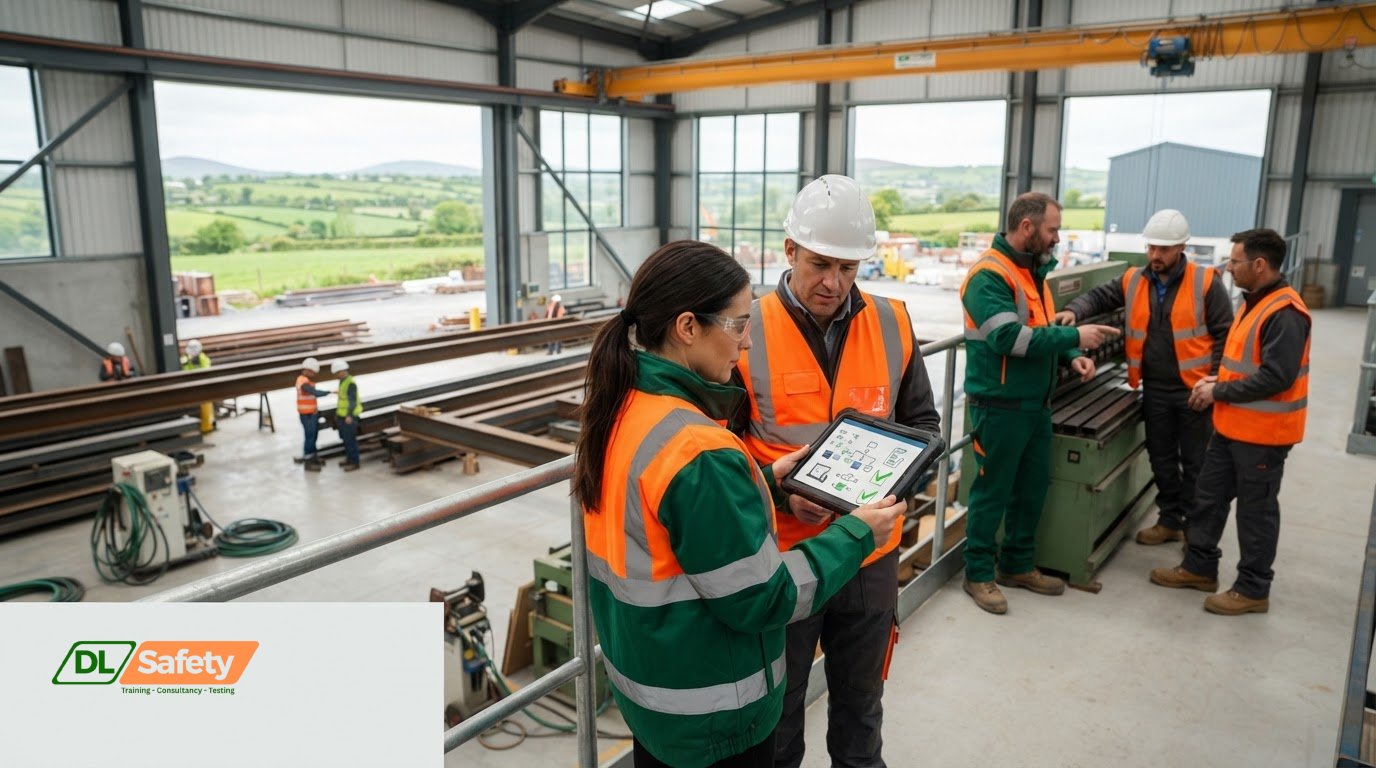
Health and safety work can call for very different skills. A generalist may coordinate procedures and training, but technical testing can require dedicated knowledge, methods and equipment that aren’t part of a typical in-house role. Outsourcing gives businesses a way to access specialist input when it’s needed, without expecting one employee to cover every discipline.
That depth matters in construction and industrial settings, where planning, equipment condition and vehicle safety can affect how work is carried out. DL Safety provides GA1 testing, lift plans, on-site quarry vehicle brake testing and traffic management design. Each service addresses a distinct practical need, connecting safety oversight with the equipment and activities on site.
Technical support for lifting operations
Planning a lift involves understanding the task, equipment and site conditions. For complex crane work, a lift plan can help set out how the operation is to be organised and managed. GA1 testing provides specialist support for relevant lifting equipment, while suitable inspection and follow-up arrangements help businesses keep equipment safety under review. Inspection intervals depend on the equipment and applicable requirements, so avoid relying on a blanket six- or twelve-month rule. Learn more about GA1 testing and lifting safety.
Testing and training for higher-risk environments
Technical requirements vary by workplace. PAT testing supports checks of portable electrical equipment, while quarry vehicle brake testing addresses a specific risk associated with vehicle use in quarry settings. Traffic management design can help businesses plan how vehicles and people move around a worksite. Bringing these capabilities into an outsourced support arrangement gives a business access to focused expertise beyond general safety administration.
Training is another area where specialist resources can make a difference. Simulation training gives participants an opportunity to practise responses in a structured setting, while online or face-to-face courses can support different learning needs. Choose an approach according to the work, the risks and the people being trained. This is one of the practical benefits of outsourcing health and safety: a business can draw on technical services and training alongside ongoing safety support, rather than relying on a single generalist to provide every element.
To explore technical safety support, view DL Safety’s testing and training services, or contact the team at info@dlsafety.ie or 085 8316885.
Implementing an Outsourced Model with DL Safety
Moving health and safety support outside your business doesn’t have to mean changing everything at once. A structured approach helps identify priorities, assign responsibilities and build support around how your sites operate. DL Safety works with businesses in construction and industry to make safety requirements more practical for managers and site teams.
A clear, site-led starting point
Start by reviewing current arrangements and identifying where attention is needed. A Health & Safety Site Audit can help highlight gaps between documented procedures and what happens in practice. Findings can then inform a Monthly Safety Support Package shaped around the work and risks on site. This gives ongoing support a practical starting point, rather than applying the same checklist to every business.
Next, review training needs and records. Online safety courses can be incorporated into employee onboarding, helping new starters access relevant training as they join. Existing training arrangements can also be reviewed so course records and training needs are easier to manage alongside day-to-day operations.
Build testing and review into the routine
Planning ahead helps reduce the chance of technical checks being overlooked. DL Safety can help organise a rolling calendar for relevant testing, including GA1 testing and PAT testing, with dates guided by the equipment and applicable requirements. Assign responsibility for tracking upcoming checks, recording completed work and following up any findings. Review the calendar when equipment, processes or requirements change.
Ongoing support matters because sites, equipment and tasks change. David and the DL Safety team provide continued guidance through a Monthly Safety Support Package, helping businesses review actions and keep safety arrangements connected to current operations. This joined-up model brings audits, training and technical support into a more consistent process, rather than leaving each task to be managed in isolation.
Make the transition manageable
A practical handover starts by mapping existing responsibilities, records and upcoming deadlines. Keep current processes running while priorities are reviewed, then agree which tasks need immediate attention and how support will fit alongside internal roles. Make sure employees know who is responsible for each action and where records are kept. This helps the transition build on useful systems already in place.
The benefits of outsourcing health and safety are strongest when support is organised around real workplace needs. DL Safety’s approach focuses on explaining requirements in clear terms, so site teams can understand what actions are needed and why. The Monthly Safety Support Package provides ongoing expert oversight, with related technical services to support specific tasks.
To discuss a support package for your business, email info@dlsafety.ie or call 085 8316885. View DL Safety’s Monthly Safety Support Packages.
Build a More Confident Approach to Workplace Safety
The benefits of outsourcing health and safety extend beyond easing the administrative load. External support can give your business access to specialist expertise, help organise compliance work and provide a practical framework for preparing for HSA inspections. It can also bring focused technical support, including GA1 testing and quarry vehicle brake testing, alongside ongoing safety oversight.
Outsourcing doesn’t remove an employer’s legal responsibilities, but a structured support arrangement can help directors keep safety actions visible and address issues with greater confidence. DL Safety’s Monthly Safety Support Packages offer ongoing expert oversight, with support shaped around your business and its workplace risks.
Take a practical next step towards clearer, better-organised safety management. Explore DL Safety’s Monthly Safety Support Packages and see how ongoing support can fit your operations.
For enquiries, email info@dlsafety.ie or call 085 8316885. A clear support plan can help your team manage safety responsibilities with greater consistency.
Frequently Asked Questions
Is it cheaper to outsource health and safety in Ireland?
It can be, but the right comparison depends on the support your business needs. An in-house role brings salary and recruitment costs, alongside employer payroll contributions and ongoing professional development. Outsourcing provides access to external expertise through a support arrangement, which may suit a business that doesn’t need a full-time officer. Assess the benefits of outsourcing health and safety by comparing the package scope with your workload, risks and internal resources.
Does outsourcing remove my liability as a company director?
No. Outsourcing doesn’t transfer an employer’s legal responsibilities to a consultant. Under Section 80 of the Safety, Health and Welfare at Work Act 2005, directors, managers and similar officers may be held personally liable for certain company offences where consent, connivance or neglect applies. A consultant can help organise safety arrangements, records and follow-up actions, but directors still need to oversee how controls are put into practice.
What is included in a Monthly Safety Support Package?
A Monthly Safety Support Package provides ongoing health and safety advice and dedicated safety oversight to support compliance management. The work can help a business review safety arrangements and keep actions visible as its operations change. DL Safety also provides related services such as Health & Safety Site Audits, Safety Statements, training and technical testing. The specific support required depends on the business and its workplace risks.
Can a safety consultant help with GA1 testing?
Yes. DL Safety provides GA1 testing as a specialist technical service for lifting equipment. Testing and inspection requirements depend on the equipment and applicable rules, so a blanket interval shouldn’t be assumed for every item. A consultant can help businesses address testing needs and organise relevant records, while the employer remains responsible for managing equipment safely and acting on any findings.
How often should an outsourced safety audit take place?
There isn’t one audit frequency that suits every workplace. The appropriate schedule depends on factors such as the work being carried out, the risks identified, changes to equipment or processes, and previous findings. A site audit can help assess whether documented controls are working in practice and identify actions for follow-up. Review the schedule when operations or risk conditions change, rather than treating an audit as a one-off exercise.
Can a consultant represent us during an HSA inspection?
A consultant can provide practical support during an HSA inspection, such as helping organise relevant documentation and explain how safety arrangements are managed. The employer and relevant workplace representatives still need to cooperate with the inspection and respond to the HSA. An inspection doesn’t automatically lead to a fine or prosecution, and a consultant’s support can’t guarantee a particular outcome.
Do I need a safety consultant for a small construction site?
A small site may still involve hazards that need careful planning, so the decision depends on the work, risks and expertise available within the business. A consultant can provide focused support such as a Health & Safety Site Audit, Safety Statement assistance or a lift plan where relevant. Outsourcing can help smaller teams access specialist advice without assigning every safety task to an employee who has other responsibilities.
What are the benefits of online safety courses for my staff?
Online safety courses can help employers organise staff training and support onboarding, with course content selected to suit the work and relevant training needs. They can complement face-to-face and simulation training as part of a broader approach to workforce learning. DL Safety provides online safety courses. Visit www.dlsafety.ie, email info@dlsafety.ie or call 085 8316885.