With the HSA’s 2026 shift from “observation” to “rigorous enforcement,” a single forged document on your site is no longer just a clerical oversight; it’s a significant legal liability that can trigger heavy fines. You’re likely feeling the pressure of nationwide inspection campaigns and the constant worry that a worker might slip through with a sophisticated AI-generated forgery. It’s a frustrating hurdle when you’re trying to keep a project on schedule, especially when manual checks feel like they’re draining your morning. Mastering how to verify a safety training certificate is now a critical defensive strategy for every modern site manager.
This guide will show you the exact steps to authenticate safety qualifications and protect your business from the legal risks of fraudulent certification. We’ll outline a foolproof process for checking credentials that ensures legal peace of mind while keeping your staff onboarding efficient. At DL Safety, we’re dedicated to simplifying these compliance burdens from our base at Unit 3D Thurles Business Center, Stradavoher, Thurles, County Tipperary, E41 W880. If you need help organising your site safety or want to learn about our monthly support packages, you can contact us at info@dlsafety.ie, call 085 8316885, or find more resources at www.dlsafety.ie.
Key Takeaways
- Understand why confirming the authenticity of safety qualifications is a legal mandate under the Safety, Health and Welfare at Work Act.
- Master the 2026 digital workflow for how to verify a safety training certificate using secure QR codes to outsmart sophisticated AI-generated forgeries.
- Learn why the verification process must be integrated into your site induction to ensure no uncertified worker ever sets foot on your project.
- Discover how to spot the subtle signs of fraudulent documents that appear “official” but lack proper accreditation and valid encrypted links.
- Find out how DL Safety’s professional site audits and Monthly Safety Support Packages can streamline your compliance and provide total legal peace of mind.
The Legal Necessity of Verifying Safety Competence
Verification is the rigorous process of confirming three distinct elements: the document’s authenticity, its current validity, and the official accreditation of the issuing body. In the context of Professional certification, this ensures that the worker has actually reached the standard required to operate safely on a high-risk site. Under the Safety, Health and Welfare at Work Act, the burden of proof lies with the employer. You’re legally required to ensure every worker is a “competent person.” If a worker presents a fraudulent document and you fail to spot it, the law doesn’t care that you were “tricked.” The liability remains firmly on your desk. This shift in responsibility is why knowing how to verify a safety training certificate has become a non-negotiable skill for site managers in 2026.
Statutory Duties and the HSA
The Health and Safety Authority (HSA) has transitioned to a strategy of rigorous enforcement in 2026. During site inspections, they aren’t just looking for the presence of records; they’re looking for proof of validation. If you can’t demonstrate a clear process for checking credentials, you risk immediate prohibition notices that can shut down your entire project. For company directors, the consequences of allowing unverified workers on site can include personal fines or even prosecution. It’s a high-stakes environment where a “good enough” approach to paperwork won’t suffice. Proactively learning how to verify a safety training certificate ensures that when an inspector asks for your training matrix, you can provide it with absolute confidence.
Insurance Implications for Construction Firms
Your professional indemnity and public liability insurance rely on the fact that your team is qualified. If an accident occurs and the subsequent investigation reveals a fraudulent certificate, your insurer has every right to void your policy. This leaves your firm exposed to catastrophic financial claims. Insurers are increasingly demanding digital audit trails to prove that every person on site was vetted before they started work. At DL Safety, we help firms bridge this gap through our Monthly Safety Support Packages, which provide a structured way to manage these records and ensure you’re always audit-ready. We operate out of our centre at Unit 3D Thurles Business Center, Stradavoher, Thurles, County Tipperary, E41 W880, and you can reach our team at info@dlsafety.ie or 085 8316885 to discuss your compliance needs. You can also find more information about our services at www.dlsafety.ie.
Spotting the Signs: Identifying Forged Safety Certificates
Forgery has transitioned from crude, grainy photocopies to high-definition, AI-enhanced documents that can fool even an experienced eye. In the past, site managers could often rely on a quick visual check to spot a fake. Today, that’s a dangerous gamble. Because of this evolution, knowing how to verify a safety training certificate requires a more clinical approach than simply trusting a gold seal or a professional layout. You’ve got to look past the surface to find the inconsistencies that forgers often miss, ensuring every worker on your site is genuinely qualified.
Relying on a document because it looks “official” is no longer a valid metric for authenticity. Forgers frequently use high-quality templates found online, adding legitimate-looking logos from awarding bodies to gain trust. You should always cross-reference these logos against official registries. If the accreditation number on the certificate doesn’t appear in the provider’s database, the document is worthless. This level of scrutiny is essential to maintain site safety and protect your business from the legal fallout of using non-compliant labour.
Visual Red Flags on Physical Documents
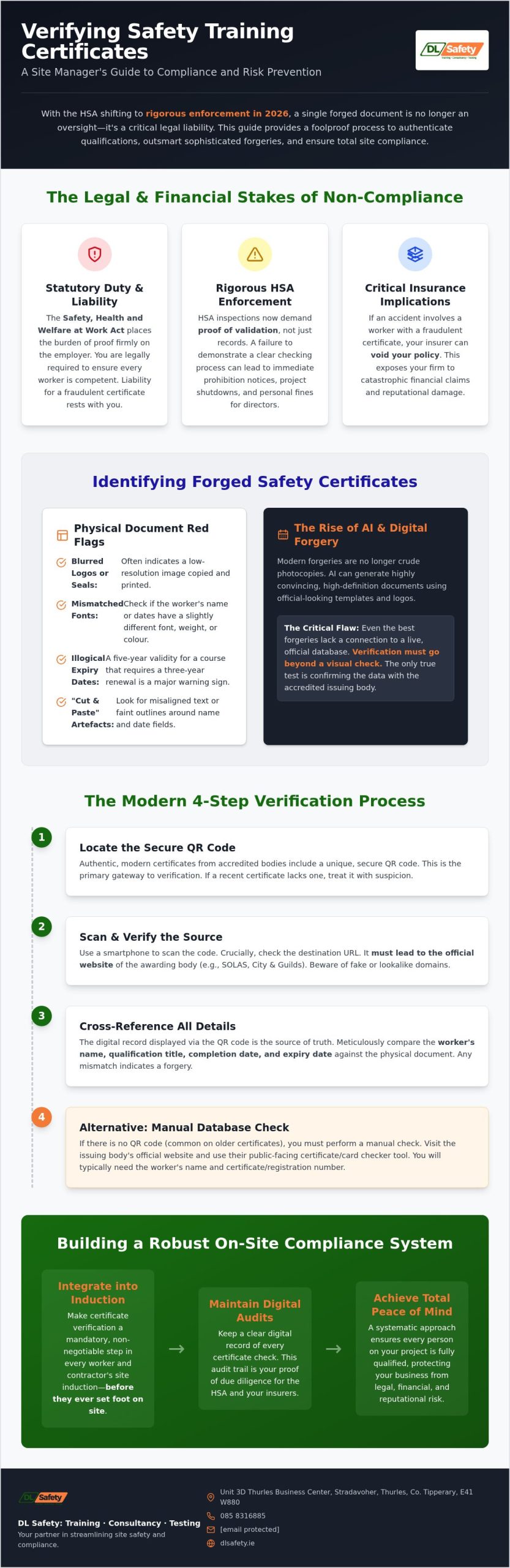
Check for blurred logos or low-resolution seals; these are often signs of a digital scan that’s been printed onto card stock. Look for “cut and paste” artifacts around the name and date fields. If the font for the worker’s name looks slightly different in weight, colour, or spacing compared to the rest of the text, it’s likely been altered. You should also verify the expiry date logic. If a worker presents a certificate with a five-year validity for a course where industry standards dictate a three-year refresh, you’re likely holding a forgery.
The Rise of AI and Digital Forgery
The rise of AI has made the task of how to verify a safety training certificate even more complex. AI tools now allow forgers to generate realistic signatures and unique-looking accreditation numbers that don’t immediately trigger suspicion. This makes digital certificate validation a vital step in your onboarding process. Don’t be swayed by “vanity” certificates that use familiar colours to mimic official SOLAS or LEEA documents. Every PDF should be checked against its digital source. If you’re unsure about the authenticity of a worker’s credentials, our team at DL Safety can help you organise a thorough site audit to clear out any non-compliant records.
Our experts at Unit 3D Thurles Business Center, Stradavoher, Thurles, County Tipperary, E41 W880, are always available to help you navigate these risks. You can reach us at info@dlsafety.ie or call 085 8316885 for direct support. Visit www.dlsafety.ie to see how we help site managers across Ireland maintain the highest standards of safety compliance.
Step-by-Step Digital Verification and Validation
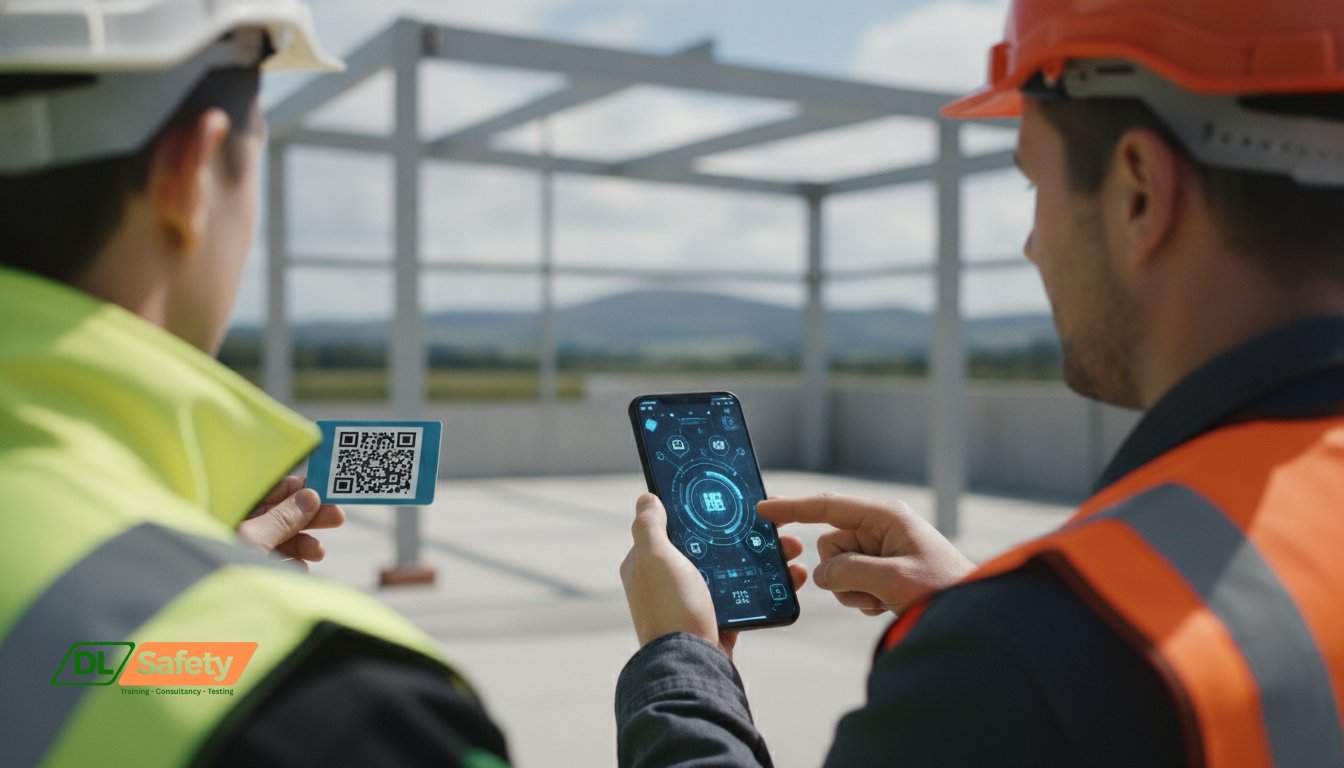
Whilst visual checks help you spot basic forgeries, digital validation is the only way to achieve 100% certainty in 2026. The universal workflow for authenticating any safety qualification involves moving beyond the paper document to its digital source. Many modern certifications now provide real-time validation via encrypted portals. When you’re learning how to verify a safety training certificate, the most reliable method is to use a secure QR code. However, you must be cautious. Don’t just scan and trust. Always check that the URL leads to the official domain of the awarding body and not a spoofed website designed to mimic a legitimate result.
It’s worth noting that Irish SOLAS Safe Pass and CSCS cards currently require physical inspection on-site as the standard method of verification, as they don’t yet use an online system. For other certifications, such as first aid or technical training, digital tools are the industry standard. For example, the American Red Cross certificate verification tool demonstrates how major organisations allow employers to enter a unique ID to confirm a learner’s record instantly. This cross-referencing ensures that the person standing in front of you is the same individual who completed the training.
Using Online Validation Portals
- Step 1: Locate the unique certificate ID or validation code, which is usually found in the bottom corner or near the awarding body’s seal.
- Step 2: Access the official awarding body portal directly through your browser. Avoid clicking links provided on the certificate itself, as these can lead to fraudulent validation sites.
- Step 3: Enter the learner’s details and the ID code. Ensure the result matches the physical ID produced by the worker, including the spelling of their name and the specific course title.
Verifying Bespoke and International Qualifications
Bespoke training from private consultants or international qualifications requires extra diligence. If a worker provides a non-standard certificate, you should contact the original training provider to confirm the record. For technical lifting qualifications, check the trainer’s credentials via bodies like LEEA. When dealing with international certificates, you must verify them against Irish equivalence standards to ensure they meet HSA requirements. At DL Safety, we help managers navigate these complexities through our site audits and Monthly Safety Support Packages. You can reach us at our centre at Unit 3D Thurles Business Center, Stradavoher, Thurles, County Tipperary, E41 W880, or by emailing info@dlsafety.ie. For more information on how to verify a safety training certificate or to view our online courses, visit www.dlsafety.ie or call 085 8316885.
Building Robust Contractor Compliance Systems
Verification must be a prerequisite for site entry. Waiting until a worker is already operating heavy machinery to check their papers is a recipe for disaster. By integrating certificate checks into your induction and “signing in” process, you create a hard barrier against non-compliance. Refuse access to the unverified. This is where you apply the practical knowledge of how to verify a safety training certificate to every single person crossing the threshold. Moving away from overflowing paper folders to cloud-based safety portals allows for real-time access and, crucially, automated alerts. Implementing a cloud-based portal ensures that your safety documentation is not only stored securely but is also instantly searchable during an unannounced HSA inspection, providing a clear audit trail that demonstrates your commitment to due diligence.
Subcontractor Pre-Qualification Frameworks
You should require every subcontractor to submit an “Evidence of Competence” pack before their contract even begins. This pack should include verified training records, safety statements, and equipment certifications. Auditing a contractor’s safety management system allows you to identify training gaps early. For instance, using GA1 testing as a benchmark for equipment competence ensures that both the operator and their machinery meet statutory standards before work starts. This proactive approach prevents the common headache of turning away workers on their first morning because their documentation is insufficient.
The Role of Toolbox Talks in Verifying Competency
Daily toolbox talks are more than just a box-ticking exercise. They’re a practical tool for spotting incompetence that a piece of paper might hide. Whilst a worker might have a valid certificate, their behaviour during a briefing or their answers to safety questions can reveal a lack of true understanding. Documenting attendance at these talks provides a secondary layer of verified training, linking on-site behaviour to the theoretical knowledge found on certificates. It’s about ensuring the person is as competent in the field as they are on paper.
DL Safety is your partner in site excellence. If you want to automate your record-keeping and reduce the risk of HSA fines, our Monthly Safety Support Packages provide the expert oversight you need to stay compliant. We are located at Unit 3D Thurles Business Center, Stradavoher, Thurles, County Tipperary, E41 W880. For direct support, email info@dlsafety.ie or call 085 8316885. You can also visit www.dlsafety.ie to see how we help businesses across Ireland manage their safety duties and protect their staff.
How DL Safety Ensures Total Site Compliance
DL Safety understands that site managers have enough to worry about without becoming full-time forensic document examiners. Our Monthly Safety Support Packages are designed to take the entire burden of verification off your desk, allowing you to focus on project delivery. We don’t just provide a checklist; we act as your dedicated safety partner. By conducting professional site audits, we identify fraudulent or expired certifications before they become a liability. We’ve seen the rise in AI-generated fakes first-hand, and our team knows exactly how to verify a safety training certificate to ensure your site remains above board.
When your team needs new qualifications, our Online Safety Courses provide a streamlined solution. Each course comes with instantly verifiable digital credentials, removing any doubt about authenticity. This commitment to transparency is part of our “Personable Expert” approach. We combine high-level technical proficiency with a friendly, supportive demeanour, ensuring that compliance feels like a benefit rather than a hurdle. We’re here to help you build a culture where safety is a core value, not just a paperwork exercise.
Outsourced Safety Management for Peace of Mind
In 2026, more construction firms are moving toward retained safety consultants to manage their complex regulatory duties. The ROI of this professional oversight is clear: you avoid the astronomical costs of HSA prohibition notices and project delays. Our experts provide a grounded, helpful service that alleviates the stress of compliance. If you’re ready to secure your site, contact us at info@dlsafety.ie or call 085 8316885 for a comprehensive compliance review.
Visit Our Thurles Training and Support Centre
We support the Irish construction sector from our base at Unit 3D Thurles Business Center, Stradavoher, Thurles, County Tipperary, E41 W880. This centre is a hub where we deliver bespoke training programmes tailored to your specific site needs. We ensure your team is truly competent, not just “certified” on paper. Knowing how to verify a safety training certificate is a great start, but having a trusted advisor like DL Safety ensures your entire safety culture is robust. Visit www.dlsafety.ie to explore our full service list.
Future-Proofing Your Site Safety Through Rigorous Verification
Mastering how to verify a safety training certificate is no longer just a task for the office; it’s a vital part of your site’s defence against legal liability and HSA enforcement. By moving beyond simple visual checks and embracing digital validation portals, you ensure that every worker on your project is genuinely qualified to be there. The responsibility for site competence rests with the employer, but you don’t have to manage that burden alone. Building a robust compliance system ensures that your project remains safe, insured, and on schedule.
At DL Safety, we’re committed to helping you navigate these regulatory complexities with ease. Our team, based at Unit 3D Thurles Business Center, Stradavoher, Thurles, County Tipperary, E41 W880, is ready to support your business. You can secure your site with a Monthly Safety Support Package from DL Safety to automate your record-keeping and gain total peace of mind. Reach out to us at info@dlsafety.ie or call 085 8316885 to discuss your specific site requirements. Let’s work together to make your next project your safest and most efficient one yet.
Frequently Asked Questions
Is a photo of a safety certificate sufficient for site entry in Ireland?
A photograph of a certificate is generally insufficient for site entry because it lacks the security features of an original document and is easily manipulated with digital editing tools. Site managers should insist on seeing the physical card or a live digital credential that can be validated in real-time. This ensures you are meeting your statutory duty to ensure worker competence rather than relying on a potentially altered image that wouldn’t stand up to an HSA inspection.
What should I do if a safety certificate cannot be verified online?
If an online portal fails to recognise a certificate ID, your next step is to contact the training provider directly via their official phone number or email. Provide the learner’s name and the certificate number for a manual record check. If the provider cannot confirm the training took place, you must refuse site entry. This manual step is a key part of how to verify a safety training certificate when digital systems encounter errors or older records.
How long are safety training certificates typically valid for?
Validity periods vary depending on the specific qualification and industry standards. For example, a SOLAS Safe Pass is valid for four years, whilst Manual Handling training typically requires a refresh every three years. You should always check the expiry date printed on the document and cross-reference it with the awarding body’s standard duration. Using expired certificates is a common non-compliance issue that can lead to prohibition notices during a site audit.
Can I be fined by the HSA if a subcontractor provides a fake certificate?
Yes, you can face significant fines and legal action if a subcontractor is found working with a fraudulent certificate. Under the Safety, Health and Welfare at Work Act, the responsibility to ensure a “competent person” is on-site rests with the employer or site controller. Failing to implement a robust verification process is seen as a failure of your statutory duty. This is why professional oversight and regular site audits are essential for protecting your business from third-party non-compliance.
Are digital safety certificates more secure than physical paper ones?
Digital certificates are generally more secure because they often include encrypted data, unique validation IDs, and QR codes that link directly to a secure database. Unlike paper documents, which can be physically altered or forged using high-quality printers, digital credentials allow for instant, tamper-proof verification. However, security only works if you actually use the validation tools provided. Always ensure the digital link leads to a legitimate, official domain belonging to the accredited training body.
How do I verify a certificate issued by an international training body?
Verifying international qualifications requires checking the issuing body’s official registry and ensuring the training meets Irish equivalence standards. Start by visiting the global provider’s website to use their specific verification tool. If the training is for specialised tasks like lifting operations, you should verify the provider’s accreditation through international organisations like LEEA. It’s vital to confirm that the international standard aligns with HSA requirements before allowing the worker to commence high-risk activities on your site.
What are the most commonly forged safety certificates in the construction industry?
High-demand, mandatory qualifications like the SOLAS Safe Pass, CSCS cards, and Manual Handling certificates are the most frequent targets for forgery. Because these are required for site entry, some individuals use sophisticated AI tools to create realistic fakes. Site managers must be especially vigilant when checking these specific documents. Learning how to verify a safety training certificate for these common roles is your first line of defence against site accidents and subsequent legal investigations into worker competency.
Does DL Safety provide a verification service for existing staff records?
Yes, we offer comprehensive verification as part of our Health & Safety Site Audits and Monthly Safety Support Packages. Our team reviews your existing training matrix to identify fraudulent, expired, or non-accredited certifications that could put your business at risk. We provide a clear report on your team’s current competence levels and help you organise any necessary refresher training. For professional support, contact us at info@dlsafety.ie or visit our centre at Unit 3D Thurles Business Center, Stradavoher, Thurles, County Tipperary, E41 W880.