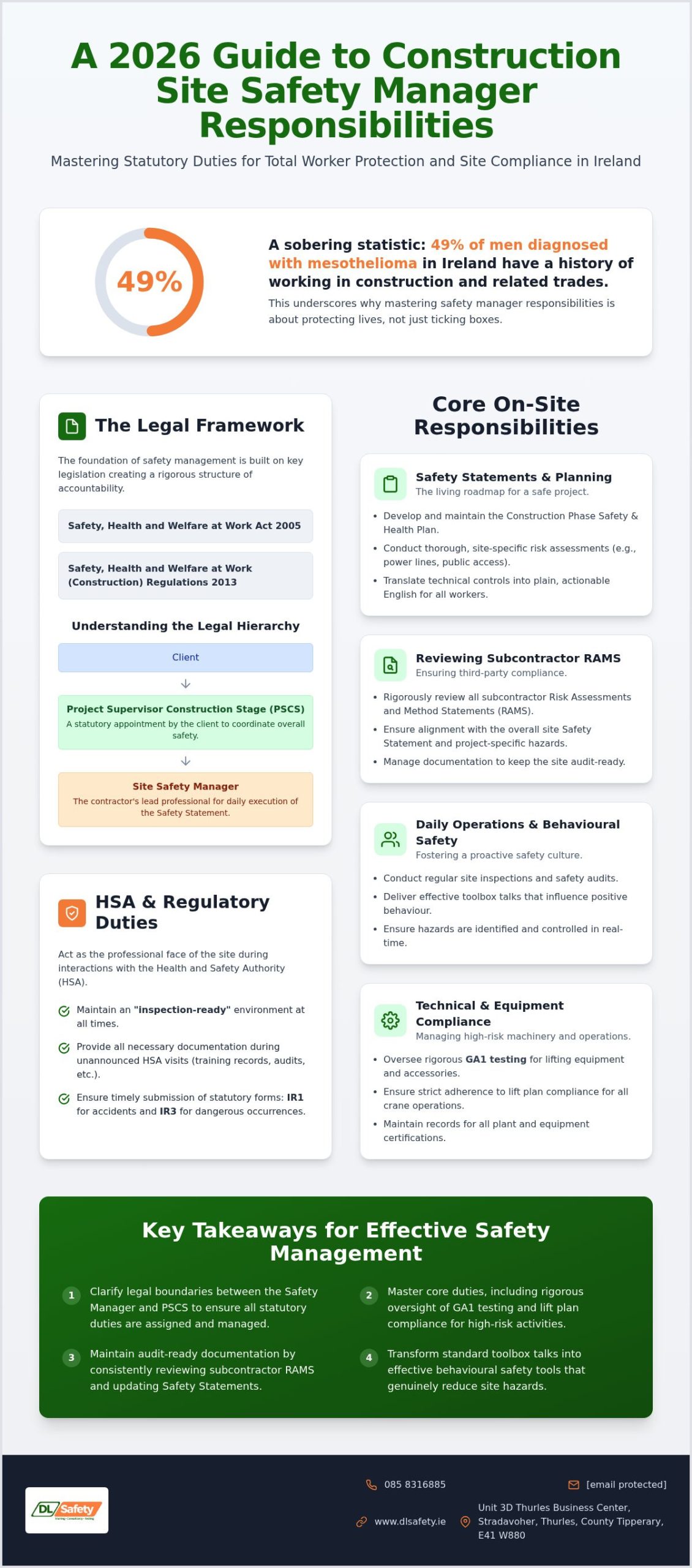
Did you know that 49% of men diagnosed with mesothelioma in Ireland have a history of working in construction and related trades? It is a sobering statistic that underscores why mastering construction site safety manager responsibilities in Ireland is about far more than just ticking boxes; it is about protecting lives in a high-stakes environment. We understand that the role often feels like a constant juggle between maintaining site productivity whilst managing an overwhelming volume of technical testing and safety documentation.
If you are feeling the pressure of potential HSA inspections or struggling to distinguish your daily duties from those of the PSCS, you aren’t alone. It is common to feel that safety requirements are a barrier to progress, but we believe that robust compliance is the foundation of a truly efficient site. This 2026 guide promises to clear the fog, offering a definitive list of your statutory requirements and practical daily tasks to ensure total worker protection and site compliance.
We will explore everything from the new 2026 asbestos exposure limits to the latest chemical agents regulations. At DL Safety, based at Unit 3D Thurles Business Centre, Stradavoher, Thurles, County Tipperary, E41 W880, we provide expert safety support that removes the stress of regulatory paperwork from your shoulders. You can reach us at info@dlsafety.ie, 085 8316885, or www.dlsafety.ie to see how we simplify your compliance journey.
Key Takeaways
- Clarify the legal boundaries between the Safety Manager and the PSCS to ensure every statutory duty is clearly assigned and managed under the 2026 regulations.
- Master the core construction site safety manager responsibilities Ireland requires, including the rigorous oversight of GA1 testing and lift plan compliance.
- Gain a practical framework for reviewing subcontractor RAMS and updating Safety Statements to keep your site-specific documentation audit-ready at all times.
- Learn how to transform standard toolbox talks into effective behavioural safety tools that reduce site hazards whilst maintaining high levels of productivity.
- Discover how integrating professional safety support packages can alleviate the administrative burden of technical documentation and provide expert backup during accident investigations.
Defining the Role: Statutory Framework for Safety Managers in Ireland
The bedrock of safety management in the Irish construction sector is the Safety, Health and Welfare at Work Act 2005, supported by the Safety, Health and Welfare at Work (Construction) Regulations 2013. These laws don’t just suggest best practices; they mandate a rigorous structure of accountability. Within this framework, the construction site safety manager responsibilities Ireland requires are often confused with the Project Supervisor Construction Stage (PSCS). Whilst the PSCS is a statutory appointment made by the client to coordinate safety across the entire construction phase, the Safety Manager is typically the contractor’s lead professional tasked with the granular, daily execution of the Safety Statement.
The Legal Hierarchy on Irish Construction Sites
Understanding the chain of command is vital for site stability. The client appoints the PSCS, who then oversees the safety coordination between various contractors. The Safety Manager acts as the engine room of this process, ensuring that the safety file is updated and that all statutory appointments are clearly documented. On large-scale civil projects, this role might involve managing a team of officers, whereas on smaller sites, it often falls to a single dedicated expert. Regardless of project size, the legal expectation remains the same: you must demonstrate a clear line of authority and competence in every safety-related decision.
Liaising with the HSA and Regulatory Bodies
A primary duty for any safety manager is acting as the professional face of the site during interactions with the Health and Safety Authority (HSA). This isn’t just about being polite during a visit; it’s about maintaining an “inspection-ready” environment every single hour of the day. You’re responsible for the timely submission of IR1 forms for accidents or IR3 forms for dangerous occurrences. When an inspector arrives unannounced, the Safety Manager provides the necessary documentation, from training records to Construction site safety audits, demonstrating that the site is under control.
Taking on this role carries significant weight. Liability is a real concern, which is why professional indemnity and a disciplined approach to documentation are non-negotiable. At DL Safety, we act as a “Trusted Advisor” to alleviate this burden. We help you navigate these complex legal waters from our base at Unit 3D Thurles Business Center, Stradavoher, Thurles, County Tipperary, E41 W880. If you’re feeling overwhelmed by the statutory requirements, you can reach our expert team at info@dlsafety.ie or call 085 8316885. For more information on how we support site managers, visit http://www.dlsafety.ie.
Core Responsibilities: Safety Statements and Planning
Effective planning is the silent engine of a safe site. The construction site safety manager responsibilities Ireland requires begin with the creation and maintenance of the Construction Phase Safety and Health Plan. This document isn’t a static folder destined to gather dust on a shelf; it’s a living roadmap that must evolve as the project moves from initial groundworks to final fit-out. Under the Safety, Health and Welfare at Work (Construction) Regulations 2013, you’re responsible for ensuring this plan remains relevant and accessible to every person working on the project.
Mastering the Site-Specific Safety Statement
Generic templates are a significant risk for any project. Your value as a safety manager lies in your ability to conduct a thorough site risk assessment that captures unique local hazards, such as overhead power lines, underground services, or adjacent public spaces. Once these risks are identified, you must translate the Safety Statement into actionable instructions. It’s your job to ensure every worker understands the specific controls relevant to their task, moving beyond technical jargon into plain English that actually protects lives on the ground.
Reviewing Contractor RAMS and Method Statements
Subcontractors often bring their own set of risks to a project. A key part of your role involves establishing a robust system to verify subcontractor competency before they ever set foot on-site. You need to review their Risk Assessments and Method Statements (RAMS) to ensure they aren’t just generic files recycled from previous jobs. Are they practical? Do they account for overlapping risks with other trades? Linking these documents to the overall project schedule allows you to anticipate and manage dangerous “clashes” in high-risk activities.
Managing the Site Safety File from project inception to completion requires a methodical approach that many find overwhelming. We often see site managers buried under a mountain of paperwork, which is why we offer professional safety statement support to take that weight off your desk. By ensuring your documentation is audit-ready and legally sound, you can focus your energy on the physical safety of your team. If you need help organising your safety file or reviewing complex RAMS, visit us at Unit 3D Thurles Business Center, Stradavoher, Thurles, County Tipperary, E41 W880, or email info@dlsafety.ie. You can also reach our team directly at 085 8316885 to discuss your specific site needs.
Daily Operations: Site Inspections and Behavioural Safety
The transition from a well-drafted safety plan to a secure working environment happens during the daily site walkabout. This is where the construction site safety manager responsibilities Ireland requires become most visible. It isn’t just about spotting a missing toe-board or a trailing lead; it’s about active engagement with the workforce to ensure that the controls you’ve put on paper are actually working in practice. Your daily presence on the ground allows for the immediate rectification of hazards before they escalate into accidents, whilst also ensuring that PPE compliance and equipment storage standards remain high across all trades.
Effective Site Inspections and Auditing
Modern site management has moved beyond the paper clipboard. We recommend using digital auditing tools to track recurring issues, which allows you to identify trends that might otherwise go unnoticed. If you notice a spike in ladder-related near-misses on Tuesday mornings, you can address it specifically in your next toolbox talk. Documenting these daily logs creates a vital paper trail of safety diligence. We believe in a non-adversarial approach to these corrections; safety shouldn’t feel like a “gotcha” moment. Instead, it should be a collaborative effort to keep everyone healthy and productive.
Fostering a Positive Safety Culture
Safety is a behaviour, not just a rulebook. Moving from a “policing” mindset to a coaching style transforms how workers perceive your role. When you act as a trusted advisor, employees feel comfortable reporting near-misses without fear of reprisal. This open dialogue is the only way to catch the “small” errors that often precede major incidents. To bridge the gap between theory and reality, we often suggest leveraging simulation training to sharpen hazard perception in a controlled environment. This proactive approach builds a culture where safety is everyone’s responsibility, not just the manager’s.
Maintaining this level of daily vigilance can be exhausting, especially when combined with the technical testing requirements we will cover in the next section. At DL Safety, our team provides the expert backup you need to stay on top of these daily demands. Whether you need a fresh set of eyes for a site audit or bespoke training for your crew, you can find us at Unit 3D Thurles Business Center, Stradavoher, Thurles, County Tipperary, E41 W880. We’re always available for a chat at info@dlsafety.ie or 085 8316885. Discover more about our approach at www.dlsafety.ie.
Technical Oversight: Lifting, Testing, and Equipment Compliance
Whilst daily walkabouts are essential for general site order, the technical oversight of machinery and equipment is where the real complexity lies. A core pillar of construction site safety manager responsibilities Ireland projects demand is the coordination of statutory testing for all site electrical tools and heavy plant. This isn’t merely an administrative task; it’s a critical safety barrier. You’re responsible for ensuring that every piece of equipment, from a simple handheld drill to a 50-tonne crane, is safe for use and legally compliant before it ever begins work on your site.
Managing GA1 and Lifting Equipment Compliance
Lifting operations represent one of the highest-risk activities on any Irish construction site. Your role involves verifying that every sling, chain, and shackle arriving on-site is accompanied by a valid GA1 certificate. You must maintain a rigorous register of lifting gear and implement a “quarantine” system to remove damaged items immediately. Beyond the small accessories, you’re tasked with verifying the thorough examination of telehandlers and excavators. This oversight ensures that the equipment is fit for purpose and that the operators hold the correct CSCS tickets to manage the specific machinery safely.
Vehicle and Plant Safety Management
Managing the movement of heavy plant requires a strategic perspective on site layout. You must implement site-specific traffic management plans that create a physical separation between pedestrians and moving machinery. In specialised environments, such as quarries or large-scale muck-shifting projects, you’re required to organise quarry vehicle brake testing to meet stringent HSA standards. This testing provides objective data on braking efficiency, which is a vital component of your overall risk management strategy. By ensuring that all vehicles are fit for purpose, you reduce the likelihood of mechanical failure leading to a serious site incident.
Technical compliance can be the most daunting aspect of safety management due to the precise nature of the testing required. At DL Safety, we act as your technical partner to ensure no certificate expires and no machine goes untested. If you’re struggling to coordinate your GA1 schedules or need help with PAT testing, contact our team at Unit 3D Thurles Business Center, Stradavoher, Thurles, County Tipperary, E41 W880. You can email us at info@dlsafety.ie or call 085 8316885. To book your next technical audit, schedule a GA1 inspection with DL Safety today and ensure your site remains fully compliant.
Strategic Support: The Value of Retained Safety Consultancy
Mastering the full spectrum of construction site safety manager responsibilities Ireland demands is a Herculean task for a single individual. Between managing technical GA1 testing schedules and ensuring daily behavioural compliance amongst a rotating workforce, it’s easy for critical details to slip through the cracks. This is where strategic, retained consultancy provides a vital safety net. By moving beyond a “one-off” audit mindset, businesses can integrate expert oversight into their weekly routine, ensuring that safety remains a constant priority rather than a reactive response to an impending HSA visit.
Why Retained Services Beat In-House Overload
Many site managers find themselves stretched thin during busy project phases, leading to a backlog of documentation and missed inspections. Our Monthly Safety Support Packages are designed to alleviate this burden by acting as a proactive extension of your existing team. We bring an objective, external perspective to site safety audits, identifying blind spots that in-house staff might overlook due to “site blindness.” This partnership allows the site manager to focus on productivity whilst we handle the high-level technical compliance and documentation updates.
The financial benefits of this approach extend far beyond simple risk mitigation. Proactive compliance often leads to reduced insurance premiums and fewer costly project delays caused by equipment failure or regulatory stop-notices. Should an incident occur, having a third-party expert available for accident investigations ensures a transparent, unbiased process that protects the integrity of the business. Accessing a full suite of technical services through a single vendor simplifies your supply chain and ensures a consistent standard of excellence across all safety disciplines on your site.
Contact DL Safety for Expert Support
Navigating the complexities of Irish construction safety doesn’t have to be a solo journey. Whether you need assistance with ISO preparation, bespoke simulation training, or a complete overhaul of your safety statements, David and the team are ready to help. We pride ourselves on being personable experts who simplify the legal requirements so you can get on with the job. You can find our centre at Unit 3D Thurles Business Center, Stradavoher, Thurles, County Tipperary, E41 W880. Reach out to us via email at info@dlsafety.ie or call 085 8316885 to discuss how we can support your next project. Explore our full range of technical and training services at www.dlsafety.ie.
Taking Control of Your Site Safety Standards
Navigating the 2026 statutory landscape requires a shift from simple compliance to strategic leadership. By mastering the construction site safety manager responsibilities Ireland demands, you move beyond the stress of paperwork and into a role that actively protects lives. We’ve explored how technical oversight, including LEEA-certified GA1 inspections and specialised brake testing, forms the backbone of a secure environment. When you combine this with bespoke simulation training, you build a culture where every worker is an active participant in safety.
At DL Safety, based at Unit 3D Thurles Business Center, Stradavoher, Thurles, County Tipperary, E41 W880, we’re your trusted advisor. We know the documentation is overwhelming, but you don’t have to manage it alone. You can secure your site with a Monthly Safety Support Package from DL Safety to ensure your project remains audit-ready. Reach out to us at info@dlsafety.ie or call 085 8316885 to discuss your needs. We’re committed to your success and look forward to helping you lead a safer, more productive site.
Frequently Asked Questions
Is a Construction Safety Manager legally required on every Irish site?
A dedicated Safety Manager isn’t a universal legal requirement for every small project, but a competent person must always manage safety. Under the 2013 Regulations, the Project Supervisor Construction Stage (PSCS) is the mandatory appointment for projects involving high-risk work. However, on larger Irish sites, a dedicated manager is essential to handle the complex construction site safety manager responsibilities Ireland mandates, ensuring daily compliance that a PSCS might only oversee periodically.
What is the difference between a Safety Officer and a Safety Manager in Ireland?
The primary difference lies in the level of authority and strategic involvement. A Safety Officer typically focuses on on-site monitoring and inspections. In contrast, a Safety Manager takes a “big picture” approach, developing the Safety Statement and managing technical compliance. The manager often acts as the primary liaison with the HSA and coordinates with partners like DL Safety, based in Unit 3D Thurles Business Center, Stradavoher, Thurles, County Tipperary, E41 W880.
How often should a Safety Manager conduct a full site audit?
Full site audits should ideally be conducted at least once a month to ensure long-term compliance. Whilst daily walkabouts identify immediate hazards, a comprehensive audit examines the safety file, training records, and equipment certifications in detail. High-risk projects or sites with high worker turnover may require fortnightly audits to maintain standards. At DL Safety, we offer Monthly Safety Support Packages to provide an objective, external perspective that keeps your site audit-ready throughout the project lifecycle.
What qualifications does a Construction Safety Manager need in Ireland?
Most employers require a Level 7 or Level 8 qualification in Occupational Health and Safety. Beyond academic degrees, a manager needs practical experience in the construction sector and a deep understanding of the 2013 Construction Regulations. Professional membership in organisations like IOSH is standard. They must also be competent in technical areas, such as overseeing Lift Plans, to effectively manage the diverse construction site safety manager responsibilities Ireland requires on modern sites.
Can a Safety Manager also act as the PSCS?
Yes, an individual or a company can act as both the Safety Manager and the PSCS, provided they are competent to do so. Whilst the roles are distinct, combining them can streamline communication and ensure that the statutory coordination of the PSCS is backed by the daily vigilance of a manager. It’s vital that the specific legal duties of each role are clearly documented in the safety file to avoid confusion during any HSA inspections.
What happens if a Safety Manager fails to report an accident to the HSA?
Failing to report a qualifying accident or dangerous occurrence is a serious breach of the Safety, Health and Welfare at Work Act. If a manager ignores the requirement to submit an IR1 or IR3 form, the company faces potential HSA prosecution and heavy fines. In cases of serious injury, a failure to report can lead to criminal charges. Proactive reporting is a cornerstone of transparent safety leadership and essential legal protection for any Irish business.
How does a Safety Manager manage subcontractor safety compliance?
Subcontractor safety is managed through a rigorous pre-qualification process and the regular review of their Method Statements. A Safety Manager must ensure that every subcontractor’s plan is site-specific and aligns with the overall Construction Phase Safety and Health Plan. By conducting regular inspections and holding coordination meetings, the manager can identify overlapping risks between trades, ensuring that all workers adhere to the high standards set for the project at www.dlsafety.ie.
What are the most common safety failures found during HSA inspections?
HSA inspections frequently highlight failures in working at height controls, traffic management, and equipment certification. Common issues include missing guardrails and expired GA1 certificates for lifting accessories. Maintaining an “inspection-ready” site requires constant vigilance, which is why we provide expert audits for our clients. For professional support, contact DL Safety at info@dlsafety.ie or 085 8316885. Our team is dedicated to helping you maintain a safe, compliant, and productive construction environment.